

Note: This article contains affiliate links. If you click on these links and make a purchase, I may earn a small commission at no extra cost to you. This helps support my research and content. Read my full affiliate disclosure here.
Towing with a Toyota Tacoma calls for gear that keeps the truck and trailer balanced, responsive, and safe. Choosing the right weight distribution hitch affects steering feel, braking distance, and overall trailer control when hauling heavier loads or longer trailers. This guide presents seven shortlisted weight distribution hitches selected specifically for the Toyota Tacoma and explains the practical tradeoffs between capacity, sway control, and ease of setup.You will find compact explanations of each hitch's strengths alongside clear decision factors used to evaluate them, covering capacity, coupling methods, and installation concerns. Continue down the page to see the options and the buying guidance that helps you pick the best fit for your Tacoma and towing needs.
Looking for other parts? See all Toyota Tacoma parts & accessories.
Top Picks at a Glance
| Best Overall Weight Distribution Hitch The all-around top choice balancing performance, ease, and reliability | CURT Round Bar Weight Distribution Hitch with Integrated Sway Control |  |
| Best Budget Weight Distribution Hitch A low-cost option that provides basic weight distribution performance | Fastway Connect Weight Distribution Hitch |  |
| Best Premium Weight Distribution Hitch Higher-end components and features for demanding, long-term use | Andersen Hitches 3324 No‑Sway Weight Distribution Hitch, 4" Drop/Rise, 2" Ball |  |
| Best Compact Weight Distribution Hitch A smaller-footprint design for tighter storage and simpler handling | Camco Eaz-Lift ReCurve R3 Weight Distribution Hitch (1000 lb kit) |  |
| Best Heavy-Duty Weight Distribution Hitch Built for higher stresses and frequent heavy towing applications | CURT 17422 Trunnion Weight Distribution Hitch with Sway Control |  |
| Best High-Capacity Weight Distribution Hitch Higher tongue-weight and gross trailer weight ratings for big loads | BRICZUNA 14,000 lb Weight Distribution Hitch for 7-inch Trailer Frames |  |
| Best Complete-Kit Weight Distribution Hitch Includes all necessary hardware and accessories for a full installation | Camco Eaz-Lift TR3 Weight Distribution Hitch Kit with Dynamic Sway Control |  |
CURT Round Bar Weight Distribution Hitch with Integrated Sway Control
Best Overall Weight Distribution Hitch

| Towing capacity (GTW) | 10,000–14,000 lbs. |
|---|---|
| Tongue weight (TW) | 1,000–1,400 lbs. |
| Shank size fit | 2" receiver (fits 2-1/2" shanks with compatible components) |
| Ball size | 2-5/16" pre-torqued ball |
| Material | Carbon steel, powder coated |
This CURT round bar weight distribution hitch is a full-featured towing solution that redistributes tongue weight and adds a sway control unit to improve trailer tracking and vehicle stability. It is typically used on bumper-pull trailers where leveling the tow vehicle and reducing rear sag are priorities. Notable features include forged round spring bars, a formed steel head with built-in zerk fittings for easy lubrication, an adjustable shank that fits a 2" receiver, and an included pre-torqued 2-5/16" ball and sway control kit. In practice the hitch gives a firmer, more controlled tow, smoother steering feel, and reduced trailer wag when set up within the specified weight range. The design is robust and powder coated for corrosion resistance, but the unit is heavy and installation can require two people and some frame access to mount the sway bracket. Also be sure to match your Tacoma and trailer weights to the hitch's 10,000–14,000 lb. GTW and 1,000–1,400 lb. TW ratings for safe operation.
Best for: Toyota Tacoma owners who want a dependable, rugged weight distribution hitch that improves everyday towing stability and are comfortable doing a hands-on installation and setup.
Less Ideal for: Drivers who need a lightweight, tool-free quick-change solution or who frequently swap the hitch between multiple vehicles should consider alternatives designed for easy transfer and minimal frame work.
- Integrated sway control included for improved trailer tracking without buying separate components
- Built-in grease zerk fittings allow easier, continuous lubrication of spring bar pivots
- Forged round steel spring bars and formed steel head for strong, durable load handling
- Adjustable shank fits 2" receiver and accepts heavier 2.5" shanks for higher-capacity setups
- Powder coat finish improves corrosion resistance for long-term use
- Heavy assembly that may require two people to install and adjust safely
- Sway control bracket requires access to the vehicle frame which can complicate installation for some setups
Verdict: The best all-around weight distribution hitch that balances towing stability, build quality, ease of setup, and value for most DIY mechanics looking for a dependable everyday solution.
Fastway Connect Weight Distribution Hitch
Best Budget Weight Distribution Hitch

| Maximum Towing Capacity | 10000 Pounds |
|---|---|
| Pull Force | 10000 Pounds |
| Automotive Fit Type | Universal Fit |
| Material Type | Alloy Steel |
| Finish Type | Powder Coated |
The Fastway Connect is a straightforward chain-and-arm weight distribution hitch that brings better steering, braking, and level towing when hauling a trailer near your vehicle's conventional capacity. Designed to handle up to 10,000 lb trailer weight and 1,000 lb tongue weight, it installs on a 2" receiver and includes a pre-installed 2-5/16" ball and standard shank. Setup uses hardened steel chains and round-bar arms; adjusting which chain link hooks to the trailer lets you tune the amount of weight distribution. For DIY mechanics it is attractive because the design is time-tested, the powder-coated alloy steel feels durable, and installation requires no frame drilling. Trade-offs are that chain-style systems need more manual adjustment and muscle during install and tightening, and fine-tuning can take time to get the trailer and tow vehicle perfectly level. For Tacoma owners wanting a capable, budget-friendly weight distribution solution, this unit delivers strong value and reliable load control when set up carefully.
Best for: DIY-minded Tacoma owners who want competent load control and improved towing stability on a budget and are comfortable doing a hands-on installation and adjustments themselves.
Less Ideal for: Drivers who prefer fully automatic or trunnion-style systems, those unwilling to spend time on setup, or people who need professional installation and on-the-road adjustability.
- Supports up to 10,000 lb trailer weight and 1,000 lb tongue weight
- Includes 2-5/16" pre-installed hitch ball and standard shank for 2" receivers
- Hardened steel chains and round-bar arms provide durable, time-tested weight distribution
- Powder-coated alloy steel construction resists corrosion and feels heavy-duty
- Universal-style fit installs on RV, cargo, utility, horse, and ATV trailers without frame drilling
- Chain-style design requires manual adjustment and can be physically demanding to install
- Fine tuning to achieve a perfectly level tow may take extra time and effort
Verdict: The best budget weight distribution hitch for DIY mechanics who need competent load control and improved towing stability without spending much.
Andersen Hitches 3324 No‑Sway Weight Distribution Hitch, 4" Drop/Rise, 2" Ball
Best Premium Weight Distribution Hitch

| Maximum Towing Capacity | 10000 Pounds |
|---|---|
| Pull Force | 10000 Pounds |
| Automotive Fit Type | Universal Fit |
| Material Type | Alloy Steel |
| Finish Type | Powder Coated |
The Andersen 3324 is a premium chain‑tension weight distribution hitch built for drivers who want refined control and low maintenance. It replaces heavy torsion bars with tension chains and a friction cone inside the ball housing so you get sway suppression and reduced bounce without frequent greasing. Typical use is on bumper‑pull trailers where you need to firm the nose of the tow vehicle and keep the trailer tracking straight; the unit ships with the ball and mounting hardware so it is ready to install. Notable features include a grease‑free friction cone, easy chain tension adjustment, powder coated alloy steel construction, and a relatively light overall weight for a distribution hitch. The practical benefits are quieter operation, simpler hookup and unhitching, and corrosion resistance from the powder coat. Limitations are that the chain system moves slightly differently than solid bar designs so pure weight distribution may be marginally less than the heaviest bar systems, and precise alignment of the triangle plate can take practice. For Tacoma owners who tow frequently and value durable materials and refined adjustments, this hitch delivers a premium, low‑maintenance solution.
Best for: Tacoma owners who tow bumper‑pull trailers and are willing to pay more for refined adjustment, durable materials, and reduced maintenance over the long term.
Less Ideal for: Drivers who need the absolute maximum weight distribution for the very heaviest trailers or who prefer the feel of traditional solid bar systems.
- Grease‑free friction cone and urethane components reduce routine maintenance and keep hands clean.
- Chain tension system adjusts quickly without leverage bars for easier hookup and finer tuning.
- Alloy steel with powder coat finish offers durable corrosion resistance for long service life.
- Includes ball and hardware so the hitch is a complete ready‑to‑install unit.
- Relatively light compared with many distribution hitches, easing handling and installation.
- May not distribute weight as uniformly as heavy solid‑bar systems for extreme tongue loads.
- Aligning and reattaching the triangle plate can be fiddly until you learn the technique.
Verdict: The best premium weight distribution hitch for buyers who prioritize superior materials, refined adjustments, and long-term durability over initial cost.
Camco Eaz-Lift ReCurve R3 Weight Distribution Hitch (1000 lb kit)
Best Compact Weight Distribution Hitch

| Maximum Towing Capacity | 1000 Pounds |
|---|---|
| Pull Force | 1200 Pounds |
| Compatible with Vehicle Type | Trailer |
| Automotive Fit Type | Universal Fit |
The Camco Eaz-Lift ReCurve R3 is a compact weight distribution hitch that combines load leveling and built-in sway control in a relatively easy-to-handle package. It uses top-loading, roll-tapered spring bars that snap into place from above, which simplifies hookup and increases ground clearance compared with chain-style systems. The integrated adjustable sway brake is operated with a single bolt and can be disengaged for low-speed maneuvers or on slippery surfaces. In practice this hitch reduces nose lift and trailer sway for lighter trailers, gives a quieter ride by avoiding metal-on-metal grinding, and the no-grease design makes day-to-day use cleaner. Expect a weight capacity suitable for lighter towing: Camco lists a 1,000 lb maximum tongue weight and 1,200 lb pull force with a 2 5/16" ball interface. Trade-offs are that the unit is heavy to carry for one person and initial setup and fine tuning can take patience, and some users report missing hardware or unclear instructions for specific adjustments.
Best for: Tacoma owners who tow lighter travel trailers and want a compact, store-friendly weight distribution solution that still provides solid sway control and easier hookup.
Less Ideal for: Drivers who routinely tow heavy trailers near their truck or hitch capacity limits or who prefer the lightest possible carrier-mounted solutions should consider higher-capacity or different-style systems.
- Top-loading spring bars for faster, cleaner hookup and better ground clearance
- Integrated adjustable sway control that can be turned off for low-speed maneuvers
- No-grease design reduces mess and maintenance
- Compact kit intended for lighter travel trailers while still offering consistent sway reduction
- Relatively heavy to remove and store despite compact footprint
- Setup and fine-tuning can be tricky and instructions may be unclear or incomplete
Verdict: The best compact weight distribution hitch for users who need effective load management in a lighter, easier-to-store package without sacrificing core performance.
CURT 17422 Trunnion Weight Distribution Hitch with Sway Control
Best Heavy-Duty Weight Distribution Hitch

| Gross trailer weight capacity | Up to 15,000 lbs. |
|---|---|
| Tongue weight capacity | 1,500 lbs. |
| Shank size | 2-Inch |
| Material | Carbon Steel |
The CURT 17422 is a robust trunnion-style weight distribution hitch designed to level a tow vehicle and trailer by redistributing tongue weight across axles and adding built-in sway control. It uses forged steel square spring bars and a formed head for precise height adjustment, and the package includes hook-up brackets, safety chains, a trailer ball, and hardware. In everyday use it reduces rear sag, improves steering feel while towing, and helps keep the trailer tracking straight at highway speeds. The powder coated carbon steel finish resists rust for long service life, and the included sway control unit provides extra lateral stability when hauling large loads. Installation requires some mechanical skill and time, and a few reviewers noted packaging or fastener issues on delivery and rare component failures under extreme use, so inspect hardware during install. For DIY mechanics who tow heavy loads frequently this hitch delivers the strength and features needed to handle big trailers, but plan for a careful setup and periodic hardware checks.
Best for: DIY mechanics who tow heavy trailers frequently and prioritize rugged, high-strength components and the ability to set up a durable, factory-quality weight distribution system.
Less Ideal for: Drivers who only tow light trailers occasionally or want a plug-and-play, minimal-install solution should consider simpler or lighter-duty options.
- High capacity: rated up to 15,000 lb gross trailer weight and 1,500 lb tongue weight
- Forged steel trunnion-style spring bars for heavy-duty strength and durability
- Includes sway control unit and necessary mounting hardware for added stability
- Durable powder coated carbon steel finish resists corrosion during regular use
- Installation can be time consuming and requires mechanical ability and careful hardware inspection
- Some users reported damaged packaging or missing/poor fasteners on delivery
- Rare reports of spring bar failures under extreme loads suggest close inspection before use
Verdict: The best heavy-duty weight distribution hitch for DIY mechanics who tow heavy loads frequently and need rugged construction and high-strength components.
BRICZUNA 14,000 lb Weight Distribution Hitch for 7-inch Trailer Frames
Best High-Capacity Weight Distribution Hitch

| Pull Force | 14000 Pounds |
|---|---|
| Compatible with Vehicle Type | Trailer |
| Material Type | Carbon Steel |
| Applicable Trailer Frames | Max 7 in |
This BRICZUNA weight distribution hitch is built for heavy-duty towing where higher tongue and trailer ratings are required. It installs on trailer frames up to 7 inches and uses a chain connection with tensioning hardware to transfer load from the vehicle rear to the trailer and trailer axles. That load redistribution helps the tow vehicle maintain level stance, improves steering and braking stability, and reduces trailer sway when hauling larger campers, boats, or cargo. The kit includes the hitch head, mounting hardware, a crowbar for adjustments, and an instruction manual so a competent DIY installer can fit it without specialty tools. Constructed from #45 carbon steel with a spray-molded finish, it is meant to resist corrosion and withstand repeated use. Limitations include a heavy assembly that requires two people to handle during installation and the need to verify tongue weight and hitch setup carefully because the unit is rated to 14,000 pounds and must not be used beyond that capacity. For Tacoma owners, confirm your truck hitch class and tongue ratings before purchasing to ensure safe fitment and performance.
Best for: Drivers who need a high-capacity weight distribution solution to tow larger trailers or heavier loads safely while keeping the tow vehicle level and stable on the road.
Less Ideal for: Casual or light-duty tow users with small trailers or those unwilling to confirm tongue and hitch ratings should consider lighter, simpler hitches instead.
- 14,000 lb pull/towing capacity suitable for large trailers and heavy loads
- Fits trailer frames up to 7 inches, covering common bumper-frame setups
- Carbon steel #45 construction with spray-molded finish for durability and corrosion resistance
- Includes mounting hardware and a crowbar to simplify installation and adjustments
- Heavy unit that may require two people and basic tools to install safely
Verdict: The best high-capacity weight distribution hitch for users who require elevated tongue-weight and trailer-weight ratings to safely tow larger trailers or heavier cargo.
Camco Eaz-Lift TR3 Weight Distribution Hitch Kit with Dynamic Sway Control
Best Complete-Kit Weight Distribution Hitch
| Maximum Towing Capacity | 1200 Pounds |
|---|---|
| Pull Force | 1500 Pounds |
| Compatible with Vehicle Type | Trailer |
| Automotive Fit Type | Universal Fit |
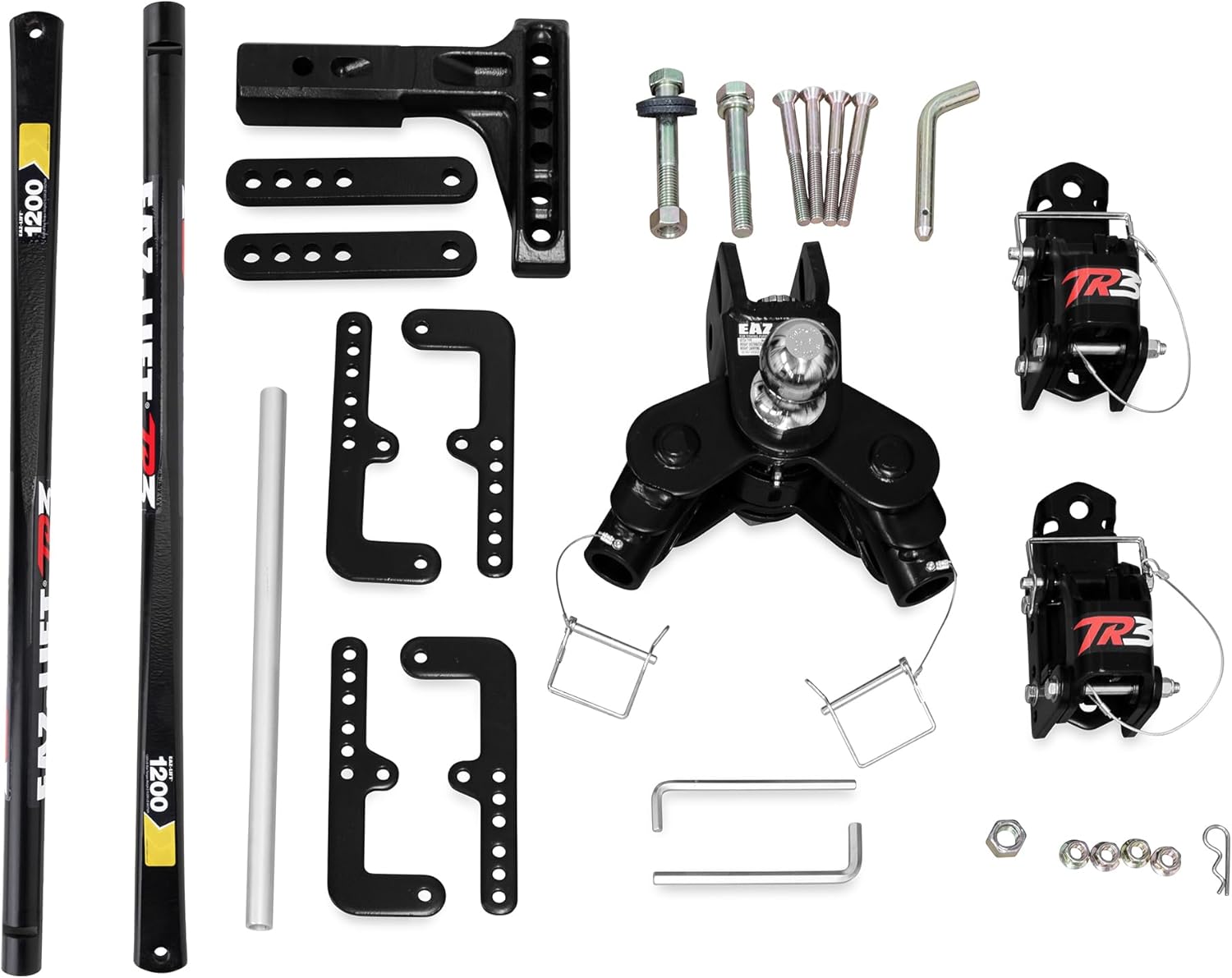
The Camco Eaz-Lift TR3 is a full kit that includes the head, roll-tapered spring bars, hookup brackets, and mounting hardware designed to simplify fitment and setup. It pairs weight distribution with a patented Consistent Sway Control system that clamps rather than using chains, so highway sway is reduced without the noise and metal-on-metal wear of older designs. Installation is generally quick thanks to side-loading spring bars and adjustable hookup brackets that clear frame-mounted obstructions. The unit ships with a pre-installed hitch ball and allows easy temporary disengagement of sway control for low-speed maneuvers or reversing. For Tacoma owners the TR3 supports a 1,200 lb maximum towing capacity and side-load spring bars let one-person hookup feel easier than traditional systems. Trade-offs include a relatively heavy assembly to handle the loads and occasional fit issues with receiver slop or shank drop length on some trucks, so confirm tongue weight and shank drop before purchase. Overall it delivers quiet, dependable load leveling and integrated sway control in a single kit.
Best for: Tacoma owners who want a single, ready-to-install weight distribution system that includes all necessary components and reduces setup complexity so you can get towing sooner with integrated sway control.
Less Ideal for: Drivers who prefer a minimal hitch head only and want to source custom spring bars or brackets separately or those unwilling to check exact tongue weight and shank drop before buying.
- Complete kit includes head, spring bars, hookup brackets, mounting hardware, and pre-installed hitch ball for one-purchase installation
- Patented clamp-style Consistent Sway Control provides steady sway resistance and can be disengaged for low-speed maneuvers
- Side-loading, roll-tapered spring bars speed hookup and reduce the need to raise the trailer to engage bars
- Quiet operation with brake-pad material on the center spindle to minimize clunking and metal-on-metal wear
- Heavier assembly that can be cumbersome to lift and position by hand
- Standard shank drop and receiver fit may not match every Tacoma configuration without ordering a different shank or anti-rattle solution
Verdict: The best complete-kit weight distribution hitch for buyers who want a single purchase that includes head, spring bars, brackets, and mounting hardware for a straightforward install.
Choosing the Right Toyota Tacoma Weight Distribution Hitch: Key Factors to Consider
Tongue Weight and Hitch Capacity
Matching the hitch's rated tongue weight and gross trailer weight to your Tacoma's towing setup is fundamental. Tongue weight determines how much downward force the trailer applies to the Tacoma's hitch; a weight distribution hitch redistributes some of that force across the truck's axles. Selecting a hitch with rated capacity above your actual tongue weight provides a safety margin and allows for load variations.
Undersized hitches will be overstressed and can compromise handling and component life. Oversizing excessively may reduce the precision of adjustments for lighter loads. Choose a capacity range that aligns with the trailer's typical loaded tongue weight and is compatible with the Tacoma's towing limits.
Sway Control Performance
Effective sway control reduces side-to-side trailer movement caused by wind, passing vehicles, or uneven roads. Different weight distribution systems incorporate sway control via friction, spring bars, or integrated friction heads; each method responds differently under dynamic conditions. For the Tacoma, which is often used with narrow or tall trailers, good sway control directly translates to safer lane changes and less driver fatigue.
Consider how the sway control engages at highway speeds and how adjustable it is while hitched. Systems that allow fine-tuning of sway damping let you dial in the balance between free articulation during tight turns and firm control at speed.
Compatibility With Tacoma Receiver and Bed Clearance
Not all hitches and head styles fit neatly on every truck. The Toyota Tacoma has specific bumper, receiver, and rear overhang dimensions that affect how a weight distribution hitch will sit and clear the tailgate. Check that the hitch head and spring bar geometry clear the truck's bumper and any accessories like spare tire carriers or tailgate handles.
Receiver height and hitch drop/rise options matter too. A system that requires excessive drop or blocks access to the bed or tailgate can be inconvenient in daily use. Prioritize hitches with head and bar configurations that accommodate the Tacoma's rear geometry without additional fabrication.
Adjustability and Ease of Setup
A good weight distributing hitch should be straightforward to set up, adjust, and reconfigure when trailer loading changes. Look for systems with clear adjustment points, multiple shank positions, or ball mount options to tune tongue weight transfer. Tools required for initial setup and later adjustments should be common and simple to use.
Ease of setup reduces the chance of improper adjustment, which can negate the benefits of the system. Also consider how repeatable the setup is if you hitch different trailers to the Tacoma or alter cargo distribution frequently.
Build Quality and Corrosion Resistance
Hitches are exposed to road grime, salt, and repeated stress cycles. For Tacoma owners who tow in varied climates, material quality and protective finishes affect long-term reliability. Heat-treated spring bars, robust cast or forged hitch heads, and durable coatings extend service life and reduce maintenance needs.
Evaluate the warranty language and visible design features that indicate longevity, such as solid pin connections, reinforced shank tubes, and replaceable wear components. Components that are easier to inspect and service make routine checks more practical.
Installation Requirements and Tools
Installation complexity ranges from simple drop-in assembly to systems that need torqueing of fasteners or specific mounting alignments. Consider whether you will install the hitch yourself or use a professional. Systems that require specialized tools or permanent modifications to the trailer or truck can add time and cost.
Look for clear instructions and common fastener sizes, and verify whether the setup needs re-torqueing after initial use. If you frequently hitch different trailers, choose a system that minimizes time and effort to attach and detach.
Types of Weight Distribution Systems
Weight distribution systems for the Tacoma typically fall into a few practical categories: spring-bar systems, integrated head systems with friction or hydraulic damping, and sway-control add-on designs. Each type balances load transfer and sway mitigation differently, so understanding the operational differences helps you match a system to your towing profile.
Spring-bar systems are common and provide predictable load transfer, especially for heavier trailers. Integrated head units bring sway damping and distribution together for simpler setup but sometimes at the cost of heavier head assemblies. Add-on sway control gives flexibility if you already own a distribution head and want to upgrade lateral control without changing the entire hitch.
- Spring bars: robust load transfer, widely serviceable
- Integrated heads: simpler single-unit setup, often heavier
- Add-on sway control: modular upgrade path for existing systems
Setting Up Correct Spring Bar Tension
Proper spring bar tension is critical to achieve the intended axle load transfer. Start by measuring tongue weight with the trailer loaded as you would tow and consult the hitch's adjustment guidelines to set initial bar angle and chain length. Small changes to chain length or head position can significantly affect how much weight moves forward to the Tacoma's front axle.
After the initial setup, perform a short test drive with measured braking and lane-change maneuvers to sense handling. Recheck hitch hardware torque and ensure chains and attachments are seated correctly. Documenting the setup that works for a particular trailer load saves time on future re-hitches.
- Measure tongue weight with trailer loaded
- Adjust chain length to obtain desired bar angle
- Test drive and re-torque all fasteners after initial miles
Common Installation Pitfalls and How to Avoid Them
Owners often under- or over-tighten sway control components, leading to either excessive stiffness during turns or insufficient damping at speed. Follow manufacturer torque specs and start with moderate sway control settings, increasing firmness only if you experience lateral movement at highway speed.
Another common issue is incorrect ball height or shank adjustment that leaves the trailer level but the bars at an ineffective angle. Confirm both trailer level and bar geometry during setup. Avoid makeshift mounting hacks; they can shift stresses and create unsafe conditions on the Tacoma.
- Do not overtighten sway devices; incrementally adjust
- Verify trailer level and bar angle together
- Use proper-sized hardware and follow torque specs
Maintaining Your Weight Distribution Hitch
Routine inspection keeps performance consistent. Check for loose hardware, worn pin holes, and corrosion on bars and head components. Clean and lightly lubricate moving parts where specified to prevent binding, and replace worn pins or clips promptly.
Seasonal maintenance matters for Tacoma owners who tow through winter. Salt and grit accelerate wear, so flush off corrosive deposits and touch up protective coatings if needed. Periodic re-torqueing of critical bolts after a few towing trips helps avoid gradual loosening.
- Inspect fasteners and wear points before each towing season
- Lubricate pivot points per instructions
- Replace worn components instead of improvising repairs
Trailer Load Distribution Tips
How cargo is distributed in the trailer affects tongue weight and how much work the weight distribution hitch must do. Aim for roughly 60 percent of cargo forward of the trailer axle for conventional trailers, and secure items to prevent shifting. For the Tacoma, managing load distribution reduces rear sag and improves front tire traction during braking and steering.
When loading heavier items, re-measure tongue weight and adjust the hitch setup accordingly. Small shifts in cargo position can change handling characteristics markedly, so re-evaluate the setup if you alter trailer contents significantly.
- Place heavy items over or slightly forward of the axle
- Secure cargo to minimize in-transit shift
- Re-check tongue weight after major load changes
How We Chose the Best Toyota Tacoma Weight Distribution Hitch
We focused on attributes that matter to Tacoma owners who tow regularly or occasionally with moderate to heavy trailers. Selection began with load capacity and tongue weight compatibility to ensure hitches could safely transfer part of the trailer load onto the Tacoma without exceeding factory tongue weight limits. Sway control effectiveness was the next filter; systems that reduce lateral motion under real towing conditions scored higher. Build quality and corrosion resistance were prioritized for durability in mixed road and weather conditions. Ease of installation and adjustability were assessed so owners can achieve proper weight distribution and can re-tune the system as loads change. Additional criteria included compatibility with common receiver sizes, available head styles that clear Tacoma bed and bumper geometry, and practical mounting hardware.We excluded units that lack clear capacity ratings, require extensive frame modification, or do not provide an adjustable method for handling varying tongue weights. Final picks balanced capacity, sway control, durability, and owner-friendly setup to reflect the needs of Toyota Tacoma drivers.
Our full evaluation process is outlined in our review methodology.
FAQ
How do I know if my Tacoma needs a weight distribution hitch?
If the rear of your Tacoma sags, the steering feels light under braking, or the trailer causes noticeable instability at highway speeds, a weight distribution hitch can help. It is particularly useful when the trailer's tongue weight approaches the upper end of the truck's rated tongue capacity.
Can I install a weight distribution hitch myself on a Tacoma?
Many Tacoma owners can install these systems with common hand tools, but some setups require torqueing critical fasteners and careful alignment. If you are unsure about proper adjustment or clearance, have a professional check the installation.
How often should I re-torque hitch hardware after initial installation?
Re-torque critical fasteners after the first 50 to 100 miles of towing, then inspect periodically during the first few trips. Components can settle or shift slightly after initial use, so early checks help maintain safe operation.
Will a weight distribution hitch eliminate trailer sway completely?
A properly set up weight distribution hitch with effective sway control greatly reduces sway but does not guarantee complete elimination. Sway can still occur from extreme crosswinds, abrupt maneuvers, or improper trailer loading.
Does using a weight distribution hitch change my Tacoma's towing capacity?
A weight distribution hitch helps redistribute tongue load across axles to improve handling and may allow safer towing near the Tacoma's limits, but it does not change the vehicle's factory-rated towing capacity. Always stay within the truck and trailer ratings.
How should I adjust the hitch when towing different trailers?
Measure the tongue weight for each trailer and set the chain length, ball height, and sway control to match that load. Keep a written note of the setup that worked for each trailer to speed future adjustments.
Final Verdict
Choose the weight distribution hitch that delivers the right combination of capacity, sway control, and fit for your Toyota Tacoma. Prioritize a unit sized to handle your typical tongue weight, with sway control features that you can fine-tune for highway stability. Consider ease of installation and long-term durability when deciding, and document successful setups for each trailer you tow. With the right tradeoffs in mind, you can significantly improve handling, braking, and confidence when towing with your Tacoma.
Explore More:
- Check out all Toyota Tacoma parts & accessories
- Explore Other Accessories
- Browse all Accessories
