

Note: This article contains affiliate links. If you click on these links and make a purchase, I may earn a small commission at no extra cost to you. This helps support my research and content. Read my full affiliate disclosure here.
Towing with a Jeep Grand Cherokee can be comfortable and capable, but improper hitch setup quickly undermines handling, braking, and ride height. Choosing the right weight distribution hitch matters because it redistributes tongue weight and helps keep the tow vehicle level under load.This guide lists the top seven weight distribution hitches we shortlisted for the Jeep Grand Cherokee. Each option was evaluated for load capacity, sway-control effectiveness, and fit with typical Grand Cherokee towing setups. Read on to understand the tradeoffs and which features deserve the most attention for your towing needs.
Looking for other parts? See all Jeep Grand Cherokee parts & accessories.
Top Picks at a Glance
| Best Overall Weight Distribution Hitch The best all-around hitch balancing performance, ease, and value | CURT 17063 Round Bar Weight Distribution Hitch with Sway Control |  |
| Best Budget Weight Distribution Hitch A low-cost option that still improves trailer control and safety | Rumngsuy Replacement Weight Distribution Hitch Brackets with Sway Control |  |
| Best Premium Weight Distribution Hitch Higher-end materials and finish with refined performance and features | Andersen Hitches No-Sway Weight Distribution Hitch — 2-1/2" Shank, 8" Drop, 2-5/16" Ball, 16,000 lb |  |
| Best Heavy-Duty Weight Distribution Hitch Built for high loads and frequent heavy towing use | BulletProof Hitches Weight Distribution Hitch System, 14,000 lb Capacity |  |
| Best Compact Weight Distribution Hitch Low-profile design for limited clearance and easier storage | Fastway Connect Weight Distribution Hitch |  |
| Best High-Capacity Weight Distribution Hitch Rated for higher tongue and gross trailer weights for big loads | Camco Eaz-Lift TR3 Weight Distribution Hitch Kit (1,200 lb) |  |
| Best Integrated Sway Control Weight Distribution Hitch Includes built-in sway control for simpler setup and sway reduction | CURT TruTrack 17500 Weight Distribution Hitch with Integrated Sway Control |  |
CURT 17063 Round Bar Weight Distribution Hitch with Sway Control
Best Overall Weight Distribution Hitch

| Towing capacity (GTW) | 10,000–14,000 lbs. |
|---|---|
| Tongue weight (TW) | 1,000–1,400 lbs. |
| Receiver shank | 2" x 2" (fits class 3–5) / compatible with 2-1/2" shanks |
| Material | Carbon steel |
| Finish | Powder coated |
The CURT 17063 is a solid, user-friendly weight distribution hitch that levels a tow vehicle and trailer while reducing sway. It uses forged round steel spring bars and a formed steel head with built-in grease zerk fittings so you can keep the pivot points lubricated without disassembly. The unit includes a pre-torqued 2-5/16" ball, a sway control unit, and hardware for a conventional chain hookup and snap-up adjustment. In practice the hitch gives a firmer front axle contact and smoother handling on highways and rough roads when set within its 10,000 to 14,000 lb GTW range and 1,000 to 1,400 lb TW range. Installation is straightforward for a DIY mechanic but the assembly is heavy and requires two people to position the head and spring bars safely. The system uses a clamp-style frame attachment for sway control that may require drilling for permanent mounting depending on vehicle and frame setup. Overall it delivers durable construction and practical features for regular towing, though it is substantial to handle and must be matched to your trailer and Jeep Grand Cherokee weight limits for safe use.
Best for: Jeep Grand Cherokee owners who prioritize a durable, easy-to-maintain hitch that improves on-road stability and can be installed by a competent DIYer focused on balanced performance and value.
Less Ideal for: Buyers who need a lightweight, frequently transferable hitch to move between multiple tow vehicles or who cannot manage a heavy installation without professional help.
- Integrated grease zerk fittings for easy continuous lubrication at the spring bar pivot
- Includes pre-torqued 2-5/16" ball and sway control unit for a complete setup
- Forged round steel spring bars and formed steel head provide robust, durable construction
- Adjustable shank and chain brackets allow fine tuning to level the load
- Heavy assembly typically requires two people to install and position safely
- Clamp or bolt frame attachment may need drilling or modification on some vehicles
Verdict: The best all-around weight distribution hitch that balances towing stability, ease of setup, durability, and price for most DIY mechanics.
Rumngsuy Replacement Weight Distribution Hitch Brackets with Sway Control
Best Budget Weight Distribution Hitch

| Brand | Rumngsuy |
|---|---|
| Model Number | 17208 |
| Included Components | Weight Distribution Hitch Hookup Brackets |
| Mounting Type | Hitch Mount |
These Rumngsuy replacement hitch brackets provide the structural connection needed to use a weight distribution hitch and sway control system. They bolt onto the trailer and accept the stabilizer and tension bars that shift tongue weight toward the tow vehicle, which smooths handling and improves front-axle traction on highway runs. Built from alloy steel with a rust-resistant coating, the brackets are heavy duty and straightforward to install for anyone comfortable with basic trailer hookups. Buyers report they work well for long-distance RV and enclosed trailer towing and can extend the life of an otherwise good hitch system without replacing the whole assembly. The product is a bracket set only, so you must already have or separately purchase the head, spring bars, chains, and ball assembly for a complete weight distribution setup. Also expect to source a tensioning pipe or lever for tightening since no handle tool is included. For Jeep Grand Cherokee owners towing light to moderate trailers, these brackets are a practical, budget-friendly way to get better stability without buying a full premium hitch.
Best for: Jeep Grand Cherokee owners who want an affordable way to restore or upgrade their trailer's weight distribution mounting hardware to improve highway stability and steering confidence while towing.
Less Ideal for: Drivers planning to tow very heavy trailers who need a complete, professionally tuned weight distribution hitch or those who prefer an all-in-one premium hitch package.
- Heavy-duty alloy steel construction for durable towing use
- Rust-resistant finish extends service life in wet conditions
- Bolt-on design that most users can install without specialized tools
- Compatible with common weight distribution and sway control systems
- Brackets are sold alone and do not include the head, spring bars, chains, or hitch ball
- No tensioning lever or pipe provided for tightening the bars
Verdict: The best budget weight distribution hitch for buyers who need meaningful towing improvement and safer handling without a high upfront cost.
Andersen Hitches No-Sway Weight Distribution Hitch — 2-1/2" Shank, 8" Drop, 2-5/16" Ball, 16,000 lb
Best Premium Weight Distribution Hitch

| Pull Force | 16000 Pounds |
|---|---|
| Shank Size | 2-1/2 inch |
| Drop/ Rise | 8 inch |
| Ball Size | 2-5/16 inch |
| Material Type | Alloy Steel, Aluminum |
This Andersen No-Sway weight distribution hitch is built for heavy-duty towing where durability and controlled handling matter. It pairs a 2-1/2-inch shank and 8-inch drop with a tension-chain and friction cone system that reduces trailer sway and dampens porpoising without the bulk and noise of spring bars. Typical use is on trucks or SUVs towing larger travel trailers or enclosed trailers; with proper setup the bracket choices let you fine-tune head angle for a flatter trailer and a more planted tow vehicle front end. Practical benefits include American-made construction, powder-coated alloy steel and aluminum components, and a simpler hookup and adjustment process compared with traditional equalizer hitches. Limitations are that this is a heavy, high-capacity unit intended for vehicles with large receivers and elevated ride height, so it is overkill for light SUVs or small trailers and may need additional chain extensions or frame attention depending on trailer A-frame accessories. Initial setup takes some time to dial in for best performance.
Best for: Buyers who prioritize premium build quality and smooth, long-distance towing performance for a lifted Jeep Grand Cherokee setup and who value a quieter, easier-to-adjust anti-sway system.
Less Ideal for: Drivers who tow light trailers infrequently or who have a factory-height receiver and prefer a lighter, lower-capacity hitch solution.
- High 16,000 lb GTWR capacity suitable for heavy trailers and large tow vehicles
- Tension-chain and friction cone design reduces sway and trailer bounce while being quieter than heavy spring bars
- Multiple bracket options (3, 4, 5, 6 in) allow precise head-angle adjustment
- Powder-coated alloy steel and aluminum construction with American manufacturing for durability
- Designed for large 2-1/2-inch receivers and lifted trucks so it is heavier and not optimized for lighter SUVs or small trailers
Verdict: The best premium weight distribution hitch for shoppers willing to pay more for superior build quality, smoother towing performance, and longer-lasting components.
BulletProof Hitches Weight Distribution Hitch System, 14,000 lb Capacity
Best Heavy-Duty Weight Distribution Hitch

| Rated trailer capacity | 14,000 lbs |
|---|---|
| Tongue weight capacity | 1,400 lbs |
| Material | Alloy Steel |
| Finish | Powder Coated |
| Fit type | Universal Fit |
This BulletProof Hitches weight distribution system is built for heavy towing: it redistributes trailer tongue weight across the tow vehicle and trailer axles and includes integrated sway control to reduce side-to-side movement. It is typically used on larger A-frame trailers where maintaining steering, braking, and level ride are important while towing. Notable features include alloy steel construction with a powder coat finish, a 14,000 lb trailer rating with high tongue capacity, and an included ball mount assembly, spring bars, brackets, retention clips, and a lift tool for setup. In practice the system should improve stability and control when hauling heavy loads and lets you reverse and turn without removing the hitch. Limits to consider are finish wear reported on the hitch ball and the universal fit approach means you may need compatible shanks or adapters for exact fit to the Grand Cherokee's hitch configuration. Installation can require some effort and additional parts for vehicle-specific mounting and alignment when used with a Jeep Grand Cherokee towing rig.
Best for: Aimed at mechanics and vehicle owners who regularly tow heavy, A-frame trailers and prioritize a rugged, high-capacity distribution system that improves stability under heavy loads.
Less Ideal for: Not the best choice for occasional light towing or for buyers who want a plug-and-play hitch tailored to a specific vehicle without buying additional adapters or shanks.
- High rated capacity up to 14,000 lb for heavy trailers
- Integrated sway control reduces trailer wobble without extra components
- Alloy steel construction with powder coat for durability
- Complete kit includes ball mount, spring bars, brackets, clips, and lift tool
- Some users report the hitch ball finish wears quickly under real-world use
- Universal-fit design may require separate shanks or adapters for exact vehicle fitment
Verdict: The best heavy-duty weight distribution hitch for mechanics and owners who regularly tow heavy trailers and need a rugged, strain-resistant setup.
Fastway Connect Weight Distribution Hitch
Best Compact Weight Distribution Hitch

| Maximum Towing Capacity | 10000 Pounds |
|---|---|
| Maximum Tongue Weight | 1000 lb max tongue wt. |
| Pull Force | 10000 Pounds |
| Material Type | Alloy Steel |
| Finish Type | Powder Coated |
The Fastway Connect is a traditional chain‑and‑arm weight distribution hitch built to smooth towing by transferring load from the rear axle back toward the front axle. It installs to a 2" receiver and ships with a 2‑5/16" hitch ball and a standard shank that offers a 3" drop and 7" rise to suit different setups. Hardened steel chains and round bar arms let you fine‑tune spring tension by selecting different chain links, so you can quickly correct sag and improve steering and braking when towing. The powder coated alloy steel construction feels heavy duty and reviewers report straightforward, durable hardware once fitted. Setup requires some effort: dry fitting, the right tools and at least one helper make alignment and torqueing easier, and some users needed longer or higher‑grade bolts in tight frame areas. If you want a compact, no‑frills unit that focuses on effective weight distribution and clearance, the Connect delivers, but it is a hands‑on install and uses chain links rather than a built‑in tensioning system.
Best for: Buyers who prioritize a lower‑profile, compact weight distribution solution for improved ground clearance and easier handling when the hitch is installed but not towing, and who are comfortable performing a hands‑on installation.
Less Ideal for: People who want a tool‑free or purely bolt‑on self‑adjusting system or those unwilling to do a careful dry fit and torque procedure during setup.
- Solid alloy steel construction with powder coating for corrosion resistance
- Includes 2‑5/16" hitch ball and standard shank with both drop and rise configurations
- Hardened steel chains and round bar arms allow quick, incremental adjustment of weight distribution
- Rated for up to 10,000 lb trailer weight and 1,000 lb tongue weight, covering most mid‑size trailer needs
- Installation can be labor intensive and may require a second person plus grade‑8 bolts in some frame clearances
Verdict: The best compact weight distribution hitch for users who prioritize a lower-profile hitch for better ground clearance and easier handling when not towing.
Camco Eaz-Lift TR3 Weight Distribution Hitch Kit (1,200 lb)
Best High-Capacity Weight Distribution Hitch
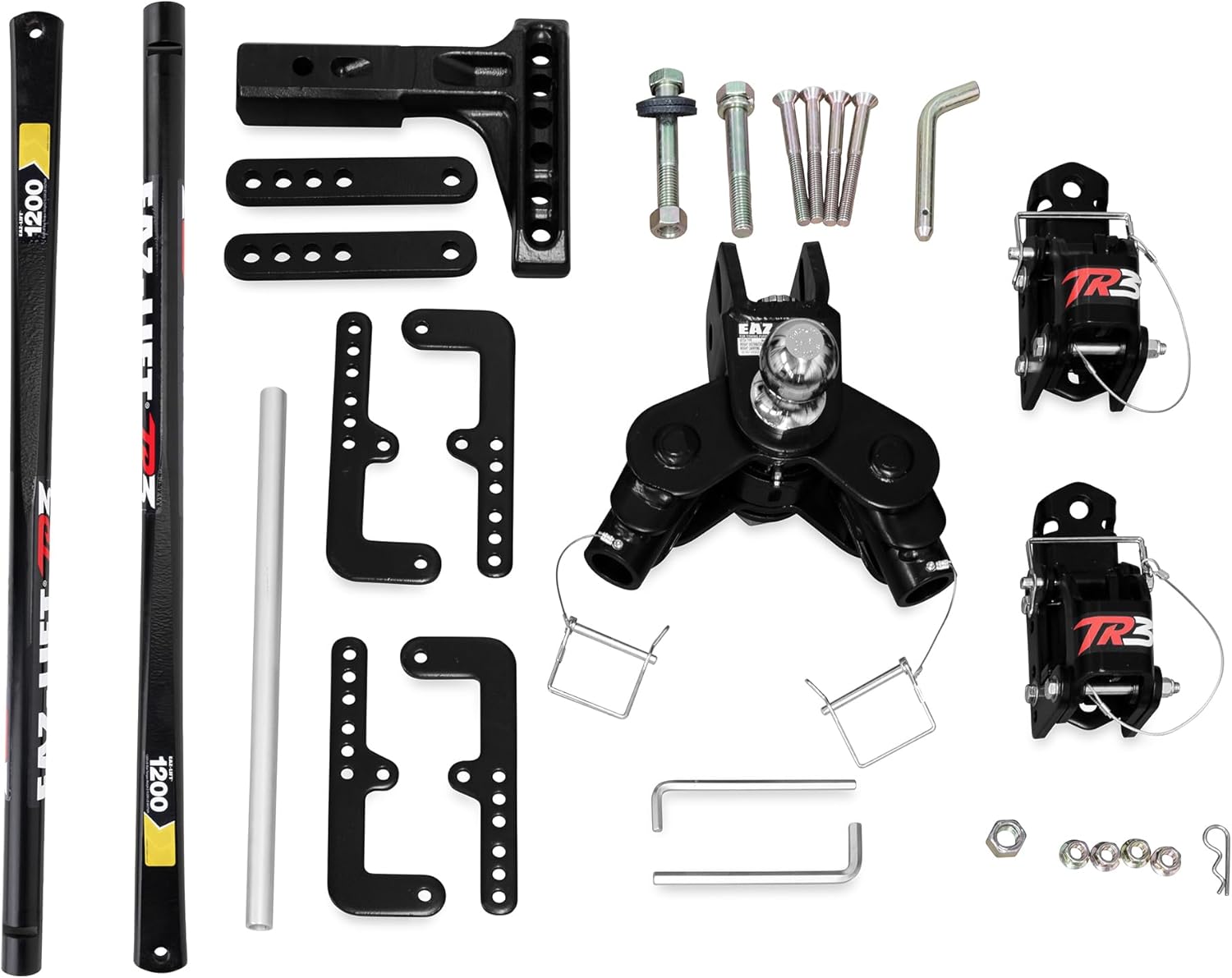
| Maximum Towing Capacity | 1200 Pounds |
|---|---|
| Pull Force | 1500 Pounds |
| Compatible with Vehicle Type | Trailer |
| Automotive Fit Type | Universal Fit |
The Camco Eaz-Lift TR3 is a weight distribution hitch that combines load leveling and a built-in sway control system designed for heavier travel trailers. You install the ball-mounted unit in a 2 5/16" ball assembly and attach the straight, roll-tapered spring bars to transfer tongue load across the trailer axles, which helps keep the tow vehicle and trailer more level at speed and under braking. The TR3’s patented consistent sway control uses a clamp-style brake pad on the center spindle and an on/off feature so you can disengage sway control at low speeds or when reversing. Practical benefits include quieter operation compared with chain-style systems, multiple spring bar thicknesses to match tongue weight, and adjustable hookup bracket locations that clear frame-mounted obstructions. Important limitations for high-capacity towing: this specific kit lists a maximum towing capacity and tongue weight that you must match to your trailer and vehicle setup, and some users report receiver slop or the need for a different shank drop for certain trucks. Fitment and proper setup matter for safe performance when towing larger trailers behind a Jeep Grand Cherokee, so verify tongue weight and receiver configuration before purchase.
Best for: Buyers who need a robust, integrated weight distribution system to improve stability when towing heavier travel trailers and who prioritize quiet, easy-to-adjust sway control and reliable load spreading.
Less Ideal for: Drivers who tow very light trailers or who require a hitch rated above the kit’s specified capacities should consider alternatives built for higher tongue or gross trailer weights.
- Combines weight distribution and consistent sway control in one unit for improved highway stability
- Quiet operation using brake-pad style sway control instead of metal-on-metal contact
- Adjustable hookup bracket positions to work around trailer-mounted obstructions
- Straight, roll-tapered spring bars available in multiple thicknesses to match different tongue weights
- Pre-installed hitch ball and user-friendly setup reduce installation time
- Listed maximum capacities must be matched to trailer and vehicle—not suitable beyond its rated tongue or gross trailer weight
- Some users report receiver fitment slop or need to change shank drop for proper geometry
Verdict: The best high-capacity weight distribution hitch for towing larger trailers that require higher tongue weight and gross trailer weight ratings for safe stability.
CURT TruTrack 17500 Weight Distribution Hitch with Integrated Sway Control
Best Integrated Sway Control Weight Distribution Hitch

| Maximum towing | Up to 10,000 lbs. |
|---|---|
| Shank size | 2-inch |
| Ball size | 2-5/16-inch |
| Material | Carbon Steel |
| Finish | Powder Coated |
The CURT TruTrack 17500 combines weight distribution and integrated sway control into a single assembly so DIY mechanics avoid mounting separate sway devices. It uses forged trunnion-style spring bars, welded head pieces, and adjustable brackets that fasten to the trailer frame to transfer tongue load across axles and actively resist lateral movement. The TruTrack's spring-and-cam system builds pressure to stop sway and then relaxes for smooth cornering, and six preset tilt holes plus interlocking nuts make on-vehicle adjustments quicker than washer-and-chain setups. In practice this means fewer parts to fit and maintain and a simpler setup process for someone comfortable working on trailers. Hardened components and grease fittings improve long-term durability, but installers should expect a moderately heavy assembly and a bit of effort during alignment and torqueing. If you tow near the hitch capacity or have an unusually heavy trailer, choose a heavier-duty rating. For a Grand Cherokee owner looking to add factory-quality integrated sway control and a cleaner installation, the TruTrack is a strong, user-friendly choice.
Best for: DIY-minded owners who want a single, integrated weight distribution and sway control solution that reduces separate components and simplifies adjustments while towing everyday trailers behind a Jeep Grand Cherokee.
Less Ideal for: Drivers who routinely tow at or above the upper capacity limit or need a commercial-grade heavy duty system for oversized loads should consider heavier rated alternatives.
- Integrated sway control removes need for an added friction or dual-arm device
- Preset tilt holes and accessible interlocking nuts simplify on-vehicle adjustments
- Hardened spring-and-cam components with grease fittings for better wear resistance
- Adjustable trailer-frame brackets provide fixed lateral support instead of chains
- Requires proper alignment and torqueing during installation which can be time consuming for one person
- At its published capacity it may be less robust than heavier-duty commercial systems
Verdict: The best weight distribution hitch with integrated sway control for DIY mechanics who want fewer separate components and straightforward, effective anti-sway performance.
Choosing the Right Jeep Grand Cherokee Weight Distribution Hitch: Key Factors to Consider
Gross Trailer Weight and Tongue Weight Capacity
Matching the hitch's gross trailer weight and tongue weight ratings to your trailer is the first critical step. A weight distribution hitch must be rated above the trailer's actual loaded weight and its corresponding tongue weight to perform as intended. Under-rating risks component failure and poor load transfer; over-rating can lead to unnecessary complexity or rougher ride characteristics.
For the Jeep Grand Cherokee, estimate your trailer's loaded tongue weight including cargo and fluids. Account for variations between different trailers you tow. Choose a hitch whose tongue weight range covers those values comfortably, and prefer options with adjustable head positions or multiple spring bar settings to fine-tune the distribution across the expected load range.
Sway Control and Lateral Stability
Sway control is often the difference between a manageable tow and a dangerous situation. Effective sway-control systems resist lateral oscillation caused by crosswinds, sudden lane changes, or passing vehicles. Some weight distribution hitches include integrated friction or hydraulic sway control, while others provide attachment points for aftermarket sway-control devices.
Assess how the hitch's sway-control method works with the Grand Cherokee's steering feel and suspension. Systems that allow incremental tuning or that combine with the vehicle's trailer brake setup provide better on-road control. Consider the typical towing conditions you encounter, such as highway cruising versus winding backcountry roads, when prioritizing sway control capability.
Spring Bar Design and Adjustability
Spring bars are the mechanical link that transfers tongue weight back to the tow vehicle axles. Different designs—trunnion-style, round bar, or cam-action—affect leverage, leverage points, and ease of adjustment. Adjustable spring bars let you fine-tune head height and the amount of weight transferred for a flatter vehicle stance.
For Jeep Grand Cherokee owners who tow a range of trailers, look for spring bars with multiple attachment points or lengths to cover varied tongue weights. Also consider whether the bars are easy to change and whether spare bars are available. Robust attachment hardware and clear indexing marks make setup faster and more repeatable during seasonal towing changes.
Receiver Height and Ball Mount Compatibility
Receiver height and ball mount geometry determine how level the trailer and vehicle will sit when hitched. The right combination minimizes sag at the rear of the Grand Cherokee and reduces nose lift on the trailer. Some weight distribution systems require specific head heights or shank lengths to function correctly.
Measure the Grand Cherokee's hitch receiver height and typical trailer coupler height before selecting a system. Choose a hitch with head tilt and rise/drop options or that works with common ball mount heights. Compatibility with the vehicle's receiver and any existing ball mounts you own reduces the need for additional adapters or custom fabrication.
Build Quality and Corrosion Resistance
Towing hardware operates in harsh conditions, so construction quality directly affects longevity and safety. Steel grade, weld quality, bolt and pin sizes, and protective coatings all matter. Corrosion-resistant finishes, plated components, and stainless hardware extend service life, especially for vehicles used in regions with road salt or frequent rain.
Inspect whether critical components like spring bars and attachment pins use high-strength materials and whether replacement parts are readily available. A well-built hitch will show thoughtful design features such as tapered pins, captive fasteners, and sealed pivot points to reduce maintenance and prevent premature wear.
Ease of Installation and Maintenance
A hitch that is difficult to install or adjust will discourage regular checks and can lead to improper setup. Consider how straightforward the initial install is, whether the system requires special tools, and how easily you can check and re-tension components before each trip. Clear setup guides, indexed adjustments, and accessible grease points all reduce setup time and error.
Also evaluate the maintenance demands over time. Systems that allow simple replacement of wear items without removing the entire assembly are preferable. For owners who hitch and unhitch frequently, quick-release features or simplified bar removal methods can save time and encourage proper pre-trip checks.
Preparing Your Jeep Grand Cherokee for a Weight Distribution Hitch
Before selecting and installing a weight distribution hitch, confirm the Grand Cherokee's towing package details and measure your unloaded and loaded vehicle ride heights. Check the receiver class and any factory-installed towing prep that affects ball mount choices. Accurate measurements of coupler height and tongue weight with a loaded trailer will guide the correct hitch head height and spring bar selection.
- Measure vehicle and trailer heights on level ground.
- Calculate loaded tongue weight including cargo and fluids.
- Verify receiver class and pin diameter compatibility.
- Document current rear and front axle ride heights for comparison after installation.
Common Installation Steps and Safety Checks
Installation typically involves mounting the hitch head to the receiver, attaching spring bars, setting initial tension, and connecting sway-control components if included. Follow the manufacturer's torque specs for pins and bolts and use rated hitch pins and clips. After the initial setup, perform a short test drive at low speed to verify level, steering feel, and that no rubbing or binding occurs.
- Start with a conservative initial tension setting and fine-tune on the road.
- Recheck fastener torque after the first 50 miles of towing.
- Inspect spring bar retentions and sway-control connections before each trip.
- Use wheel chocks when making hitch adjustments.
Tuning Weight Distribution for Best Ride and Handling
Fine-tuning weight distribution is an iterative process. Start by leveling the vehicle fore-aft when hitched, then adjust to remove excessive tongue lift or rear sag. Small increments to spring bar angle or head position can significantly change feel. Pay attention to braking distances and steering return to center as you tune settings.
- Aim for roughly level vehicle stance with trailer hitched.
- Adjust in small steps and test on a safe stretch of road.
- Watch for reduced nose dive under braking as a sign of proper distribution.
- If sway increases after an adjustment, back off and re-evaluate.
Maintenance Tips to Keep the System Reliable
Regular maintenance keeps the hitch performing reliably. Wash off road grime and road salt after exposure, inspect pivot points and pins for wear, and lubricate where recommended. Replace worn or kinked spring bars and any fasteners that show elongation or corrosion. Periodically confirm the hitch's rated components match your current towing loads.
- Rinse and dry components after salty or muddy trips.
- Lubricate pivot points with manufacturer-recommended lubricants.
- Replace any bent or damaged fasteners immediately.
- Keep an inspection log with dates and mileage for maintenance actions.
When to Consider Professional Setup or Inspection
If you tow heavy loads frequently, carry variable loads, or have an unfamiliar trailer geometry, professional setup can dial in the system for optimal safety and drivability. A pro can verify tongue weight measurements, confirm sway-control calibration, and ensure the head and spring bar geometry suit the Grand Cherokee chassis and hitch receiver height. Professional inspection is also advisable after a significant impact or hard braking event while towing.
- Get a professional check if towing near vehicle or hitch limits.
- Consider inspection after any collision involving the hitch or trailer.
- Use a certified tow technician for complex combination trailers or commercial towing use.
- Schedule a periodic inspection if the hitch sees heavy use.
How We Chose the Best Jeep Grand Cherokee Weight Distribution Hitch
We focused on features that directly affect towing safety and drivability for Jeep Grand Cherokee owners. Our selection criteria emphasized load capacity appropriate for common trailer weights carried by this vehicle, measured tongue weight ranges, and the ability to maintain vehicle rake under load. We prioritized hitches with integrated sway-control options or compatibility with effective sway-control modules because lateral stability is crucial for midsize SUV towing.Durability and corrosion resistance were assessed by looking at construction materials and finish types to ensure long-term service in road salt or coastal environments. Ease of installation and adjustability were important for owners who frequently hitch different trailers or who prefer DIY setup. We also considered weight distribution designs that work with common Grand Cherokee hitch receivers and typical ball mount heights.Excluded from the list were light-duty units rated below the practical tongue weight for standard recreational trailers and commercial setups that require specialized certification. We did not include proprietary or vehicle-specific adapter systems that limit interchangeability. The resulting shortlist balances capacity, sway control, durability, and owner-friendly setup features.
Our full evaluation process is outlined in our review methodology.
FAQ
How do I measure tongue weight for my trailer?
Use a tongue weight scale or a household bathroom scale with a rigid beam and fulcrum method on level ground. Measure the fully loaded trailer as you plan to tow it, then compare the result to your hitch's tongue weight range. Repeat measurements after any major cargo changes.
Will a weight distribution hitch increase my Jeep Grand Cherokee's towing capacity?
A weight distribution hitch does not change the vehicle's maximum towing rating set by the manufacturer. It helps distribute load for better handling and can allow you to safely tow trailers closer to the vehicle's rated limits by maintaining proper geometry and stability.
How often should I check and re-tension the spring bars?
Inspect and verify tension before every trip, and recheck fastener torque after the first 50 miles of towing. Regular checks every few hundred miles on long trips are prudent because fasteners can settle and components can shift under load.
Can I install a weight distribution hitch myself?
Many owners can install a weight distribution hitch using basic tools and careful attention to instructions. However, accurate measurements and careful tuning are essential. If you are unsure about setup, professional installation ensures correct head height, spring bar angle, and sway-control calibration.
How does sway control integrate with weight distribution systems?
Some weight distribution hitches include built-in friction or hydraulic sway control, while others provide attachment points for separate modules. Effective integration reduces lateral oscillation and can be tuned independently to match trailer behavior and towing conditions.
Final Verdict
For Jeep Grand Cherokee owners, prioritize a weight distribution hitch that matches your trailer's gross and tongue weight and offers reliable sway-control capability. Focus on spring bar adjustability and proper head height to achieve a level stance and predictable handling. Regular inspection, correct setup, and modest tuning adjustments deliver the best balance between comfort and safety. Choose a system that fits the Grand Cherokee's receiver and that you can install and maintain with confidence so your towing stays stable and controlled.
Explore More:
- Check out all Jeep Grand Cherokee parts & accessories
- Explore Other Accessories
- Browse all Accessories
