

Note: This article contains affiliate links. If you click on these links and make a purchase, I may earn a small commission at no extra cost to you. This helps support my research and content. Read my full affiliate disclosure here.
If you tow with a Ford Maverick, selecting the right weight distribution hitch can make a major difference in ride quality, steering response, and braking. A properly matched hitch rebalances tongue weight across the tow vehicle and trailer, reducing nose-down attitude, headlight aim problems, and trailer sway in common towing scenarios.This guide covers seven top options suited to the Maverick and explains the practical tradeoffs you should weigh. We shortlisted hitches that address capacity, ease of installation, sway control compatibility, and daily usability so you can pick one that fits the trailers you tow. Read on for the selection criteria and the key features to consider before you buy.
Looking for other parts? See all Ford Maverick parts & accessories.
Top Picks at a Glance
| Best Overall Weight Distribution Hitch The best all-around hitch balancing performance, fit, and value | CURT 17063 Round Bar Weight Distribution Hitch with Sway Control |  |
| Best Budget Weight Distribution Hitch A low-cost option that delivers basic weight distribution performance | VEVOR 1,500 lb Sway Control Weight Distribution Hitch |  |
| Best High-Capacity Weight Distribution Hitch Designed for heavier tongue loads and larger trailer payloads | BulletProof Hitches Weight Distribution Hitch System, 14,000 lb Capacity |  |
| Best Compact Weight Distribution Hitch A smaller, lower-profile hitch that saves space and weight | CURT 17050 Round Bar Weight Distribution Hitch, Up to 6,000 lb, 2" Shank |  |
| Best Heavy-Duty Weight Distribution Hitch Built with beefier components for rugged, frequent towing use | Weigh Safe TrueTow Heavyweight Distribution Hitch with Built-in Scale |  |
| Best Complete-Kit Weight Distribution Hitch Includes head, spring bars, sway control, and necessary hardware | Camco Eaz-Lift ReCurve R3 Weight Distribution Hitch, 2 5/16" Ball Kit |  |
| Best Easy-Install Weight Distribution Hitch Simplified setup and user-friendly adjustments for quick fitting | Fastway e2 Round Bar Weight Distribution Hitch, 8,000 lb |  |
1. CURT 17063 Round Bar Weight Distribution Hitch with Sway Control
Best Overall Weight Distribution Hitch

| Towing capacity (GTW) | 10,000–14,000 lbs. |
|---|---|
| Tongue weight range (TW) | 1,000–1,400 lbs. |
| Shank fit | 2-inch receiver |
| Ball size | 2-5/16-inch |
| Material | Carbon steel, powder coated |
The CURT 17063 is a round bar weight distribution hitch that redistributes tongue weight to level the tow vehicle and trailer while providing an integrated sway control unit. It is intended for heavier trailers and includes a pre-torqued 2-5/16-inch ball, grease zerk fittings built into the head for continuous lubrication, and forged steel spring bars installed from the underside for strength. Installation uses chain hookup brackets and an adjustable shank that fits a 2-inch receiver and accommodates class 3 through class 5 setups; the kit also includes the sway control #17200 and necessary hardware. In real-world use the grease zerk and powder-coated carbon steel construction should improve longevity and reduce maintenance noise from the spring bars, while the formed steel head and forged bars give confidence when towing near the hitch capacity. The unit is larger and heavier than compact alternatives and is optimized for substantial loads, so it may be more than necessary for lighter trailers and adds complexity compared with simpler ball-mount solutions.
Best for: A practical DIYer who wants a durable, well-featured hitch that balances on-road stability, straightforward setup, and long-term durability when towing moderate to heavy loads with a Ford Maverick.
Less Ideal for: Buyers who only tow very light loads or need the simplest possible hitch solution should consider smaller, lighter alternatives that are easier to store and install.
- Integrated grease zerk fittings for easier continuous lubrication at the spring bar mount
- Includes pre-torqued 2-5/16-inch ball and hardware for straightforward setup
- Forged steel spring bars and formed steel head provide robust strength for heavy trailers
- Built-in sway control unit reduces trailer sway without adding a separate device
- Designed for higher-capacity towing so it is heavier and bulkier than light-duty alternatives
Verdict: The best all-around weight distribution hitch that balances towing stability, build quality, ease of adjustment, and price for most DIY mechanics.
2. VEVOR 1,500 lb Sway Control Weight Distribution Hitch
Best Budget Weight Distribution Hitch

| Maximum Towing Capacity | 1500 Pounds |
|---|---|
| Pull Force | 1500 Pounds |
| Compatible with Vehicle Type | RV, Truck, Van |
| Automotive Fit Type | Universal Fit |
This VEVOR weight distribution hitch is a basic, budget-focused system designed to improve towing stability for light trailers. It uses a 4-point sway control arrangement and forged alloy steel components to reduce trailer sway, redistribute tongue weight across axles, and lessen stress on the vehicle bumper. Typical use is on small travel trailers or utility trailers paired with a compact truck like the Ford Maverick where improved control at highway speeds and during maneuvers is needed. Notable features include the 2-inch solid steel shank, a 2-5/16-inch trailer ball, a tilt-head leveling design for on-the-fly adjustment, and a powder-coated finish to resist corrosion. The practical benefits are smoother towing, more predictable handling in turns and lane changes, and easier backing with reduced trailer wobble. Limitations are the modest 1,500 lb maximum towing/pull rating and universal-fit approach, which means buyers should confirm tongue weight and vehicle/hitch receiver compatibility for the Maverick; it lacks the higher-capacity components and refined fittings of premium systems.
Best for: Buyers with a Ford Maverick who want an affordable way to reduce trailer sway and improve everyday towing control without paying for high-capacity, premium hardware.
Less Ideal for: Those who tow heavier trailers, frequently carry maximum loads, or need the finest-fit, feature-rich suspension-matched systems should consider higher-capacity alternatives.
- 4-point sway control system improves stability during turns and reversing
- Forged alloy steel construction for strong deformation resistance
- Tilt-head leveling design allows real-time height and balance adjustment
- Powder-coated finish and double-layer plating for corrosion resistance
- Rated for only 1,500 lb towing capacity, limiting use to lighter trailers
Verdict: The best budget weight distribution hitch for buyers who need improved trailer control and load distribution at a lower price without premium features.
3. BulletProof Hitches Weight Distribution Hitch System, 14,000 lb Capacity
Best High-Capacity Weight Distribution Hitch

| Compatible with Vehicle Type | Trailer |
|---|---|
| Pull Force | 1000 Pounds |
| Automotive Fit Type | Universal Fit |
| Material Type | Alloy Steel |
| Finish Type | Powder Coated |
This BulletProof Hitches weight distribution system is built to handle heavy trailers while keeping the tow vehicle and trailer level and controllable. It installs as a complete kit with ball mount assembly, spring bars, brackets, retention clips, and a lift tool, and its powder-coated alloy steel construction is meant for corrosion resistance in regular use. The hitch redistributes trailer tongue load across vehicle and trailer axles to reduce sag and improve steering and braking response, while the integrated sway control helps resist side-to-side movement on highways and in crosswinds. Its 14,000 lb trailer rating and high tongue-weight capability let it manage larger loads without removing the unit for tight maneuvers or reverse turns. Practical limitations are that the system uses a 1 inch shank and requires compatible ball and shank sizes, and weight distribution shanks or adapters are sold separately, so some buyers will need additional parts for fitment on their vehicle setup.
Best for: Ford Maverick owners who routinely tow larger trailers and prioritize higher tongue-weight and gross towing capacity for stable, confidence-inspiring highway towing.
Less Ideal for: Drivers who tow only light loads infrequently or who need a simple ball mount without distribution or sway control should consider lighter, simpler hitch options.
- Rated for up to 14,000 lb trailer weight and high tongue-weight capacity for heavy towing
- Integrated sway control reduces trailer side-to-side movement for safer highway towing
- Alloy steel construction with powder-coat finish for corrosion resistance
- Includes core installation components like ball mount assembly, spring bars, brackets, clips, and lift tool
- Weight distribution shanks and adapters are not included and must be purchased separately
Verdict: The best high-capacity weight distribution hitch for owners who tow heavier loads and need higher tongue-weight and gross towing capacity ratings for safe, stable towing.
4. CURT 17050 Round Bar Weight Distribution Hitch, Up to 6,000 lb, 2" Shank
Best Compact Weight Distribution Hitch

| Pull Force | 6000 pounds |
|---|---|
| Automotive Fit Type | Universal Fit |
| Material Type | Alloy Steel |
| Finish Type | Powder Coated |
This CURT round bar weight distribution hitch redistributes tongue weight to level a tow vehicle and trailer while offering built-in lubrication for the spring bar mount. It is typically used on compact trucks like the Ford Maverick paired with small travel trailers or light campers to reduce sag and improve steering feel and braking under load. Notable features include forged steel round spring bars installed from beneath the head, grease zerk fittings built into the head for easy continuous lubrication, adjustable shank that fits a 2" receiver, and integrated sway-control attachment tabs. In practice the formed steel head and forged bars give predictable load transfer and durable performance, while the grease fittings simplify maintenance and reduce binding at the spring bar pivot. Limitations are that the hitch requires a separate trailer ball and that its weight distribution range is aimed at trailers roughly in the 5,000 to 6,000 lb gross range, so it is heavier-duty than ultra-light compact systems and may add more bulk than the smallest low-profile hitch options.
Best for: Buyers who prioritize a lower-profile, functional weight distribution setup for a small truck and want reliable handling improvement without adding an oversized, snag-prone assembly.
Less Ideal for: Not a good choice for users towing very light trailers well under 3,000 lb GTW or those seeking the absolute smallest, lightest hitch with minimal hardware and lowest visual profile.
- Built-in grease zerk fittings for easy lubrication and reduced binding
- Forged round spring bars and formed steel head for durable, predictable load transfer
- Adjustable 2" shank fits standard receiver and allows proper leveling
- Integrated tabs accept one or two sway-control units for improved stability
- Designed for 5,000–6,000 lb trailer GTW so may be heavier than very low-capacity compact hitches
Verdict: The best compact weight distribution hitch for users who want a lower-profile, lighter system that still improves handling while reducing bulk and snag points.
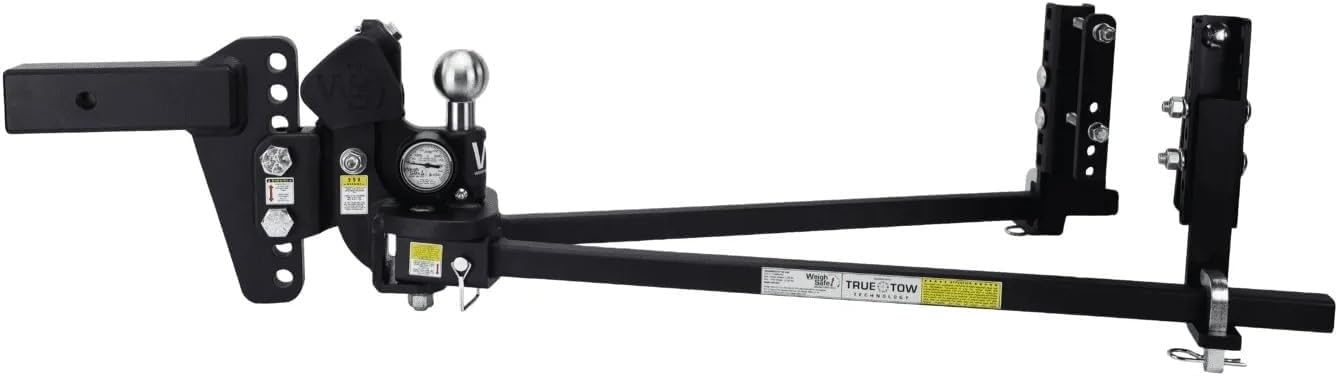
5. Weigh Safe TrueTow Heavyweight Distribution Hitch with Built-in Scale
Best Heavy-Duty Weight Distribution Hitch
| Pull Force | 18500 pounds |
|---|---|
| Compatible with Vehicle Type | Truck |
| Automotive Fit Type | Universal Fit |
| Material Type | Alloy Steel |
| Finish Type | Powder Coated |
The Weigh Safe TrueTow Heavyweight is a beefy weight-distributing hitch built for demanding towing where stronger components and precise tongue-weight control matter. It uses alloy steel construction and a powder-coated finish for corrosion resistance and durability, and the built-in hydraulic gauge lets you measure tongue weight and distributed tongue weight without guessing. Four-area anti-sway connections plus the head-assembly live adjustment screw let you tune sway control and tension quickly during setup or on the road. The hitch is available in multiple drop lengths and shank sizes and is rated up to 18,500 pounds GTW, so it handles heavy trailers that need true distribution of load between vehicle and trailer axles. Practical limits are its size and weight, which means installation and handling require two people and a compatible receiver and vehicle capacity; the integrated electronics rely on the built-in scale rather than separate digital systems. For frequent, heavy towing where long-term strength and on-the-fly adjustments matter, this model delivers reliable performance.
Best for: Buyers who tow frequently with heavier trailers and prioritize a rugged, long-lasting hitch that provides accurate tongue-weight feedback and strong sway control.
Less Ideal for: Casual or infrequent towers with light trailers or those who need a lightweight, easy-to-store solution should consider simpler, lower-capacity hitches.
- High 18,500 lb GTW rating suitable for heavy trailers
- Built-in hydraulic scale for accurate tongue weight and distributed tongue weight readings
- Four-area anti-sway design improves trailer stability under load
- Alloy steel construction with powder-coat finish for durability and corrosion resistance
- Live adjustment screw enables quick on-the-road tuning
- Heavy and bulky unit requiring at least two people to install and handle
Verdict: The best heavy-duty weight distribution hitch for frequent or demanding towing that requires stronger materials, thicker bars, and components designed to resist wear under heavy use.
6. Camco Eaz-Lift ReCurve R3 Weight Distribution Hitch, 2 5/16" Ball Kit
Best Complete-Kit Weight Distribution Hitch

| Maximum Towing Capacity | 1000 Pounds |
|---|---|
| Pull Force | 1200 Pounds |
| Automotive Fit Type | Universal Fit |
| Compatible with Vehicle Type | Trailer |
The Camco Eaz-Lift ReCurve R3 is a full kit designed to smooth and stabilize trailer tow setups by redistributing tongue weight and adding built-in sway control. It installs as a single purchase that includes the hitch head, top-loading roll-tapered spring bars, clamping-style sway brake, and a 2 5/16" ball, so you do not need to hunt for extra components. In use the R3 provides steady load leveling to flatten the tow vehicle and trailer, and its patented bolt-on sway control can be engaged or disengaged quickly for reversing or slippery conditions. The top-loading bars make setup faster and raise ground clearance compared with square-bar designs, while the roll-tapered bars and brake pad design reduce metal-on-metal noise for quieter towing. Practical limits: the kit is rated for a 1,000 lb maximum tongue weight and 1,200 lb pull force and is built for trailer applications, so it is intended for light duty towing scenarios; heavier trailers will require a higher-capacity system. Installation requires a compatible receiver and hitch ball mount on your vehicle, and professional setup or careful measuring is recommended for correct weight distribution and safe operation.
Best for: Buyers who want a single, ready-to-install weight distribution solution for light towing with minimal parts sourcing and a focus on quieter, easier setup for their Ford Maverick towing small travel trailers or light gear trailers.
Less Ideal for: People planning to tow heavier trailers near or above midweight capacities, or those who need a custom-engineered distribution system for specialized towing setups.
- Complete kit includes hitch head, top-loading spring bars, sway control clamp, and 2 5/16" ball so no extra parts are required
- Top-loading, roll-tapered spring bars speed setup and increase ground clearance
- Patented bolt-on sway control that can be disengaged for reversing or slippery conditions
- Design minimizes metal-on-metal noise for a quieter towing experience
- Rated for up to 1,000 lb tongue weight so it is not suitable for heavier trailers needing higher capacity
Verdict: The best complete-kit weight distribution hitch for buyers who want a single purchase that includes everything needed for proper installation and setup without sourcing extra parts.
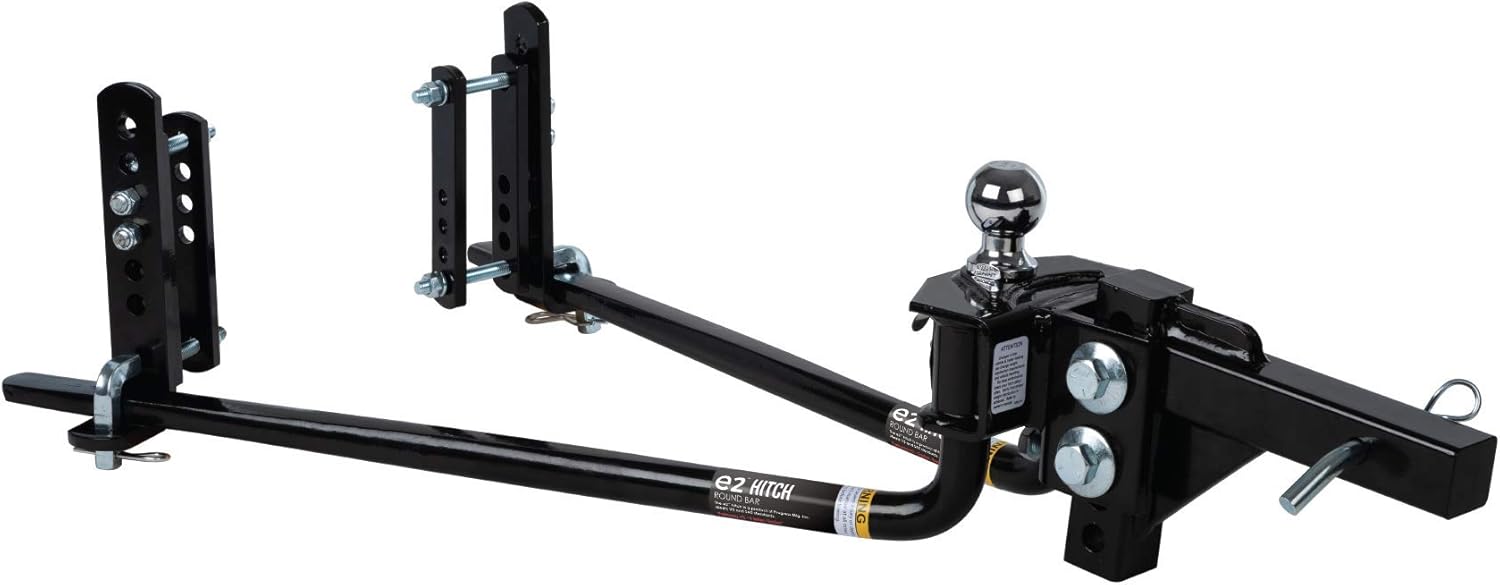
7. Fastway e2 Round Bar Weight Distribution Hitch, 8,000 lb
Best Easy-Install Weight Distribution Hitch
| Maximum Towing Capacity | 8000 pounds |
|---|---|
| Pull Force | 8000 pounds |
| Automotive Fit Type | Universal Fit |
| Material Type | Alloy Steel |
| Finish Type | Powder Coated |
The Fastway e2 round bar is a weight distribution hitch that combines load leveling and built-in two-point sway control in a single assembly. Install involves mounting the hitch head and brackets to the trailer frame and attaching the round spring bars to the head; because the sway control is integrated there are no extra chains or sway bars to hook up when backing. For a DIY installer the kit’s universal fit and common hardware mean you can assemble it with typical hand tools, and the rigid steel brackets and powder coat finish feel durable for seasonal use. Practical benefits include improved steering and braking control by transferring tongue weight across axles and faster hitching/unhitching since there is nothing to remove for tight turns or reverse maneuvers. Limitations are that the unit is sized for an 8,000 lb tow rating and 800 lb tongue weight, so it is not appropriate if your Maverick setup requires a lower-capacity or lighter-weight-specific solution, and the weight of the assembly makes handling during install easier with two people. Follow tow vehicle and trailer specifications when setting up and adjusting spring bar tension for safe operation.
Best for: A Ford Maverick owner who wants a straightforward, durable hitch that reduces trailer sway and simplifies hookup and adjustments using common hand tools and repeatable steps.
Less Ideal for: Not a good choice for drivers who need a lighter-capacity or ultralight hitch solution or who prefer a completely removable sway system for specialized trailer setups.
- Integrated two-point sway control eliminates separate sway bars or chains to connect when hitching or backing up
- Weight distribution transfers tongue load to vehicle and trailer axles for improved steering and braking
- Powder-coated alloy steel construction provides corrosion resistance and durable service life
- Universal-fit design and common fasteners let DIYers install using standard hand tools
- Designed for an 8,000 lb tow rating and 800 lb tongue weight so it is overkill for lighter trailers or setups
Verdict: The best easy-install weight distribution hitch for DIY mechanics who prioritize straightforward assembly, clear instructions, and fast, repeatable adjustments with common hand tools.
Choosing the Right Ford Maverick Weight Distribution Hitch: Key Factors to Consider
Tongue Weight and Hitch Capacity
Matching the hitch to your trailer's tongue weight is the single most important decision. A weight distribution hitch is effective only when its rated tongue weight range overlaps the measured tongue weight of your loaded trailer. If the hitch is undersized it will not transfer load properly, leaving the Maverick's nose low and handling compromised. If it is oversized for a very light trailer, you may struggle to preload the spring bars and achieve proper distribution.
Pay attention to both the unloaded tongue weight of the trailer and how that weight shifts once cargo and gear are added. Many owners carry tools, fuel, or bikes that significantly change tongue load. Choose a hitch with a capacity window that allows some margin for seasonal or trip-to-trip weight variation.
Spring Bar Type and Adjustability
Spring bars are the component that creates the leverage to redistribute load. Different systems use round steel bars, trunnion-mounted bars, or forged bars with different stiffness characteristics. The bar type influences how progressive and controllable the weight transfer feels when braking, accelerating, or cornering.
Adjustability matters when matching the hitch to changing loads. Look for units that allow multiple height settings, easy bar angle changes, and fine-adjustment on the head assembly. Those features make it simpler to achieve level towing and to tune the setup for different trailers without repeated heavy lifting.
Sway Control Compatibility
Weight distribution improves pitch and ride height, but sway control addresses lateral instability. Some hitches include integrated sway-control devices while others are compatible with separate friction or dual-cam sway systems. Consider how the hitch interfaces with your preferred sway-control method and whether the attachment points and geometry support an effective setup.
Compatibility also affects installation complexity and the potential need for additional hardware. A hitch that readily accepts common sway-control brackets will simplify achieving stable highway travel, especially in crosswind conditions or when towing lighter trailers with a higher center of lateral pressure.
Installation and Fitment for the Maverick
Ease of installation is particularly important for a compact truck like the Ford Maverick where access around the receiver and wiring may be tighter than on larger trucks. Consider how the hitch head, shank length, and spring bar path will clear the bumper, spare tire area, and rear suspension travel.
Look for systems with clear instructions, readily available mounting hardware, and no requirement for permanent vehicle modifications. A design that allows the head to tilt or the bars to disconnect without tools will make seasonal removal easier and reduce garage time.
Material Quality and Corrosion Resistance
Hitches operate under significant load and are exposed to road salt, water, and debris. Solid steel construction, robust welds, and a durable finish extend service life and preserve predictable behavior under load. Powder coatings, hot-dip galvanizing, or high-quality paint reduce rust buildup and ease maintenance.
Inspect the quality of fasteners and replaceable wear items. Models with replaceable bushings or greaseable pivot points can stay serviceable longer with routine maintenance. Material durability contributes to safety because worn or corroded components can alter load distribution and compromise performance.
Maintenance and Adjustment Ease
A weight distribution hitch benefits from periodic checks and occasional re-tensioning as load conditions change. Systems designed for simple inspection, easy access to adjustment points, and modular replacement parts reduce long-term ownership friction.
Consider how frequently you intend to hitch and unhitch. If you tow only occasionally, a unit that stores compactly and reconnects quickly will be advantageous. For frequent towing, choose designs that minimize the need for tools and allow in-field adjustments to maintain an optimal setup.
Understanding How Distribution Helps the Maverick
A weight distribution hitch shifts some of the trailer's tongue load toward the Maverick's front axle and the trailer axle. For the Maverick, which is a compact pickup, that redistribution improves headlight aim, steering responsiveness, and braking balance when hauling moderate trailers. It also reduces rear suspension sag that can cause poor ride quality and irregular tire wear.
- Reduces nose-down attitude to restore normal steering geometry
- Helps keep headlights aligned for safe night driving
- Improves braking distribution between axles for steadier stops
Common Hitch Styles and What They Mean
There are a few widely used weight distribution architectures you will encounter. Trunnion-style bars pivot on a square head and typically offer predictable, easier-to-preload setups. Round-bar designs are simpler and often lighter, with broad availability of replacement parts. Some designs include integrated sway control, while others rely on separate sway devices that attach between the trailer and the hitch head.
- Trunnion bars: stable and easier to tune on heavier loads
- Round bars: versatile and often lighter for modest tongue weights
- Integrated sway control: convenient, but check compatibility with the Maverick's receiver clearance
When You Need Sway Control in Addition to Distribution
Even with correct weight distribution, certain trailers remain prone to lateral sway depending on wind, passing vehicles, or high center of drag. Adding a sway-control system is often the best way to address that. For the Maverick, pairing a distribution hitch with a compatible sway solution reduces trailer yaw without compromising the load transfer benefits.Choose the sway-control approach that matches your towing pattern. Friction-style systems are simple and effective at moderate speeds. Dual-cam or electronic options provide stronger control for frequent highway towing but require attention to setup to avoid overcorrection.
- Friction sway control: good for irregular, lower-speed towing
- Dual-cam or cam-type: stronger lateral control for consistent highway speeds
- Electronic options: advanced control but more complex to set up
Practical Tips for Installing on a Ford Maverick
Measure the receiver height and available clearance at the bumper before selecting shank length and head design. The Maverick's shorter wheelbase and compact rear overhang mean some long-bar systems may need a shorter shank or a head that tilts for storage. Confirm that the bars clear the license plate and spare area throughout suspension travel.When you install, use a torque wrench on critical fasteners and follow the recommended preload steps for the spring bars. After the first short trip, re-check fasteners and bar tension, as some settling is normal. If you are unsure about alignment or tension, consult a professional installer rather than leaving the system under- or over-tensioned.
- Measure receiver height and bumper clearance before ordering
- Use correct shank length to maintain bar geometry
- Retorque and recheck tension after first few miles of towing
Storage and Seasonal Removal Considerations
If you do not tow year-round, consider how the system breaks down for storage. Spring bars that disconnect without tools, a head that tilts for removal, and a shank that can remain in the receiver are helpful features. Compact storage reduces the chance of damage and makes seasonal reinstallation faster.Also think about visual obstructions from mounted components when the hitch is stored. Some owners prefer systems that allow leaving a minimal profile shank in the receiver while the head and bars are stored in the vehicle to avoid reinstalling the entire assembly each tow season.
- Look for tool-less disconnection features for easy storage
- Consider whether a partial in-receiver shank will be left during off-season
- Plan storage location to protect finish and pivot points
How We Chose the Best Ford Maverick Weight Distribution Hitch
We evaluated candidate weight distribution hitches for the Ford Maverick against a focused set of real-world towing needs to create this short list. Our primary filters were load capacity range, hitch style, and sway-control compatibility so that each option can match typical Maverick towing configurations.We prioritized hitches with clear tongue weight ranges and straightforward, documented setup procedures. Ease of installation and adjustability were included because many Maverick owners will install or seasonally adjust the system themselves. Corrosion protection and material quality were considered to ensure durability in varied climates. Compatibility with common sway-control methods and accessories was another key criterion, since effective sway mitigation is as important as redistributing weight.We excluded specialized commercial or overbuilt units that far exceed the Maverick's practical towing envelope, and any units that lack clear installation guidance or required custom vehicle modifications. Final selections balanced capacity, usability, and proven mechanical designs suitable for typical Maverick trailers.
Our full evaluation process is outlined in our review methodology.
FAQ
How do I know if my Ford Maverick needs a weight distribution hitch?
If the Maverick's rear sags noticeably when hitched, headlights aim down, or steering feels slow with a trailer attached, a weight distribution hitch can help. Also consider one when the combined tongue weight approaches the upper limits of the Maverick's recommended towing configuration.
Will a weight distribution hitch reduce trailer sway on its own?
It can reduce sway caused by improper weight balance, but not all lateral instability is solved by distribution alone. For many trailers, pairing the hitch with an appropriate sway-control device gives more reliable lateral control, especially at highway speeds or in wind.
Can I install a weight distribution hitch myself on the Maverick?
Many owners can install these systems with basic tools by following the manufacturer's instructions. Pay close attention to shank length, head clearance, and torque specs. If you are uncomfortable with alignment or heavy lifting, a professional installer is a reasonable option.
How often should I recheck adjustment and fasteners?
Inspect and re-torque critical fasteners after the first short trip following installation, then periodically during long trips or after hauling heavier loads. Regular visual checks for wear or corrosion every few months are good practice.
Does the Ford Maverick require a specific shank length or receiver size?
The Maverick uses the vehicle's standard receiver, but shank length needs to be chosen to maintain proper bar geometry and bumper clearance. Measure receiver height and bumper overhang to select a shank that provides adequate clearance without excessive protrusion.
Will a distribution hitch affect fuel economy?
Redistributing weight can improve aerodynamics slightly by leveling the vehicle and trailer, but the primary effect on fuel economy depends on trailer drag and total trailer weight. Any gains are usually modest compared with changes in towing speed and trailer profile.
Final Verdict
For Ford Maverick owners, the right weight distribution hitch restores proper ride height, improves steering feel, and helps achieve safer braking balance. Prioritize matching the hitch's tongue weight range to your loaded trailer, confirm spring-bar style and adjustability meet your hauling patterns, and ensure sway-control compatibility for reliable highway stability.Weigh the tradeoffs between ease of installation, long-term maintenance, and corrosion resistance when choosing. With a correctly selected and properly tuned system, your Maverick will tow more confidently and predictably across a wider range of trailers.
Explore More:
- Check out all Ford Maverick parts & accessories
- Explore Other Accessories
- Browse all Accessories
