

Note: This article contains affiliate links. If you click on these links and make a purchase, I may earn a small commission at no extra cost to you. This helps support my research and content. Read my full affiliate disclosure here.
Towing heavy trailers with a Ford F-450 changes how the truck rides, steers, and brakes. The right Ford F-450 weight distribution hitch reduces sag, restores front axle load, and helps the truck maintain more predictable handling and braking when loaded. That matters for long trips, steep grades, and emergency maneuvers.This guide highlights our top five weight distribution hitches selected for the F-450, focusing on real-world towing concerns like tongue weight capacity, sway control performance, and ease of setup. Use the summaries and evaluation criteria to narrow the shortlist and find a solution that matches your trailer and towing style.
Top Picks at a Glance
| Best Overall Weight Distribution Hitch A balanced, all-around choice that fits most towing needs | CURT 17063 Round Bar Weight Distribution Hitch with Sway Control |  |
| Best Budget Weight Distribution Hitch A low-cost option that still improves trailer control and safety | VEVOR 1,500 lb Weight Distribution Hitch with 4-Point Sway Control |  |
| Best Premium Weight Distribution Hitch Higher-end materials, refined features, and longer-lasting performance | Weigh Safe TrueTow Heavyweight Weight Distribution Hitch with Built-In Scale (22,000 lb) |  |
| Best Compact Weight Distribution Hitch Smaller footprint and simpler setup for limited space or storage | CURT 17062 Round Bar Weight Distribution Hitch with Sway Control |  |
| Best Integrated Sway-Control Weight Distribution Hitch Combines weight distribution and sway control in one package | CURT TruTrack 17500 Integrated Sway-Control Weight Distribution Hitch |  |
1. CURT 17063 Round Bar Weight Distribution Hitch with Sway Control
Best Overall Weight Distribution Hitch

| Towing capacity (GTW) | Up to 14,000 lbs. |
|---|---|
| Tongue weight (TW) | 1,000 to 1,400 lbs. |
| Receiver fit | 2" x 2" (shank fits; head accepts 2-1/2" shank) |
| Ball size | 2-5/16" pre-torqued |
| Finish | Carbide powder coat |
This CURT round bar weight distribution hitch is built to level and stabilize heavy trailer loads by redistributing tongue weight through forged steel spring bars and a formed steel head. It includes an integrated grease zerk at the head for easier continuous lubrication, a pre-torqued 2-5/16-inch ball, and a matched sway control unit to reduce trailer yaw on highway runs. Setup uses chain hookup brackets with a snap-up design and an adjustable shank that fits 2" x 2" receivers; the head also accepts a larger 2-1/2" shank for heavier-duty class 5 setups. In practice the system provides a firmer, more controlled tow for long hauls and heavy travel trailers, and the powder coat finish and robust construction promise long service life. The hitch is heavy and requires two people to install, and its round bar design is bulkier than some trunnion-style alternatives, which may affect clearance in tight storage or when working around the rear of a truck. For Ford F-450 owners towing large travel trailers, this unit delivers strong build quality, effective sway control, and straightforward adjustment for DIY installation.
Best for: Ford F-450 owners who want a robust, factory-quality weight distribution hitch that balances durable construction, integrated sway control, and straightforward, adjustable setup for towing large travel trailers.
Less Ideal for: Drivers who prioritize the lightest possible hitch or tight rear clearance where a more compact trunnion-style unit would be preferable.
- High towing capacity up to 14,000 lb GTW with 1,000–1,400 lb tongue weight range
- Integrated grease zerk for easier, continuous lubrication of spring bar pivot
- Includes matched sway control unit and pre-torqued 2-5/16" ball for ready-to-install towing
- Forged steel spring bars and formed steel head provide durable, heavy-duty construction
- At about 100 lb the assembly is heavy and typically needs two people to install
- Round bar design is bulkier than trunnion-style hitches and can limit clearance around the rear of the truck
Verdict: The best all-around weight distribution hitch that balances ease of setup, towing stability, build quality, and value for most DIY mechanics.
2. VEVOR 1,500 lb Weight Distribution Hitch with 4-Point Sway Control
Best Budget Weight Distribution Hitch

| Maximum Towing Capacity | 1500 Pounds |
|---|---|
| Pull Force | 1500 Pounds |
| Compatible with Vehicle Type | RV, Truck, Van |
| Automotive Fit Type | Universal Fit |
This VEVOR weight distribution hitch provides the core functions you want when towing heavier loads with a Ford F-450: it redistributes tongue weight across axles and uses a 4-point sway control system to reduce lateral movement during turns and lane changes. Built from alloy steel with a powder-coated finish and a straight plate bracket, the unit is meant to resist corrosion and minimize wear between moving parts. Installation is straightforward for a competent DIYer and the tilt-head design plus adaptive leveling makes height adjustments easier without full disassembly. In practice the hitch firms up steering feel, helps keep the truck level under load, and makes reversing with a trailer less prone to snatch and sway. Limitations to note are its 1,500 lb maximum towing rating, which is modest compared with higher-capacity setups, and its relatively heavy package that may be cumbersome to handle during installation. For buyers prioritizing essential stability improvements on a budget, this unit delivers dependable performance without extras like integrated anti-bind hardware or premium finishes.
Best for: F-450 owners who want the tangible handling and load-distribution benefits of a weight distribution hitch while keeping purchase cost and complexity low.
Less Ideal for: Drivers who tow very heavy trailers or require higher-capacity commercial towing systems should choose a higher-rated, heavyweight distribution hitch designed for larger tongue loads.
- 4-point sway control improves lateral stability while turning and reversing
- Powder-coated alloy steel construction resists rust and reduces component wear
- Adaptive leveling and tilt-head design allow easier height and load adjustments
- Universal fitment for common tow vehicle types like trucks and RVs
- 1,500 lb maximum towing capacity is limited for heavy commercial or large fifth-wheel loads
Verdict: The best budget weight distribution hitch for buyers who want the core benefits of improved trailer handling and load balance without spending much.
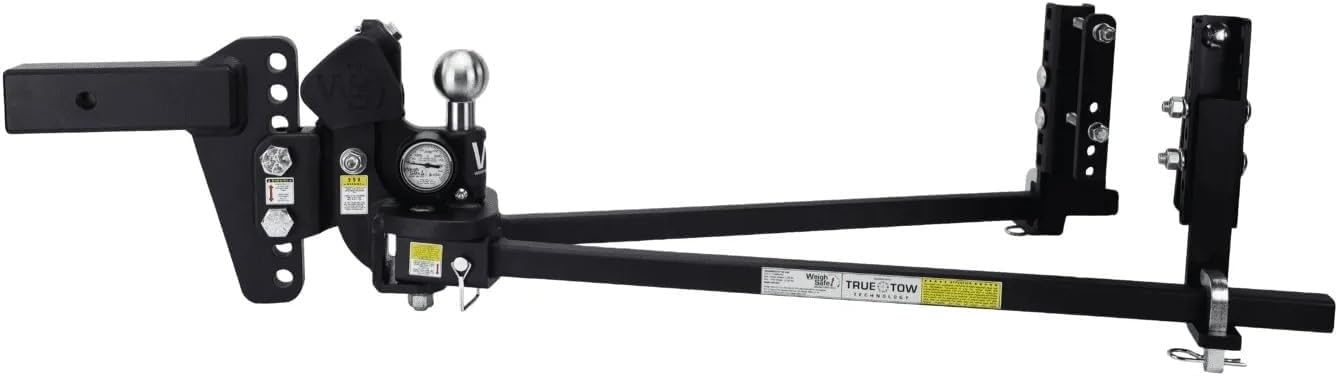
3. Weigh Safe TrueTow Heavyweight Weight Distribution Hitch with Built-In Scale (22,000 lb)
Best Premium Weight Distribution Hitch
| Pull Force | 22000 Pounds |
|---|---|
| Compatible with Vehicle Type | RV, Truck |
| Automotive Fit Type | Universal Fit |
| Material Type | Alloy Steel |
The Weigh Safe TrueTow Heavyweight is a premium weight distribution hitch aimed at heavy towing setups. It combines a 22,000 lb gross trailer weight rating with an integrated hydraulic gauge that measures tongue weight and distributed tongue weight so you can achieve the recommended 10 to 15 percent tongue weight. The head assembly includes four-area anti-sway connection points and a live adjustment screw with an internal pivot for quicker on-the-trailer tuning. In practice this means easier initial setup, the ability to fine-tune balance without complete disassembly, and stronger sway resistance when hauling large RVs or heavy equipment. The hitch is made from alloy steel with a powder-coated finish for corrosion resistance and is offered in multiple drop and shank sizes to match receiver height. The primary limitations are the unit's heavy mass and installation complexity compared with lighter, simpler hitches; it requires proper setup and possibly assistance to handle and install. For buyers prioritizing build quality and precise control over ride and handling, this model delivers noticeable benefits.
Best for: Buyers who want a high-capacity, premium hitch that prioritizes precise weight measurement, strong sway control, and convenient on-the-trailer adjustment for heavy towing on a Ford F-450.
Less Ideal for: Casual or occasional towers with lighter trailers who prefer a lighter, simpler hitch that is easier to install and requires less setup time.
- Built-in hydraulic scale for measuring tongue weight and distributed tongue weight.
- 4-area anti-sway connection points for improved sway control.
- Live adjustment screw allows on-trailer tuning without full teardown.
- High 22,000 lb GTW rating suitable for very heavy trailers.
- Alloy steel construction with powder-coated finish for durability.
- Heavy unit weight makes handling and installation more difficult for one person.
- Requires careful setup and calibration to realize benefits over simpler hitches.
Verdict: The best premium weight distribution hitch for buyers willing to pay more for superior materials, smoother performance, and advanced adjustment options.
4. CURT 17062 Round Bar Weight Distribution Hitch with Sway Control
Best Compact Weight Distribution Hitch

| Maximum Towing Capacity | 10000 Kilograms |
|---|---|
| Automotive Fit Type | Universal Fit |
| Material Type | Alloy Steel |
| Finish Type | Powder Coated |
The CURT 17062 is a compact round-bar weight distribution hitch designed to level a tow vehicle and trailer by shifting tongue weight across the towing platform. It installs into a 2" receiver and comes with forged round spring bars, a pre-torqued 2-5/16" ball, and an included sway control unit for improved on-road stability. Built-in zerk fittings at the head let you lubricate the spring-bar pivot points without disassembly, which keeps movement smooth and reduces setup maintenance. The formed steel head and powder-coat finish make it rugged for frequent use, and the adjustable shank and chain hookup brackets let you dial in tension to get the trailer level. Because it is a round-bar design it keeps overall height and bulk lower than some trunnion-style hitches, making it easier to store when not in use. Limitations are that tuning chain tension and initial setup take some time, and the unit is purpose-built for heavy towing so its size and included ball may be overkill if you only pull very light trailers.
Best for: A mechanic or fleet tech who wants a lower-profile, easier-to-store weight distribution hitch that still improves trailer stability during heavy towing and is straightforward to maintain.
Less Ideal for: Users seeking the absolute highest load shifting capacity in the tallest class or those who prefer a trunnion-style hitch for extreme loads should consider other designs.
- Integrated grease zerk fittings for easy lubrication without disassembly
- Includes sway control unit and pre-torqued 2-5/16" ball for out-of-box stability
- Forged round spring bars and formed steel head for durable load handling
- Adjustable shank and chain brackets allow precise leveling
- Setup and tuning require time and some trial to get optimal tension
Verdict: The best compact weight distribution hitch for mechanics who need a lower-profile, easier-to-store unit that still improves trailer stability.
5. CURT TruTrack 17500 Integrated Sway-Control Weight Distribution Hitch
Best Integrated Sway-Control Weight Distribution Hitch

| Tow capacity | Up to 10,000 lbs. |
|---|---|
| Ball size | 2-5/16 inch |
| Shank | 2-inch shank |
| Material | Carbon steel |
| Finish | Powder coated |
The CURT TruTrack 17500 is an integrated sway-control weight distribution hitch designed to both redistribute trailer tongue weight and actively resist trailer sway. It uses forged trunnion-style spring bars and a spring-and-cam system that builds pressure to stop sway and then relaxes for smooth turning, while adjustable brackets secure the bars laterally and vertically instead of relying on chains. Installation and tuning are simplified by interlocking nuts and six preset tilt positions accessible from outside the hitch head, which speeds setup compared with hitches that require partial disassembly or trial-and-error shimming. The welded head, hardened components, and powder-coated carbon steel construction target durability for heavier towing tasks such as campers, car haulers, and livestock trailers. Limitations to consider are that it is a heavy-duty, fixed-shank style requiring a 2-inch receiver with the correct rise/drop and that its integrated design means sway-control adjustments are tied to the hitch hardware rather than a separate aftermarket unit. For Ford F-450 users who need a factory-quality integrated solution, the TruTrack delivers reliable sway reduction and predictable weight distribution under load.
Best for: Buyers who want a single, heavy-duty unit that both evens trailer tongue weight and actively reduces sway while towing large trailers behind a Ford F-450.
Less Ideal for: Drivers who prefer a lightweight, minimal hitch setup or who need a modular sway-control solution that can be transferred between multiple tow vehicles.
- Integrated sway control and weight-distribution in one unit for coordinated performance
- Trunnion-style forged spring bars and hardened components for durability under heavy loads
- Interlocking nuts and six preset tilt holes simplify setup and on-vehicle adjustments
- Adjustable support brackets eliminate chain angle guesswork and stabilize spring bars
- Powder-coated carbon steel construction resists wear and corrosion
- Requires matching receiver drop/rise and proper installation for the F-450 due to fixed 2-inch shank configuration
- Integrated sway-control means you cannot swap in a different sway system without replacing the hitch
Verdict: The best integrated sway-control weight distribution hitch for buyers who want a single unit that both balances load and actively reduces trailer sway during towing.
Choosing the Right Ford F-450 Weight Distribution Hitch: Key Factors to Consider
Tongue Weight Capacity
Tongue weight capacity is the single most important number to match for safe towing because it determines whether the hitch can support the downward force the trailer places on the truck's hitch. For the Ford F-450 you should confirm the hitch's rated tongue weight comfortably exceeds your trailer's measured tongue weight with cargo and fluids loaded, leaving margin for dynamic loads encountered during acceleration, braking, and pitching.
Choosing a hitch with insufficient tongue weight capacity leads to excessive rear sag, reduced steering control, and increased stopping distances. Conversely, a hitch that is overbuilt for your actual tongue weight can add complexity and extra hardware weight but does not harm safety. Always grab a scale and measure your actual tongue weight so you can pick a hitch with an appropriate capacity band.
Gross Trailer Weight Rating
Gross trailer weight (GTW) rating indicates the maximum trailer mass the hitch system is designed to control. The F-450 is often used with large, heavy trailers, so verify that the hitch's GTW rating covers the loaded weight of your trailer plus any cargo you normally carry.
Operating a hitch beyond its GTW rating risks component failure and unstable towing behavior. Choose a hitch whose GTW rating aligns with your typical towing scenarios, and consider upgrading capacity if you occasionally tow heavier loads. Ratings should be treated as design limits, not targets to push.
Sway Control Integration
Effective sway control helps manage lateral movement caused by crosswinds, passing semis, or sudden steering inputs. Some weight distribution hitches include integrated sway control mechanisms, while others accept add-on sway control modules. For the F-450, integrated systems reduce the amount of separate hardware to install and can provide a more unified response.
When evaluating sway control, consider how well the mechanism blends with the weight distributing function and whether it allows predictable breakaway when you need to make tight turns or reverse. Mechanisms that are overly stiff can be difficult to back up, while systems that are too loose may not provide enough anti-sway benefit at highway speeds.
Adjustability and Setup Range
A hitch with a wide and clearly documented adjustment range makes it easier to dial in the correct load distribution for trailers with different tongue loads or when you change cargo. Look for clear markings, adjustable spring bar angles or shank heights, and the ability to fine-tune tension without disassembling major parts.
On the Ford F-450, cab height and receiver placement vary with suspension and bed configurations. A hitch that accommodates common receiver heights and offers vertical and horizontal adjustment reduces the need for drop shanks or custom hardware. Good setup guides and indexed adjustment positions save time and help achieve consistent results.
Durability and Corrosion Resistance
Hitches for heavy-duty towing are exposed to road grime, salt, and high mechanical loads. Material quality, weld integrity, and corrosion protection affect longevity and safe operation. Look for robust steel construction, well-formed welds, and finishes or coatings that resist rust in areas where you operate year-round or on salted roads.
Durability extends to replaceable wear components. Designs that allow swapping out bushings, pins, or spring bars rather than replacing the entire hitch make maintenance more economical and keep the system functioning properly over many seasons.
Ease of Installation and Maintenance
How straightforward a weight distribution hitch is to install affects both initial setup and how often you will adjust it. For F-450 owners, jobs that require lifting heavy parts into position or modifying the receiver can increase time and risk. Look for hitches with user-friendly mounting procedures, clear torque specifications, and accessible grease or lubrication points.
Maintenance considerations include how often the system needs re-torquing, lubrication intervals, and whether specialized tools are required. Systems designed for easier service reduce downtime and the chance of incorrect reassembly after adjustments or seasonal storage.
Matching Hitch Specs to F-450 Towing Profiles
The Ford F-450 is commonly used with larger gooseneck or conventional trailers that carry heavy loads. Even when using a ball hitch rather than a gooseneck, understanding your typical towing profile helps you choose an appropriate weight distribution setup. Consider your average trailer weight, how often you run at highway speeds, and whether you tow in hilly or windy regions.
Documenting two or three representative towing scenarios and the associated tongue weights lets you compare how different hitches cover your needs. Look beyond maximum ratings and think about how each hitch performs near the middle of its capacity range where you will spend most time towing.
- Record loaded trailer weight and tongue weight for typical trips
- Note operating environments such as sustained grades or crosswinds
- Choose a hitch with a usable adjustment range, not just a high maximum
Practical Setup Tips for F-450 Owners
Start by measuring the trailer's tongue weight at the truck hitch point with cargo and fluids loaded. Use that number to set initial spring bar tension and shank height. Small incremental adjustments while driving short test sections will help you achieve the right balance between front axle load and rear support.
When installing, ensure the hitch receiver and mounting hardware are clean and free of debris. Tighten fasteners to the recommended torque values and recheck after the first few hundred miles. If your hitch includes sway control, practice backing and tight maneuvers to understand its limits before hitting the highway.
- Measure tongue weight at the hitch before setting up
- Adjust in small increments and re-test on low-traffic roads
- Retorque hardware after initial break-in miles
Common Installation Challenges and Solutions
Heavy spring bars and large components can be difficult to position, particularly without a second person. Use a floor jack or support stands to help lift and align components during assembly. If your receiver height differs from the trailer's ball height, consider using an appropriate shank drop or rise that maintains the hitch's recommended geometry.
If sway control feels too restrictive when maneuvering at low speeds, verify that the sway mechanism is correctly adjusted and not preloaded. Conversely, if sway persists at highway speeds, increase tension in small steps and re-test. Address binding points such as corroded pins or misaligned brackets early to avoid accelerated wear.
- Use mechanical assistance to handle heavy components
- Match shank drop/rise to preserve geometry
- Inspect pins and mounting points for smooth operation
Maintenance Checklist for Long-Term Performance
Establish a seasonal maintenance routine that inspects fasteners, checks for corrosion, and lubricates pivot points. Replace worn bushings or hardware as soon as you notice excessive play. Keep a record of adjustment settings that worked well so you can return to them after disassembly for storage or repair.
Before extended trips, verify torque on critical fasteners and confirm that any sway control attachments are secure. Address surface rust with appropriate coatings and touch-up paint to prevent deeper corrosion that could compromise structural integrity over time.
- Inspect and torque fasteners before long trips
- Lubricate pivot points and inspect bushings regularly
- Record ideal adjustment settings for repeatable setup
When to Consider Professional Installation
Professional installation is worthwhile if your trailer setup is unusually heavy, if you lack lifting assistance, or if your truck has aftermarket suspension that changes receiver height. A professional can ensure the hitch geometry is correct, torque values are met, and that sway control systems are integrated properly.
Consider professional setup when you plan to tow frequently at high speeds or through mountainous terrain. Proper initial setup reduces the chance of roadside adjustments and can prevent early component wear caused by misalignment or improper tensioning.
- Use a pro if receiver height or suspension is non-standard
- Get professional help for very heavy or irregular trailer loads
- Have a shop verify sway control tuning for long-haul towing
How We Chose the Best Ford F-450 Weight Distribution Hitch
We prioritized features and specifications that directly affect towing performance with the Ford F-450. Key evaluation criteria included rated tongue weight capacity to ensure the hitch can safely handle typical heavy trailer loads for this truck, and overall gross trailer weight ratings so owners can match the hitch to their trailer's mass. We also assessed sway control integration and how effectively the system reduces lateral movement under typical highway and crosswind conditions.Installation and adjustability were important. We looked for designs that offer clear setup ranges, accessible adjustments, and compatibility with common receiver heights on the F-450. Fitment tolerance and hardware quality were considered to gauge long-term durability under sustained heavy loads. Ease of maintenance and serviceability were reviewed to minimize roadside fuss and keep the hitch performing over time.We excluded any products with insufficient published capacity for heavy-duty truck towing, unclear setup guidance, or obviously incompatible mounting geometries. The resulting list reflects a balance of rated capacity, sway mitigation capability, installation practicality, and construction robustness for Ford F-450 owners.
Our full evaluation process is outlined in our review methodology.
FAQ
How do I know the right tongue weight for my F-450 setup?
Tongue weight is the downward force at the hitch when the trailer is loaded. Use a tongue weight scale at the trailer coupler or at the truck hitch to measure with cargo and fluids aboard. Aim for a hitch rated above that measured number to provide a safety margin.
Can I install a weight distribution hitch myself on an F-450?
Many owners can install a weight distribution hitch with common tools and a helper to manage heavy parts. However, if you are unsure about receiver height, torque specs, or handling heavy components, professional installation reduces risk and ensures correct geometry.
Will a weight distribution hitch eliminate trailer sway completely?
A weight distribution hitch with integrated sway control significantly reduces sway risk, but it will not always eliminate it. Proper tongue weight, correct setup, and appropriate trailer loading are all necessary to minimize sway under different road conditions.
How often should I recheck hitch torque and adjustments?
Retorque critical fasteners after the first 50 to 100 miles of towing following installation, then check them periodically, such as monthly or before long trips. Recheck adjustments after heavy use or after changing trailer load distribution.
Will installing a weight distributing hitch change my truck's ride height?
Yes. A properly adjusted weight distribution hitch transfers some trailer load to the truck's front axle, which often reduces rear sag and raises the front slightly. The visible change depends on tongue weight and the hitch's adjustment setting.
Are spring bars required for weight distribution on the F-450?
Spring bars are a common and effective component for distributing load and providing sway resistance. Some systems use alternate mechanisms, but spring bars remain a reliable choice for heavy trailers when properly sized and installed.
Final Verdict
For Ford F-450 owners, the right weight distribution hitch restores steering feel, improves braking stability, and reduces rear sag when towing heavy trailers. Prioritize matching rated tongue weight and gross trailer weight to your loaded trailer, and choose a system with effective sway control and an adjustment range that fits your receiver height.Weigh the tradeoffs between adjustability and complexity, and follow a careful setup and maintenance routine. When in doubt about installation or unusual towing demands, professional help can ensure a safe, durable setup that keeps your F-450 predictable and stable on the road.
