

Note: This article contains affiliate links. If you click on these links and make a purchase, I may earn a small commission at no extra cost to you. This helps support my research and content. Read my full affiliate disclosure here.
If you tow frequently with a Chevrolet Tahoe, a properly selected weight distribution hitch can make towing safer and more predictable. The right hitch redistributes tongue weight across the tow vehicle and trailer axles, reduces rear-end sag, and improves steering and braking response. This guide covers seven shortlisted options chosen for common Tahoe towing setups, focusing on load capacity, sway control effectiveness, and ease of installation.Below you will find practical notes on fitment, setup, and the decision factors that matter for Tahoe owners. Use these picks as a starting point for matching a hitch to your trailer weight and towing goals.
Looking for other parts? See all Chevrolet Tahoe parts & accessories.
Top Picks at a Glance
| Best Overall Weight Distribution Hitch The top all-around hitch balancing performance, build, and ease of use | CURT Round Bar Weight Distribution Hitch with Integrated Sway Control |  |
| Best Budget Weight Distribution Hitch A low-cost option that still provides basic load leveling and control | Fastway Connect Weight Distribution Hitch with 2-5/16" Ball |  |
| Best Premium Weight Distribution Hitch Higher-end components and refined performance for heavy or frequent towing | B&W Trailer Hitches Continuum Weight Distribution Hitch (Regular Coupler) |  |
| Best Compact Weight Distribution Hitch A smaller, lower-profile hitch for limited clearance and tighter storage | CURT TruTrack 2P Round Bar Weight Distribution Hitch with Integrated Sway Control |  |
| Best High-Capacity Weight Distribution Hitch Designed for heavier tongue loads and larger trailers needing extra support | Weigh Safe TrueTow Heavyweight Distribution Hitch with Built-In Scale (6" Drop, 2.5" Shank) |  |
| Best Complete Kit Weight Distribution Hitch Includes head, bars, brackets, and sway-control hardware in one package | CURT TruTrack 17500 Weight Distribution Hitch with Integrated Sway Control |  |
| Best Easy-Install Weight Distribution Hitch Simplified setup and clear instructions for faster, less-fussy installation | Camco Eaz-Lift ReCurve R3 1,200 lb Weight Distribution Hitch with 2 5/16" Ball |  |
1. CURT Round Bar Weight Distribution Hitch with Integrated Sway Control
Best Overall Weight Distribution Hitch

| Towing capacity | Up to 14,000 lbs. GTW |
|---|---|
| Tongue weight range | 1,000 to 1,400 lbs. TW |
| Receiver size | 2" x 2" shank |
| Ball size | 2-5/16" trailer ball |
| Material | Carbon Steel |
This CURT round bar weight distribution hitch is designed to level your tow vehicle and trailer by redistributing tongue weight and adding a sway control unit for steadier towing. It installs into a 2" x 2" receiver and includes a pre-torqued 2-5/16" trailer ball, forged round spring bars, chain hookup brackets, and a grease zerk system built into the head for easier lubrication. In practice the formed steel head and powder-coated finish make it durable for regular towing, and the included sway control helps reduce trailer oscillation on highways or in crosswinds. Setup is straightforward with the snap-up chain design and adjustable shank, though fitting and adjustment will still require time to dial in proper tension and lubrication. This model covers a broad towing range and includes hardware for most heavy trailers, making it a strong, practical choice when you need a robust, all-purpose weight distribution hitch for frequent or heavy towing with a Chevrolet Tahoe.
Best for: Drivers who tow medium to heavy trailers with a Chevrolet Tahoe and want a durable, easy-to-adjust system that improves stability and reduces sway for regular highway and camping use.
Less Ideal for: Casual users who tow very light loads infrequently or who prefer an anti-sway solution that does not require mechanical adjustments and maintenance.
- Integrated sway control unit reduces trailer sway without a separate device
- Grease zerk fittings in the head allow easy, continuous lubrication of the spring bar mount
- Forged round steel spring bars and formed steel head provide durable load handling
- Adjustable shank and chain brackets simplify leveling and tension setup
- Requires periodic greasing and adjustment to maintain optimal performance
Verdict: The best all-around weight distribution hitch for most buyers, offering the right mix of towing stability, construction quality, sway control, and straightforward setup.
2. Fastway Connect Weight Distribution Hitch with 2-5/16" Ball
Best Budget Weight Distribution Hitch

| Maximum Towing Capacity | 10000 Pounds |
|---|---|
| Maximum Tongue Weight | 1000 lb max tongue wt. |
| Pull Force | 10000 Pounds |
| Material Type | Alloy Steel |
| Finish Type | Powder Coated |
The Fastway Connect is a straightforward, chain-based weight distribution hitch aimed at buyers who want dependable load-leveling without extra frills. It installs into a 2" receiver and comes with a pre-installed 2-5/16" ball and a standard shank that offers a 3" drop and 7" rise for common hitch heights. Using hardened steel chain links and round bar arms, it shifts tongue load from the rear axle back toward the front axle to reduce sag, improve braking and steering, and make towing a Chevrolet Tahoe with an appropriately rated setup more stable. Adjustments are simple: change which chain link hooks to the trailer frame to increase or decrease leverage. The unit is powder-coated alloy steel for corrosion resistance, but the chain-and-link design means it lacks the smoother adjustability and anti-sway refinements of higher-end spring-bar systems. It is best when you need a rugged, no-nonsense hitch that handles up to 10,000 lb trailer weight at an affordable level, provided the Tahoe’s tow specs and hitch class match those limits.
Best for: Cost-conscious Tahoe owners who need effective load-leveling and improved trailer control for occasional towing and value straightforward installation and durability over premium features.
Less Ideal for: Drivers who tow frequently with heavy loads, want integrated sway control or the smoothest adjustments, or who prioritize the highest-end materials and finishes.
- Simple, proven chain-and-arm design for reliable weight distribution
- Includes 2-5/16" pre-installed ball and standard shank for quick installation
- Handles up to 10,000 lb trailer weight and 1,000 lb tongue weight
- Powder-coated alloy steel construction for corrosion resistance
- Easy adjustments by changing chain link attachment
- Chain-style system offers less refined sway control compared with higher-end spring-bar hitches
Verdict: The best budget weight distribution hitch for cost-conscious buyers who need reliable load-leveling and improved trailer handling without high-end features or premium materials.
3. B&W Trailer Hitches Continuum Weight Distribution Hitch (Regular Coupler)
Best Premium Weight Distribution Hitch

| Maximum Towing Capacity | 1600 Pounds |
|---|---|
| Pull Force | 1600 Pounds |
| Automotive Fit Type | Universal Fit |
| Material Type | Alloy Steel |
The B&W Continuum weight distribution hitch is built to manage tongue weight and improve towing stability for heavier trailers. It uses composite spring bars rated for a 600–1600 lb tongue range, so a single bar set handles varying loads without swapping hardware. A closed-loop hydraulic cylinder and hand pump let you fine-tune how much weight is transferred to the tow vehicle quickly and without tools. Built-in friction sway prevention is active as soon as the bars are loaded, reducing trailer sway without separate sway chains. The unit ships preassembled with a preset head angle and installs quickly with common hand tools, and the powder-coated alloy-steel construction aims for long service life. Expect smoother steering and more level hauling when towing frequently or with close-to-capacity loads. The system is heavier and more complex than simple fixed bars, and the hydraulic adjustment adds components that may need occasional attention over years of heavy use.
Best for: Drivers who tow frequently or haul heavier trailers and prioritize smoother handling, precise weight transfer, and durable construction for regular use.
Less Ideal for: Casual or infrequent towers who tow light loads and prefer a simpler, lower-maintenance hitch solution.
- Composite spring bars cover a wide 600–1600 lb tongue weight range with one bar set
- Hydraulic closed-loop pump allows fast, tool-free fine tuning of weight distribution
- Integrated friction sway prevention engages continuously for immediate sway control
- Preassembled head angle and quick install reduce setup time
- Powder-coated alloy-steel construction for corrosion resistance and durability
- More complex system with hydraulic components that can require maintenance over long-term heavy use
Verdict: The best premium weight distribution hitch for owners who tow often or with heavier loads and want superior materials, smoother sway control, and longer-lasting hardware.
4. CURT TruTrack 2P Round Bar Weight Distribution Hitch with Integrated Sway Control
Best Compact Weight Distribution Hitch

| Pull Force | 8000 Pounds |
|---|---|
| Automotive Fit Type | Universal Fit |
| Material Type | Carbon Steel |
| Finish Type | Powder Coated |
The CURT TruTrack 2P is a compact weight distribution hitch that combines weight spreading and passive sway control into a single, low‑profile unit. It uses forged round spring bars and fixed support brackets to transfer tongue weight across the vehicle and trailer axles while resisting lateral movement, so it both levels the tow vehicle and reduces trailer sway without a separate sway device. Setup is straightforward thanks to the tilting head and a 7‑hole adjustable shank that shortens overall assembly length and simplifies height matching to the Chevrolet Tahoe. The carbide black powder coat and fabricated steel head give the hitch durable corrosion resistance and strength for typical towing duties up to the listed capacity. Limitations include its universal fit approach, which may require careful shank selection for ideal rise/drop on some Tahoe configurations, and the integrated passive sway control is not adjustable like some friction or dual‑arm active systems. For buyers prioritizing a compact, easy‑stored hitch that still provides meaningful load distribution and built‑in sway resistance, the TruTrack is a practical choice for towing with a Tahoe.
Best for: Someone who needs a compact, easy‑stored weight distribution hitch for regular towing with a Chevrolet Tahoe and values simple setup and integrated sway resistance over fiddly adjustments.
Less Ideal for: Drivers who tow highly variable loads and want a fully adjustable or active sway control system, or those who need vehicle‑specific fitment without selecting shank options, should consider alternatives.
- Integrated passive sway control removes the need for a separate sway unit
- 7‑hole adjustable shank allows closer height matching and reduces overall hitch length
- Forged round spring bars and fabricated steel head for reliable strength
- Durable carbide black powder coat resists corrosion for outdoor use
- Integrated sway control is passive and less tunable than some adjustable sway systems
Verdict: The best compact weight distribution hitch when low profile, reduced overall length, and easier storage are priorities while still providing meaningful load distribution.
5. Weigh Safe TrueTow Heavyweight Distribution Hitch with Built-In Scale (6" Drop, 2.5" Shank)
Best High-Capacity Weight Distribution Hitch
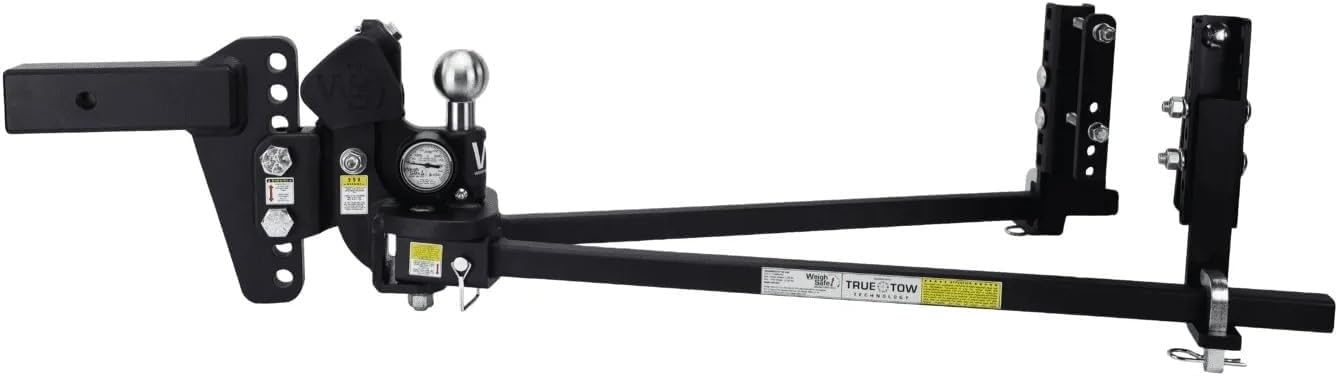
| Pull Force | 22000 Pounds |
|---|---|
| Compatible with Vehicle Type | RV, Truck |
| Automotive Fit Type | Universal Fit |
| Material Type | Alloy Steel |
This Weigh Safe TrueTow Heavyweight distribution hitch is built for high-capacity towing, offering a 22,000 lb gross trailer weight rating and an integrated hydraulic gauge that reads both tongue weight and distributed tongue weight. It installs like a conventional weight distribution system but adds four-area sway control through multiple connection points for improved trailer stability on long hauls. The head assembly includes a live adjustment screw and internal pivot for on-the-fly tensioning, and a smartphone DTW tool helps set the distributed tongue weight accurately. Constructed from alloy steel with a powder coat finish, the hitch is aimed at heavy travel trailers where restoring front axle load and reducing trailer sway matter. Limitations include the physical heft and need for a 2.5-inch receiver and an appropriate drop height to match the tow vehicle and trailer geometry; professional alignment of spring bar tension is recommended for best results. For a Tahoe setup, confirm your vehicle’s hitch class and mounting requirements before selecting this heavy-duty model.
Best for: Buyers who need a high-capacity, professionally tuned weight distribution solution for towing larger trailers and want built-in measurement and strong sway control to improve highway stability.
Less Ideal for: Casual or infrequent towers with light trailers, or owners unable to accommodate a 2.5" shank and the heavier hitch weight in their vehicle hitch setup.
- High 22,000 lb GTW rating for heavy trailers
- Built-in hydraulic scale to measure tongue weight and distributed tongue weight
- Four-area anti-sway connections for stronger sway control
- Live adjustment screw and DTW smartphone tool for easier tuning
- Requires a 2.5" receiver and correct drop height, adding installation constraints
Verdict: The best high-capacity weight distribution hitch for towing heavier trailers or carrying larger tongue loads where higher weight ratings and robust components are required.
6. CURT TruTrack 17500 Weight Distribution Hitch with Integrated Sway Control
Best Complete Kit Weight Distribution Hitch

| Maximum trailer weight | Up to 10,000 lbs. |
|---|---|
| Shank size | 2-inch shank |
| Ball size | 2-5/16-inch ball |
| Material | Carbon Steel |
| Finish | Powder Coated |
The CURT TruTrack 17500 is a full-package weight distribution hitch that pairs spring bars, adjustable support brackets, and integrated sway control into one matched system designed for heavy trailers. It installs like a conventional 2-inch shank, uses a 2-5/16-inch ball, and routes spring bars through welded and forged components to spread tongue weight across vehicle and trailer axles. The integrated sway control arms and a spring-and-cam mechanism actively resist trailer yaw while still allowing smooth turns, so you get steadier towing without a separate friction device. Setup is faster than many competitors because of interlocking nuts and six preset tilt holes accessible from outside the head, and the adjustable brackets replace guesswork with fixed support points. Hardened components and a powder-coated carbon steel finish aim for durability in regular towing use. Limitations are typical for heavy-duty WD systems: it needs correct installation and periodic inspection, and its universal fit approach means confirming compatibility and proper adjustments for your Chevrolet Tahoe and the specific trailer tongue weight before towing.
Best for: Buyers who want a fully matched, single-package solution that handles both load leveling and sway control for towing heavier trailers with a Chevrolet Tahoe and prefer faster, clearer setup over piecing together separate components.
Less Ideal for: Drivers who only tow very light trailers infrequently or who prefer minimal added hardware and sway-control solutions integrated into the trailer rather than the hitch should consider simpler options.
- Integrated sway control and weight distribution in a single matched system for simpler setup
- Interlocking nuts and preset tilt holes speed and simplify adjustment
- Adjustable, fixed-support brackets reduce lateral spring bar movement compared with chain systems
- Hardened spring and cam components claim longer wear life than friction-only designs
- Requires accurate initial setup and periodic checks to ensure correct weight distribution
Verdict: The best complete-kit weight distribution hitch for buyers who want everything needed for installation and sway management in a single, matched package.
7. Camco Eaz-Lift ReCurve R3 1,200 lb Weight Distribution Hitch with 2 5/16" Ball
Best Easy-Install Weight Distribution Hitch

| Compatible with Vehicle Type | Trailer |
|---|---|
| Pull Force | 1200 Pounds |
| Maximum Towing Capacity | 1200 Pounds |
The Camco Eaz-Lift ReCurve R3 is a weight distribution hitch engineered to reduce trailer sway and keep a trailer level while towing. It uses roll-tapered spring bars and a patented sway-control clamp that you can engage or disengage with a bolt, so you get consistent sway control at normal speeds and the option to turn it off during tight maneuvers or low-traction conditions. The top-loading spring bars speed installation and increase ground clearance, and the no-grease design along with the brake-pad-style clamping reduces the metal-on-metal noise common with older hitches. For DIYers the setup is straightforward: place the hitch in the receiver, mount the top-loading bars, and make small adjustments with the bolt-based sway control. Practical benefits include a quieter ride, easier hookup and alignment, and dependable sway damping for highway driving. Important limitations are its specified tongue capacity of 1,200 pounds and that fitment and safe operation depend on matching the hitch to the Tahoe's receiver, hitch class, and the trailer's tongue weight, so confirm those before installation.
Best for: Home installers who want a straightforward, fast-to-setup weight distribution hitch with built-in sway control and minimal maintenance effort for towing with a Chevrolet Tahoe.
Less Ideal for: Drivers planning to tow heavier trailers that exceed the hitch's tongue capacity or those who need a higher-capacity commercial-grade distribution system.
- Top-loading spring bars simplify alignment and reduce the physical effort during installation
- Bolt-adjustable sway control provides consistent damping that can be disengaged for low-speed maneuvers
- No-grease design and brake-pad-style clamp minimize clunking and metal-on-metal wear
- Designed for quick user setup which suits DIYers who want minimal tools and fuss
- Rated for a 1,200 lb tongue capacity which limits use to lighter trailers
- Requires matching the Tahoe's hitch receiver and trailer tongue weight for safe, effective operation
Verdict: The best easy-install weight distribution hitch for DIYers who prefer minimal fuss, clear instructions, and hardware designed to speed up alignment and setup without sacrificing safety.
Choosing the Right Chevrolet Tahoe Weight Distribution Hitch: Key Factors to Consider
Tongue Weight and Gross Trailer Weight Capacity
Knowing the tongue weight range and the gross trailer weight capacity is essential because these two numbers determine whether a hitch can safely handle your trailer. For a Chevrolet Tahoe, tongue weight often sits between 10 and 15 percent of trailer gross weight, so choose a hitch whose tongue weight range matches your loaded trailer. A mismatch can leave you with inadequate lift or an overloaded hitch creating unsafe towing dynamics.
Capacity numbers also affect how you set the spring bars. If the hitch capacity is too close to your trailer weight, there is less room for adjustment, and fine-tuning sway control becomes harder. Always use the lower of the vehicle, hitch, and trailer coupler ratings when planning capacity to maintain a safety margin.
Sway Control Performance
Sway control is a primary reason Tahoe owners add a weight distribution hitch because it helps limit lateral movement from crosswinds, passing vehicles, or uneven loads. Different systems deliver sway control in different ways: friction-based units, dual-cam designs, or integrated spring-bar tension. Evaluate how the hitch applies resistance and how adjustable that resistance is for your trailer's behavior.
Effective sway control should not lock up hitch articulation entirely. You need enough dampening to stop oscillation while retaining smooth turning clearance. Also consider whether the sway control mechanism is built into the head unit or requires a separate attachment; integrated systems tend to be simpler to set up on a Tahoe but replacement components can be more specialized.
Spring Bar Style and Adjustability
Spring bars are the mechanical core of most weight distribution systems. Styles include round, trunnion, and adjustable-length bars, each with different leverage and mounting considerations. For Chevy Tahoe owners, bar length, angle, and attachment geometry affect how much lift is transferred to the vehicle and trailer axles.
Adjustability matters because initial setup rarely yields perfect balance. Look for systems with multiple tension positions or cam settings that allow incremental changes. Some designs let you change ball mount drop height to fine-tune the bar angle. Durable, replaceable bars and clear indexing marks will save time during setup and future retunes if tow conditions change.
Compatibility With Tahoe Hitch Receiver and Accessories
The Chevrolet Tahoe uses a standard hitch receiver, but variations in receiver height, aftermarket bumper attachments, or accessories like a hitch-mounted cargo carrier can affect fitment. Choose a weight distribution hitch that fits the Tahoe's receiver dimensions and integrates cleanly with common accessories without obstructing electrical hookups or backup sensors.
Also check whether the system requires a specific rise or drop ball mount and whether additional shank adapters are needed for your Tahoe's setup. Compatibility with anti-rattle inserts and trailer wiring should be verified to avoid installation surprises and ensure the hitch functions properly with the vehicle's existing hardware.
Installation Complexity and Required Tools
Installation ranges from straightforward bolt-on setups to systems that require temporary vehicle lift or help from a second person. For Tahoe owners who prefer DIY, a hitch with simple hand tools, clear instructions, and minimal torque-critical fasteners reduces installation time and risk of incorrect assembly.
Consider whether you will need to adjust the hitch after the first tow and whether the system is user-friendly for repeated changes. Some hitches require specialized tools to change sway-control settings or to swap spring bars, so factor that into your decision if you plan to retune the hitch frequently.
Corrosion Resistance and Long-Term Durability
Towing exposes hardware to road salt, moisture, and abrasive conditions, so corrosion-resistant coatings and robust materials matter for long-term performance. Look for powder-coated finishes, zinc plating on pins and bolts, and replaceable wear components. For Chevrolet Tahoe owners who tow in harsh climates or near coastal areas, investing in a system with better protection will extend service life and maintain safe operation.
Durability also includes ease of obtaining replacement parts like spring bars, head assemblies, and fasteners. Choose a system where common wear items are accessible and serviceable rather than requiring full-unit replacement.
Matching Hitch Capacity To Typical Tahoe Trailers
Start by calculating your trailer's loaded gross weight and the expected tongue weight. For many Tahoe towing scenarios, trailers range from small utility loads to mid-size campers or boat trailers. Knowing these numbers narrows the field to hitches rated for the correct tongue weight and gross trailer weight bands.
If you plan to tow a variety of trailers, prefer a hitch with a broader tongue weight window or easily changeable spring bars. That flexibility reduces the need to swap hitches when your towing needs change.
- Measure loaded trailer weight at a certified scale when possible.
- Estimate tongue weight as 10 to 15 percent of loaded trailer weight.
- Pick a hitch where your tongue weight falls near the middle of the rated range for best adjustability.
Setup Steps To Improve Tow Stability
A systematic setup reduces sway and ensures even load distribution. Begin with the vehicle and trailer on level ground, ensure tire pressures match recommended values, and position the trailer so the coupler sits at the correct height. Attach the hitch components per manufacturer torque specs, then set spring bar tension to the initial recommended setting.
Perform a short test drive with incremental changes. Increase tension slowly if you notice rear sag or excessive play, and reduce it if turning clearance or ride quality is too harsh. Document the final settings so you can replicate them later.
- Check and adjust trailer load distribution before hitch installation.
- Use short test drives after each adjustment to evaluate sway behavior.
- Record ball mount position and bar index for future setups.
Common Installation Pitfalls and How To Avoid Them
One frequent error is relying solely on tongue weight estimates instead of measuring actual loaded weight. Underestimating tongue weight can lead to insufficient lift and compromised braking. Another pitfall is over-torquing hardware or misaligning the head unit, which can damage components or impair sway control performance.
Also be mindful of receiver height and ball mount selection. Incorrect ball height changes spring bar geometry and reduces the effectiveness of the distribution. Finally, do not skip verifying electrical and safety-chain routing; these can interfere with hitch components if not planned during installation.
- Always verify actual weights at a scale when possible.
- Follow torque specs and alignment instructions precisely.
- Ensure wiring and safety chains clear the hitch head and bars.
Maintenance Tips To Keep The Hitch Performing
Regular maintenance prolongs the life of the weight distribution system and preserves sway control function. Inspect spring bars and pivot points for wear, lubricate friction surfaces when specified, and check fasteners for proper torque periodically. Replace any corroded or bent components immediately.
Seasonal maintenance before heavy towing seasons helps catch issues early. Keep a small kit with replacement clips, pins, and corroded fasteners so you can address common failures quickly and avoid downtime when preparing the Tahoe for a trip.
- Inspect after the first 100 miles of use then at regular intervals.
- Lubricate only when the manufacturer recommends specific products.
- Replace worn pins and clips promptly to maintain safety.
When To Consider Professional Setup or Alignment
If you tow near the limits of your vehicle or trailer ratings, or if you experience persistent sway despite adjustments, a professional setup can identify issues like improper weight distribution, suspension sag, or mismatched components. Professionals can also verify hitch geometry and perform a dynamic sway test under controlled conditions.
Consider professional help when installing more complex systems that include separate friction sway arms or when fitting a hitch to a Tahoe with aftermarket suspension modifications. A pro can also recommend alternate load-management solutions if a weight distribution hitch alone is insufficient.
- Seek help for repeated or severe sway incidents.
- Professional shops can provide documented setup parameters for future reference.
- Ask a professional to re-evaluate setup after vehicle or trailer changes.
How We Chose the Best Chevrolet Tahoe Weight Distribution Hitch
We prioritized hitches that meet the load and towing dynamics typical for Chevrolet Tahoe owners, favoring options with clear capacity ratings and well-documented sway control features. Our evaluation used four to six concrete criteria relevant to trailer towing: tongue weight range and gross trailer weight capacity, integrated or compatible sway-control systems, spring bar style and adjustability, build quality and corrosion resistance, installation complexity and required hitch components, and adaptability to common trailer coupler heights. We also considered compatibility with anti-rattle or drop-hitch accessories that Tahoe owners often need.Excluded from consideration were hitches with unclear load ratings, products lacking documented sway-control performance, and options designed only for light-duty SUVs with much lower tongue weight than typical Tahoe towing setups. We focused on durable materials, user-adjustable tensioning, and designs that minimize trailer head sway while preserving hitch articulation. The shortlist favors systems that can be properly tuned to the Tahoe's rear ride height and common trailer types without extensive vehicle modifications.
Our full evaluation process is outlined in our review methodology.
FAQ
How do I know if my Chevrolet Tahoe needs a weight distribution hitch?
If the rear of your Tahoe sags when hitched, steering feels less precise, or the trailer sways during braking or in crosswinds, a weight distribution hitch can help. Check tongue weight and towing stability during a short road test to decide.
Can I install a weight distribution hitch myself on a Tahoe?
Many Tahoe owners can install these hitches with basic hand tools, clear instructions, and an assistant. However, some systems require precise torque settings or temporary suspension support, so follow instructions closely and consider professional help for complex setups.
Will a weight distribution hitch eliminate trailer sway completely?
A proper weight distribution hitch with effective sway control greatly reduces sway risk but does not guarantee complete elimination. Correct loading, proper tire pressure, and appropriate driving techniques are also important in preventing sway.
How often should I recheck the hitch setup on my Tahoe?
Recheck hardware torque and bar tension after the first 50 to 100 miles of a new setup, then inspect periodically before major trips. Also re-evaluate setup when you change trailer weight or distribution.
Do I need different spring bars for different trailers I tow with my Tahoe?
You might need different-length or different-rated spring bars if your trailers have significantly different tongue weights. Choosing a system with interchangeable or adjustable bars simplifies switching between trailers.
Can a weight distribution hitch affect my Tahoe's fuel economy?
A weight distribution hitch itself has minimal direct effect on fuel economy, but better level ride height and reduced aerodynamic drag from less sag can marginally improve efficiency compared with an improperly loaded tow setup.
Final Verdict
Prioritize matching capacity and sway-control capability when choosing a weight distribution hitch for a Chevrolet Tahoe. Confirm tongue weight and gross trailer weight, pick a system with adjustable spring bar geometry and dependable sway dampening, and verify fitment with your Tahoe's receiver and accessories. Expect to trade some initial setup time for greater confidence and stability on the road.In most cases, choose the hitch whose rated capacity centers your typical loaded tongue weight and offers straightforward adjustability. That approach gives you the best balance between control, durability, and repeatable setup for safe towing with your Tahoe.
Explore More:
- Check out all Chevrolet Tahoe parts & accessories
- Explore Other Accessories
- Browse all Accessories
