

Note: This article contains affiliate links. If you click on these links and make a purchase, I may earn a small commission at no extra cost to you. This helps support my research and content. Read my full affiliate disclosure here.
If you tow with a Dodge Journey, choosing the right trailer brake controller matters for safety and drivability. The proper controller helps your vehicle slow predictably, reduces sway, and makes stop distances more consistent when hauling a trailer.This guide highlights the top shortlisted options in the trailer brake controller category for the Dodge Journey. We evaluated candidates on braking performance and installation effort, plus user-facing controls and reliability. Read on to compare features and pick the setup that fits your towing needs.
Looking for other parts? See all Dodge Journey parts & accessories.
Top Picks at a Glance
| Best overall The best all-around choice for most situations | REDARC Tow‑Pro Liberty Electric Trailer Brake Controller |  |
| Best Quality Built to a higher standard if you want something more solid | CURT Echo Mobile Bluetooth Trailer Brake Controller (Proportional) |  |
| Best Value The sweet spot between price and what you get | CURT Venturer NEXT Electric Trailer Brake Controller (Time-Delay, Low Profile) |  |
| Best budget The cheapest option that still gets the job done reliably | briidea BR-122 Proportional Trailer Brake Controller |  |
| Highest Rated A top-rated pick with lots of positive feedback | Tekonsha Brakeman IV Time-Delay Trailer Brake Controller |  |
| Most popular A crowd favorite that many people choose with confidence | Pro Series POD Time-Delay Trailer Brake Controller (Tekonsha Pro Series 80500) |  |
| Best Seller A high-volume bestseller chosen again and again | CURT TriFlex NEXT Proportional Inertia Electric Trailer Brake Controller |  |
1. REDARC Tow‑Pro Liberty Electric Trailer Brake Controller

| Fit | 1–2 axles |
|---|---|
| Voltage | 12 Volts |
| Mounting | Remote head with 3.3 ft cable |
| Operation | Proportional (inertia sensing) |
The REDARC Tow‑Pro Liberty is a proportional electric brake controller designed to integrate cleanly into a vehicle dash while managing trailer brakes for one or two axles. It uses an active inertia sensing system and a small remote head dial so braking is applied smoothly in proportion to tow vehicle deceleration, reducing jolt and trailer push‑pull on highways and city driving. Typical installation routes the main module under the dash and mounts the dial in a blank switch or bezel for a near‑factory appearance; vehicle wiring harnesses are available separately for a neater install. Practical benefits include easy set up, compact footprint that avoids knee bumps, and reliable proportional braking for everyday towing like small campers or utility trailers. Limitations to expect are that an additional wiring pigtail or vehicle‑specific harness may be required for a fully factory integration and the remote button assembly can be sensitive to imperfect mounting surfaces, which may need attention during installation.
Best for: Balanced buyers who want a tidy, reliable brake controller that blends into the dash and delivers predictable on‑road braking for routine towing tasks.
Less Ideal for: Drivers who need heavy‑duty solutions for multi‑axle or high‑capacity commercial towing or those who require advanced off‑road braking features.
- Proportional braking for smooth, predictable stop control under tow
- Compact remote head that mounts flush for a near‑factory dash look
- Simple one‑piece main unit eases installation and hides under the dash
- Active calibration and sway control improve stability with and without a trailer
- Vehicle wiring connector is sold separately which adds an installation step
- Remote button assembly can bind or be sensitive if not mounted on a flat surface
Verdict: A compact, user‑friendly proportional brake controller that gives Dodge Journey owners smooth everyday towing with a clean, factory‑style dash installation.
2. CURT Echo Mobile Bluetooth Trailer Brake Controller (Proportional)
| Manufacturer | CURT |
|---|---|
| Model | Echo Mobile 51180 |
| Connectivity | Bluetooth (OneControl Auto app) |
| Brake control | Proportional (triple-axis accelerometer) |
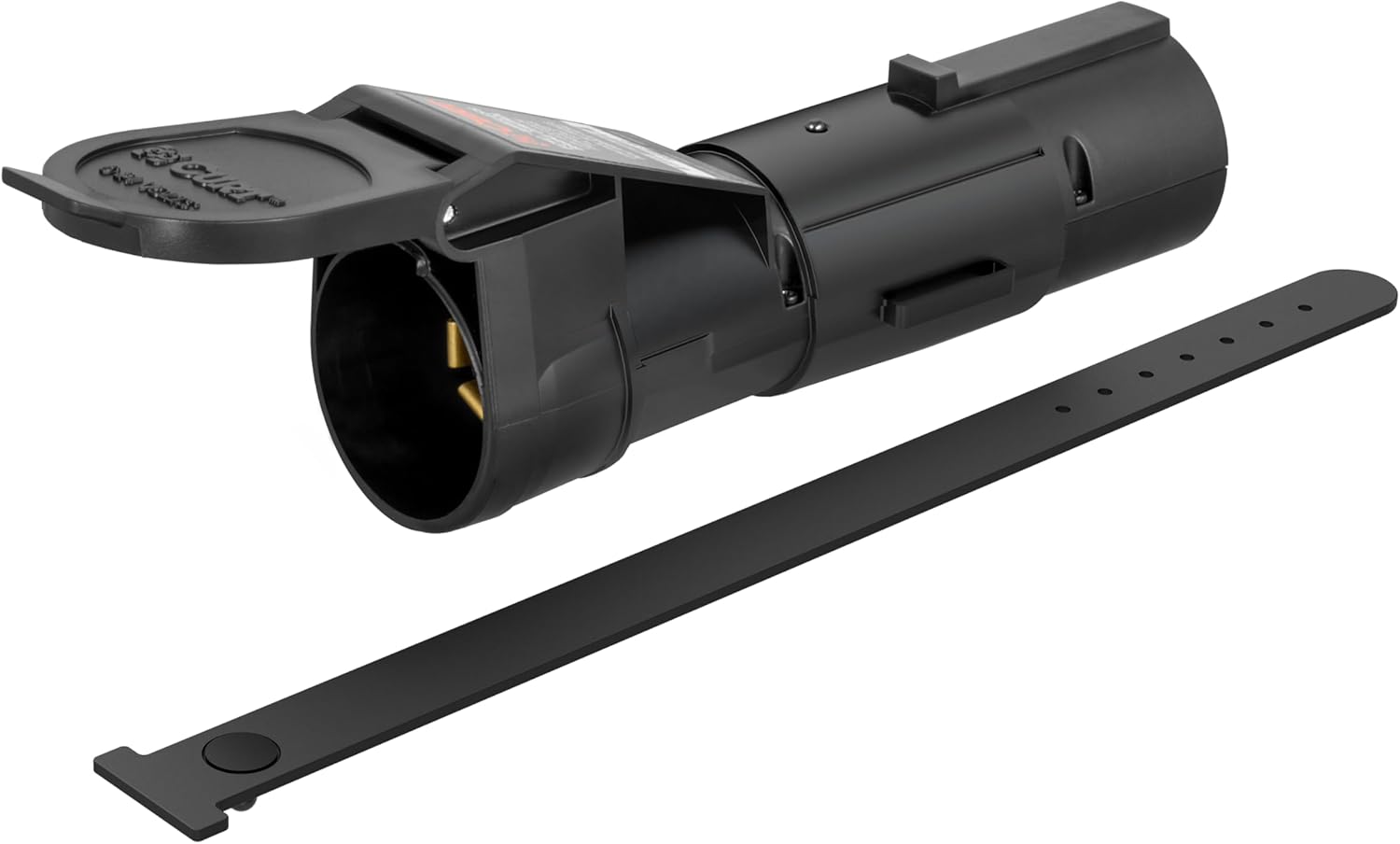
The CURT Echo Mobile is a plug-and-play, portable trailer brake controller that connects to your Dodge Journey through the vehicle 7-way RV blade and is controlled via a smartphone app. It uses a triple-axis accelerometer for proportional braking, automatic calibration to simplify setup, and allows manual activation and tuning from the OneControl Auto app on iOS or Android. For a Journey owner this avoids under-dash installation work and gives a quick way to move the controller between vehicles. The rugged potted enclosure and retention strap help protect the electronics from moisture and vibration, while app profiles let you save settings for different trailers. Practical limitations include reliance on a phone for configuration and occasional Bluetooth connectivity quirks reported by users, plus the unit projects from the 7-way and can be exposed to road impacts or strain in low-mounted sockets. Also it requires a properly wired auxiliary power feed to the 7-way for full operation. For performance-focused owners the Echo delivers proportional braking and fine-tunable settings without permanent wiring, but keep mounting and phone pairing best practices in mind.
Best for: Performance-oriented owners who prioritize responsive, adjustable proportional braking and want a noninvasive, transferable solution for towing with a Dodge Journey.
Less Ideal for: Drivers who prefer a permanently mounted in-cab controller or those who cannot reliably run a dedicated auxiliary power line to the 7-way should consider a hardwired under-dash option instead.
- Plug-and-play portable design that transfers between vehicles using the Dodge Journey 7-way
- Bluetooth app control for on-the-fly adjustment and multiple towing profiles
- Triple-axis accelerometer for smooth proportional braking and automatic calibration
- Potted, weather-resistant enclosure and retention strap for improved durability
- Projects from the 7-way connector and can be vulnerable to impacts or loosen over rough roads
- Depends on smartphone Bluetooth connection for configuration and live monitoring
Verdict: For Dodge Journey owners seeking a high-performance, noninvasive proportional controller, the CURT Echo Mobile delivers tunable, smartphone-controlled braking you can move between vehicles.
3. CURT Venturer NEXT Electric Trailer Brake Controller (Time-Delay, Low Profile)

| Controls | Up to 6 brakes (1-3 axles) |
|---|---|
| System compatibility | 12-volt vehicle systems |
| Display | LED ramp indicator with adjustable brightness |
| Operation type | Time-delay (fully adjustable power and ramp) |
The CURT Venturer NEXT is a slim, time-delay brake controller designed to operate electric trailer brakes from inside the Dodge Journey cabin. It mounts with a low-profile bracket to save dash space and controls up to six brakes (1 to 3 axles) with fully adjustable power and ramp time so you can match braking feel to different trailers. LED indicators show ramp progress and brightness is adjustable for day or night use. Setup is straightforward since there are no internal moving parts and the unit can be installed at any angle; many owners use a manufacturer wiring harness for simple plug-and-play hookup. In practical terms the Venturer NEXT is a budget-friendly way to add dependable trailer braking without a complex installation or advanced proportional sensing. Limitations to consider are that it is a time-based controller rather than proportional, so braking response will not mirror the Dodge Journey deceleration as closely as a proportional unit, and you may need to fine-tune gain settings for different trailer loads.
Best for: Practical optimizers who want a reliable, easy-to-install brake controller for occasional to regular towing with a Dodge Journey and prioritize straightforward setup and value over feature-rich proportional control.
Less Ideal for: Drivers who tow frequently with heavy trailers or need the most natural, vehicle-matched braking response should consider a proportional controller instead.
- Low-profile design conserves dash space and includes a mounting bracket for clearance
- Fully adjustable power and ramp time let you tune braking for different trailers
- Controls up to six brakes (1 to 3 axles), covering common small-to-medium trailers
- LED ramp indicators with adjustable brightness for easy monitoring day or night
- Time-delay operation does not provide the same real-time proportional braking feel as proportional controllers
- Requires manual adjustment of gain/load when towing different trailers for optimal performance
Verdict: A compact, budget-friendly time-delay controller that gives Dodge Journey owners easy installation and tunable braking but lacks proportional sensing for the most natural brake feel.
4. briidea BR-122 Proportional Trailer Brake Controller

| Axle support | 1 to 4 braked axles (2–8 brakes) |
|---|---|
| Display | LED/LCD digital display |
| Safety features | Over-current, short-circuit protection and fault detection |
| Controls | Boost button and manual override switch |
The briidea BR-122 is a budget-friendly proportional trailer brake controller designed to match trailer braking to your vehicle's deceleration. It mounts under the dash and uses motion sensors to apply braking force automatically, with a boost button to increase output for heavier trailers and an LED/LCD display that shows output and settings. Installation is intended to be straightforward using the included plug-and-play wiring port and mounting bracket, though some users report the supplied connector and hardware feel cheap and can make lining up pins fiddly. In use the controller delivers smoother, more balanced stops than time-delayed units and the manual override switch gives easy on-the-fly control from the driver's seat. Safety features include over-current and short-circuit protection and basic fault detection. Expect a competent, low-cost controller that improves tow stability but may show lower build refinement and occasional connector quality issues compared with higher-end factory-quality units.
Best for: Budget-conscious owners looking for a proportional controller that upgrades towing safety without a large investment and who prioritize value over premium fit and finish.
Less Ideal for: Drivers who need a rugged, professional-grade controller for constant commercial use or who require the highest-quality connectors and finish should consider more durable, higher-end alternatives.
- Proportional braking with motion-sensor control for smoother, vehicle-matched stops
- Boost function to increase braking force for heavier trailers or different weight distributions
- Plug-and-play wiring port and included mounting bracket speed up installation
- Clear LED/LCD display and manual override switch for easy monitoring and control
- Built-in protections including over-current and short-circuit detection
- Connector and some supplied hardware are cheaply made and can complicate installation
- Feels plasticky compared with premium brake controllers
Verdict: A cost-conscious proportional controller that noticeably improves trailer braking for Dodge Journey owners but compromises on connector and build quality compared with premium units.
5. Tekonsha Brakeman IV Time-Delay Trailer Brake Controller

| Compatibility | Works with 1-4 axle trailers |
|---|---|
| Brake type | Electric and electric-over-hydraulic |
| Installation | Plug & Play port; vehicle-specific harness sold separately |
| Controls | Power, sync, manual override with digital display |
The Tekonsha Brakeman IV is a time-based trailer brake controller designed for basic, light-duty towing. It senses vehicle braking and produces a ramped output that increases at a fixed rate, with front-panel controls to set overall power, sync/aggressiveness, and a manual override lever for immediate trailer braking. The unit supports 1–4 axle trailers and works with electric and electric-over-hydraulic systems. Installation is straightforward for vehicles with a compatible wiring harness because it includes a Plug & Play port and necessary mounting hardware, and the compact shape allows mounting above or below the dash. A digital display provides real-time diagnostics and short-circuit protection, helping identify connection issues. Because it is time-delay rather than proportional, it does not match braking intensity precisely to vehicle deceleration, so it is best for straightforward towing rather than precision braking setups. Some users have reported early failures on certain vehicles, so expect to verify compatibility and monitor initial performance after installation on a Dodge Journey.
Best for: A reliability-focused buyer who needs a straightforward, proven brake controller for routine towing with a Dodge Journey and values simple installation and clear diagnostics.
Less Ideal for: Drivers who tow heavy loads frequently or need precise proportional braking response should consider a proportional controller instead.
- Simple plug-and-play installation when paired with a vehicle-specific wiring harness
- Digital display with real-time diagnostics and short-circuit protection
- Manual override lever for immediate trailer braking control
- Compact design that can be mounted above or below the dash
- Supports 1–4 axle trailers and both electric and electric-over-hydraulic brakes
- Time-delay control does not provide proportional braking that mirrors vehicle deceleration
- A small number of users report early defects or vehicle-specific electrical conflicts
Verdict: A dependable, easy-to-install time-delay controller that’s well suited to routine towing with a Dodge Journey but not for users who require proportional braking performance.
6. Pro Series POD Time-Delay Trailer Brake Controller (Tekonsha Pro Series 80500)
| Manufacturer | Pro Series |
|---|---|
| Brand | Tekonsha |
| Model | 80500 |
| Voltage | 12 Volts |
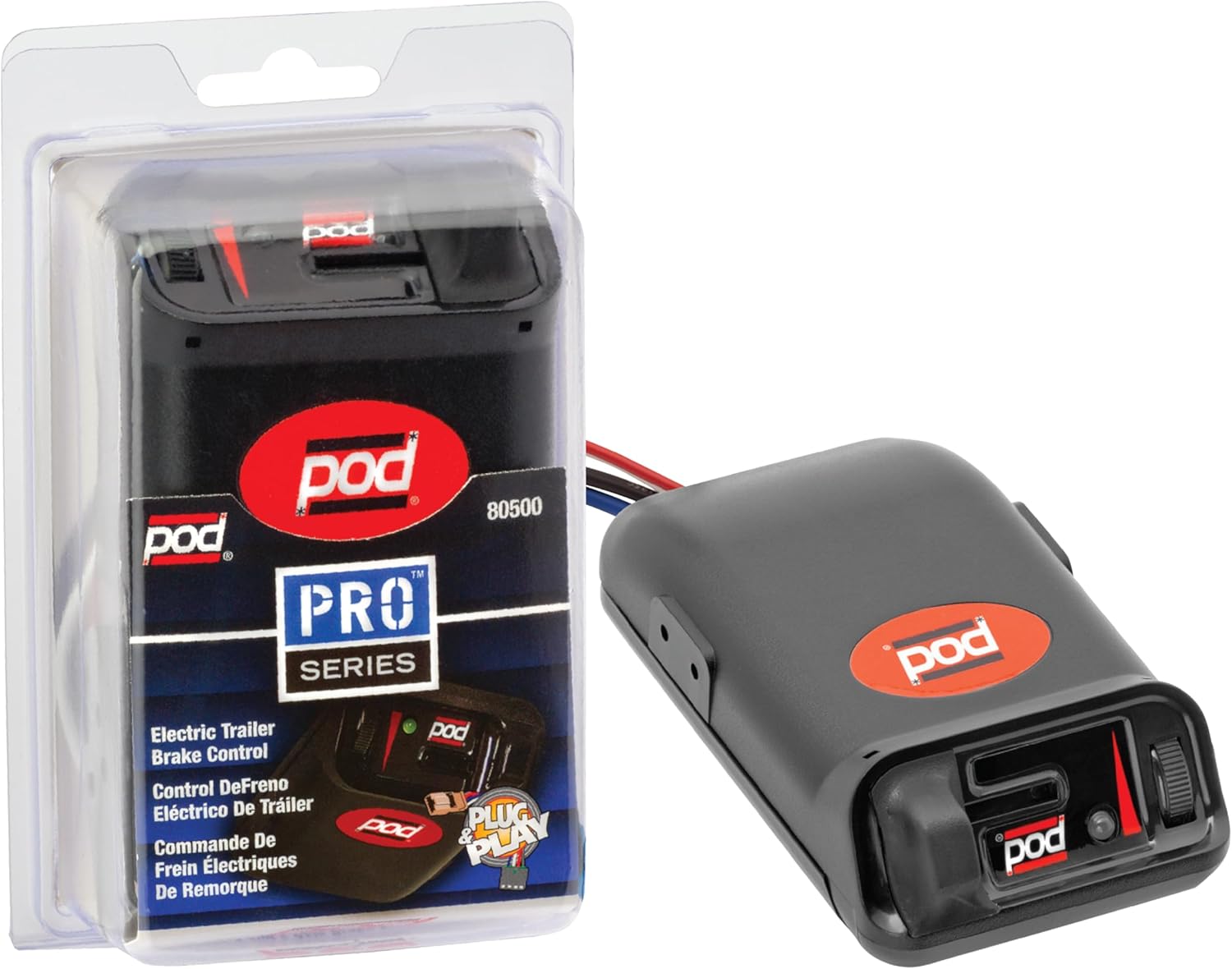
The Pro Series POD (Tekonsha 80500) is a simple time-delay trailer brake controller intended for light-duty towing and occasional use. It connects to your vehicle wiring for quick installation and uses a two-digit LED display to show power output and diagnostics while a manual lever lets you apply the trailer brakes independently. Because it is time-based, the unit can be mounted in any orientation and works with 1–2 axle trailers. Practical benefits include easy set up with a vehicle-specific wiring harness, clear visual feedback for adjusting braking power, and built-in circuit protection against short or ground faults. The main limitation is that it is not a proportional controller, so braking ramps at a fixed rate rather than matching tow vehicle deceleration which can feel less smooth on steep grades or with heavier trailers. Some buyers report occasional quality-control issues such as missing hardware or dead units, so check the unit before permanent installation. For light towing where convenience and straightforward controls matter, the POD delivers a dependable, no-frills solution.
Best for: Convenience-driven buyers who prioritize easy installation and straightforward controls for occasional, light towing with a Dodge Journey. Ideal for owners who want a quick, low-complexity solution they can set and forget.
Less Ideal for: Drivers who regularly tow heavy loads, need smoother proportional braking on steep or winding roads, or who demand the most refined trailer brake modulation should consider a proportional controller instead.
- Plug-and-play wiring reduces installation time with a vehicle-specific harness
- Large two-digit LED display provides clear output and diagnostic info
- Manual override lets driver apply trailer brakes independently
- Time-delay design allows mounting in any direction and simple configuration
- Built-in short-circuit and ground-fault protection improves electrical reliability
- Time-delay operation is not proportional so braking does not mirror tow vehicle deceleration
- Designed for light-duty towing only and not ideal for heavy trailers
- Some users report occasional missing screws or dead units indicating variable quality control
Verdict: A budget-friendly, easy-to-install time-delay controller that suits Dodge Journey owners who want convenient, basic trailer braking but not the modulation of a proportional unit.
7. CURT TriFlex NEXT Proportional Inertia Electric Trailer Brake Controller

| Model | TriFlex NEXT |
|---|---|
| Manufacturer | CURT |
| Compatible brakes | 2-8 brakes (1-4 axles) |
| Protection | Reverse polarity and short-circuit |
The CURT TriFlex NEXT is a proportional, motion-sensing electric brake controller that uses a triple-axis accelerometer to modulate trailer braking for smoother stops and improved control on grades. It installs as a low-profile dash unit and is intended for use with a compatible vehicle plug or CURT wiring harness; the display shows full-text diagnostics, battery voltage, and trailer disconnect status while offering day and night brightness modes. Adjustable gain and ramp settings let you tune braking force to match trailer weight and load, while short-circuit and reverse polarity protection add a layer of safety. The unique mounting bracket and slim footprint make it easy to position on the dash at any angle. Some users report intermittent shutdowns or occasional failures, so reliability appears mixed across installations. Also note that a vehicle-specific plug-in harness is recommended but sold separately, which adds steps to a truly plug-and-play setup. For the Dodge Journey this unit provides modern proportional control and clear diagnostics, but expect to confirm plug compatibility or source the correct harness before installation.
Best for: Risk-averse mainstream buyers who prioritize clear diagnostics, modern proportional control, and a conservative approach to towing setup for occasional to regular towing with a Dodge Journey.
Less Ideal for: Buyers who want a fully integrated plug-and-play solution without sourcing additional harnesses or who need an absolute no-risk, failproof controller for heavy daily commercial towing.
- Triple-axis accelerometer provides proportional braking that adapts to inclines and declines for smoother stops
- Slim, low-profile design and flexible bracket allow mounting at any angle with minimal dash intrusion
- Full-text display with diagnostics, voltage and trailer disconnect indicators simplifies setup and troubleshooting
- Adjustable gain and ramp settings let you fine-tune braking to match different trailer loads
- Built-in reverse polarity and short-circuit protection enhance towing safety
- Some reports of intermittent failures or units shutting off that may require returns or troubleshooting
- Requires vehicle-specific wiring harness for easiest installation which is sold separately
- A few users report occasional need to unplug and reconnect to restore operation
Verdict: A modern, compact proportional brake controller with clear diagnostics that suits cautious Dodge Journey owners who want tunable braking, but verify plug compatibility and be aware of some reliability reports.
Choosing the Right Dodge Journey Trailer Brake Controller: Key Factors to Consider
Braking Modulation and Responsiveness
How smoothly a controller applies and releases trailer brakes affects trailer stability and stopping distance. Modulation determines whether braking force ramps up progressively or applies in abrupt steps. A controller with fine-tuned responsiveness reduces trailer sway and prevents wheel lockup on the trailer, especially during emergency stops or on slippery roads.
Consider models that offer adjustable gain or proportional control so braking output can be matched to trailer weight and load distribution. Responsiveness also affects driver confidence when merging, descending hills, or navigating stop-and-go traffic.
Compatibility With Dodge Journey Wiring
Compatibility with the Journey's wiring harness and tow package simplifies installation and reduces the risk of poor connections. Some controllers plug directly into factory connectors while others require splicing into the vehicle harness. Matching the controller to the Journey wiring reduces installation time and prevents faults that could disable the trailer brakes.
Check the required wire colors and circuit functions the controller uses, such as brake output, power, ground, and stop lamp sense. Ensuring the controller integrates cleanly with the Journey electrical system helps maintain vehicle safety systems and avoids unintended warnings or faults.
Installation Complexity and Mounting
Installation complexity affects total setup time and whether professional help is needed. In-cab mount controllers require a secure, accessible location near the driver's line of sight and reach, while under-dash or concealed installs can improve cabin aesthetics but may complicate wiring.
Evaluate how the controller mounts, whether a dash bezel or bracket is included, and if the unit permits simple routing of the wiring harness to the trailer connector. Simpler installation options reduce the chance of loose connections and make future servicing easier.
Control Options and Usability
Controls that are intuitive and easy to reach help the driver adjust braking in real time. Look for clear displays or tactile knobs for gain adjustment, a manual override for immediate braking, and indicators that show status or fault conditions. Usable controls matter when making quick adjustments for changing trailer loads or road conditions.
Visibility at a glance and reachable placement without distraction support safer towing. Controls that allow one-handed operation or quick setup from a preset can be valuable for frequent hook-up situations.
Type of Controller: Proportional Vs Time-Delay
Proportional controllers sense vehicle deceleration and apply trailer brakes in proportion to that movement, producing more natural braking behavior. Time-delay controllers apply a preset amount of braking after a short delay and can be simpler to set up but may not match braking forces as closely in varying conditions.
Consider how you tow: frequent highway miles or varied terrain often benefit from proportional control, while occasional, predictable towing can be managed with time-delay designs. Understand the tradeoff between precision and simplicity when selecting the type.
Durability and Serviceability
A controller will spend years exposed to vibration and temperature changes, so build quality and ease of service matter. Robust housings, reliable connectors, and replacement parts availability reduce long-term downtime. Controllers with sealed electronics resist moisture and corrosion that can affect wiring and contacts.
Also consider how easy it is to access the unit for troubleshooting or replacing fuses. Units that support standard wiring practices and offer clear documentation simplify repairs and extend useful life.
How We Chose the Best Dodge Journey Trailer Brake Controller
We focused on controllers that suit the Dodge Journey and common trailer weights encountered with this vehicle. Key evaluation criteria included braking responsiveness, installation complexity in the Journey cabin and wiring harness compatibility, adjustability of braking force and modulation, physical size and mounting options for in-cab placement, and long-term reliability based on design and common failure modes.We excluded controllers that require extensive vehicle modification, models lacking basic safety features such as gain adjustment or manual override, and units intended only for commercial or heavy-haul vehicles outside the Journey's typical towing range. Our selection prioritized solutions that balance effective stopping power with straightforward trailer brake controller installation and durable wiring practices for everyday towing.
Our full evaluation process is outlined in our review methodology.
FAQ
Do I need a trailer brake controller for my Dodge Journey?
It usually depends on the trailer weight and local regulations. Trailers above a certain gross weight often require an independent braking system, and a controller lets you manage that braking from the cab. Even when not legally required, a controller can improve stopping distances and stability when hauling heavier loads.
What is the difference between proportional and time-delay controllers?
Proportional controllers detect vehicle deceleration and apply proportional braking to the trailer, yielding smoother, more natural stops. Time-delay controllers apply braking after a set delay or at a preset level regardless of vehicle deceleration. Proportional units often offer better modulation, while time-delay units are typically simpler to set up.
How hard is trailer brake controller installation in a Dodge Journey?
Installation difficulty varies by controller type and whether your Journey has a factory tow prep harness. Plug-in units that match existing connectors can be quick, while hardwired installations require routing power, ground, and brake output wires and may take several hours. If you are uncomfortable with vehicle wiring, a professional installation can ensure reliable operation.
Can I mount the controller anywhere in the cabin?
You should mount the controller within easy reach and sight of the driver without obstructing vehicle controls or airbags. Many drivers prefer mounting on the dash or under it in a visible spot. The key is secure attachment, clear access to controls, and routing wiring without pinching or exposing it to wear.
Will the controller affect other vehicle electronics?
A properly installed controller should not interfere with other systems, but incorrect wiring or using the wrong connection points can cause faults or signal issues. Use the correct brake light sense and power circuits and follow wiring best practices to avoid electrical interactions with vehicle lighting or electronic modules.
How should I set the braking power for different trailers?
Start conservatively and increase gain until the trailer brakes supplement vehicle braking without locking the trailer wheels. Adjust for trailer weight, load distribution, and road conditions. Recheck settings after the first few stops and fine-tune as needed for safe, stable performance.
Conclusion
Choosing the right trailer brake controller for a Dodge Journey means balancing braking modulation, installation effort, and control usability. Prioritize a controller that integrates cleanly with the Journey wiring, offers the modulation type that fits your towing style, and provides accessible controls for on-the-road adjustments.Accepting some tradeoffs between setup simplicity and braking precision will help you pick a solution that improves safety and confidence when towing. Focus on compatibility, durable installation, and the control features that matter most for how and where you tow.
Explore More:
- Check out all Dodge Journey parts & accessories
- Explore Electronics
- Browse all Accessories
