

Note: This article contains affiliate links. If you click on these links and make a purchase, I may earn a small commission at no extra cost to you. This helps support my research and content. Read my full affiliate disclosure here.
Towing with a Honda Ridgeline places specific demands on brake control. The right trailer brake controller improves stopping consistency, reduces trailer sag and sway, and makes everyday towing more predictable. Whether you tow a small utility trailer or a heavier load, choosing a controller that matches the Ridgeline's electrical setup and your towing style matters.This guide shortlists six top-rated trailer brake controllers compatible with 2017-present Ridgeline models and explains the decision factors we used. We focus on braking performance, installation effort, and driver convenience to help you pick the best option for how and where you tow.
Looking for other parts? See all Honda Ridgeline parts & accessories.
Top Picks at a Glance
| Best Overall Trailer Brake Controller Top-performing controller for smooth, reliable braking across common towing setups | Tekonsha Brake-EVN Proportional Trailer Brake Controller |  |
| Best Budget Trailer Brake Controller Low-cost controller that delivers basic, safe braking without extra features | Timilge Proportional Trailer Brake Controller (Fits 1–4 Axles) |  |
| Best Bluetooth Trailer Brake Controller Wireless controllers with smartphone apps for setup, diagnostics, and trailer profiles | CURT Echo 51180 Mobile Bluetooth Trailer Brake Controller (Proportional) |  |
| Best Low-Profile Dash-Mount Brake Controller Slim, dash-friendly units or knob-style interfaces that save dash space | CURT Spectrum Integrated Electric Trailer Brake Controller (Proportional) |  |
| Best Time-Delay Trailer Brake Controller Simple, time-based controllers that ramp braking power over a preset interval | REESE Towpower Brakeman IV Time-Delay Trailer Brake Controller |  |
| Best Multi‑Axle / Heavy‑Duty Brake Controller Units rated for more brakes/axles and higher loads for heavier trailers | REDARC Tow-Pro Elite Electric Trailer Brake Controller |  |
1. Tekonsha Brake-EVN Proportional Trailer Brake Controller
Best Overall Trailer Brake Controller

| Model | 8508220 |
|---|---|
| Compatible axles | 1-4 axles |
| Display | Digital LED |
| Warranty | Five-year limited |
The Tekonsha Brake-EVN is a proportional trailer brake controller designed to give predictable, smooth stops for typical towing chores. It uses an internal inertia sensor to apply trailer braking in proportion to how hard you press the truck brakes, and a digital LED display shows power output and diagnostics. Installation is simplified by a plug-and-play connector for vehicle-specific harnesses and the unit includes mounting hardware. Controls include arrow buttons for adjusting power, a three-level boost feature for heavier loads, and a manual lever for immediate brake application when needed. Practical benefits are consistent, automatic braking response that reduces trailer sway and driver workload, plus a compact footprint that mounts within easy reach. Limitations are that the vehicle-specific wiring harness is sold separately and advanced users wanting smartphone integration or wireless setup will find those features absent here.
Best for: DIY mechanics who tow with a Ridgeline and want a dependable, easy-to-install controller that balances automated proportional braking and manual control for everyday trailer loads.
Less Ideal for: Buyers who need wireless app control or factory-integrated telematics should consider a more connected model instead.
- Proportional braking via internal inertia sensor for smooth, responsive stops
- Digital LED display provides clear real-time diagnostics and settings
- Boost feature offers three levels of extra braking power for heavier trailers
- Plug-and-play connector and included mounting hardware speed installation
- Vehicle-specific plug-in wiring harness is not included
- No smartphone app or wireless configuration options
Verdict: The all-around pick for DIY mechanics who want the best mix of braking performance, features, and dependable stops with typical trailer loads.
2. Timilge Proportional Trailer Brake Controller (Fits 1–4 Axles)
Best Budget Trailer Brake Controller

| Model | BC06 |
|---|---|
| Manufacturer | Timilge |
| Brake type supported | Proportional electric |
| Axles supported | 1 to 4 axles |
| Display | LED digital voltage display |
This Timilge proportional brake controller is a budget-minded unit that brings vehicle-sensing braking to occasional tow users. It automatically senses your tow vehicle's deceleration and applies braking power to the trailer in proportion, which helps smooth stops and reduces wear compared with time-delay controllers. The LED digital display shows voltage output in real time so you can monitor and fine-tune settings while towing. It supports 1 to 4 axle trailers and includes clearly labeled wiring leads and ports for quicker plug-in installation with vehicle-specific harnesses. On the downside it is a basic controller aimed at light to moderate towing rather than heavy commercial use, so it lacks advanced tuning options and premium build features found on higher-end units. For drivers who tow intermittently and want a straightforward proportional controller that is easy to install and operate, this is a practical, value-focused choice.
Best for: Drivers who tow occasionally and prioritize an easy-to-install, dependable proportional controller on a tight budget rather than professional-grade features.
Less Ideal for: Frequent heavy haulers or users who need advanced tuning, wireless integration, or premium build materials should consider higher-end controllers.
- Proportional braking for smoother, more responsive trailer stops
- LED digital display shows real-time voltage output for on-the-fly adjustments
- Supports 1 to 4 axle trailers, covering most small to medium trailers
- Plug-in wiring ports simplify installation with vehicle-specific harnesses
- Basic feature set with limited advanced tuning and refinement compared with premium controllers
Verdict: A wallet-friendly option for owners who tow occasionally and need a straightforward, dependable controller without advanced bells and whistles.
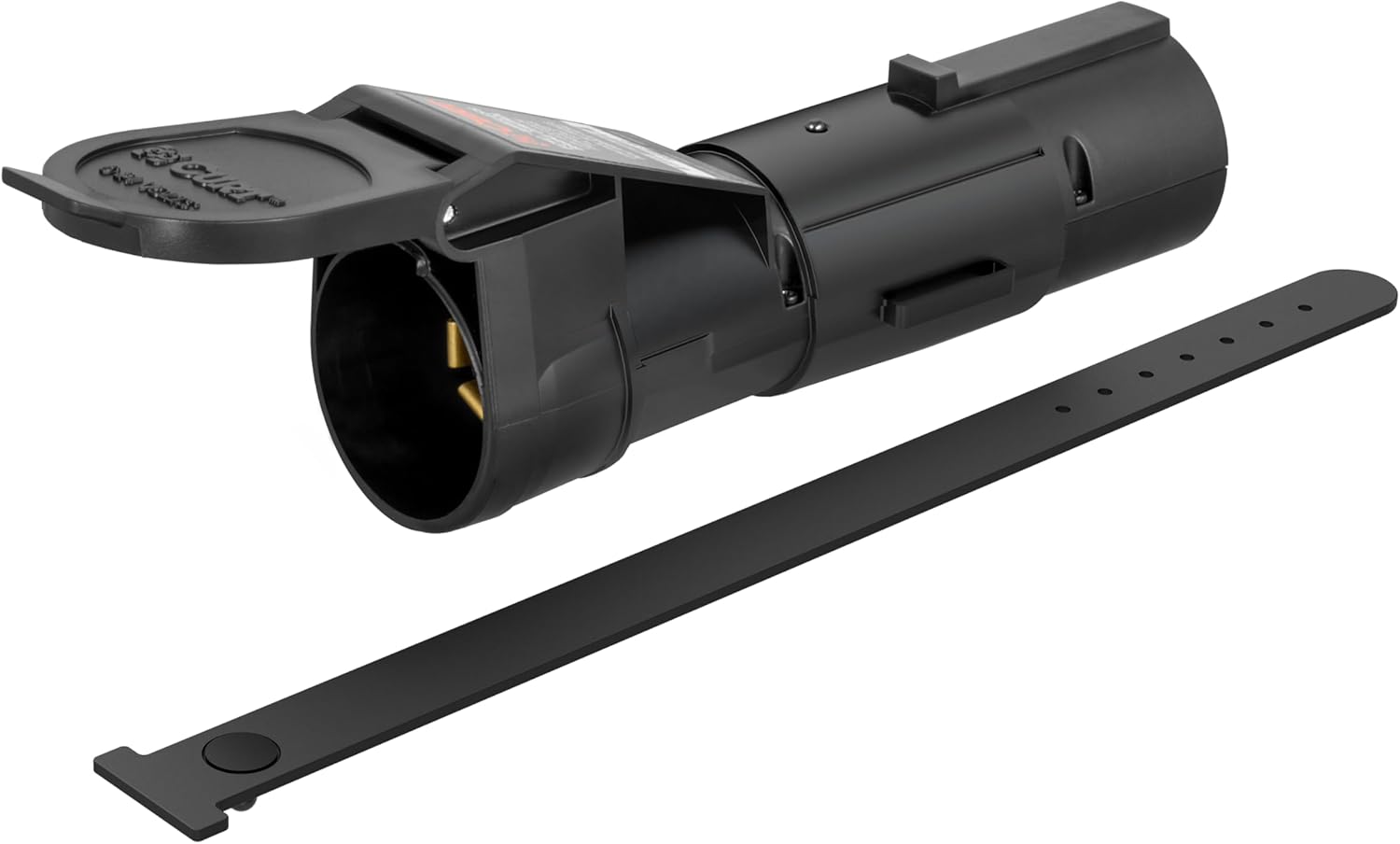
3. CURT Echo 51180 Mobile Bluetooth Trailer Brake Controller (Proportional)
Best Bluetooth Trailer Brake Controller
| Model number | 51180 |
|---|---|
| Connection | 7-way RV blade plug |
| Control | Bluetooth smartphone app |
| Brake type | Proportional, triple-axis accelerometer |
| Compatibility | Works with 1–2 axles (2–4 brakes), ABS and cruise control |
The CURT Echo mobile is a plug-and-play Bluetooth trailer brake controller designed to sit between your truck and trailer on the 7-way RV connector and let you configure and activate trailer brakes from your phone. For a Ridgeline owner who tows occasionally and prefers tuning from an app, Echo offers quick installation with no dash wiring, a rugged potted enclosure for weather resistance, and a triple-axis accelerometer for smooth, hill-aware braking. The OneControl Auto app lets you create vehicle-trailer profiles, adjust maximum output and sensitivity, and trigger the brakes manually when needed. Because the unit is portable it is easy to move between a Ridgeline and another tow vehicle without permanent installation. Limitations include dependence on a smartphone and Bluetooth connectivity for full functionality and the need to keep the Echo plugged into the 7-way while towing, which may be less tidy than an under-dash or in-line mount. Cruise control and ABS compatibility plus built-in electrical protection make it a practical, modern alternative to traditional dash-mounted controllers for tech-focused DIY owners.
Best for: Tech-minded DIY owners who want wireless, app-based control of trailer braking and the ability to move a single controller between vehicles without permanent wiring.
Less Ideal for: Buyers who prefer a permanent in-cab controller, need a hidden under-vehicle installation, or who do not want to rely on a phone for brake configuration.
- True plug-and-play portable design for easy transfer between vehicles
- Bluetooth app control lets you tune sensitivity, maximum output, and save towing profiles
- Triple-axis accelerometer provides responsive proportional braking on slopes
- Rugged potted enclosure and retention strap on the 7-way plug for weather and vibration resistance
- Compatible with cruise control and ABS and includes reverse-polarity and short-circuit protection
- Requires a smartphone and Bluetooth for full configuration and manual control
Verdict: For tech-minded DIYers who prefer app control and wireless setup so they can tune and monitor braking from a phone instead of fiddling with dash controls.
4. CURT Spectrum Integrated Electric Trailer Brake Controller (Proportional)
Best Low-Profile Dash-Mount Brake Controller

| Brand | CURT |
|---|---|
| Model | Spectrum (51170) |
| Special Feature | Easy to Install |
| Included Components | Spectrum |
The CURT Spectrum is a dash‑mounted proportional brake controller designed to stay visually unobtrusive while delivering responsive trailer braking. The unit separates the main module, which mounts behind the dash, from a small rotary knob with a push button and multicolor LEDs that you install wherever dash space is tight. It uses a triple‑axis accelerometer to sense vehicle motion and apply trailer braking smoothly on grades and during stops, and the rotary control lets you make manual adjustments or overrides on the fly. Installation is simplified by vehicle‑specific quick‑plug harnesses and automated leveling and calibration features, so mounting in a Ridgeline dash pocket or near existing controls is straightforward. The main compromises are that advanced diagnostics or large displays are absent because of the low‑profile interface, and full functionality depends on using the correct vehicle harness for fitment. For drivers prioritizing a clean, factory‑like dash appearance and reliable proportional braking, the Spectrum balances discretion and performance effectively.
Best for: Drivers who want a discreet, factory‑looking controller that fits into small dash spaces and still gives smooth proportional braking control for routine towing with the Ridgeline.
Less Ideal for: Users who need detailed on‑screen diagnostics, multiple trailer profiles, or a full‑size control head with a large display should consider alternatives.
- Low‑profile rotary knob that mounts neatly on the dash to preserve factory appearance
- Hidden main module allows installation out of sight for a clean dash layout
- Triple‑axis accelerometer provides smooth, grade‑compensated proportional braking
- Quick‑plug vehicle harnesses and automated leveling speed up installation
- Push‑button manual override and multicolor LEDs give easy, at‑a‑glance status and adjustment
- No large display or advanced onboard diagnostics due to the compact interface
Verdict: Ideal for drivers who want a compact, unobtrusive controller that mounts cleanly in tight dash areas while still giving reliable control.
5. REESE Towpower Brakeman IV Time-Delay Trailer Brake Controller
Best Time-Delay Trailer Brake Controller

| Compatibility | 1–4 axles (2,4,6,8 brakes) |
|---|---|
| Power system | 12-volt negative ground only |
| Controls | Output and sync push-button adjustments |
| Display | Bright LED/digital indicator |
The REESE Towpower Brakeman IV is a straightforward time-delay brake controller designed for light or occasional towing. It mounts in any orientation and connects via a vehicle-specific plug-and-play harness, making installation quick when paired with the correct wiring kit. Two push-button controls let you set output (how much braking power) and sync (how quickly the power ramps), and a bright LED/Digital display shows the settings and warns of overloads or shorts. The unit uses a voltage-sensing circuit for smoother activation across city and highway speeds and includes internal circuit protection for reliability. As a time-delayed controller, it applies braking power at a fixed ramp rate rather than reacting to vehicle deceleration, so it is forgiving when towing mixed loads but cannot adapt dynamically to braking events the way proportional units do. For simple towing with varied trailers the Brakeman IV is easy to use and dependable, but drivers looking for the most responsive, trailer-sensing control will want a proportional design instead.
Best for: Buyers who tow occasionally with light trailers and want a simple, easy-to-install controller that is forgiving across different loads and driving styles.
Less Ideal for: Drivers who tow frequently with heavy loads or need the most responsive, real-time trailer braking should consider a proportional controller instead.
- Compact, mounts in any orientation for flexible dash placement
- Plug-and-play compatibility with vehicle-specific wiring harnesses simplifies installation
- Separate output and sync controls allow tuning for different trailer weights and driver preference
- Clear LED/digital display provides readable feedback and fault indication
- Solid-state design with internal circuit protection enhances durability
- Time-delay operation cannot match the responsiveness of proportional controllers in dynamic braking situations
Verdict: A practical choice for light or occasional towing when you prefer a simpler time-delay unit that’s easy to set and forgiving for varied loads.
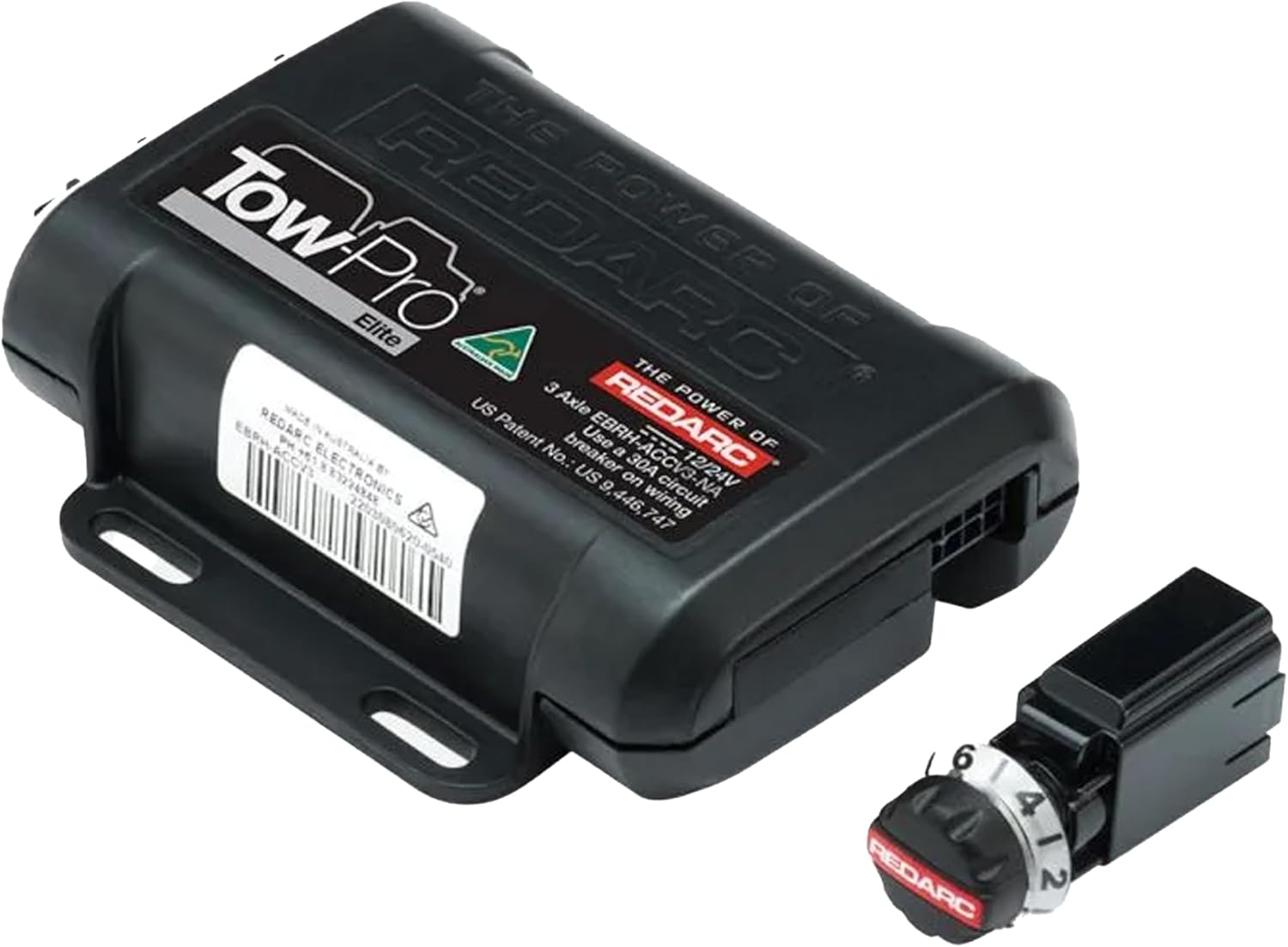
6. REDARC Tow-Pro Elite Electric Trailer Brake Controller
Best Multi‑Axle / Heavy‑Duty Brake Controller
| Axles supported | 1–3 axles |
|---|---|
| Voltage | 12V/24V compatible |
| Model number | EBRH-ACCV3-NA |
| Includes | Remote head, harness, main unit wires and universal mount |
The REDARC Tow-Pro Elite is a versatile in-dash brake controller that delivers proportional braking for smooth on-road stops and a user-controlled mode for precise low-speed or off-road maneuvers. It installs with the supplied remote head, harness and universal mount for a factory-style fit and supports 1 to 3 axle trailers, which suits heavier trailers that need multiple-axle braking management. Notable features include an easy-to-use dash dial, active calibration so the unit adapts without frequent reprogramming, and built-in sway control to help maintain stability while towing. The compact remote head keeps the dash tidy while the main unit wires and connector are sized for discreet installation. Practical benefits are consistent, predictable braking across a range of loads and the ability to fine-tune response when crawling or backing. Limitations are that full plug-and-play fitment still may require dash trimming or wiring routing on some vehicles and professional installation may be preferable for complex factory wiring or electronic stability systems integration.
Best for: DIY-minded haulers who tow larger, multi-axle trailers and want a rugged controller that manages heavier braking loads while allowing on-the-fly adjustment and a tidy dash installation.
Less Ideal for: Buyers seeking a fully vehicle-specific OEM replacement that requires no wiring changes or those unwilling to handle wiring or professional install for complex factory systems.
- Proportional and user-controlled modes for both smooth highway braking and precise low-speed control
- Supports 1 to 3 axle trailers for multi-axle braking demands
- Compact remote head and universal mount for near factory-style dash integration
- Active calibration and sway control improve stability and reduce setup fiddling
- Designed and tested for heavy-duty conditions, offering durable real-world performance
- May require vehicle-specific wiring routing or minor dash modification for clean install
- Not explicitly vehicle-specific so some integrations with advanced factory towing electronics could need professional assistance
Verdict: For DIY mechanics who haul larger trailers and need a controller built to manage multiple axles and heavier braking demands reliably.
Choosing the Right 2026 Honda Ridgeline Trailer Brake Controller: Key Factors to Consider
Control Mode
Control mode determines how the controller applies power to trailer brakes and shapes braking feel. Proportional controllers sense the truck's deceleration and apply a matching rate of braking to the trailer, which reduces jarring and helps maintain stable vehicle-trailer separation.
Time-delayed or user-rated controllers apply a preset level of braking after a delay. They are simpler to set up and can be effective when trailer weight is consistent, but they require manual tuning to prevent either insufficient braking or premature lockup. For the Ridgeline you should weigh whether you need seamless modulation for mixed loads or a straightforward timed unit for predictable, repeatable setups.
Electrical Compatibility
Electrical compatibility is key to a reliable installation on the Ridgeline. Some controllers plug into an existing factory tow connector or integrate with an aftermarket wiring harness; others require hardwiring to vehicle circuits. Ensuring the controller matches the Ridgeline's 12V accessory power, ground, brake output, and reverse-light circuits avoids blown fuses and erratic operation.
Verify whether the controller needs a dedicated power feed, fused connection, or a specific brake-light feed. Also consider the quality of included wiring and connectors, since poor connections are a common cause of intermittent braking issues on trailers.
Installation Complexity
Installation complexity affects cost, time, and whether you can install the controller yourself. Some controllers offer simple dash- or under-dash mounting with a four-pin plug or quick-connect, while others require splicing into the Ridgeline's brake switch or running a power cable to the battery.
If you prefer a DIY install, choose units with clear wiring diagrams and plug-and-play harnesses compatible with the Ridgeline. If your truck lacks a factory tow module, plan for extra time or professional installation to ensure clean routing and secure mounting.
Driver Interface and Accessibility
How and where the controller mounts affects how quickly you can adjust braking on the road. In-cab controllers with large knobs, clearly marked buttons, or an easy-to-read digital display allow you to fine-tune gain and sensitivity without removing attention from driving.
Consider whether you want a compact head unit hidden under the dash or a more prominent dash-mounted controller. Manual override controls are crucial for emergencies, so make sure the controller's override is reachable from the driver's seat.
Trailer Brake Type and Compatibility
Know whether your trailer uses electric drum brakes or electric-over-hydraulic systems, and confirm the controller supports that type. Most controllers are designed for electric drum brakes; electric-over-hydraulic setups often require a controller that can trigger a pump or interface with a hydraulic actuator.
Matching the controller output characteristics to the trailer brake hardware helps avoid sluggish response or overdriving the actuator. On the Ridgeline, give extra consideration to heavier trailers where actuator responsiveness and sustained braking heat can be a factor.
Durability and Weather Resistance
Trailer brake controllers are exposed to vibration, temperature swings, and occasional moisture during service. Units with robust housings, sealed connectors, and corrosion-resistant terminals will last longer and maintain consistent performance on the Ridgeline.
Assess build quality and mounting stability. Components that rattle or loose connectors can cause intermittent braking. A controller rated for automotive environments reduces the chance of failure during long highway pulls or in wet conditions.
Installation Tips for the Ridgeline
Plan the wiring route before starting to avoid interference with airbags, steering column components, and HVAC ducts. Typical installations require a fused power connection, a reliable ground, a brake-output run to the trailer connector, and, for some units, a reverse-light sense or brake-light input.
If your Ridgeline has a factory tow wiring block, use a harness that mates to that connector to avoid splicing. For hardwire installs, use ring terminals on the battery feed and secure all runs with zip ties and protective loom to prevent chafing. Test the controller and trailer brakes at low speed in a safe area before heading onto busy roads.
- Mount the head unit within easy reach of the driver but out of the way of pedals and shifters
- Use an inline fuse near the battery for any direct power runs
- Label wires during installation to simplify future troubleshooting
- Use dielectric grease on exposed connectors to resist corrosion
Tuning and Initial Setup
Start with conservative gain settings and perform low-speed brake tests with a light load to gauge response. Gradually increase gain until the trailer brakes assist deceleration without inducing wheel lock or trailer push.
For proportional controllers, perform a calibration or learning cycle if provided. For time-delayed units, set the timing and intensity to match a typical trailer weight you tow most often. Recheck settings after a loaded trip and adjust for changes in trailer mass or road conditions.
- Test on a quiet road at 20 to 30 mph to evaluate initial stopping
- Make small, incremental adjustments rather than large jumps
- Verify manual override fully activates the trailer brakes independently of controller settings
Maintenance and Troubleshooting
Regularly inspect wiring to the trailer connector and controller for corrosion, loose terminals, or broken insulation. Clean and tighten ground connections at the chassis, as poor grounds are a frequent cause of inconsistent brake output.
If the trailer brakes are weak or dead, check fuses, the controller's status LED or error codes, and continuity on the brake-output circuit. Swap the trailer to a known-good controller or use a multimeter to trace voltage under braking to isolate the issue.
- Check wiring after winter or exposure to salt and road spray
- Replace frayed wires and secure loose loom clips
- Refer to error codes or diagnostics in the controller manual for guided fixes
Choosing Between Proportional and Time-Delayed Units
Proportional controllers are generally better for mixed or variable loads because they match trailer braking to actual deceleration. This yields smoother stops and less trailer sway when road or load conditions change.
Time-delayed units can be simpler and predictable for steady, repeatable towing conditions such as hauling the same trailer at the same weight. They may also be easier to install and adjust for DIYers who prioritize straightforward setup over adaptive modulation.
- Choose proportional when you tow different trailers or frequently change loads
- Choose time-delayed if you tow a consistent load and prefer simple controls
- Consider driver comfort and available budget alongside towing needs
Wiring and Connector Notes Specific to the Ridgeline
The Ridgeline's tow-friendly wiring layout often includes dedicated circuits and accessible mounting points in the bed and under-dash. Identify the factory tow connector or pinout before choosing a controller to determine whether you need a plug-and-play harness or a hardwired solution.
When adding a controller, protect the wiring runs that pass through the firewall with grommets and route battery feeds along existing harness paths when possible. Keep controller wiring separate from high-current circuits to reduce electrical noise and false inputs.
- Use factory grounds when available to ensure reliable return paths
- Secure any underbody runs with clamps using existing holes to avoid drilling
- Confirm trailer connector pin assignments after installation with a tester
Still looking for the perfect fit?
Select your Honda Ridgeline configuration to see the most relevant Trailer Brake Controllers recommendations
How We Chose the Best 2026 Honda Ridgeline Trailer Brake Controller
We evaluated candidates using criteria that reflect real-world towing with the Honda Ridgeline. First, braking performance: we prioritized controllers with adjustable braking force and consistent activation to match the truck's stopping characteristics under varying loads. Second, installation compatibility: units that integrate cleanly with the Ridgeline's factory tow wiring or with straightforward wiring adapters received higher marks. Third, control mode: proportional controllers that modulate based on deceleration were favored for smoother trailer response, while time-delayed units were considered where simplicity and reliability mattered. Fourth, driver controls and ergonomics: we looked for in-cab accessibility, clear displays, and simple manual override features to make on-road adjustments easy. Fifth, reliability and build quality: durable connectors, solid housing, and corrosion-resistant terminals were part of the evaluation.We excluded units that require significant vehicle modifications, obscure wiring hacks, or that lack documented compatibility with the Ridgeline electrical footprint. The result is a practical list focused on dependable braking behavior, straightforward installation, and better driver control for Ridgeline owners.
Our full evaluation process is outlined in our review methodology.
FAQ
Do I need a trailer brake controller for towing with my Ridgeline?
It depends on trailer weight and local regulations. Many regions require a controller above certain trailer weights. Even where not required, a controller improves stopping consistency and reduces wear on the truck brakes when towing moderate to heavy loads.
Can I install a controller myself in a 2017-present Ridgeline?
Many Ridgeline owners can perform installation with basic tools if a plug-and-play harness exists. Hardwiring to battery and brake switch requires electrical knowledge. When in doubt, professional installation ensures correct routing and secure connections.
Will a proportional controller prevent trailer sway?
A proportional controller can reduce sway caused by mismatched braking between truck and trailer by delivering smoother, matched braking. However, sway can have other causes such as improper load distribution or tire issues, so braking control is only one part of prevention.
How often should I re-tune the controller settings?
Re-tune whenever trailer weight or packing changes significantly, or after towing different trailers. Also check settings seasonally and after any maintenance that affects brake response so the controller remains matched to real-world conditions.
Are there wiring modifications I should avoid on the Ridgeline?
Avoid splicing into airbag, ABS, or other safety-system circuits. Do not bypass fuse protection. Stick to designated brake switch, battery, and tow connector circuits, or use manufacturer-recommended harnesses to prevent electrical issues.
What signs indicate a controller is not working correctly?
Intermittent braking, blown fuses, error LEDs on the controller, or a lack of voltage at the trailer connector during braking are common indicators. Address wiring and ground connections first, then consult diagnostics or a technician if problems persist.
Final Verdict
Prioritize a controller that matches how you use your Ridgeline. If you haul varying loads or tow heavier trailers, favor a proportional unit for smoother, more adaptive braking. If your towing is consistent and you want simple setup, a time-delayed controller can be effective and easier to install.Focus on electrical compatibility, a dependable installation, and an accessible driver interface when evaluating options. Those tradeoffs will guide you to a controller that improves stopping performance and confidence while towing with your Honda Ridgeline.
Explore More:
- Check out all Honda Ridgeline parts & accessories
- Explore Electronics
- Browse all Accessories
