

Note: This article contains affiliate links. If you click on these links and make a purchase, I may earn a small commission at no extra cost to you. This helps support my research and content. Read my full affiliate disclosure here.
If you tow with a 1997-2004 Dodge Dakota, a dedicated trailer brake controller can meaningfully improve stopping stability and confidence. The right controller reduces trailer sway on heavy stops, helps maintain steering control, and lets you adjust braking balance between truck and trailer for different loads.This guide covers a short list of the top trailer brake controllers suited to the Dakota between 1997 and 2004. Each pick was chosen for real-world factors drivers care about: installation compatibility, braking feel and responsiveness, and driver controls inside the cab. Read on for an overview of what matters and practical setup tips before the product summaries.
Looking for other parts? See all Dodge Dakota parts & accessories.
Top Picks at a Glance
| Best Overall Trailer Brake Controller A well‑rounded, reliable controller that suits most DIY towing needs | Tekonsha Brake-EVN Proportional Trailer Brake Controller |  |
| Best Budget Trailer Brake Controller An affordable, no-frills controller that still meets basic towing safety needs | Gihdfer Brakeman IV Time-Delayed Digital Trailer Brake Controller |  |
| Best Premium Proportional Controller High-end proportional units with refined sensors, boost modes and long warranties | REDARC Tow-Pro Liberty Electric Trailer Brake Controller |  |
| Best Wireless / Portable Controller Portable Bluetooth or removable-head controllers for tool-free install and mobile use | CURT Echo Mobile Bluetooth Trailer Brake Controller (Proportional) |  |
| Best Split‑Display / Remote‑Head Controller Two-piece controllers with a remote display head for flexible mounting options | Kohree Split Electric Trailer Brake Controller with LCD Display | 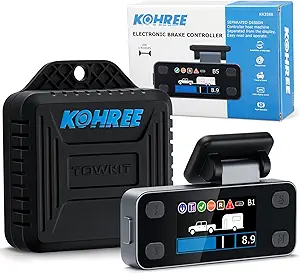 |
| Best Low‑Profile Dash Controller Slim, dash-friendly controllers with small knobs or low-profile mounting hardware | CURT Spectrum Integrated Proportional Trailer Brake Controller |  |
| Best Complete Kit (Includes Wiring Harness) Controllers sold with vehicle-specific plug‑and‑play harnesses and mounting hardware | RIZZ-MAN 90195 Proportional Brake Controller with Wiring Harness |  |
1. Tekonsha Brake-EVN Proportional Trailer Brake Controller
Best Overall Trailer Brake Controller

| Model | 8508220 |
|---|---|
| Axle support | 1-4 axles |
| Display | Digital LED |
| Warranty | Five-year limited |
The Tekonsha Brake-EVN is a proportional trailer brake controller designed for consistent, predictable braking when towing. It senses deceleration with an internal inertia sensor and applies trailer brakes in proportion to how hard you stop, which smooths trailer feedback and reduces jerky stops. Setup is straightforward for DIYers: the unit includes mounting hardware, a plug-and-play port for vehicle-specific harnesses, and arrow buttons plus an LED display for tuning power and monitoring diagnostics. Notable features include a three-step boost for extra braking on heavier loads, a manual override lever for immediate brake application, and a power-save mode to limit battery drain. In real-world use it makes dialing in trailer feel quick and repeatable and the compact housing keeps it accessible from the driver seat. Limitations to note are that the vehicle wiring harness is sold separately and you may need that harness for a clean installation on a 1997-2004 Dodge Dakota; also advanced users who want smartphone configuration or wireless controls will find those features absent.
Best for: A hands-on DIY owner of a 1997-2004 Dodge Dakota who wants a reliable, easy-to-adjust proportional controller that delivers predictable everyday towing performance.
Less Ideal for: Buyers seeking wireless or smartphone-configured brake controllers or those who prefer a fully integrated OEM-style harness included out of the box.
- Proportional braking via internal inertia sensor for smoother, more natural trailer stops
- Digital LED display and arrow buttons make tuning and diagnostics easy from the cab
- Manual override and three-level boost give immediate control and extra stopping power when needed
- Compact design with included mounting hardware fits neatly within reach of the driver
- Vehicle-specific plug-and-play wiring harness is not included and must be purchased separately
- No smartphone app or wireless configuration options for remote tuning
Verdict: The go-to choice for DIY mechanics who want a dependable, easy-to-tune controller with the features and build quality to handle everyday towing.
2. Gihdfer Brakeman IV Time-Delayed Digital Trailer Brake Controller
Best Budget Trailer Brake Controller

| Fitment | 1 to 4 axle trailers (2-,4-,6-,8-brake systems) |
|---|---|
| Control type | Time-delayed brake activation |
| Display | LED shows braking force |
| Package contents | Controller, mounting bracket, 6 screws, instruction |
The Brakeman IV is a straightforward time-delayed trailer brake controller intended for occasional towing. It mounts compactly under the dash and uses a time-based activation to apply braking force across 1 to 4 axle trailer systems, with an LED readout that shows the current brake output so you can dial in a comfortable level. Installation is simple and the unit ships with a mounting bracket and screws, so hobbyist installers can get it working without specialized tools. For light, infrequent towing of a 1997–2004 Dodge Dakota, the controller delivers predictable, smoother stop starts compared with not using a controller and lets you adjust overall braking intensity. Limitations are that it is a time-delayed controller rather than proportional, so response is less refined during quick maneuvers or variable-speed towing and it lacks advanced diagnostics and automatic gain features found on higher-end units.
Best for: Buyers who tow occasionally with a 1997–2004 Dodge Dakota and want an inexpensive, no-frills controller that improves trailer braking without complicated setup.
Less Ideal for: Frequent heavy haulers or drivers who need the most responsive, trailer-synchronized braking should consider a proportional controller with automatic gain and diagnostics instead.
- Compatible with 1 to 4 axle trailers supporting 2-, 4-, 6- and 8-brake systems
- Time-delayed control with adjustable brake force for smoother trailer stops
- Clear LED display that shows braking output for easy monitoring
- Compact design with included mounting bracket and hardware for simple installation
- Uses time-delayed activation rather than proportional sensing, so braking feels less responsive in dynamic situations
Verdict: Choose this slot if you need a low-cost controller that gives safe, acceptable braking performance for occasional towing without extra bells and whistles.
3. REDARC Tow-Pro Liberty Electric Trailer Brake Controller
Best Premium Proportional Controller

| Voltage | 12 Volts |
|---|---|
| Supports | 1–2 axles |
| Item model number | EBRH-ACCNA |
| Item Weight | 8.8 ounces |
The REDARC Tow-Pro Liberty is a compact proportional brake controller built to give smooth, confidence-inspiring braking for trailers with one or two axles. It uses active calibration and proportional sensing to match the trailer braking to vehicle deceleration, which reduces tugging and improves stability. The dash-mounted rotary head is low-profile and easy to operate while towing, and the unit supports sway control and multiple boost levels for heavier loads. Installation is straightforward when used with REDARC wiring harnesses or the universal pigtail, and the remote head cable and bezel make a clean dash fit. Its rugged design and testing pedigree aim at frequent towing use, and REDARC backs the unit with a two year limited warranty. Limitations include the need to purchase a vehicle-specific wiring harness separately for factory-style integration and that advanced features are focused on proportional braking rather than user-programmable multi-trailer profiles.
Best for: Buyers who tow frequently or haul heavier loads and want a premium proportional controller with solid sensing, sway control, and a low-profile dash interface.
Less Ideal for: Casual towers who rarely haul or those who need a controller with extensive user-programmable trailer profiles and settings beyond proportional boost levels.
- True proportional braking with active calibration for smooth, vehicle-matched braking.
- Compact remote head with easy-to-use rotary control that integrates neatly into the dash.
- Supports sway control and adjustable boost for heavier or variable loads.
- Designed and tested for heavy use with a durable build and 2 year limited warranty.
- Vehicle-specific wiring harness sold separately for a factory-style plug-in installation.
Verdict: This pick is for owners who prefer a premium proportional controller with advanced sensing, multiple boost levels and build quality for frequent or heavy towing.
4. CURT Echo Mobile Bluetooth Trailer Brake Controller (Proportional)
Best Wireless / Portable Controller
| Manufacturer | CURT |
|---|---|
| Model number | 51180 |
| Connectivity | Bluetooth |
| Installation | Plug-in 7-way RV blade |
| Brake type | Proportional (triple-axis accelerometer) |
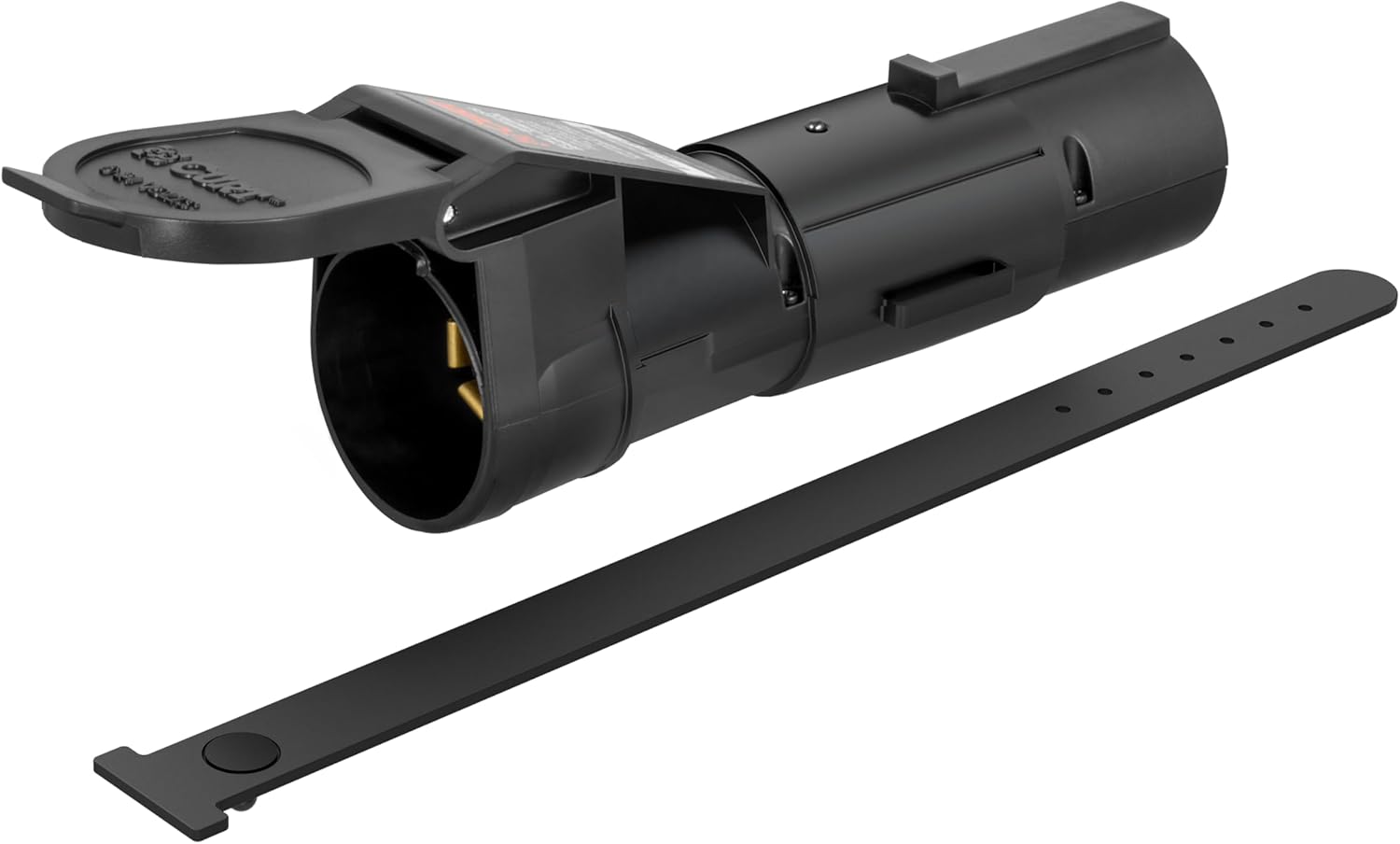
The CURT Echo Mobile is a plug-and-play, portable trailer brake controller that brings brake control onto your phone. You insert the unit into the vehicle’s 7-way RV blade connector, pair it with the OneControl Auto (Smart Control) app on iOS or Android, then create vehicle-trailer profiles, adjust max output and sensitivity, and manually apply the trailer brakes from the app. Its triple-axis accelerometer provides proportional braking for smooth stops on hills and during towing, and the potted enclosure plus retention strap and locking tab on the connector help protect electronics and keep the unit seated in the socket. Because it is portable and requires no permanent wiring, it is easy to move between trucks, which is useful if you run multiple vehicles. Limitations include dependence on a smartphone to access settings and control, and the need for a compatible 7-way socket under the rear of the vehicle rather than hardwiring for an in-cab dash display.
Best for: Buyers who need a no-wires, easy-to-move brake controller for occasional towing or for sharing between vehicles and who prioritize quick installation and smartphone control.
Less Ideal for: Drivers who want a permanently mounted in-cab display or those without a compatible 7-way connector or reliable smartphone access should look elsewhere.
- Truly plug-and-play portable design for easy transfer between vehicles
- Bluetooth app control lets you adjust output, sensitivity, and save towing profiles
- Triple-axis motion sensor provides proportional, smooth braking on grades
- Potted enclosure and connector retention strap improve durability and vibration resistance
- Requires a smartphone to configure and operate instead of a dedicated in-cab controller
- Not a permanent in-cab solution for users who prefer visible controls
Verdict: Pick this when you want a portable or app‑enabled controller you can move between vehicles or operate wirelessly for quick, flexible installs.
5. Kohree Split Electric Trailer Brake Controller with LCD Display
Best Split‑Display / Remote‑Head Controller
| Application | Supports trailers with 1-4 axles |
|---|---|
| Boost levels | 9 levels (S1-S9) |
| Display | 1.9" IPS color LCD |
| Braking modes | Proportional and electronic hydraulic |
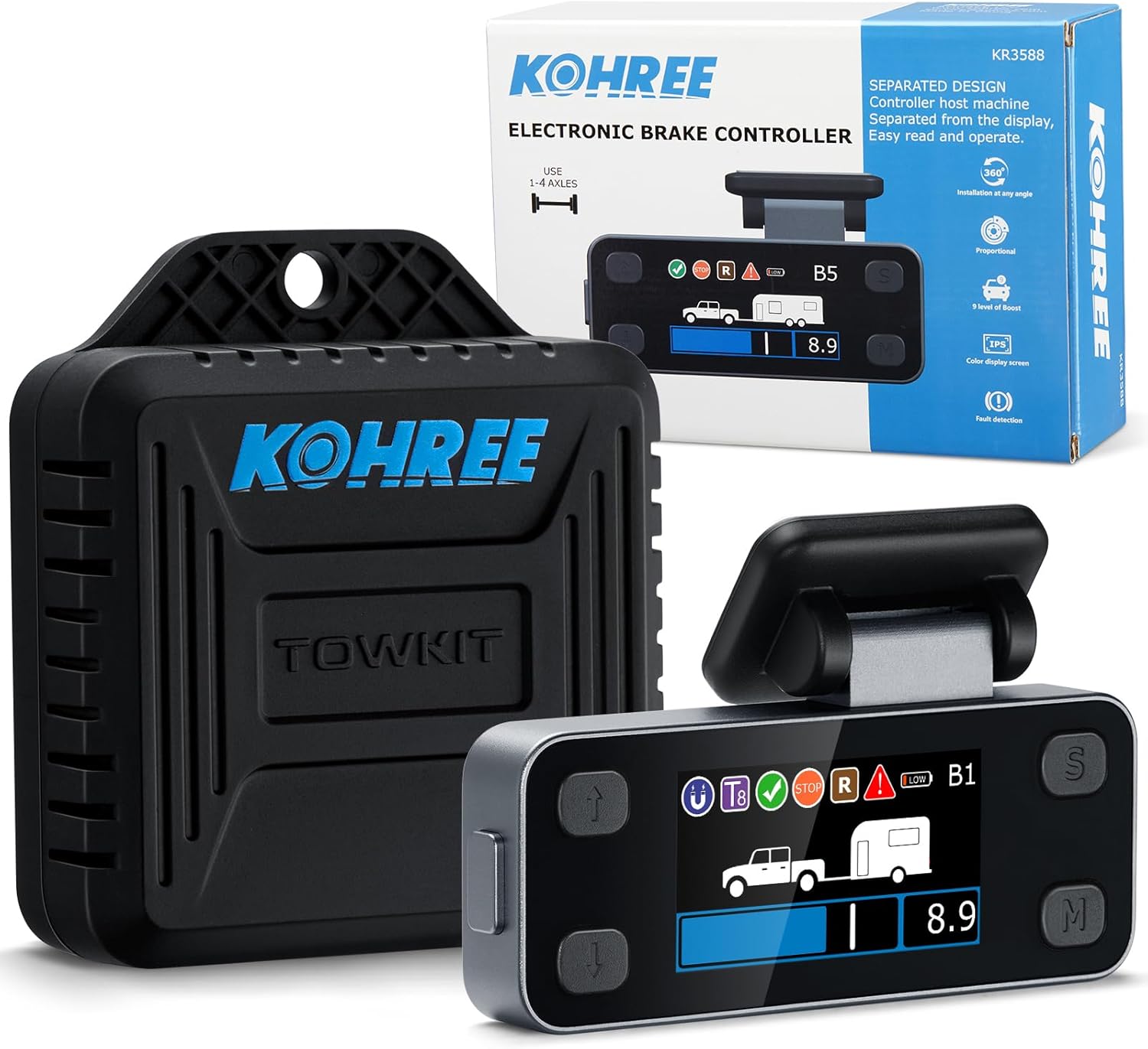
The Kohree split electric trailer brake controller separates the control head from the brake module so you can mount the main unit out of sight while keeping the color LCD display within easy reach. It provides proportional braking with built-in sensors and supports automatic and manual leveling, making setup simpler and maintaining consistent braking in turns. The display stores settings for up to eight trailers and the controller offers nine boost levels to tune braking feel for different trailer weights. The kit includes a plug-in wiring harness and a Type-C data cable to simplify installation. Practical benefits include a compact, readable IPS color screen that can be mounted at any angle and a dual-processor design intended to keep braking response smooth and reliable. Limitations to note are that this is an aftermarket controller that requires vehicle wiring and mounting effort and that advanced users may need to fine-tune boost and sensitivity to match a specific trailer and towing setup.
Best for: Buyers who want the cleanliness of a hidden brake module but still need a visible, easy-to-read control head and who value proportional braking and tunability for varied trailer loads.
Less Ideal for: Drivers looking for a completely plug-and-play, no-setup controller or those unwilling to perform wiring and mounting work should consider simpler integrated units or professional installation.
- Split design lets you hide the brake module and place the readable LCD head within easy view
- Proportional braking with built-in sensors for smoother, more natural trailer braking
- Nine boost levels and storage for up to eight trailer profiles to match different loads
- Automatic and manual leveling plus an IPS color screen that mounts at any angle
- Requires vehicle wiring and some installation effort to mount the module and run the harness
- May need tuning of boost and sensitivity to get ideal braking for specific trailer setups
Verdict: This category fits controllers with a separate display or remote head that lets you mount the main unit out of sight while keeping controls and readouts within easy reach.
6. CURT Spectrum Integrated Proportional Trailer Brake Controller
Best Low‑Profile Dash Controller

| Brand | CURT |
|---|---|
| Model | Spectrum |
| Special Feature | Easy to Install |
| Included Components | Spectrum |
| Triple-axis accelerometer | Yes |
The CURT Spectrum is a low-profile proportional brake controller that places a small rotary knob on the dash while the main module mounts out of sight behind the dash. It measures vehicle motion with a triple-axis accelerometer and applies braking power proportionally for smooth, predictable stops and better hill compensation. The user interface uses a push-button rotary knob plus ten tri-color LEDs for clear status and simple manual override. Installation is simplified by vehicle-specific quick plug harnesses and automated leveling and calibration, so mounting and setup are straightforward for a hands-on DIYer. Because the main unit is hidden, the dash stays uncluttered and sightlines are preserved, which is ideal when interior space is limited. The controller is tailored to electric trailer brakes and offers flexible adjustment for different trailers and loads, though it requires a compatible wiring harness and space behind the dash for the module during installation.
Best for: Buyers who prioritize a compact, factory-looking dash installation and want smooth, proportional brake control without a large aftermarket module taking up dash space.
Less Ideal for: Drivers who need a self-contained, dash-mounted unit with no behind-dash mounting or those without access to a compatible vehicle harness should consider other controller styles.
- Low-profile dash knob keeps the dash tidy and does not block sightlines
- Triple-axis accelerometer provides responsive, proportional braking and hill compensation
- Separate hidden module allows flexible mounting and preserves interior aesthetics
- Simple rotary knob with push-button and LEDs makes manual adjustment and status checks intuitive
- Vehicle-specific quick plug harnesses and automated calibration speed installation
- Requires sufficient behind-dash space and the correct vehicle-specific harness for installation
Verdict: Choose a low‑profile dash unit if you want a compact controller that blends into the dash and doesn’t obstruct driving space or sightlines.
7. RIZZ-MAN 90195 Proportional Brake Controller with Wiring Harness
Best Complete Kit (Includes Wiring Harness)

| Manufacturer | RIZZ-MAN |
|---|---|
| Manufacturer Part Number | 90195+vehicle20 |
| Item Weight | 1.21 pounds |
| Date First Available | December 19, 2023 |
The RIZZ-MAN 90195 is a proportional electric brake controller packaged as a complete kit that includes a vehicle-compatible wiring harness and dash-hugging mounting options for quick installation. Designed for use on 1997-2004 Dodge Dakota (and listed compatible years nearby), it senses tow vehicle deceleration and applies trailer brakes smoothly for more stable stops and reduced trailer sag. The kit emphasizes ease of fitment with a harness tailored to the Dakota wiring, an easy-to-read LCD, and multiple mounting positions for a tidy dash installation. In practice the controller offers predictable proportional braking that works in reverse and handles one to four brake axes, making it suitable for light- to medium-weight trailers. Limitations include a modest feature set compared with higher-end controllers and limited vehicle compatibility restricted to the listed Chrysler/Dodge/RAM years, so it is not a universal solution. If you want a straightforward, harness-included controller that reduces installation hassle on a Dakota, this kit delivers practical braking control without extra complexity.
Best for: Buyers who want a ready-to-install controller kit for a 1997–2004 Dodge Dakota that minimizes wiring work and speeds up a clean, factory-like dash installation.
Less Ideal for: Drivers who tow very heavy trailers needing advanced tuning or who plan to use the controller on other vehicle makes should look elsewhere.
- Includes vehicle-compatible wiring harness and mounting options for faster, cleaner installation on listed Dodge Dakota years
- Proportional sensor control for smoother, more stable trailer braking and operation in reverse
- Compact, dash-friendly design with an easy-to-read LCD for simple monitoring and adjustments
- Supports control for one to four brake axes to cover most light- and medium-trailer setups
- Compatibility is limited to the specified Chrysler/Dodge/RAM years so it will not fit other vehicles
- Fewer advanced features and tuning options than premium brake controllers
Verdict: This slot is for buyers who want an out-of-the-box controller kit that includes a vehicle-compatible wiring harness and mounting parts for a faster, cleaner install.
Choosing the Right 1997-2004 Dodge Dakota Trailer Brake Controller: Key Factors to Consider
Compatibility With 1997-2004 Electrical Systems
Older Dakotas may use simpler trailer wiring and less integrated vehicle electronics than newer trucks. Confirming that a controller will interface cleanly with the Dakota electrical setup is essential. Some units plug into a standard 4- or 7-pin harness with minimal splicing, while others require a dedicated brake output wire or grounding checks.
A mismatched controller can produce inconsistent braking, fault lights, or require complex adaptors. When planning an installation, check whether the controller requires a separate power lead, an ignition-switched supply, or a brake signal input and ensure your Dakota has accessible routing paths behind the dash or under the console. Attention to connector types and mounting space inside the cab will reduce installation time and headaches.
Proportional Versus Time-Delayed Operation
Controllers generally operate either proportionally or with a time-delay algorithm. Proportional controllers sense deceleration and apply trailer brakes in proportion to vehicle braking, giving a more natural, immediate feel that reduces jerking. Time-delayed controllers apply a preset braking force after a short delay and ramp, which can be simpler but may feel abrupt with varying loads.
For a Dakota used for mixed towing — such as occasional boat or utility trailers with different weights — proportional control often provides smoother, more consistent stops. However, time-delayed units can be adequate for very light, infrequent towing and are typically less complex to install and set up.
Mounting Location and In-Cab Accessibility
Where you mount the controller affects usability and safety. A controller should be reachable without taking your eyes off the road, yet not block vehicle controls or airbags. Common mounting spots in the Dakota include under the dash near the steering column or on the center console.
Consider cable routing length to the trailer connector and to a power source. Units with modular faceplates or swingout brackets can help achieve an ergonomic installation. If you often adjust settings while driving, choose a controller with intuitive knobs or a clear display to minimize distraction.
Wiring and Installation Complexity
Installation difficulty varies from simple plug-and-play to installations requiring splicing, drilling, or relay installations. Assess your comfort level with vehicle wiring or whether you will seek professional help. A straightforward wiring harness that ties into the existing trailer plug and brake light circuit will simplify setup on a Dakota.
Also consider whether the controller needs a dedicated fused power feed from the battery, an ignition-switched source, or a connection to the Dakota's brake light switch. Proper grounding and secure mounting of the control module help prevent intermittent faults during towing.
Adjustability and Fine-Tuning Options
Good controllers let you tailor braking force to the trailer weight and road conditions. Look for adjustable gain settings, boost modes for heavy loads, and manual application overrides. These adjustments help prevent trailer jackknifing on sudden stops and allow you to shift braking bias for light versus heavy trailers.
Some units provide clear visual feedback or audible cues during setup, making it easier to dial in safe braking without repeated trial and error. If you tow different trailers, multi-stage or memory features that save settings can reduce setup time between hauls.
Durability and Environmental Resistance
Trailer controllers are exposed to vibration, temperature swings, and occasional moisture depending on mounting location. Select controllers built with durable housings and reliable connectors to withstand the working environment of a Dakota.
Corrosion-resistant connectors and sealed modules help prevent failures on long trips. Consider the expected maintenance needs and whether replacement wiring or mounting hardware is readily available to keep the system functional over time.
Why a Dedicated Controller Matters for Dakota Towing
A dedicated trailer brake controller improves braking coordination between the truck and trailer, reducing the chance of trailer sway or loss of control during emergency stops. The Dakota's braking performance changes with payload and trailer weight, so having a device that can proportionally apply trailer brakes helps maintain a predictable stopping distance.
Drivers who tow frequently will notice better steering stability and less nose dive when a controller is properly set. This is especially relevant on older Dakotas, where suspension and brake components were designed for the era's typical loads; a modern controller can bring more consistent braking behavior without modifying the truck's core systems.
- Reduces trailer push or sway during hard braking
- Improves driver confidence when towing mixed loads
- Allows fine tuning of trailer braking force for different trailers
Installation Tips for the 1997-2004 Dakota
Plan your wiring route before beginning. Common paths run under the dash, down the driver's side kick panel, and along the frame to the trailer connector. Keep power leads away from high-heat components and secure lines with clips to prevent chafing.
If your Dakota has an existing factory trailer wiring harness, verify the pinout and whether a brake controller harness is available to avoid splicing. When splicing is necessary, use quality connectors and heat-shrink tubing for a durable, weather-resistant joint.
- Locate a switched ignition source for power so the controller disables when the vehicle is off
- Use a fused line to the battery for consistent power where required
- Test the brake input signal at the pedal switch before finalizing wiring
Setting Up and Tuning Brake Response
Begin setup on a low gain setting and perform short test stops with a lightly loaded trailer to observe braking behavior. Increase gain gradually until the trailer brakes contribute noticeably without locking wheels or causing instability.
If the controller has proportional sensing, verify that the initial sensing calibration matches the Dakota's deceleration profile. For time-delayed units, set an appropriate ramp time and maximum output suited to your typical trailer weight to avoid abrupt engagements.
- Start with minimal gain, then increase incrementally
- Test on a quiet road with room to stop safely
- Adjust based on trailer load and road grade
Common Wiring Pitfalls and Troubleshooting
Intermittent braking at the trailer often stems from poor ground connections or corroded trailer plug pins. Inspect and clean connector contacts, and ensure the controller module ground is attached to a solid metal chassis point.
If the controller shows no power, confirm the fused battery feed and ignition-switched lead are connected to the correct circuits. Fault indicators on modern controllers can point to shorted outputs or signal loss; use the manual to interpret those diagnostics and isolate the problem.
- Check ground quality and connector corrosion first
- Verify fused power and switched ignition supplies
- Use controller diagnostics to narrow wiring issues
Legal and Safety Considerations
Local towing laws may dictate trailer brake requirements based on trailer weight. Ensure your Dakota's controller setup meets any statutory requirements for brake activation and control. Properly functioning trailer brakes also reduce liability by improving stopping performance under load.
Regular maintenance of the trailer brake system, including drum or electric brake assemblies and the controller wiring, keeps the system reliable. Inspect the trailer braking components and controller wiring before long trips or when changing towing setups.
- Verify local laws on trailer brake thresholds
- Perform routine inspections on trailer brake assemblies
- Keep spare fuses and basic wiring repair tools accessible
Still looking for the perfect fit?
Select your Dodge Dakota configuration to see the most relevant Trailer Brake Controllers recommendations
How We Chose the Best 1997-2004 Dodge Dakota Trailer Brake Controller
We evaluated candidates based on criteria that matter specifically for owners of 1997-2004 Dodge Dakota trucks. First, installation compatibility was a top filter: units had to support the Dakota electrical and mounting constraints typical of late 1990s and early 2000s pickups, or be adaptable with standard wiring harnesses. Second, braking performance was judged by reported responsiveness, modulation capability, and consistency across a range of trailer weights. Third, driver controls and in-cab ergonomics were considered, including whether the controller offered proportional behavior, manual gain options, and clear feedback while driving. Fourth, reliability and build quality were included to favor durable hardware and connectors that hold up under towing conditions. Fifth, features such as boost modes, diagnostics, and user-adjustable settings were weighed for their real-world usefulness.We excluded devices that require substantial vehicle modifications beyond standard wiring or that are explicitly incompatible with the Dakota electrical architecture of this era. We also excluded controllers lacking basic safety features such as a manual override or clear fault indicators. The final list balances easy installation, dependable braking performance, and practical features for everyday towing with a 1997-2004 Dodge Dakota.
Our full evaluation process is outlined in our review methodology.
FAQ
Do I need a trailer brake controller for every trailer I tow with my Dakota?
It depends on trailer weight and local regulations. Many areas require trailer brakes above a certain gross trailer weight. Even if not required, brakes improve control for heavier trailers and are recommended for frequent towing.
Can I install a modern proportional controller in a 1997-2004 Dakota?
Often yes. Many modern controllers can interface with older electrical systems if you run the required power, ground, and brake signal lines. Confirm connector compatibility and whether a simple harness or minimal splicing is needed for your Dakota.
Will a controller drain my battery when the truck is parked?
Most controllers need an ignition-switched power source or incorporate an internal sleep mode, so they do not drain the battery when the vehicle is off. Proper installation using a switched feed prevents parasitic battery draw.
How do I know if my controller is applying too much trailer braking?
Excessive trailer braking shows as trailer wheels locking, premature tire wear, or a tugging sensation that pulls the truck rearward. Reduce the gain or output setting and re-test until the trailer contributes smoothly without locking.
Can I mount the controller anywhere inside the cab?
You should mount it where it is reachable yet does not interfere with vehicle controls, airbags, or obstruct visibility. Typical spots in the Dakota are under the dash near the steering column or on the center console with tidy cable routing.
Is professional installation necessary for a Dakota owner?
Not always. Owners comfortable with basic wiring and following wiring diagrams can install many controllers. However, professional installation reduces the risk of wiring errors and ensures proper routing and grounding, especially if splicing or drilling is required.
Final Verdict
Prioritize controllers that match the 1997-2004 Dodge Dakota electrical layout, offer proportional braking or well-tuned time-delay operation, and provide clear in-cab controls. Installation simplicity and reliable wiring connections will reduce downtime and prevent intermittent faults while towing.Balance responsiveness against ease of use: a controller that is easy to mount and tune will deliver safer, more predictable stops for a variety of trailer weights. Focus on compatibility, adjustability, and durable wiring to choose a controller that keeps your Dakota and trailer stable on the road.
Explore More:
- Check out all Dodge Dakota parts & accessories
- Explore Electronics
- Browse all Accessories
