

Note: This article contains affiliate links. If you click on these links and make a purchase, I may earn a small commission at no extra cost to you. This helps support my research and content. Read my full affiliate disclosure here.
If you drive a 1997-2006 Jeep Wrangler, protecting the front end from trail impacts, brush, and low-speed dents is a practical upgrade. A properly selected grille guard preserves critical components such as the radiator, headlights, and front bumper while keeping clearance and approach angles usable. This guide covers the top shortlisted grille guards chosen for the 1997-2006 Wrangler (the TJ, LJ, and TJU generation). We evaluated options for secure mounting, material strength, and how they affect clearances and accessory fitment so you can pick the right design for daily driving and weekend off-road use.
Looking for other parts? See all Jeep Wrangler parts & accessories.
Top Picks at a Glance
| Best Overall Grille Guard Top all-around choice balancing protection, fit, finish, and value | Rugged Ridge Front Grille Guard, Textured Black |  |
| Best Premium Grille Guard Higher-end construction, finish, and features for long-term durability | Quadratec Winch-Ready Front Bumper with Removable Bull Bar |  |
| Best Heavy-Duty Grille Guard Extra-strong construction rated for rigorous use and heavier impacts | Hooke Road Tubular Front Bumper with Full Grille Guard for 1987–2006 Jeep Wrangler YJ/TJ |  |
| Best Tubular Grille Guard Classic tubular design that combines style with frontal protection | Hooke Road Tubular Front Bumper with Hoop Grille Guard and LED Lights for 1997–2006 Jeep Wrangler TJ |  |
| Best Full-Coverage Grille Guard Extensive coverage protecting grille, headlights, and lower fascia areas | Fishbone Offroad Piranha Series Front Bumper with Winch Guard for 1997–2006 Wrangler TJ |  |
| Best Compact Grille Guard Low-profile guard for lighter protection and improved clearance | RAMPAGE PRODUCTS Euro Front Grille Guard, Steel, Black |  |
1. Rugged Ridge Front Grille Guard, Textured Black
Best Overall Grille Guard

| Fitment | 1997-2006 Jeep Wrangler TJ |
|---|---|
| Material | Alloy Steel |
| Installation Type | Bolt On |
| Finish | Textured Black Powder Coat |
| Manufacturer Warranty | 5 Year Limited |
This Rugged Ridge grille guard is a straightforward bolt-on accessory that adds noticeable front-end protection and a rugged look to a 1997–2006 Jeep Wrangler TJ. Constructed from alloy steel with 3/8 inch side plates and 2.5 inch tubular cross members, the textured black powder coat improves corrosion resistance and appearance. Installation attaches to the factory bumper with no drilling required, so a basic hand tool set and one person can usually complete the job quickly. The guard provides bumper-level coverage and a solid mounting platform if you later want the optional brush guard. It is not an expedition-grade winch bumper but it does a good job deflecting brush, small impacts, and road debris while preserving vehicle approach angles. Buyers should be aware that this is an add-on fascia guard rather than a full-width heavy-duty off-road bumper, so it will not significantly change towing or recovery capacity. For most TJ owners looking for a balance of build quality, fit, and value, this unit delivers practical protection and clean OEM-compatible fitment.
Best for: Buyers who want reliable, factory-friendly front-end protection and rugged styling for a TJ without the expense or complexity of a full bumper upgrade.
Less Ideal for: Drivers who need heavy-duty winch mounting, extensive recovery points, or full-width impact protection should choose a purpose-built off-road bumper instead.
- Bolt-on installation requires no drilling for quick, factory-compatible fitment
- Alloy steel construction with 3/8 inch side plates and 2.5 inch tubular cross members for durable front-end protection
- Textured black powder coat resists corrosion and maintains a rugged appearance
- Works as a base for adding the optional bolt-on brush guard later
- Not a heavy-duty full-width bumper, so it does not add winch mounting or major recovery capability
Verdict: The best all-around grille guard that balances coverage, build quality, fitment ease, and value for most buyers seeking reliable front-end protection.
2. Quadratec Winch-Ready Front Bumper with Removable Bull Bar
Best Premium Grille Guard

| Compatible Years | 1997-2006 |
|---|---|
| Material Type | Alloy Steel |
| Winch Capacity | Up to 10,000 lb |
| Finish | Textured Black Powder Coat |
| Mounting | Bolt-on, vehicle specific fit |
This Quadratec front bumper is built as a premium, bolt-on replacement for 1997–2006 Wrangler TJ and LJ models, combining a fully welded steel body, mandrel-bent grille hoop, and an integrated winch plate. It is typically used by owners who want serious front-end protection and recovery capability on trail or daily-driven rigs. Notable features include a 3-inch, removable grille guard hoop, a 6 mm thick integrated winch plate that fits most 10,000 lb winches without modification, welded recovery plates with D-ring tabs, and a textured powder coat over e-coating for corrosion resistance. In practice the bumper gives a substantial upgrade in durability and recovery readiness while preserving a factory-style bolt-on installation that uses existing mounting points. The removable hoop lets you switch between an aggressive protected look and a lower-profile appearance. Expect the unit to be heavy and require at least two people for installation, and the large steel construction will change front-end weight and approach angles compared with stock plastic bumpers.
Best for: Buyers who prioritize long-term durability, corrosion resistance, and integrated recovery capability for serious off-road use and want a refined, bolt-on factory-style upgrade.
Less Ideal for: Drivers seeking a lightweight or minimalist aesthetic, or those who never use recovery gear and prefer minimal change to vehicle weight and approach angles.
- Fully welded steel construction with mandrel-bent grille hoop for strong front-end protection
- Integrated 6 mm winch plate accepts most winches up to 10,000 lb without drilling
- Removable grille guard hoop allows quick change between protected and low-profile looks
- E-coat plus textured black powder coat finish for improved corrosion resistance
- Heavy steel construction increases front-end weight and may affect handling
- Large bumper profile can reduce approach angle compared to stock bumper
Verdict: The best premium grille guard for buyers willing to pay more for superior materials, corrosion resistance, refined fit, and long-term durability.
3. Hooke Road Tubular Front Bumper with Full Grille Guard for 1987–2006 Jeep Wrangler YJ/TJ
Best Heavy-Duty Grille Guard
| Compatible Vehicle | 1987-2006 Jeep Wrangler YJ TJ |
|---|---|
| Material Type | Carbon Steel |
| Finish Type | Powder Coated with E-coating |
| Installation Type | Bolt-On |
| Included Components | D-rings, License Plate Mount, Mounting Hardware Kit |
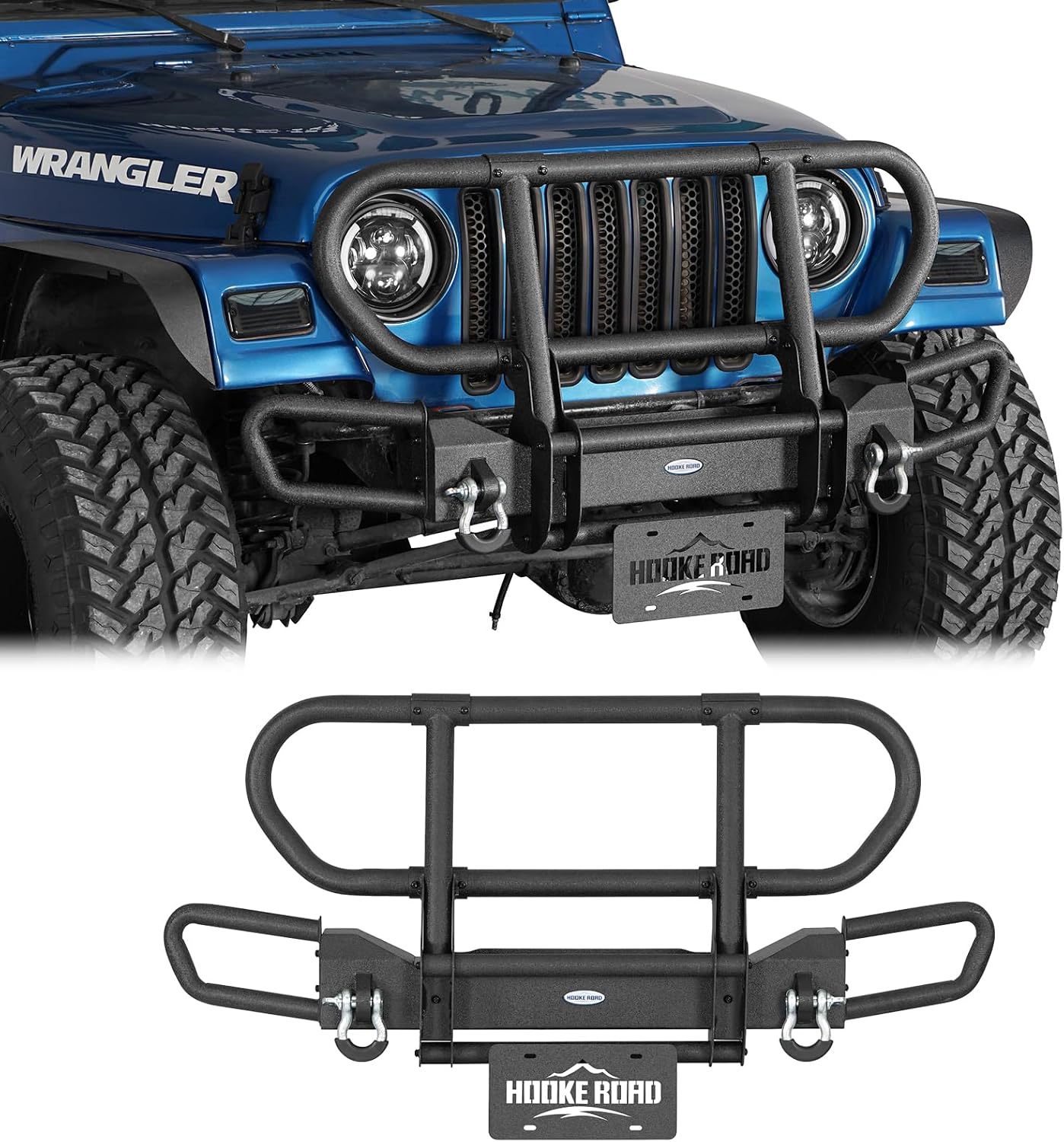
This Hooke Road tubular front bumper is built to protect the Wrangler’s front end during serious off-road use. Constructed from 11-gauge steel plate with 1.89" and 1.50" tubing and a textured powder-coat plus E-coating, it resists impact and corrosion while keeping a rugged appearance. The full grille guard and U-shaped tube structure shield headlights and grille from rocks and brush, and the included flip-up license plate mount keeps you street legal without compromising protection. Recovery-ready with two welded D-ring mounts and heavy-duty 3/4" D-rings, it provides reliable anchor points for winching or towing. Installation is bolt-on to factory frame mounts using the supplied hardware, so you can fit it without cutting or welding. Expect added weight up front, which improves durability but can affect fuel economy and steering feel; also this bumper does not include a winch plate or integrated lighting, so you will need additional parts for those functions. For heavy trail use and worksite recovery this bumper emphasizes strength and straightforward protection.
Best for: Buyers who need the strongest grille guard-style bumper for demanding off-road trails or worksite recovery and prioritize reinforced mounting and impact protection over integrated accessories.
Less Ideal for: If you want a lightweight street bumper, an integrated winch-ready system, or a minimalist aesthetic, this heavy tubular bumper is not the best match.
- Vehicle-specific fit for 1987–2006 Jeep Wrangler YJ/TJ for straightforward installation
- Robust construction: 11-gauge steel plate and reinforced tubing for impact resistance
- Full grille guard shields headlights and grille during rock crawling
- Welded D-ring mounts with included heavy-duty D-rings provide certified recovery points
- Textured powder-coat plus E-coating for improved corrosion resistance
- No integrated winch plate or light mounts included, requiring additional purchases for those functions
Verdict: The best heavy-duty grille guard for users prioritizing maximum strength and reinforced mounting for demanding off-road or worksite conditions.
4. Hooke Road Tubular Front Bumper with Hoop Grille Guard and LED Lights for 1997–2006 Jeep Wrangler TJ
Best Tubular Grille Guard

| Compatible vehicle | 1997–2006 Jeep Wrangler TJ |
|---|---|
| Material Type | Carbon Steel |
| Included components | Front bumper assembly, 2 D‑rings, license plate mount, hardware kit |
| Finish | Textured black powder coat |
| Lights | Two 25W LED spotlights |
This Hooke Road tubular front bumper provides a traditional tube‑style grille guard that combines aggressive styling with practical off‑road protection for 1997–2006 Jeep Wrangler TJ vehicles. It bolts onto factory mounting points for a straightforward install and includes all hardware and a flip‑up license plate bracket. Built from 11‑gauge steel plate with tubular side arms, the bumper adds a reinforced hoop to shield the grille and houses two 25W LED spotlights to improve low‑light visibility. Integrated D‑ring mounts and two rated 3/4" D‑rings offer solid recovery points, while a textured powder coat with internal e‑coating helps resist corrosion and accepts repainting. Because it is a tube bumper, it is not rated for mounting a winch and prioritizes deflection and aesthetics over heavy front impact absorption. Expect added frontal protection against rocks and brush and a lighter, classic tubular look compared with full‑width winch bumpers.
Best for: Someone who wants the classic tube‑style grille guard look that balances front‑end protection, lighter weight, and clean styling for trail and daily use on a 1997–2006 Wrangler TJ.
Less Ideal for: Drivers who need a heavy‑duty winch bumper or maximum crash energy absorption should look at reinforced winch‑capable bumpers instead.
- Direct bolt‑on fitment to 1997–2006 Jeep Wrangler TJ factory mounting points for easier installation
- Traditional tubular hoop grille guard offers good brush and rock deflection while keeping weight down
- Includes two 25W LED spotlights for improved visibility in low light
- Welded D‑ring mounts with rated 3/4" D‑rings provide reliable recovery attachment points
- Textured powder coat plus internal e‑coating for corrosion resistance and repaint readiness
- Not compatible with a winch so it cannot serve as a winch mounting platform
Verdict: The best tubular grille guard for buyers who want a traditional tube-style front guard that balances aesthetics, weight, and crash deflection.
5. Fishbone Offroad Piranha Series Front Bumper with Winch Guard for 1997–2006 Wrangler TJ
Best Full-Coverage Grille Guard

| Compatible Years | 1997–2006 |
|---|---|
| Auto Part Position | Front |
| Material Type | Alloy Steel |
| Exterior Finish | Powder Coat Steel |
This Fishbone Offroad Piranha Series front bumper combines a full-coverage grille and winch guard with a stout steel bumper for TJ Wranglers. It installs as a direct vehicle-specific replacement and is intended to protect the grille, headlights, and front fascia while providing a mounting point for a winch. Built from alloy steel with a textured powder coat, the bumper resists road and trail wear and arrives well packaged with hardware included. Buyers will appreciate the simple bolt-on fitment reported by multiple owners and the provision for fog light holes. Expect to add a separate winch plate for some winch brands since that plate is not guaranteed to be included. The design favors a clean, proportional look rather than an overbuilt fortress, so it is a good balance of protection and curb appeal, but it is not the lightest option and may require basic trimming or adapter work for non-Fishbone winch plates.
Best for: Buyers who prioritize integrated front-end protection and a factory-style, bolt-on upgrade for a 1997–2006 Wrangler TJ and want a clean look that still accepts a winch.
Less Ideal for: If you need the absolute lightest aftermarket option or a bumper with an included winch plate tailored to a different winch brand, look at more specialized or lightweight alternatives.
- Vehicle-specific fit for 1997–2006 Wrangler TJ for easier installation
- Integrated winch guard and grille coverage protect headlights and front fascia
- Alloy steel construction with textured powder coat for corrosion and wear resistance
- Packaging and included hardware simplify the install process
- May require a separate winch plate or trimming to fit third-party winches
Verdict: The best full-coverage grille guard for those who want comprehensive protection for the grille, headlights, and bumper area in one integrated unit.
6. RAMPAGE PRODUCTS Euro Front Grille Guard, Steel, Black
Best Compact Grille Guard

| Compatible with Vehicle Type | Car |
|---|---|
| Product Grade | Replacement Part |
| Material Type | Alloy Steel |
| OEM Equivalent Part Number | 7659 |
This Rampage Euro Front Grille Guard is a compact tubular guard designed to add low-profile protection and a classic look to older Wrangler front ends. It bolts to existing bumper/tow hook mounting points for a mostly no-drill installation and keeps a slim profile so it preserves approach angles and does not protrude far from the bumper. Constructed from alloy steel with a black powder-coated finish and zinc undercoating, the guard resists corrosion and stands up to light trail impacts like brush and small-road debris. Installation is straightforward for someone with basic tools but may require relocating or removing factory fog lights and trimming or compressing bumper stops to fit cleanly. The finish is serviceable but can scratch on heavy impact and the product ships without auxiliary mounting hardware for non-standard bumpers. For buyers who want a lighter, modest-looking guard that improves front-end protection without changing vehicle stance, this is a practical choice; drivers needing heavy-duty collision protection should consider a beefier alternative.
Best for: Buyers who want a subtle, lighter grille guard that protects against brush and minor impacts while keeping the Jeep's approach angles and stock appearance largely intact.
Less Ideal for: Drivers who plan to take heavy-duty impacts, frequent winching, or need a guard designed to carry large auxiliary lights and heavy accessories should choose a more robust bumper or guard.
- Low-profile tubular design preserves approach angles and factory look
- Bolts to existing bumper/tow hook points for mostly no-drill installation
- Black powder-coat with zinc undercoating for basic corrosion resistance
- Compact and lighter than full-width heavy-duty guards, minimizing added weight
- Finish can scratch or chip on impact and may need touch-up for off-road use
- May require moving factory fog lights and minor trimming or compression of bumper stops to fit
- Does not include extra hardware for non-stock bumper setups
Verdict: The best compact grille guard for buyers seeking a lower-profile, lighter option that preserves approach angles and minimizes interference with aftermarket accessories.
Choosing the Right 1997-2006 Jeep Wrangler Grille Guard: Key Factors to Consider
Mounting and Fitment
Secure mounting is the single biggest safety and performance factor for a grille guard on a TJ, LJ, and TJU Wrangler. A guard that fastens to the frame or factory bumper mounts spreads impact forces properly and prevents bending or tearing during a low-speed collision or brush strike. Poorly designed mounts can transmit loads to thin sheet-metal components instead of the frame, increasing the chance of costly damage. Fitment matters because the TJ, LJ, and TJU uses specific bumper and frame geometry. Choose guards that list TJ, LJ, and TJU or 1997–2006 Wrangler compatibility and include hardware that mates to existing holes or reinforced locations. Avoid products that depend on ambiguous universal brackets unless you are prepared to drill or fabricate secure attachment points.
Material and Corrosion Resistance
Material thickness and construction determine how well a grille guard holds up under impact and long-term use. Thick, welded steel tubing or plate with gussets at stress points resists deformation better than thin single-wall tubing. Look for cold-formed or DOM tubing where load-bearing members need to remain straight under strain. Equally important is the finish. Road salt, mud, and water accelerate corrosion on exposed steel. A multi-stage coating system such as zinc pretreatment followed by powder coat extends service life. If you plan to use the vehicle in winter climates or near saltwater, prioritize thicker material and a robust finish to avoid premature rust.
Clearance and Approach Angle
A grille guard can change the Wrangler's approach angle and the clearance between the guard and the ground or obstacles. On TJ, LJ, and TJU Wranglers used for trail running, maintaining approach and departure angles is essential to prevent snags on rocks and logs. Choose a guard profile that follows the bumper line and does not protrude excessively below the stock bumper. Consider how the guard interacts with aftermarket tires or lifted suspensions. Some guards sit low and can catch on steep obstacles once larger tires are installed, while higher-profile designs offer better off-road clearance but may expose more of the radiator and lower bumper area. Balance protection needs with your typical driving conditions.
Accessory Integration
Many Wrangler owners add auxiliary lighting, winches, or recovery points. A practical grille guard should offer secure, flat mounting surfaces for light bars or individual lamps and not obstruct winch access if present. Guards with built-in mounting brackets simplify installation of common accessories and keep wiring runs tidy. Ensure the guard configuration you choose does not block factory tow points or access to serviceable components. If you plan to mount lights, check the guard provides a stable, vibration-resistant platform and that wiring can be routed without rubbing against sharp edges.
Impact Absorption and Deflection
A grille guard should deflect brush and small obstacles rather than transmit all energy directly to the vehicle. Designs with curved tubing and plates can guide impacts away from vulnerable areas. Reinforced crossmembers and strategic gusseting help the structure absorb energy without catastrophic deformation. Be realistic about expectations. Grille guards reduce cosmetic damage and shield components from minor impacts, but they are not a substitute for structural crumple zones. Consider whether you want a lightweight deflector-style guard for everyday protection or a heavier-duty unit intended to take harder hits during off-road use.
Installation Complexity and Serviceability
Installation difficulty affects whether you can fit the guard yourself or need professional help. Vehicle-specific kits for the TJ, LJ, and TJU Wrangler that include necessary brackets, fasteners, and instructions reduce installation time and avoid trial-and-error fitment. Kits that require trimming or drilling increase labor and the risk of improper mounting. Serviceability matters after installation. Guards that block access to radiator drains, sensor ports, or tie-downs make routine maintenance harder. Choose a guard that either provides access panels or is easily removable with basic tools to avoid added service time.
Why TJ, LJ, and TJU-Specific Fitment Matters
The 1997-2006 Wrangler uses the TJ, LJ, and TJU chassis geometry and bumper mounting points that differ from other Wrangler generations. A grille guard engineered for the TJ, LJ, and TJU will align with existing holes, frame rails, and bumper reinforcement, giving a more secure attachment and predictable behavior under load.
Choosing a TJ, LJ, and TJU-specific design reduces the need for modification during installation. It also helps maintain correct bumper height and prevents unwanted interference with factory components such as turn signals and tow points.
- Avoid one-size-fits-all guards without TJ, LJ, and TJU hardware
- Confirm the guard does not obstruct factory lights
- Check if the kit reuses factory mounting points to preserve structural integrity
Comparing Tubular Guards Versus Plate Designs
Tubular guards typically use round or oval tubing to deflect branches and small impacts. They are often lighter and preserve more airflow to the radiator. Plate-style designs use sheet metal to create a broader shield and can offer better impact coverage for the grille and headlights.
Your choice depends on the balance you want between weight, airflow, and protection. For slow-speed trail exposure a tube guard may be adequate, while a plate-style guard offers more comprehensive coverage against brush and animal strikes.
- Tubular: lighter, better airflow, easier to mount lights
- Plate: more coverage, heavier, can trap mud if not drained
Lighting and Winch Compatibility for Off-Road Use
If you add auxiliary lights or a winch to your TJ, LJ, and TJU Wrangler, select a grille guard that provides dedicated mounting surfaces and does not obstruct winch fairlead access. Many guards include reinforced plates or bolt-on tabs for lamps and light bars to minimize vibration and simplify wiring.
Consider the wiring route and switch placement before installing lights. Guards that offer built-in channels or tie-down points make routing cleaner and reduce the likelihood of abrasion points that can wear wiring over time.
- Confirm fairlead clearance if a winch will be installed
- Look for flat, reinforced light-mount tabs rather than welded-on round tubing
- Plan wiring routes to keep connectors above likely splash zones
How a Grille Guard Affects Vehicle Safety Systems
While TJ, LJ, and TJU Wranglers from 1997-2006 have relatively simple safety systems compared with modern vehicles, adding a grille guard can still affect air flow to the radiator and the location of impact loads. Ensure the guard does not block ventilation needed for engine cooling during extended low-speed use.
Check for interference with sensors or lights. Guards that cover or shadow turn signals or marker lamps may require relocation of those lamps or use of auxiliary lighting to remain compliant with local regulations.
- Ensure radiator airflow is not overly restricted
- Avoid blocking factory lighting or signals
- Verify that added loads do not stress frame mounts beyond rated limits
Maintenance and Long-Term Care
Regular inspection and upkeep extend grille guard life. Rinse mud and salt from welded joints and fasteners after off-road runs, and touch up any paint chips to prevent rust. Periodic torque checks on mounting bolts keep attachments secure and identify any movement before it becomes a problem.
If the guard has removable light mounts or accessory brackets, inspect wiring grommets and fasteners for corrosion. Refinish scratches and chips promptly to preserve the protective coating.
- Rinse and dry after salty or muddy driving
- Torque-check mounting bolts after initial installation and periodically
- Address finish damage promptly to prevent rust
Design Considerations for Daily Driving Versus Trail Use
Decide whether you mainly need protection for daily driving hazards like parking lot scrapes and animal strikes or for serious trail hazards. Daily drivers benefit from lower-profile guards that preserve parking sensors and curb clearance. Trail-focused builds may favor heavier guards with greater coverage and reinforced mounts.
If you split time between both environments, look for a compromise design that offers moderate coverage with removable elements such as an attachable center plate so you can tailor protection to the day's activity.
- Low-profile guards for urban and suburban use
- Heavier, reinforced guards for frequent off-road use
- Consider modular designs for flexibility
Still looking for the perfect fit?
Select your Jeep Wrangler configuration to see the most relevant Grille Guards recommendations
How We Chose the Best 1997-2006 Jeep Wrangler Grille Guard
We focused selection on criteria that matter most to 1997-2006 Jeep Wrangler owners and the TJ, LJ, and TJU chassis layout. Primary evaluation factors included mounting design and compatibility with the TJ, LJ, and TJU frame, since a grille guard that relies on factory bumper mounts or the frame horns provides the most secure load path. We assessed material and construction, prioritizing cold-formed and welded steel sections with durable finishes for corrosion resistance in wet and salty conditions. Clearance and approach angle impact was evaluated to ensure guards do not significantly reduce off-road capability or interfere with stock tire and bumper configurations. We also considered accessory integration such as light mounting points and winch compatibility so owners can maintain or add common Wrangler accessories. Ease of installation and the availability of vehicle-specific mounting hardware were weighed to minimize cutting or drilling. Finally, we excluded universal-fit products that require extensive modification unless they offered clear, documented TJ, LJ, and TJU-specific mounting kits. Products that relied on flimsy brackets, thin tubing without reinforcement, or poor corrosion protection were not included in the final shortlist.
Our full evaluation process is outlined in our review methodology.
FAQ
Will a grille guard affect radiator cooling on my 1997-2006 TJ, LJ, and TJU Wrangler?
It can if the design covers a large portion of the grille. Many grille guards are open or tubular to preserve airflow. If you choose a plate-style guard, verify that airflow is sufficient for prolonged low-speed use and watch engine temps during heavy towing or summer driving.
Can I install a grille guard on a lifted TJ, LJ, and TJU with larger tires?
Often yes, but check the guard's clearance relative to larger tires and altered approach angles. Some guards that fit stock-height Wranglers may sit low once larger tires or a lift are installed and could increase snag risk on the trail.
Do I need to drill into the frame to mount a grille guard on a TJ, LJ, and TJU Wrangler?
Many vehicle-specific kits use existing holes or reinforced mounts and do not require drilling. Universal kits sometimes need drilling or fabrication. Prioritize TJ, LJ, and TJU-specific hardware if you want to avoid permanent modifications.
Will a grille guard interfere with mounting auxiliary lights?
Most grille guards provide mounting tabs or plates for lights, but configurations vary. Confirm that the guard offers flat, reinforced surfaces and that wiring can be routed without rubbing on sharp edges.
How should I care for the finish on a steel grille guard?
Rinse off mud and salt after use, inspect for scratches, and touch up bare metal with appropriate primer and paint or a rust-inhibiting product. Regular maintenance prevents corrosion and extends service life.
Are there grille guards that allow winch installation on a 1997-2006 Wrangler?
Yes. Some guards are designed to accommodate winch fairleads or leave access to a bumper-mounted winch. Verify clearances and mounting compatibility with your intended winch and fairlead before buying.
Final Verdict
For a 1997-2006 Jeep Wrangler TJ, LJ, and TJU, prioritize secure frame-mounted fitment, durable steel construction, and a finish that stands up to mud and road salt. Balance protection with approach-angle and airflow needs so the guard performs in both daily driving and off-road situations. Consider whether you need integrated mounts for lights or a winch, and favor vehicle-specific kits to minimize installation complexity. Choose the grille guard that best matches how you use the Jeep: a lower-profile tubular guard for everyday protection and airflow, or a reinforced plate-style unit with stronger mounts for frequent off-road work. Focus on mounting integrity and corrosion resistance to get the most reliable long-term protection.
Explore More:
- Check out all Jeep Wrangler parts & accessories
- Explore Exterior Accessories
- Browse all Accessories
