

Note: This article contains affiliate links. If you click on these links and make a purchase, I may earn a small commission at no extra cost to you. This helps support my research and content. Read my full affiliate disclosure here.
Choosing the right oil for your Volkswagen Passat matters because the wrong viscosity or spec can affect performance, fuel economy, and engine longevity. You want an oil that matches the engine's requirements and driving conditions, whether you do mostly city miles, highway commuting, or occasional long trips.This guide highlights seven shortlisted options that meet common Volkswagen specifications and covers why each made the cut. We evaluated viscosity grades, API and OEM approvals, and formulation type to help you pick the right product for your Passat. Read on to see the top picks and the criteria used to evaluate them.
Looking for other parts? See all Volkswagen Passat parts & accessories.
Top Picks at a Glance
| Best Overall The best all-around choice for most situations | Mobil 1 Full Synthetic Motor Oil 0W-40, 5 Quart (Pack of 2) |  |
| Best Quality Built to a higher standard if you want something more solid | Volkswagen Genuine Full Synthetic Engine Oil SAE 0W-30 (VW 504.00/507.00) |  |
| Best Value The sweet spot between price and what you get | Volkswagen 0W-20 Engine Oil Change Kit (1 qt bottles) |  |
| Best Budget The cheapest option that still gets the job done reliably | Valvoline European Vehicle Full Synthetic SAE 5W-40 Motor Oil, 1 qt |  |
| Highest Rated A top-rated pick with lots of positive feedback | Castrol EDGE 0W-20 Advanced Full Synthetic Motor Oil (5 qt) — Pack of 3 |  |
| Most Popular A crowd favorite that many people choose with confidence | Valvoline European Vehicle Full Synthetic SAE 5W-40 Motor Oil, 5 qt |  |
| Best Seller A high-volume bestseller chosen again and again | Mobil 1 Extended Performance High Mileage Full Synthetic Motor Oil 5W-30 (6 qt pack) |  |
1. Mobil 1 Full Synthetic Motor Oil 0W-40, 5 Quart (Pack of 2)

| Viscosity Grade | 0W-40 |
|---|---|
| Type | Full Synthetic Motor Oil |
| Size | 5 Quart (Pack of 2) |
| Liquid Volume | 10000 Milliliters |
Mobil 1 0W-40 European Car Formula is a full synthetic engine oil designed to protect modern European engines under a range of conditions. For a Volkswagen Passat, this grade flows easily at cold starts and maintains robust film strength at operating temperature, which helps protect turbocharged and high-output VW powertrains. The formulation claims internal heat protection up to 500°F, resistance to oxidation for longer drain intervals, and approvals that include VW 502 00 and 505 00 for compatibility with many VW gasoline and diesel engines. Practical benefits include reduced friction and deposit control that help keep valves and turbochargers clean, plus convenient handled bottles for neat pouring. Trade-offs are that it is a premium synthetic aimed at longer change intervals, so it costs more than conventional oils and some VW-specific longlife service schedules may still require dealer confirmation before extending intervals. Overall it is a proven, widely recommended synthetic choice for owners who want strong all-weather protection and extended engine cleanliness in a Passat.
Best for: Balanced owners who want a single oil that delivers reliable year-round protection and extended drain capability for routine driving and occasional spirited use in a Volkswagen Passat.
Less Ideal for: Drivers who strictly follow dealer-prescribed short-interval service plans or those looking for the lowest upfront oil cost should consider lower-viscosity or conventional alternatives.
- Full synthetic 0W-40 provides excellent cold-start flow and high-temperature film strength.
- Approved to VW 502 00 and 505 00, indicating compatibility with many Volkswagen engines.
- Formulation resists oxidation and deposits enabling up to 10,000 miles between oil changes as stated by the manufacturer.
- Pack of two 5-quart bottles and handled design makes DIY oil changes convenient and reduces spill risk.
- Premium synthetic cost is higher than conventional or mid-grade oils.
- Extended drain recommendation should be verified against the Passat's specific maintenance schedule.
Verdict: A proven full synthetic 0W-40 built for European engines that gives Volkswagen Passat owners strong all‑temperature protection and extended oil life.
2. Volkswagen Genuine Full Synthetic Engine Oil SAE 0W-30 (VW 504.00/507.00)

| Viscosity Level | Low to Medium |
|---|---|
| Compatible with Vehicle Type | Volkswagen |
| Container Type | Bottle |
| Liquid Volume | 946 Milliliters |
This is genuine Volkswagen full synthetic 0W-30 motor oil designed to meet VW 504.00/507.00 specifications for modern gasoline and diesel engines. It is sold in a one-quart bottle and intended as a direct factory-quality replacement for vehicles that require the VW 504/507 spec. In use it provides low-viscosity flow at cold start and stable film strength at operating temperatures, which helps protect turbocharged engines and minimize wear during spirited driving. The product is vehicle-specific and backed by the Volkswagen part number, so it removes guesswork when you need a correct-spec oil for a Passat. Practical benefits include predictable compatibility with VW service intervals and the peace of mind of using a branded, spec-compliant fluid. Limitations are straightforward: the single-quart packaging means you may need multiple bottles for a full oil change, and genuine branded oil can be costlier than some aftermarket equivalents despite matching factory specifications.
Best for: Performance-oriented VW owners who prioritize using factory-spec fluids to preserve engine response and long-term durability during spirited driving and regular highway use.
Less Ideal for: Budget-focused drivers who prefer lower-cost aftermarket oils or DIYers who want bulk packaging for frequent oil changes.
- Meets Volkswagen VW 504.00/507.00 specifications for modern VW engines
- Full synthetic 0W-30 viscosity supports quick cold starts and high-temp protection
- Factory-branded product reduces compatibility guesswork for VW vehicles
- Sold in one-quart bottles that are easy to handle and store
- One-quart bottle size may require multiple units for a full oil change
- Generally more expensive than many aftermarket synthetic oils
Verdict: A factory-branded full synthetic 0W-30 oil engineered to meet VW 504.00/507.00 specs for confident, spec-correct maintenance of Volkswagen Passat engines.
3. Volkswagen 0W-20 Engine Oil Change Kit (1 qt bottles)

| SAE J300 Viscosity Grade | 0W-20 |
|---|---|
| Compatible with Vehicle Type | Car, Truck |
| Container Type | Bottle |
| Liquid Volume | 946 Milliliters |
This Volkswagen oil change kit supplies factory-grade 0W-20 motor oil in the correct quantity along with the service items needed to complete a routine oil change on supported Volkswagen engines. It is typically used by DIYers or independent shops performing scheduled maintenance and arrives as a single kit with multiple 1-quart bottles, a vehicle-specific oil filter, drain plug hardware, absorbent pads, and seals. The key benefit is convenience and fitment confidence since the filter and replacement drain plug components match factory specifications, reducing guesswork and fitment issues. Because it contains OEM-branded oil and parts, it aligns with factory recommendations for engines that call for 0W-20 viscosity. Limitations are that the kit is vehicle-specific so buyers must confirm compatibility with their Passat engine, and the kit format may include parts some users do not need such as an extra drain plug if they extract oil instead of draining. The pack is straightforward for one-service use but may be less cost-effective if you only need oil or a single component.
Best for: Practical owners who prioritize getting a complete, factory-compatible oil change in one purchase and prefer minimizing parts hunting and fitment uncertainty.
Less Ideal for: Buyers who only need a single bottle of oil, those servicing non-compatible engine variants, or shoppers focused solely on the lowest per-quart price should consider alternatives.
- Includes factory-spec 0W-20 oil matched to VW recommendations
- Comes with vehicle-specific oil filter and replacement drain plug hardware for guaranteed fit
- Includes absorbent pads and seals so you have everything for a single oil service
- Packaged quantity provides the exact oil volume needed for a complete change
- Kit is vehicle-specific so it may not fit all Passat engine variants
- Includes parts that some users may not need, which can reduce per-item value
Verdict: A convenient, factory-compatible 0W-20 oil change kit that supplies the correct oil and service items to complete a Volkswagen engine oil change.
4. Valvoline European Vehicle Full Synthetic SAE 5W-40 Motor Oil, 1 qt

| SAE J300 Viscosity Grade | 5W-40 |
|---|---|
| Compatible with Vehicle Type | Car, Truck |
| Liquid Volume | 1 Quarts |
| Viscosity Level | Medium to High |
This Valvoline European Vehicle 5W-40 is a full synthetic motor oil targeted at European makes and engineered to meet many manufacturer approvals such as VW 502.00/505.00 and BMW LL-01. It is used like any engine oil for fill or top-up during service intervals and offers low-SAPS chemistry, detergents and antioxidants meant to reduce deposits, protect timing chains and defend against wear, heat, and friction. For a budget-focused buyer it gives factory-quality coverage for European engines and handles cold starts and extreme temperatures better than conventional oils. The one-quart size is convenient for topping off between services or for small-capacity engines, though buying quart bottles for a full drain and fill can be less economical than larger containers. It is a practical choice when you need a European-spec synthetic in a pinch, but fleets or owners doing full oil changes often prefer larger sizes to lower per-quart cost.
Best for: Budget-conscious owners looking for a factory-quality full synthetic that meets European specs and who need a convenient small bottle for top-ups or occasional service.
Less Ideal for: Drivers who perform frequent full oil changes on larger engines or fleets that want the lowest per-quart cost should consider larger containers or bulk options instead.
- Formulated to meet multiple European approvals including VW 502.00/505.00 and BMW LL-01
- Full synthetic low-SAPS chemistry that helps control deposits and timing chain wear
- Good high and low temperature protection suitable for cold starts and hot climates
- Single-quart bottle convenient for topping off or small-capacity engines
- One-quart packaging raises per-quart cost compared with gallon containers
- Not the most cost-effective option for routine full oil changes on larger engines
Verdict: A factory-spec full synthetic 5W-40 in a convenient one-quart bottle that gives European engines dependable protection at a budget-friendly entry point.
5. Castrol EDGE 0W-20 Advanced Full Synthetic Motor Oil (5 qt) — Pack of 3

| Viscosity Level | Low to Medium |
|---|---|
| Compatible with Vehicle Type | Car, Hybrids, Truck |
| Container Type | Jug |
| Liquid Volume | 5 Quarts |
Castrol EDGE 0W-20 is a full synthetic motor oil designed to protect modern engines while helping maintain fuel economy. It is typically used for routine oil changes in cars and compatible VW engines that specify 0W-20 viscosity, poured from the 5‑quart jugs to refill crankcases or top off on service ramps. Notable features include a formulation aimed at high temperature stability, sludge control, and enhanced wear protection so engines run cleaner and with less friction over time. The product claims extended endurance for longer drain intervals and meets multiple industry licenses and manufacturer test requirements, which supports reliability-focused maintenance. Practical benefits include predictable cold-start flow and consistent viscosity under load. Limitations are that fitment depends on Volkswagen service specifications for model year and engine — owners must confirm 0W-20 is approved for their Passat and its drain interval recommendations, and this pack is an economy bulk package that may come in different retail packaging compared with single OEM-style bottles.
Best for: Reliability-focused owners who prioritize long-term engine protection and predictable oil performance for routine maintenance on compatible vehicles.
Less Ideal for: Drivers who require a different viscosity or a manufacturer-specified oil grade for their specific Passat engine or who prefer single retail bottles rather than bulk packs.
- Full synthetic 0W-20 formulation for reliable cold-start flow and viscosity control
- Formulated to resist thermal breakdown and reduce sludge for cleaner engines
- Meets multiple industry and manufacturer specifications supporting broad engine compatibility
- Sold in three 5‑quart jugs which is convenient for multiple changes or keeping a spare on hand
- Not all Volkswagen Passat engines specify 0W-20 so buyers must verify compatibility before use
- Bulk pack may use economy packaging rather than individual factory-style bottles
Verdict: A trusted full synthetic 0W-20 choice that prioritizes engine protection and thermal stability for reliability-minded maintenance.
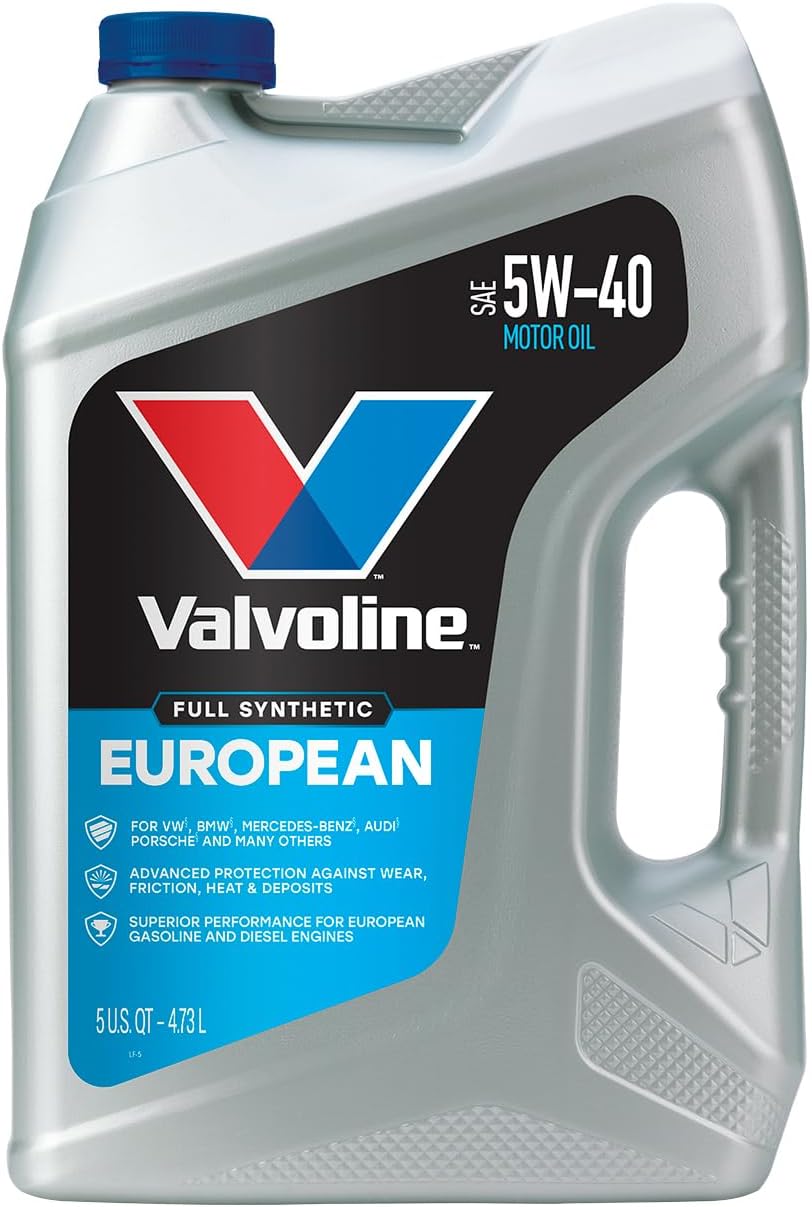
6. Valvoline European Vehicle Full Synthetic SAE 5W-40 Motor Oil, 5 qt
| SAE J300 Viscosity Grade | 5W-40 |
|---|---|
| Container Type | Bottle |
| Compatible with Vehicle Type | Car, Truck |
| Liquid Volume | 5 Quarts |
This Valvoline European 5W-40 is a full-synthetic engine oil aimed at European cars and light trucks; it is blended with high-quality base oils, antioxidants, and detergents to resist breakdown, control deposits, and protect against wear and heat. Typical use is routine oil changes for vehicles that specify a 5W-40 or equivalent European specification; it lists ACEA and manufacturer approvals that cover many Audi, BMW, Mercedes, Porsche, and Volkswagen requirements. In practice the formula offers strong high- and low-temperature protection and helps keep engines clean under stop-and-go commuting or highway driving. The 5-quart bottle is convenient for DIY oil changes and larger-capacity engines. Limitations include the single-viscosity grade, so buyers must check Volkswagen-approved specs for their Passat model and year before using it, and some users note packaging can arrive damaged if shipped in bulk. This oil is a practical, widely available choice when a European-grade 5W-40 full synthetic is required for service intervals and everyday driving demands.
Best for: Convenience-driven buyers who prioritize a ready-to-use, storeable bottle and want a European-grade full-synthetic oil they can use for routine self-service and regular commuting.
Less Ideal for: Drivers who need a different viscosity grade or a VW-specific factory-recommended oil formulation should choose a product that explicitly lists the exact Volkswagen spec for their model year.
- Formulated to meet multiple European specifications such as ACEA and VW/BMW/MB/Porsche approvals.
- Full-synthetic base and antioxidants that resist thermal breakdown and reduce deposits.
- 5-quart container size suited to DIY oil changes and larger engine capacities.
- Good high/low temperature protection for a range of driving conditions.
- Only offered in the 5W-40 grade so it may not match all Passat model year viscosity requirements.
- Some buyers report shipping/packaging damage when multiple units are packed together.
Verdict: A full-synthetic 5W-40 formulated to meet common European approvals, making it a convenient, DIY-friendly choice for European cars that call for that grade.
7. Mobil 1 Extended Performance High Mileage Full Synthetic Motor Oil 5W-30 (6 qt pack)

| SAE J300 Viscosity Grade | 5W-30 |
|---|---|
| Compatible with Vehicle Type | Car |
| Liquid Volume | 192 Fluid Ounces |
| Flash Point | 500 Degrees Fahrenheit |
Mobil 1 Extended Performance High Mileage 5W-30 is a full-synthetic engine oil designed to protect higher-mileage passenger car engines and help extend oil change intervals. It is typically used in cars with more than 75,000 miles where owners want stronger deposit control, leak mitigation, and heat protection compared with conventional oils. The formula advertises Mobil 1’s Triple Action+ blend to maintain engine cleanliness, resist sludge and deposits, and provide thermal protection up to 500°F while supporting cold starts down to -40°F. Practical benefits include potential longer intervals between changes and improved protection for timing chains and turbocharged components found in some Volkswagen Passat engines, plus wide temperature performance for varied climates. Important limitations are that any extended service interval should follow the vehicle manufacturer’s maintenance schedule and warranty guidance, and not all high-mileage issues are solved by oil alone. This product comes in a multi-quart pack suited for multiple changes but buyers should confirm the 5W-30 grade matches their Passat model year and engine requirements.
Best for: Risk-averse mainstream buyers who prefer factory-quality maintenance products and want dependable, proven protection for an aging VW Passat while minimizing the frequency of service visits.
Less Ideal for: Drivers who must strictly follow short OEM oil-change intervals, those under commercial duty cycles, or buyers whose Passat engine specification requires a different viscosity or specification than 5W-30.
- Full-synthetic formula tailored for high-mileage engines to resist deposits and extend engine life.
- Rated 5W-30 and meets ILSAC GF-6 standards for modern gasoline engines.
- Designed for extended protection claims allowing longer intervals between changes when compatible with manufacturer guidance.
- Wide temperature range protection for cold starts and high heat environments.
- Extended 20,000-mile change interval is conditional and must align with manufacturer recommendations and operating conditions.
Verdict: A trusted full-synthetic 5W-30 formulated to protect high-mileage passenger car engines and support longer oil-change intervals when used per manufacturer guidance.
Choosing the Right Volkswagen Passat Engine Oil: Key Factors to Consider
Viscosity Grade
Viscosity grade determines how the oil flows at cold start and at operating temperature. Choosing the correct grade affects start-up wear, fuel economy, and oil pressure. For example, lower first number grades improve cold-start flow while the second number ensures a stable film at high temperature.
Consider driving climate and start-stop frequency: colder climates benefit from lower cold-viscosity ratings for quicker lubrication, while consistently hot environments require a grade that maintains protective viscosity at temperature. Always match the grade to the vehicle manufacturer's recommendations to avoid increased wear or reduced performance.
OEM and Industry Approvals
Look for OEM approvals and industry standards such as API and ACEA because they show the oil has passed specific tests for performance and compatibility. OEM approvals indicate the oil meets the tolerances and additive packages recommended by the vehicle maker.
Using an oil with the correct approvals reduces the risk of warranty issues and ensures compatibility with engine materials and systems. If an oil lacks clear certifications, it may not provide the intended protection for valve trains, turbochargers, or emission control components.
Full Synthetic Vs Synthetic Blend
Full synthetic oils typically offer superior oxidation resistance, thermal stability, and flow properties compared with blends. That can translate into better protection under high load, longer change intervals, and improved cold-start behavior. Blends can be a cost-effective compromise for drivers with moderate demands.
Think about your driving style and service interval preferences. If you do frequent highway driving or carry heavier loads, a full synthetic often provides more consistent protection. For less demanding use, a high-quality blend can still offer adequate wear control and cleanliness.
Compatibility With Turbocharged Engines
Turbocharged engines place additional thermal and mechanical stress on oil, making heat resistance and deposit control critical. Oils designed for turbocharged units include additives and base stocks that resist breakdown and prevent turbocharger coking.
If your Passat has a turbocharged engine, prioritize oils known for maintaining viscosity under high exhaust and intake temperatures. Adequate film strength and detergent/dispersant chemistry help protect bearings and turbo components from premature wear.
High-Mileage Considerations
High-mileage engines can benefit from oils formulated with seal conditioners and enhanced anti-wear additives. These formulations help address common age-related issues such as minor leaks, increased blow-by, and wear on critical surfaces. They may also include extra detergents to manage deposits.
However, not every high-mileage formula is appropriate for all engines. Check for compatibility with your engine's seals and materials and consider the engine's current condition. In some cases, returning to a manufacturer-spec oil is preferable before switching to a specialty high-mileage formulation.
Oil Longevity and Change Intervals
Oil life affects maintenance frequency and total operating cost. Oils with superior oxidation resistance and detergent packages can safely extend intervals when matched with the vehicle's service recommendations and driving conditions. Longer intervals reduce downtime but require confidence that the oil will maintain protective properties.
Balance the desire for longer change intervals with the vehicle's actual use. Severe stop-start driving, towing, or dusty environments may shorten effective oil life. Follow the manufacturer's guidance for interval limits and monitor oil condition when stretching changes.
How We Chose the Best Volkswagen Passat Engine Oil
We focused on oils that meet the specific technical requirements and tolerances commonly specified for Volkswagen Passat engines. Key evaluation criteria included viscosity range and cold-start performance, OEM and API/ACEA approvals, long-term oxidation resistance and oil life, and compatibility with turbocharged and direct-injection engines.We also considered formulation type such as full synthetic versus synthetic blend, suitability for high-mileage engines, and compatibility with exhaust aftertreatment systems when applicable. Performance under realistic operating temperatures and protection against wear and sludge formation were assessed as well.Excluded items included generic oils lacking clear OEM approvals, products without verifiable specification data, and formulations intended only for non-automotive applications. The final shortlist emphasizes oils that balance protection, efficiency, and manufacturer-specified compatibility for the Volkswagen Passat.
Our full evaluation process is outlined in our review methodology.
FAQ
How often should I change Volkswagen Passat engine oil?
Change intervals depend on driving conditions and the oil used. Many modern engines can safely use extended intervals with full synthetic oils and monitored service reminders, but frequent short trips or heavy-duty use usually call for shorter intervals. Check the vehicle's maintenance schedule and inspect oil condition if you plan to extend the interval.
Can I switch from conventional to synthetic oil in my Passat?
You can usually switch to synthetic oil without issue, provided the synthetic meets the required specifications. Synthetic oils often offer better thermal stability and flow. Ensure the chosen oil meets OEM approvals and check for any manufacturer guidance regarding transitions, especially in older engines.
Does viscosity affect fuel economy in a Passat?
Viscosity impacts friction and pumping losses, so selecting the correct viscosity grade can influence fuel economy. Using a grade recommended by the manufacturer helps balance protection and efficiency. Very low-viscosity oils may improve fuel economy slightly but must still provide adequate film strength at operating temperature.
Are high-mileage oils necessary for an older Passat?
High-mileage oils can help address seal hardening and minor leaks by including conditioners and tailored additive packages. They may reduce oil consumption and improve seal flexibility, but they are not a cure-all. Consider the engine's overall condition and compatibility before making a change.
Will a different oil void my vehicle warranty?
Using an oil that meets the manufacturer's specified approvals and viscosity is typically the critical factor for warranty coverage. Oils lacking required OEM certifications could risk noncompliance. Always follow the vehicle's service documentation and retain records showing the correct specifications were used.
Conclusion
Prioritize oils that meet the Volkswagen Passat's specified viscosity and OEM approvals, and choose a formulation that matches your driving conditions. Full synthetic oils often provide better high-temperature stability and longer life, while blends can be adequate for moderate use.Weigh tradeoffs between extended change intervals and real-world driving stress. Focus on verified specifications, proper viscosity, and compatibility with turbocharged or high-mileage engines to ensure reliable protection and consistent performance.
Explore More:
- Check out all Volkswagen Passat parts & accessories
- Explore Fluids & Chemicals
- Browse all Accessories
