

Note: This article contains affiliate links. If you click on these links and make a purchase, I may earn a small commission at no extra cost to you. This helps support my research and content. Read my full affiliate disclosure here.
If you drive a 2011-2019 Ford Explorer and regularly carry a dog, the right dog car barrier matters for safety and convenience. A properly fitted barrier keeps your pet contained in the cargo area, reduces driver distraction, and protects both occupants and the animal in sudden stops. This guide highlights the top shortlisted dog car barriers chosen for the Explorer, focusing on fitment, sturdiness, and how straightforward they are to install and remove.Below you will find our top picks, followed by practical guidance on choosing, installing, and caring for a barrier tailored to the Explorer. The evaluation emphasizes fit to the cargo area, mounting options, and durability to help you make a confident decision.
Looking for other parts? See all Ford Explorer parts & accessories.
Top Picks at a Glance
| Best Overall Dog Car Barrier A reliable, well-rounded barrier that balances fit, strength, and ease. | The ZooKeeper EZ Adjustable Vehicle Pet Barrier |  |
| Best Budget Dog Car Barrier An inexpensive mesh or net barrier that keeps pets back on a tight budget. | Amazon Basics Adjustable Dog Car Barrier, 16-Inch, Black |  |
| Best Heavy‑duty Metal Barrier Rigid steel or tubular-frame barriers designed for maximum durability and escape resistance. | Gtongoko Adjustable Heavy-Duty Steel Dog Car Barrier |  |
| Best Net Barrier with Organizer Mesh barriers that include built-in storage pockets or zip organizers for gear. | Data Mist Dog Car Barrier with Zippered Mesh Organizer |  |
| Best Wide‑coverage Escape‑proof Barrier Extra‑wide or full‑height dividers made to block larger openings and lapsing gaps. | GEVINFA 52" Wide Dog Car Barrier Back Seat Divider with Removable Window and 2 Storage Pockets |  |
| Best Foldable / Portable Barrier Compact, folding gates or multi‑panel barriers that stow easily when not in use. | rabbitgoo Triple-Folding Dog Car Barrier |  |
| Best Quick‑install / Tool‑free Barrier Barriers engineered for fast, tool-free mounting using straps, hooks, or elastic cords. | PetSafe Happy Ride Metal Dog Barrier |  |
1. The ZooKeeper EZ Adjustable Vehicle Pet Barrier
Best Overall Dog Car Barrier

| Height | 28.75" |
|---|---|
| Adjustable width | 42" to 61" |
| Includes | Barrier + 2 bungees |
| Item weight | 7.5 pounds |
The ZooKeeper EZ pet barrier is a metal tubular gate that mounts between front and rear seats to keep dogs in the back without blocking rear visibility. It adjusts in width and clips to headrest posts with flexible cords, so the guard tilts, slides, and reclines as seats move—useful for drivers who recline or adjust the passenger seat frequently. Installation requires no tools and removal is straightforward, making it convenient for occasional use or multi-vehicle switching. The open metal construction gives good sightlines and airflow while acting as a firm physical barrier for small to large breeds. Limitations include that it relies on headrest attachment cords rather than hard-mounted anchors, so very strong, persistent dogs may test the restraint. Also the tall frame and adjustable width are general-purpose rather than custom-fit, so expect some trimming of fit or placement to suit tighter cabin contours in certain SUVs. For a 2011–2019 Ford Explorer this barrier offers a durable, easy-to-use option that moves with seat adjustments and keeps pets out of the driver area.
Best for: Buyers who want a sturdy, easy-to-install barrier that works with adjustable seats and can be moved between vehicles, prioritizing convenience and reliable containment.
Less Ideal for: Those who need a heavy-duty, permanently anchored partition for extremely strong or anxious dogs or buyers who require an exact factory-style fit tailored to a single vehicle.
- Adjustable width to cover common seat gaps and center consoles
- Metal tubing frame provides solid separation and good visibility
- Headrest-clip cords allow seats to tilt, slide, and recline without removing the barrier
- Tool-free installation and easy removal for occasional use or vehicle swaps
- Attaches with flexible cords rather than rigid anchors, which may allow movement under heavy force
- Universal fit may require careful positioning in tighter cabin geometries
Verdict: The all-around pick for buyers who want a dependable barrier that combines sturdy construction, straightforward installation, and broad vehicle compatibility.
2. Amazon Basics Adjustable Dog Car Barrier, 16-Inch, Black
Best Budget Dog Car Barrier

| Item model number | DS-DBL-B |
|---|---|
| Brand Name | Amazon Basics |
| Size | 16-inch |
| Item Weight | 5.53 pounds |
This Amazon Basics adjustable dog car barrier is a straightforward, budget-friendly divider that keeps dogs confined to the cargo area of a 2011–2019 Ford Explorer. It installs using the vehicle headrests with raised steel bars and can be further secured with included hook and screw mounts for a firmer fit. Side panels expand to cover a wider opening at the bottom, and the welded metal mesh resists chewing while still letting you see and hear your pet. The barrier is light and simple to handle, so removal and repositioning are quick for occasional use. Expect a no-frills fit: it gives basic restraint and visibility but lacks padding, vehicle-specific brackets, and a fully sealed floor-to-ceiling closure. If you want an inexpensive, quick-install solution to stop pets from entering the passenger area on an Explorer, this barrier does the job, but drivers seeking a heavy-duty, permanent installation or perfect OEM-style fit may prefer a purpose-made, vehicle-specific option.
Best for: Buyers wanting an inexpensive, fast-to-install barrier to keep a dog in the cargo area of a 2011–2019 Ford Explorer who prioritize function and low cost over a tailored, permanent fit.
Less Ideal for: Those who need a heavy-duty permanent partition, a perfect factory-style fit, or a fully sealed barrier for large or very active dogs should consider vehicle-specific, reinforced alternatives.
- Adjustable width panels to span the Explorer cargo opening for a basic fit
- Steel mesh construction resists chewing and allows visibility to the pet
- Simple headrest mount with optional screw hooks for quick installation and removal
- Lightweight and easy to handle for occasional use
- Not vehicle-specific so fit may require trimming or extra mounting work for a snug, gap-free seal
Verdict: Choose this slot if you need a low-cost, functional divider that provides basic restraint and fast install without extra features.
3. Gtongoko Adjustable Heavy-Duty Steel Dog Car Barrier
Best Heavy‑duty Metal Barrier

| Material Type | Steel |
|---|---|
| Extended Length | 60.6 Inches |
| Compatible with Vehicle Type | SUVs, Cars, Trucks |
| Mesh Opening Size | 1.9 Inches |
| Fastener Type | Hook |
The Gtongoko dog car barrier is a steel wire-mesh divider that bolts to headrests and stretches across the cargo area to keep large dogs behind the rear seats. It installs without tools using hook fasteners, circular knobs, and included bungee cords to tension the panels so the mesh stays upright during normal driving. The barrier’s adjustable length (36.6 to 60.6 inches) and three-panel layout let you fit tighter or wider cargo areas and reduce gaps that curious dogs might exploit. In real use it provides a rigid visual and physical separation that resists pawing and light leaning and the rounded edges lower the chance of scratches. Expect to remove the barrier if you need to fold rear seats; it is intended to be mounted to rear headrests rather than the front cabin. Heavy chewers or very large strong dogs may still damage mesh over time, but for owners seeking a robust metal divider this model balances stiffness, adjustability, and straightforward installation for SUV cargo-area use.
Best for: Buyers who need a metal, wire-mesh divider that stays rigid during travel and prioritize long-term durability and a secure cargo-area separation in their SUV.
Less Ideal for: Drivers who routinely fold rear seats for cargo flexibility or owners whose dogs are extreme chewers or escape artists that require welded, reinforced enclosures.
- Steel wire-mesh construction provides durable, rigid separation
- Adjustable length from 36.6 to 60.6 inches fits a wide range of SUV cargo widths
- Tool-free installation with knobs and bungee cords makes mounting quick
- Rounded edges and smooth finish reduce risk of scratches to pet and vehicle
- Seats must be removed or barrier uninstalled to fold rear seats down
- Not designed to withstand persistent heavy chewing from determined dogs
- Mounts to headrests only which may limit vertical adjustment in some vehicles
Verdict: This category is for shoppers who prioritize a solid metal frame or wire-mesh construction to withstand large dogs, chewing, and long-term wear.
4. Data Mist Dog Car Barrier with Zippered Mesh Organizer
Best Net Barrier with Organizer

| Item model number | Data Mist-01 |
|---|---|
| Target Audience Keyword | Dogs |
| Included Components | dog car barrier |
| Color | Black |
This mesh dog car barrier is designed to block a pet from jumping into the front seats while giving you a built-in zippered organizer for leashes, treats, waste bags, and small tools. It installs across the back of the front-seat area to separate the cargo or rear seating from the driver and is sized larger than many basic net dividers to improve containment. The organizer pocket has a zipper so stored items stay put during turns and braking, and the thicker mesh construction boosts durability compared with very lightweight nets. Installation is simple and intended to work with common headrest and seat mounting points. Limitations include a non-rigid design that will not stop a strong, large dog in high-impact situations and may shift if the vehicle has unusual seat layouts or without secure attachment points. For daily drives and calm pets it provides a practical barrier plus useful storage, but it is not a substitute for a crate or harness for active or heavy dogs.
Best for: Buyers who want a simple, easy-to-install divider for routine trips that also gives a secure place to store leashes, bags, and small pet supplies.
Less Ideal for: Families who need crash-tested restraint or owners of powerful large dogs who require a solid, rigid barrier or crate should look elsewhere.
- Integrated zippered organizer keeps leashes and small items secure and easily accessible
- Larger mesh panel improves coverage compared with narrow net barriers
- Thickened mesh increases resistance to tearing versus thin netting
- Non-rigid, flexible design will not physically restrain a strong or determined large dog
Verdict: Pick this when you want a barrier that also adds handy storage—keepers for leashes, treats, paperwork, or small tools during trips.
5. GEVINFA 52" Wide Dog Car Barrier Back Seat Divider with Removable Window and 2 Storage Pockets
Best Wide‑coverage Escape‑proof Barrier

| Width | 52 inches |
|---|---|
| Height | 31 inches |
| Frame | Reinforced metal |
| Material | Thickened rubber mesh |
The GEVINFA 52" wide dog car barrier is built as a single-piece metal frame with thickened rubber mesh to keep determined dogs from slipping through the gap behind the front seats. It installs without tools using straps to anchor to headrests and seat frames, and folds compactly for storage when not in use. The full-mesh panel preserves airflow and rear vent function while the detachable visual window lets you check on your dog via the rearview mirror or remove it for more ventilation. Two sewn storage pockets add a practical place for leashes, bags, or treats during trips. The reinforced frame keeps the barrier upright if a pet bumps it, but the fixed 52 x 31 inch dimensions and the need to attach around headrests and seat frames mean you must confirm the fit behind your specific seats before buying. For Ford Explorer models from 2011 to 2019, measure behind the front or rear headrests and ensure the rear armrest height does not exceed the barrier height to guarantee installation.
Best for: Buyers who need a wide, sturdy barrier to reliably block a mid‑sized dog from moving forward and who prioritize full coverage and simple, tool‑free installation over a custom fit.
Less Ideal for: Drivers who want a universal or adjustable barrier for many different vehicles without measuring first or those who need a barrier that mounts to cargo-area anchor points rather than headrests.
- One-piece metal frame and thickened rubber mesh resist chewing and maintain shape when bumped
- 52-inch width gives wider coverage across back seat or cargo openings
- Removable mesh window allows visual contact without compromising airflow
- Two integrated storage pockets for leashes, waste bags, and small travel items
- Fixed 52 x 31 inch size requires measuring vehicle interior and may not fit every configuration
- Attaches to headrests and seat frames which can limit placement options in some vehicles
Verdict: This slot fits buyers who need barriers that cover wider cargo areas or seat spans to stop determined dogs from slipping through.
6. rabbitgoo Triple-Folding Dog Car Barrier
Best Foldable / Portable Barrier

| Material | Steel with reinforced wire mesh |
|---|---|
| Adjustable width | 35.8" to 59.8" |
| Folded size | 17.0" x 12.0" x 2.3" |
| Strap type | Nylon straps with metal grips |
The rabbitgoo Triple-Folding Dog Car Barrier is a collapsible steel-mesh divider made to keep dogs confined to the rear of an SUV or hatchback during trips. Its three-panel folding design lets it compactly store in a trunk when not in use and unfold to span an adjustable width, with nylon straps and metal buckles that attach to headrests for stabilization. Installation is tool-free and generally quick when two people adjust the side panels and clip them to the main panel; once secured the reinforced wire mesh tolerates scratching and light pushing. The practical benefits are easy storage, portability between vehicles, and a sturdier feel than simple mesh nets. Limitations include the need for rear headrests to anchor the straps and that the barrier is designed to mount between the cargo area and the passenger compartment rather than bolt to factory mounting points, so fit and stability depend on your Explorer's headrest layout and cargo geometry.
Best for: Buyers who prioritize a portable barrier that folds for storage and can be moved between vehicles for occasional use in SUVs and similar cargo areas.
Less Ideal for: People seeking a permanent, bolted-in divider or those whose vehicle lacks rear headrests or has an unusual cargo shape that prevents secure strap anchoring.
- Triple-fold panels fold flat for compact storage and easy portability.
- Adjustable width fits a wide range of SUV cargo openings.
- Steel frame with reinforced wire mesh resists scratching and offers better rigidity than fabric nets.
- Tool-free assembly with nylon straps and clips lets you install or remove it quickly.
- Requires rear headrests for strap attachment so cannot be used in vehicles without them.
Verdict: Choose this if you want a barrier that packs down or folds for storage and occasional use across multiple vehicles.
7. PetSafe Happy Ride Metal Dog Barrier
Best Quick‑install / Tool‑free Barrier
| Closure Type | Tension |
|---|---|
| Included Components | Metal Dog Barrier |
| Breed Recommendation | All Breed Sizes |
| Age Range Description | all |
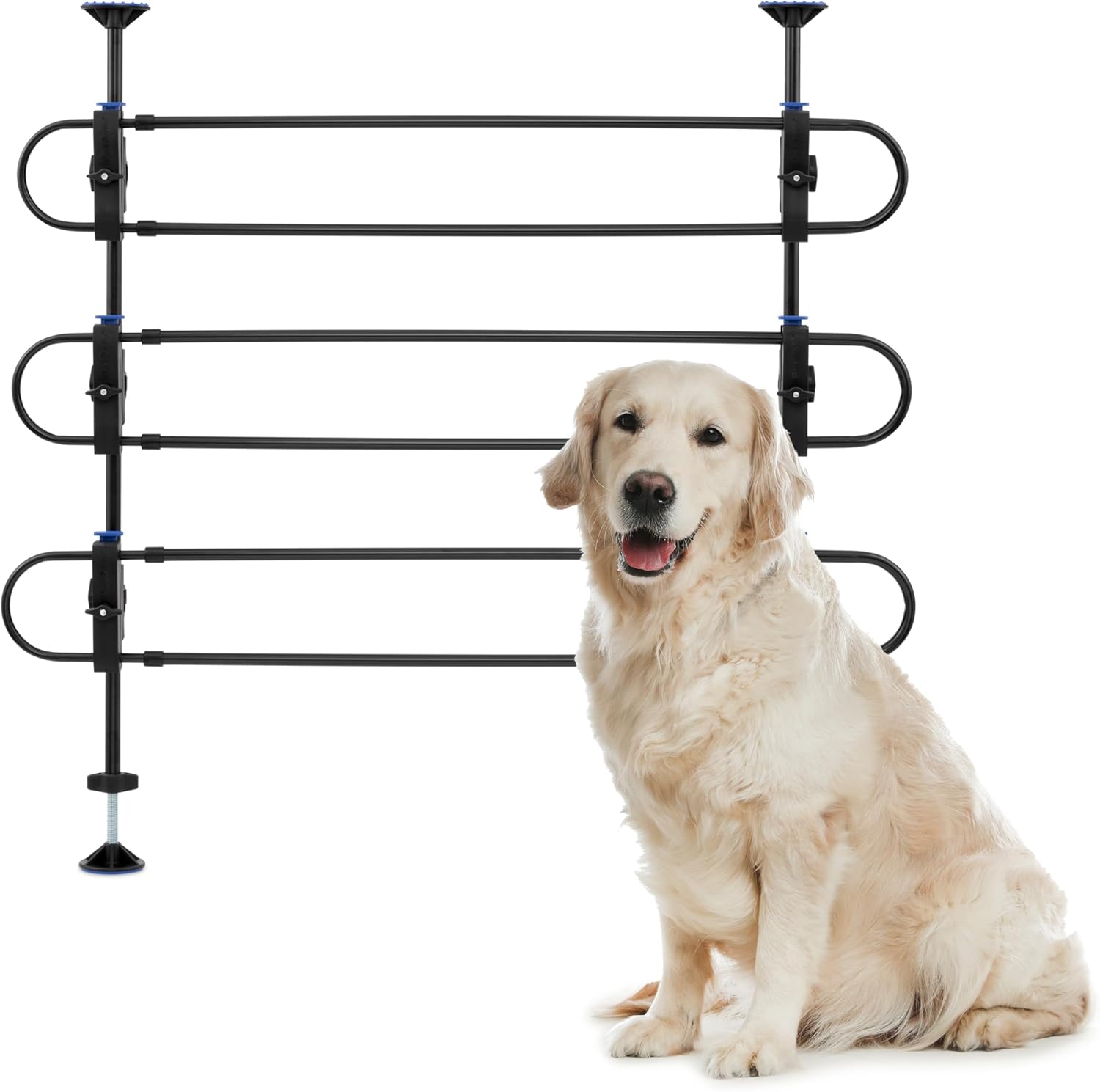
The PetSafe Happy Ride is a metal, tension-mounted dog barrier designed for quick, tool-free installation and removal. It assembles from a few frame pieces and uses adjustable tension to hold itself in the cargo area, so you can fit it, remove it, and stow it in the included pouch between trips. The open metal grid preserves your view of the rear cabin and reduces the feeling of separation for the dog. Rubberized caps on contact points help prevent slipping and minimize rattles on the road. In practice it works well for day trips and regular use when you need a fast way to keep a pet from entering the passenger area. The barrier is adjustable to accommodate different cargo shapes, but because it is tension-mounted it is not a bolt-in safety restraint and will not replace a secured crate or harness in a crash. Expect some fitment fiddling to get the tension right in certain cargo layouts on SUVs like the Ford Explorer from 2011 to 2019.
Best for: Drivers who prioritize a fast, tool-free barrier they can fit or remove between trips and want a tidy, visible separation in their 2011–2019 Ford Explorer.
Less Ideal for: Anyone looking for a crash-tested, permanent partition or a barrier that secures to mounting points should consider bolted options or a crate-based solution instead.
- Tool-free, tension-fit installation for quick in-vehicle setup and removal
- Sturdy metal frame gives a rigid separation without blocking rear visibility
- Rubberized caps reduce slipping and rattle for quieter travel
- Breaks down and stores in the included pouch for convenient transport
- Tension mounting is not a crash-rated or permanent restraint and offers limited protection in a collision
Verdict: This category suits drivers who need a barrier they can fit and remove quickly without tools while still maintaining a secure separation.
Choosing the Right 2011-2019 Ford Explorer Dog Car Barrier: Key Factors to Consider
Fitment to Explorer Cargo Area
Correct fitment is the foundation of an effective barrier. The 2011-2019 Explorer has a specific cargo width, roof height, and rear-seat geometry that affect how a barrier mounts and seats. A barrier that is too narrow or too short will allow a determined dog to bypass it, while an oversized unit can interfere with hatch closure or block access to cargo tie-downs.
When assessing fit, consider whether the barrier mounts between the cargo floor and roof, attaches to the headrests on the second row, or uses the vehicle's existing anchor points. Adjustable systems accommodate minor dimensional differences between trim levels and optional third-row configurations. Ensure the barrier design does not obstruct vents, lighting, or emergency release handles in the Explorer cargo area.
Mounting Method and Installation
Mounting approach influences how secure the barrier feels and how simple it is to install or remove. Common methods include pressure-mounted posts, headrest-mounted brackets, bolt-in anchors, and straps attached to cargo hooks. For the Explorer, headrest or cargo-hook attachments are often the least invasive and quickest to install without tools.
Evaluate whether installation requires tools, if instructions are clear, and whether the hardware avoids permanent alterations to the vehicle. Consider how easily you can remove the barrier when you need full cargo access and how long that process takes. A secure installation also minimizes movement and noise while driving, which matters for both pet comfort and driver concentration.
Strength and Material Durability
A barrier must withstand pushing, scratching, and incidental impacts from a pet. Steel and reinforced aluminum frames paired with welded mesh or heavy-duty panels offer robust containment. Plastic or thin wire designs can be lighter but may not resist an active or large dog over time.
Think about chew resistance, corrosion protection for metal components, and whether the finish will scuff or flake in the Explorer's cargo environment. High-quality materials extend service life and maintain a tidy appearance. Also consider the longevity of fasteners, strap webbings, and padding where the barrier contacts interior trim to avoid accelerated wear.
Adjustability and Compatibility
Adjustable features let a single barrier accommodate different seat positions, optional third-row stowage, and aftermarket accessories in the Explorer. Telescoping posts, sliding crossbars, and multiple bracket positions can help achieve a snug, rattle-free fit across the 2011-2019 model years and trim variations.
Compatibility also covers whether the barrier allows seat folding or partial cargo access without full removal. Some barriers offer split configurations or hinged panels to preserve cargo flexibility. Confirm that the adjustment range matches the Explorer's interior dimensions to avoid purchasing an item that only fits a narrow subset of model years or trim levels.
Safety and Certification
Safety should guide your choice more than weight or aesthetics alone. Look for barriers designed to reduce pet movement in the passenger area and that integrate securely with the vehicle to prevent detachment in sudden stops. While not all barriers are crash-tested, designs that include reinforced anchoring points and load-rated hardware provide more predictable performance under stress.
Check for user-tested assembly and clear load or weight guidance. Also consider possible interference with airbags or rear seat belt systems; proper installation should not impede any factory safety features in the Explorer. Materials should be non-toxic and free of sharp edges that could injure a pet during normal movement.
Practical Use and Maintenance
Practical considerations determine long-term satisfaction. A barrier that is easy to clean, lightweight to remove, and compact to store when not in use will see more regular use. Removable panels or washable covers simplify cleaning after muddy trips or shedding seasons.
Also think about noise and vibration. Padded contact points reduce rattling against interior trim in the Explorer. Storage space when the barrier is not required matters if you occasionally need the full cargo area for large items. Finally, review whether replacement parts and hardware are readily available to extend the product life.
Which Mounting Style Works Best in the Explorer
The Explorer accepts several barrier mounting styles, each with tradeoffs. Headrest-mounted systems are quick to fit and remove, and they avoid contact with the cargo trim, but they depend on robust headrest posts and may not suit heavy or persistent dogs. Pressure-mounted posts offer a strong, tool-free install between floor and roof, but they require careful adjustment to avoid damaging interior panels.
Bolt-in or bracket-mounted barriers are the most secure long-term solution when you plan to keep a barrier installed, though they may involve more installation effort and minor vehicle alteration. Strap and hook systems that attach to factory cargo points provide a middle ground, combining decent hold with minimal intrusion into the Explorer cabin.
- Headrest mounts: fast installation, minimal intrusion
- Pressure-mounted posts: strong hold, careful setup needed
- Bolt-in brackets: highest security, more permanent
- Strap-hook systems: flexible and vehicle-friendly
Preparing Your Explorer Before Installation
Before installing a barrier, clear the cargo area of loose items that could obstruct fitment. Fold or adjust the second-row seats to the configuration you normally use so you can confirm how the barrier will interact with seat positions and headrests.
Locate existing cargo hooks, anchor points, and headrest posts. Clean contact surfaces to prevent slipping and to avoid trapping dirt between the barrier and interior panels. If the barrier uses pressure posts, measure the distance from floor to ceiling and note any irregularities such as a sunroof recess that could affect seating.
- Check seat positions and headrest heights
- Inspect cargo hooks and anchor points
- Measure floor-to-roof distance if using telescoping posts
- Remove or secure loose items before installation
Tips for a Rattle-Free, Secure Fit
Even a properly sized barrier can rattle if not secured against the Explorer's interior. Use the included padding or add foam strips at contact points to dampen vibration and protect trim. Tighten adjustable fittings incrementally and test for movement by pushing the barrier from different angles.
Consider adding secondary straps to anchor the barrier to lower tie-downs or seat frames where the design allows. Periodically recheck fasteners and straps, especially after heavy use or off-road driving, to ensure the barrier remains stable and silent.
- Add padding at contact points to reduce noise
- Tighten fittings in stages and test for slop
- Use secondary tie-downs where possible
- Recheck hardware after long trips or rough roads
Preserving Cargo Flexibility With Split or Hinged Designs
If you frequently need to carry both cargo and a pet, look for barriers with split panels or hinged sections that permit partial seat folding. These designs let you access a portion of the cargo area without removing the entire barrier and can be especially useful in the Explorer when transporting longer items while keeping a pet contained.
Evaluate how easily each section unlatches and whether the mechanism is secure against accidental opening. A good split design balances ease of use with positive locking to prevent gaps that a pet could exploit.
- Split panels let you access cargo without full removal
- Hinges should lock positively to prevent accidental openings
- Check clearance when seats are folded with a split barrier installed
Cleaning, Storage, and Long-Term Care
Barriers exposed to pet hair, dirt, and moisture need regular care. Removable covers or panels make cleaning simpler. Wipe down metal frames with a damp cloth and use a mild detergent on fabric components. Ensure all parts are fully dry before reinstallation to prevent mildew.
For storage, collapse or disassemble components according to the maker's instructions and protect small hardware in labeled bags. Storing the barrier in a dry place preserves finishes and prevents corrosion, which is important given the Explorer's interior climate swings between seasons.
- Use removable covers or washable panels when possible
- Dry all components thoroughly before storage
- Label hardware bags to simplify reassembly
- Store in a dry, temperature-stable location
Still looking for the perfect fit?
Select your Ford Explorer configuration to see the most relevant Dog Car Barriers recommendations
How We Chose the Best 2011-2019 Ford Explorer Dog Car Barrier
We evaluated options that specifically accommodate the cargo dimensions and interior attachment points typical of 2011-2019 Ford Explorer models. Selection prioritized barriers that offer multiple secure mounting methods compatible with the Explorer's seat structures and cargo tie-downs. We favored materials and construction that resist chewing and flexing, and that maintain integrity under repeated loading from active pets.Key editorial criteria included: fitment accuracy for Explorer cargo and rear-seat geometries; installation ease and clarity of mounting hardware; structural strength and material durability; adjustability to compensate for trim and accessory variations; and user serviceability for cleaning and storage. We excluded barriers that require vehicle modifications, permanent drilling, or that lack clear fitment guidance for the Explorer years specified. Products with marginal fastening systems or unclear weight ratings were also removed from consideration.This process yielded a concise set of candidates that balance secure containment with installer-friendly design and long-term durability for Explorer owners.
Our full evaluation process is outlined in our review methodology.
FAQ
Will a universal dog car barrier fit my 2011-2019 Ford Explorer?
Universal barriers can fit if they offer enough adjustability in width and height to match the Explorer cargo space. Check the product's adjustment range and mounting options to ensure it covers the Explorer's dimensions and attachment points.
Can I install a barrier without drilling into the Explorer?
Yes. Many barriers use headrest mounts, pressure posts, or strap-and-hook systems that avoid drilling. If you prefer a bolt-in solution for maximum security, plan for a more involved installation and confirm whether the process affects warranty or trim.
Will a barrier block the rear HVAC vents or lights in the cargo area?
Some barrier placements can obstruct vents or interior lights depending on the design and mounting height. When selecting a barrier, verify that it leaves vents, lights, and emergency releases accessible in your Explorer.
How do I measure my Explorer to ensure compatibility?
Measure the cargo width at the points where the barrier will contact the trim, and measure floor-to-ceiling height where pressure or telescoping posts will seat. Also note headrest post spacing and any obstructions such as folded-seat latches that could affect installation.
Is a metal mesh barrier better than a fabric divider for large dogs?
Metal mesh and rigid panels typically offer greater containment against large or energetic dogs. Fabric dividers can be lighter and easier to store but may not resist strong pushing or chewing as well as rigid constructions.
Can I still fold the second-row seats with a barrier installed?
That depends on the barrier design. Some barriers have split or hinged sections that permit partial seat folding, while rigid single-piece barriers usually require removal to fold seats fully. Check the product's functionality against how you use your Explorer's seats.
Final Verdict
Focus on a barrier that fits the Explorer's cargo geometry and mounts securely without compromising factory features. Prioritize robust attachment methods and durable materials if you transport an active or strong dog, and choose adjustable systems if you need flexibility across different seat configurations. Consider ease of cleaning and storage so the barrier remains practical for regular use.In short, select the most secure mounting style you are willing to install and the material construction matched to your dog's size and behavior. That approach will deliver the safest, most reliable solution for a 2011-2019 Ford Explorer.
Explore More:
- Check out all Ford Explorer parts & accessories
- Explore Interior Accessories
- Browse all Accessories
