

Note: This article contains affiliate links. If you click on these links and make a purchase, I may earn a small commission at no extra cost to you. This helps support my research and content. Read my full affiliate disclosure here.
If you drive a Nissan Frontier, adding a dedicated dash cam can capture critical moments on the road, deter theft, and record evidence after an incident. A well-chosen dash cam gives you reliable video of collisions, parking events, and scenic drives without interfering with cabin space or visibility.This guide covers the top shortlisted dash cams for the Nissan Frontier. We evaluated models that balance clear daytime and nighttime recording, straightforward installation on the Frontier windshield, and features useful to Frontier owners such as parking recording and loop recording. Read on for the criteria we used and the features to prioritize before you pick one for your truck.
Looking for other parts? See all Nissan Frontier parts & accessories.
Top Picks at a Glance
| Best Overall Dash Cam The best all-around dash cam balancing features, reliability, and value | 70mai T800E 4K 3-Channel Dash Cam (Front, Inside, Rear) with GPS and Wi‑Fi 6 |  |
| Best Budget Dash Cam A low-cost dash cam that still records clear footage and runs dependably | galphi Q2 4K Front Dash Cam with 5G Wi‑Fi and 64GB Card |  |
| Best Premium Dash Cam A higher-end model with top video quality and advanced safety features | Garmin Dash Cam Live — 1440p Connected Windshield Dash Cam |  |
| Best 4K Dash Cam Ultra-high-resolution recording for exceptional detail in footage and evidence | ROVE R2-4K DUAL Dash Cam Front and Rear with SONY STARVIS 2 and 128GB Card |  |
| Best Dual-Lens Dash Cam Front-and-cabin or front-and-rear coverage for broader recording scope | VIOFO A129 Plus Duo Dual Dash Cam (Front 2K 60fps + Rear 1080p) |  |
| Best Compact Dash Cam A small, low-profile unit that’s easy to tuck behind the mirror | VANTRUE E1 Lite 1080P Compact Dash Cam with GPS and Wi‑Fi |  |
| Best Hardwired Dash Cam Designed for permanent installation with parking mode and constant power | 70mai A810 Lite 4K Dual Dash Cam (Front + Rear) with 5GHz Wi‑Fi 6 |  |
1. 70mai T800E 4K 3-Channel Dash Cam (Front, Inside, Rear) with GPS and Wi‑Fi 6
Best Overall Dash Cam

| Video Capture Resolution | 4K Front +1080P Rear+1080P Inside |
|---|---|
| Connectivity Technology | Wi‑Fi 6 |
| Included Memory Card Size | 64 GB |
| Flash Memory Supported Size Maximum | 512 GB |
| Other Special Features of the Product | 5‑mode GPS, G‑sensor, Supercapacitor, Night Vision |
The 70mai T800E is a well‑rounded 3‑channel dash cam built for complete coverage: a 4K front camera plus 1080p interior and rear sensors capture road, cabin, and rear events. It records continuously with loop recording and locks collision clips automatically using the G‑sensor, while the built‑in five‑mode GPS stamps location and speed to video for clear evidence when needed. The unit uses HDR, 3D noise reduction, and a wide F1.55 aperture for improved night performance, and the interior camera supports switchable IR for better cabin footage after dark. Wi‑Fi 6 and the 70mai app make transferring and downloading raw recordings faster, and voice commands let you lock footage hands‑free. Installation is plug‑and‑play with a windshield mount and the package includes a 64GB card and rear camera cable for a straightforward DIY fit. Note that continuous parking monitoring requires a compatible hardwire kit and the cam does not provide 4G connectivity; also audio is disabled by default for privacy and must be enabled if you want in‑cab sound.
Best for: Drivers who want a single, easy‑to‑install system that balances high daytime and nighttime video quality with reliable incident logging and simple app control for everyday use and rideshare duties in a Nissan Frontier.
Less Ideal for: Users who need built‑in cellular/cloud backup or fully uninterrupted parking recording without adding a hardwire kit should consider alternatives that include those features.
- True 4K front camera plus 1080p interior and rear channels for comprehensive coverage
- HDR, 3D noise reduction, and F1.55 aperture improve low‑light and night clarity
- Built‑in 5‑mode GPS and G‑sensor automatically log and lock incident footage
- Wi‑Fi 6 and companion app speed up file transfers and enable remote control
- Includes 64GB microSD and tidy plug‑and‑play windshield mounting for DIY installation
- Parking mode needs an optional hardwire kit for continuous monitoring
- No built‑in cellular connection for cloud backup
Verdict: The best all-around dash cam that balances video quality, reliability, ease of installation, and practical features for most drivers and DIY installers.
2. galphi Q2 4K Front Dash Cam with 5G Wi‑Fi and 64GB Card
Best Budget Dash Cam

| Video Capture Resolution | 2160p |
|---|---|
| Field Of View | 160 Degrees |
| Connectivity Technology | Wi‑Fi |
| Included Memory Card Size | 64 GB |
| Frame Rate | 30 fps |
The galphi Q2 is a compact front dash camera designed to capture 4K 2160p footage with a 160 degree lens and a minimal, screenless design. It mounts with an adhesive pad and begins recording when powered, saving clips to the included 64GB microSD and supporting up to 256GB cards. Built-in 5GHz Wi‑Fi and an app let you download clips faster and preview footage up close, while a G-sensor auto-locks collision clips and loop recording overwrites old files to keep recording without intervention. Night performance is helped by an f/1.6 aperture and WDR for clearer low-light captures. For continuous 24-hour parking monitoring you will need a separate Type-C hardwire kit. The lack of a display keeps distraction low but means setup and playback rely on the app or removing the card. For drivers who want a capable, budget-friendly front camera that records crisp daytime and improved night video, the Q2 covers core needs with a small, discreet footprint; users wanting built-in screens or cloud features should look elsewhere.
Best for: Drivers who prioritize reliable, high-resolution front recording and quick local file access on a tight budget and want a low-profile, distraction-free install for a Nissan Frontier.
Less Ideal for: Users who need an integrated screen, cloud streaming, or a factory-style multi-camera system; professional fleets requiring remote monitoring should consider models with networked features.
- True 4K 2160p recording for clear daytime evidence.
- Built-in 5GHz Wi‑Fi and app for faster file transfer and on-phone preview.
- Preinstalled 64GB microSD card and support for up to 256GB cards out of the box.
- G-sensor and loop recording automatically protect and manage incident files.
- Compact, screenless design reduces driver distraction and hides behind the mirror.
- Requires a separate hardwire kit to enable 24-hour parking monitoring.
- No built-in display so configuration and reviewing rely on the app or PC.
Verdict: The best low-cost dash cam for drivers who need reliable event recording and basic features without spending much money.
3. Garmin Dash Cam Live — 1440p Connected Windshield Dash Cam
Best Premium Dash Cam

| Video Capture Resolution | 1440p |
|---|---|
| Frame Rate | 60 FPS |
| Field Of View | 140 degrees |
| Flash Memory Type | microSD |
| Connectivity Technology | Bluetooth, LTE (subscription required) |
The Garmin Dash Cam Live is a premium connected dash camera designed to record high-resolution road video while giving you remote access to your vehicle. It captures 1440p footage at up to 60 fps with Garmin Clarity HDR optics and a 140 degree field of view, so daytime and night details are sharp and readable. The unit mounts low on the windshield via a magnetic mount and includes a preinstalled 16 GB microSD card and multiple power cables for flexible installation. Its standout feature is always-on LTE remote access through the Garmin Drive app, which enables live view, automatic upload to Garmin Vault, location tracking and theft or incident alerts when you subscribe. Voice control simplifies hands-free capturing and basic commands. Built-in driver alerts add situational awareness while driving. Important limitations are the need for an active LTE subscription to use remote features and that some cars may require a constant-power cable sold separately to enable parking surveillance. The camera is durable for hot interiors but adds complexity and ongoing subscription cost versus a basic dash cam.
Best for: Buyers who want top-tier video quality and connected features and are willing to pay for subscription-based remote access and cloud backup.
Less Ideal for: Drivers who prefer a simple, no-subscription dash cam or who want a completely self-contained unit without needing extra power wiring or mobile connectivity.
- 1440p HDR video at 60 FPS with a wide 140 degree lens for clear daytime and improved night detail
- Always-on LTE connectivity for live view, automatic cloud upload, location tracking and theft alerts
- Voice control for hands-free commands and quick captures in multiple languages
- Includes preinstalled 16 GB microSD card, low-profile magnetic mount and multiple power cables for out-of-box use
- Remote features require an active LTE subscription and may incur ongoing costs
- Parking surveillance may need a separate constant-power cable for some vehicles
Verdict: The best higher-end dash cam for buyers who prioritize superior video resolution, enhanced features, and build quality and are willing to pay extra for them.
4. ROVE R2-4K DUAL Dash Cam Front and Rear with SONY STARVIS 2 and 128GB Card
Best 4K Dash Cam

| Front resolution | 3840×2160P @30fps |
|---|---|
| Rear resolution | 1920×1080P @30fps |
| Sensor | SONY STARVIS 2 IMX675 |
| Display | 3" IPS wider display |
| Connectivity | Dual-band WiFi (5GHz/2.4GHz) |
The ROVE R2-4K DUAL is built for drivers who prioritize crisp, detailed evidence footage: the front camera records true 4K at 30 fps while the rear captures 1080p, and both lenses offer very wide fields of view to cover lanes around the vehicle. In practice the Sony STARVIS 2 sensor plus large apertures produce brighter, sharper footage in dawn, dusk, and urban night scenes, and HDR helps preserve detail in high-contrast situations. The included 128GB microSD and support for up to 1TB simplify storage for long trips, and built-in GPS stamps speed and location for forensic value. The 5 GHz WiFi and companion app let you download clips quickly without removing the card, and OTA firmware updates keep the unit current. Parking mode options and a supercapacitor for temperature resilience are practical for daily use, though full 24/7 parked surveillance requires a separate hardwire kit. Installation is typical for front-and-rear systems and the bundle includes most cables and mounts you need.
Best for: Drivers who want forensic-quality video for license-plate and incident detail and who value quick wireless access to recordings for review and sharing.
Less Ideal for: Buyers seeking a plug-and-play 24/7 fleet monitoring solution without additional accessories or professional hardwiring should consider other systems.
- True 4K front recording at 30 fps for high-detail footage
- Sony STARVIS 2 sensor and wide apertures improve low-light clarity
- Built-in GPS embeds speed and location for evidentiary value
- Fast dual-band 5 GHz WiFi and app enable quick downloads and OTA updates
- Includes 128GB microSD and supports up to 1TB storage
- Continuous 24/7 parked surveillance needs a separately sold hardwire kit
Verdict: The best 4K dash cam for drivers who want the highest video detail for license-plate clarity and forensic-quality incident footage.
5. VIOFO A129 Plus Duo Dual Dash Cam (Front 2K 60fps + Rear 1080p)
Best Dual-Lens Dash Cam

| Front resolution | 2560×1440P 60fps |
|---|---|
| Rear resolution | 1920×1080P 30fps |
| Image sensors | STARVIS IMX335 (front) + IMX307 (rear) |
| Power | Built-in supercapacitor |
| Connectivity | 2.4GHz Wi‑Fi, GPS logger |
The VIOFO A129 Plus Duo is a two-camera system designed to capture simultaneous front and rear video, making it useful for documenting collisions, hit-and-runs, and parking incidents on a Nissan Frontier. The front camera records at 2560×1440 at 60fps for clearer detail and smoother motion, while the rear records 1080p at 30fps. STARVIS sensors plus HDR improve nighttime clarity and help retain license plate detail in mixed lighting. Built-in GPS logs speed and route and the 2.0-inch LCD plus Wi‑Fi and the VIOFO app make previewing clips and changing settings quick. A supercapacitor steadies power across hot and cold conditions and removes battery-related failure risk. Parking-mode options include motion/event detection, time-lapse, and a low-bitrate continuous mode when used with a hardwire kit. Trade-offs: it does not include a microSD card or the hardwire kit required for full-time parking surveillance, and some advanced features need optional accessories. Installation on a Frontier is straightforward using the adhesive mounts and supplied rear cable routing.
Best for: Drivers who want continuous, simultaneous front-and-rear coverage on a Nissan Frontier to document on-road incidents and parking events for stronger evidence and peace of mind.
Less Ideal for: People who need built-in long-term parking power without buying a hardwire kit or users who require rear footage at the same high frame rate and resolution as the front camera.
- Simultaneous front 2K 60fps and rear 1080p recording for detailed incident capture
- STARVIS sensors and HDR improve low-light and high-contrast scenes
- Built-in GPS logger and Wi‑Fi for location/speed data and easy file transfer
- Supercapacitor for reliable power in extreme temperatures
- Multiple parking-mode options including motion, event detection, and time lapse
- microSD card and hardwire kit not included so full parking-mode use requires extra purchases
- Rear camera runs at 1080p 30fps while front is 2K 60fps, so rear detail is lower
Verdict: The best dual-lens dash cam for users who want simultaneous front and rear or interior recording to capture more of each incident.
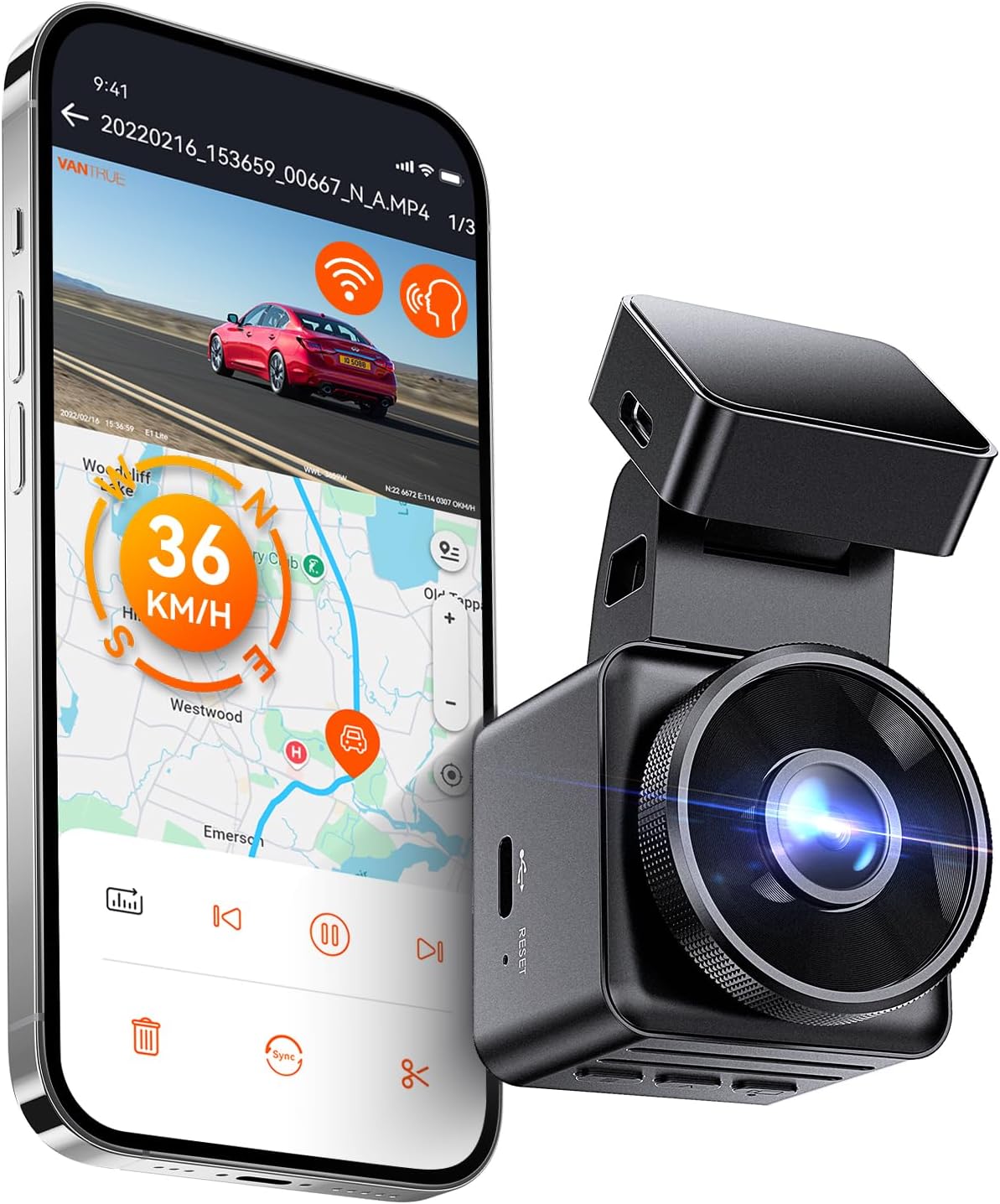
6. VANTRUE E1 Lite 1080P Compact Dash Cam with GPS and Wi‑Fi
Best Compact Dash Cam
| Video Resolution | 1080p |
|---|---|
| Field Of View | 160 Degrees |
| Connectivity Technology | Wi‑Fi |
| Frame Rate | 30 FPS |
| Max Storage Support | 512GB |
The VANTRUE E1 Lite is a small, windshield‑mounted front dash cam designed to record clear 1080p footage without drawing attention or blocking view. It captures 1920×1080 at 30fps with HDR and an f/1.8 aperture plus a wide 160 degree lens to preserve plate and scene detail day or night. Built‑in GPS logs speed and location, and Wi‑Fi paired with the Vantrue app lets you preview clips, download recordings, and share footage without removing the card. Voice commands and automatic incident detection make hands‑free operation straightforward, while loop recording and a G‑sensor lock important clips. For 24/7 parking monitoring you will need a hardwire kit, but the unit supports motion and impact triggers and stores events in a protected folder. The compact housing and small adhesive mount keep the cam low on the windshield, which suits drivers who want a discreet installation, though it does not support PD fast charging and requires a compatible microSD card (not included).
Best for: Drivers who want a discreet, easy‑to‑install front dash cam that stays out of sight while continuously recording daily drives and parking events for peace of mind in a Nissan Frontier.
Less Ideal for: Users seeking multi‑camera systems or 4K resolution should consider larger units with dual channels and higher‑resolution sensors instead.
- Compact, low‑profile housing that minimizes windshield obstruction
- 1080p HDR video with f/1.8 aperture and wide field of view for better low‑light detail
- Built‑in GPS records speed and route for evidence and trip logs
- Wi‑Fi and Vantrue app enable live view, downloading, and easy sharing
- Voice control and G‑sensor automatically lock incident footage without manual intervention
- No PD fast charging support; must use included charger or hardwire kit
- MicroSD card not included so storage requires separate purchase
Verdict: The best compact dash cam for drivers who prefer a discreet, space-saving unit that’s simple to mount and won’t obstruct the windshield.
7. 70mai A810 Lite 4K Dual Dash Cam (Front + Rear) with 5GHz Wi‑Fi 6
Best Hardwired Dash Cam

| Video Resolution | Front 3840×2160, Rear 1080p |
|---|---|
| Connectivity Technology | 5GHz Wi‑Fi 6 |
| Included Memory Card Size | 64 GB |
| Flash Memory Supported Size Maximum | 512 GB |
| Other Special Features of the Product | 24H Parking Mode, G-sensor, Loop Recording, 4G LTE support |
The 70mai A810 Lite is a hardwire-friendly dual dash cam designed for permanent installs and round-the-clock vehicle monitoring. It records the front view in true 4K and the rear in 1080p, with a 140 degree field of view and HDR plus an F1.55 aperture to improve low-light detail. The unit uses a supercapacitor for greater heat tolerance and longevity compared with internal batteries. With 5GHz Wi‑Fi 6 and an app you can quickly download footage or view live feed, and optional 4G LTE support and GPS enable remote live view and precise tracking when paired with the compatible hardwire kit. For parked-car protection it offers G-sensor incident locking, time-lapse parking recording, and low-voltage protection for safe hardwire operation. Installation hides cables behind the windshield and runs clean when connected to a hardwire kit, but full parking functionality and LTE remote features require purchasing and installing the compatible hardwire/4G accessory. MicroSD storage is supported up to 512 GB and a 64 GB card is included in the bundle.
Best for: Owners who want a permanently installed, discreet dash cam with continuous parking surveillance and remote monitoring options and expect a tidy wired installation.
Less Ideal for: Drivers who need a plug-and-play, battery-powered dash cam or who do not want to install a hardwire kit should consider simpler portable units instead.
- True 4K front plus 1080p rear recording for clear evidence capture
- Supercapacitor design improves heat resistance and lifespan for hot-cabin use
- 5GHz Wi‑Fi 6 and app control speed up file transfer and live view
- Built-in 3-mode GPS and voice control add hands-free operation and route data
- Supports 24-hour parking modes with G-sensor locking and time-lapse monitoring when hardwired
- Full parking surveillance and 4G remote access require purchasing a compatible hardwire or 4G kit separately
Verdict: The best hardwired dash cam for owners who want a permanently installed unit with parking surveillance, seamless power management, and a clean wired appearance.
Choosing the Right Nissan Frontier Dash Cam: Key Factors to Consider
Video Resolution And Sensor Quality
Resolution affects how much detail a camera records, which matters if you need readable license plates or clear facial detail after an incident. Look beyond megapixel counts and focus on the actual resolution modes available, such as 1080p or higher, and whether the sensor performs well in mixed lighting.
Sensor quality and dynamic range determine how the dash cam handles bright sunlight, shadows, and headlights at night. A model with good low-light sensitivity and HDR will capture more usable footage across varied driving conditions encountered by Frontier owners, from highway midday sun to dimly lit parking lots.
Mounting, Field Of View, And Placement
The windshield angle and cabin layout of the Frontier influence where a camera can be mounted without blocking sightlines. Consider compact mounts or low-profile units that tuck behind the rearview mirror to preserve visibility.
Field of view is a trade-off: wider angles capture more of the road and adjacent lanes but can introduce distortion at the edges. Choose a camera with an appropriate FOV that frames the lane and hood without excessive fisheye, and ensure the mount allows for easy leveling and adjustment so the image is centered on the road ahead.
Power Options And Parking Mode
How a dash cam is powered affects both installation complexity and parked surveillance capability. Many Frontier owners prefer units that can be hardwired to the fuse box for permanent power and an unobtrusive cable run, while others use a 12V outlet with an optional hardwire kit later.
Parking mode is essential if you want the camera to record while the truck is unattended. Look for built-in G-sensor event detection, time-lapse or low-bitrate motion detection to limit battery draw, and safe shutdown behaviors that protect both the camera and the truck battery.
Storage, Loop Recording, And File Protection
Continuous recording quickly fills storage, so loop recording is critical to overwrite old footage automatically. Check supported microSD sizes and whether the camera formats cards reliably. File management features such as incident file lock or automatic saving on impact prevent crucial clips from being overwritten.
Also consider how easy it is to retrieve footage. Cameras with Wi-Fi or USB export make it quicker to pull a clip after an event; models that require card removal add friction but can be more secure in some setups.
Connectivity And User Interface
Built-in Wi-Fi and a mobile app simplify settings, firmware updates, and clip downloads without removing the card. Evaluate the app experience for stability, speed of file transfer, and clarity of live view for aiming the camera during installation.
For users who prefer minimal wireless dependencies, a responsive onboard menu and readable screen can be enough. The interface should make it straightforward to change resolution, toggle parking mode, and manage files without frequent reconfiguration.
Durability, Heat Tolerance, And Warranty
Pickup trucks like the Frontier can sit in hot sun for extended periods, so a dash cam must tolerate elevated temperatures in the cabin. Check manufacturer specifications for operating temperature ranges and look for robust housings and adhesives for the mount.
A clear warranty and accessible support are important because dash cam malfunctions can be tricky to diagnose and may require replacement adhesives or firmware updates. Reliable customer support and a reasonable warranty term reduce long-term ownership risk.
Front And Rear Recording Options
Deciding between a single front camera and a dual front-and-rear setup depends on what you want to capture. A compact single front camera focuses on incident coverage ahead of the truck and is often easier to install with less cab clutter. Dual systems provide rear coverage for backing incidents, hit-and-runs, or trailer interactions when fitted correctly.
If you frequently tow or carry a bed load, consider the mounting path and whether a rear camera can be routed and secured without interfering with accessories. Rear units typically need a clean view through the rear window, so tint, bed covers, or cargo can affect performance.
- Single front cameras are simpler to install and usually less visible.
- Dual cameras cover front and rear events but require additional cable routing.
- Rear camera placement should avoid obstructions like headrests, cargo, and heavy tint.
Mount Types And Windshield Compatibility
Dash cams come with adhesive pads or suction mounts. Adhesive mounts are lower profile and hold better long term, but they are permanent once applied. Suction mounts allow for repositioning but can be bulkier and are susceptible to heat-related failure over time.
For the Nissan Frontier, a low-profile adhesive mount that places the camera close to the mirror keeps the device out of the driver view and aligns well with the windshield curvature. Confirm the mount allows cable routing along the headliner and A-pillar for a factory-like installation.
- Adhesive mounts stay put and reduce vibration when applied to clean glass.
- Suction mounts ease repositioning but can be bulkier.
- Mount location affects both visibility and the camera's angle of view.
Parking Surveillance Strategies
If you park your Frontier on the street, in shared lots, or at work, parking surveillance can capture vandalism or hit-and-run events. Choose cameras with low-power parking modes that activate only on motion or impact to protect the truck battery. Time-lapse parking recording is another efficient approach that records at longer intervals and conserves storage.
Hardwiring with a dedicated parking mode fuse tap provides continuous monitoring without relying on the accessory power port. When selecting cables and routing, plan for areas where the vehicle may be bumped and ensure connections are secure and protected from moisture.
- Use motion or G-sensor-triggered parking modes to conserve power.
- Time-lapse can extend recording duration with lower storage use.
- Hardwiring is recommended for reliable long-term parking surveillance.
Power And Cable Routing Tips For The Frontier
Route power cables up the A-pillar and tuck them behind trim panels to keep the installation neat. On the Frontier, the headliner and A-pillar trim allow discreet routing when done carefully; use plastic pry tools to avoid damaging clips. Secure the cable with adhesive clips or zip ties to prevent rattles.
If you plan to hardwire, identify an ignition-switched fuse and a constant power fuse for parking features. Consider using a low-voltage cut-off or dedicated hardwire kit designed to protect your battery when parked for extended periods.
- Tuck the cable into the headliner and down the A-pillar for a factory look.
- Use plastic trim tools to avoid broken clips during routing.
- A low-voltage protector helps prevent battery drain during parking mode.
Storage And Retrieval Best Practices
Use a high-endurance microSD card rated for continuous video recording. Lower-grade cards are prone to errors and premature failure under loop recording workloads. Format the card in the camera before first use to ensure compatibility and stable performance.
After an incident, retrieve footage promptly and make a backup copy before powering the card in another device. If the camera supports Wi-Fi, transfer critical clips to your phone for temporary storage, then move them to longer-term storage when convenient.
- Choose high-endurance cards and format them in-camera.
- Back up incident clips immediately to avoid accidental overwrites.
- Use Wi-Fi for quick transfers, then archive important footage separately.
Maintaining Reliable Performance Over Time
Check mounts and cable runs periodically to make sure adhesives and clips remain secure, especially after temperature cycles or off-road use. Clean the windshield area behind the camera to prevent dust and smudges from degrading image quality.
Keep firmware up to date to benefit from stability fixes and feature improvements. Regularly review recorded clips to ensure event detection is functioning and adjust sensitivity settings if you notice too many false triggers or missed events.
- Inspect mounts and cables after extreme temperature changes.
- Clean the windshield to maintain clear image capture.
- Update firmware and periodically test event detection settings.
How We Chose the Best Nissan Frontier Dash Cam
We started by focusing on features that matter specifically to Nissan Frontier owners and typical pickup-truck use. Key evaluation criteria included video resolution and sensor performance, mounting flexibility and field of view suitable for the Frontier windshield, parking and impact detection reliability, power and hardwiring options for parked surveillance, and ease of installation and cable routing compatible with truck interiors.We also reviewed whether units supported front and rear recording or compact single-camera setups that preserve windshield sightlines. Connectivity features such as Wi-Fi or mobile app access were considered for footage review and firmware updates. Loop recording and secure file protection for incident clips were required to ensure continuous coverage without manual management.We excluded units with poor low-light performance, overly intrusive mounts, or unclear documentation that would complicate installation in a pickup. Models lacking reliable parking modes or that required proprietary or hard-to-find accessories were not considered. The final picks balance practical performance, installation simplicity, and the specific needs of Frontier drivers.
Our full evaluation process is outlined in our review methodology.
FAQ
Can I install a dash cam in my Nissan Frontier without professional help?
Often yes. Many Frontier owners can install a dash cam using adhesive mounts and the 12V accessory outlet. For hardwiring or neat cable routing behind trim, some drivers prefer a professional installer or follow detailed DIY guides to avoid damage to clips and ensure proper fuse selection.
Will a dash cam drain my Frontier's battery while parked?
It depends on the camera and how parking mode is configured. Cameras with proper low-power parking modes or a hardwire kit with low-voltage cutoff minimize battery drain. Leaving full-time recording on without protections can risk battery depletion.
Is front-only recording enough for truck owners?
Front-only recording covers most forward collisions and road incidents, which is sufficient for many drivers. However, if you frequently back up in tight spaces, park on busy streets, or tow, adding rear coverage can provide additional protection and peace of mind.
What microSD card should I use for continuous recording?
Use a high-endurance microSD card specifically rated for surveillance or dash cam use. These cards are designed for constant write cycles and handle loop recording workloads better than general-purpose cards. Always format the card in the camera before use.
Do dash cams work well at night in a Frontier?
Night performance varies by sensor and lens quality. Cameras with larger sensors, good low-light sensitivity, and HDR deliver clearer nighttime footage. Placement and a clean windshield also influence night image clarity.
Can I connect a dash cam to my phone for playback and settings?
Many modern dash cams offer Wi-Fi and companion apps for live view, settings adjustments, and clip downloads. App stability and transfer speed vary by manufacturer, but wireless access is convenient for quickly retrieving footage without removing the card.
Final Verdict
Choose a dash cam for your Nissan Frontier by prioritizing reliable video quality, easy installation, and the power options that match how you use the truck. Decide early whether you need rear coverage and parking surveillance, as those choices affect installation complexity and wiring requirements.Balance resolution and low-light performance with practical concerns like mount profile and storage management. With those tradeoffs in mind, you can confidently pick a dash cam that provides clear, dependable recording for daily driving and parked protection.
Explore More:
- Check out all Nissan Frontier parts & accessories
- Explore Electronics
- Browse all Accessories
