

Note: This article contains affiliate links. If you click on these links and make a purchase, I may earn a small commission at no extra cost to you. This helps support my research and content. Read my full affiliate disclosure here.
If you spend time on and off pavement in a Jeep Gladiator, a purpose-built dash cam can protect you with continuous video evidence and capture memorable drives. A good Gladiator dash cam records clear daytime and nighttime video, handles vibration and dust from trail use, and keeps footage safe during parking. This guide shortlists seven top picks chosen for durability, image quality, and ease of installation specific to the Gladiator cockpit and windshield layout. Below we explain how each option was evaluated across video performance, mounting and power options, and features that matter to Gladiator owners.
Looking for other parts? See all Jeep Gladiator parts & accessories.
Top Picks at a Glance
| Best Overall Dash Cam The top all-around dash cam balancing features, reliability, and value | GATGIT Front 4K OEM-Style Dash Cam with GPS and 5.8GHz Wi‑Fi |  |
| Best Budget Dash Cam A low-cost option that still records essential driving footage reliably | galphi Q2 4K Front Dash Cam with 5G WiFi and 64GB Card |  |
| Best 4K Dash Cam Highest-resolution recording for maximum detail in footage and evidence | mangoal 4K Front + 2K Rear Dual STARVIS 2 Dash Cam — Jeep JL/JT Fit |  |
| Best Dual-Lens Dash Cam Front-and-cabin or front-and-rear coverage for complete incident capture | ROVE R2-4K DUAL Dash Cam Front and Rear with STARVIS 2 Sensor |  |
| Best Compact Dash Cam A small, unobtrusive unit that fits behind the rearview mirror | AVAPOW X1 4K Compact Front Dash Cam with Wi‑Fi 6 and Hardwire Kit |  |
| Best Wi-Fi / App Dash Cam Built-in connectivity for quick video transfer and phone-based settings | 70mai A810 Lite 4K Dual Front and Rear Dash Cam with 5GHz Wi‑Fi 6 |  |
| Best Premium Dash Cam A higher-end model with top-tier sensors, features, and build quality | VIOFO A329S 3‑Channel 4K Front + 2K Cabin & Rear Dash Cam (STARVIS 2, Wi‑Fi 6) |  |
1. GATGIT Front 4K OEM-Style Dash Cam with GPS and 5.8GHz Wi‑Fi
Best Overall Dash Cam

| Video Capture Resolution | 2160p |
|---|---|
| Connectivity Technology | Wi-Fi |
| Field Of View | 155 Degrees |
| Built-In Media | 64GB card included |
| Control Method | App |
This GATGIT front dash cam is a plug-and-play, vehicle-specific unit made to blend into Gladiator and Wrangler interiors while recording 4K HDR video. It mounts to the windshield and connects to the factory connector with no hardwiring required, so installation is straightforward for DIY mechanics who prefer a tidy, integrated result. The 3840×2160 footage at 30 fps benefits from HDR and a fast f/1.6 aperture for clearer license plates and better low-light detail, while a 155 degree field of view captures a wide stretch of the road. Built-in GPS logs speed and route, and a G‑sensor locks collision clips; loop recording keeps storage cycling and the included 64 GB card gets you started. The 5.8 GHz Wi‑Fi and mobile app make downloading and reviewing clips fast. Limitations to consider are that true 24/7 parking surveillance requires an optional hardwire kit and the unit is tailored for specific Jeep models, so it is not a universal dash cam solution.
Best for: Drivers of Gladiator or Wrangler models seeking a high-resolution, integrated dash cam that looks factory-installed and is easy to fit without professional hardwiring.
Less Ideal for: Buyers who want a single universal dash cam for multiple vehicle types or those who need out-of-the-box 24/7 hardwired parking surveillance without additional accessories.
- Vehicle-specific OEM-style fit for a clean, factory-integrated look and simple plug-in installation
- 4K (3840×2160) recording with HDR and f/1.6 aperture for clearer daytime and improved low-light footage
- Built-in GPS and G‑sensor that lock and tag important clips for use as evidence
- 5.8 GHz Wi‑Fi and companion app for fast previewing, downloading, and managing footage
- Includes 64 GB card, card reader, and installation tools so you can start recording right away
- Full 24/7 parking mode requires purchasing and installing a separate hardwire kit
Verdict: The best all-around dash cam that balances video quality, ease of use, reliability, and feature set for most drivers and DIY mechanics.
2. galphi Q2 4K Front Dash Cam with 5G WiFi and 64GB Card
Best Budget Dash Cam

| Video Capture Resolution | 2160p |
|---|---|
| Field Of View | 160 Degrees |
| Frame Rate | 30 fps |
| Included Memory Card Size | 64 GB |
| Flash Memory Supported Size Maximum | 256 GB |
The galphi Q2 is a compact, screenless front dash cam that records 4K/2160p at 30 fps with a 160 degree field of view, making it a practical budget choice for daily driving in a Jeep Gladiator. It mounts with an adhesive pad and starts recording when it receives power, using loop recording plus a G-sensor to lock collision footage. The super night vision features, F1.6 aperture and WDR help keep license plates and lane details visible at night and in poor weather. Built-in 5GHz WiFi and an app let you download clips faster than older 2.4GHz models, and a 64GB card is included so you can start using it right away. There is no built-in display so setup and playback rely on the phone app, and enabling parking mode requires an optional hardwire kit. For Gladiator owners who want straightforward, high-resolution daytime evidence and easy wireless transfers, this delivers strong value; if you need cloud features, remote monitoring, or a front-plus-rear system, look elsewhere.
Best for: Budget-minded Gladiator owners who want reliable, high-resolution daytime recording and easy wireless downloads without paying for extras like cloud services or a rear camera.
Less Ideal for: Drivers who need remote cloud streaming, a dual-channel front-and-rear setup, or built-in screen controls should consider more feature-rich systems.
- True 4K 2160p recording for clear daytime footage
- 5GHz WiFi and phone app for faster file transfer and convenient playback
- Included 64GB microSD card lets you install and record immediately
- G-sensor and loop recording automatically protect and manage incident clips
- Compact, low-profile design reduces windshield obstruction and driver distraction
- No built-in display so configuration and playback require a smartphone app
- 24-hour parking mode needs a separate hardwire kit
Verdict: The best low-cost dash cam that provides dependable daytime recording and basic features without breaking the bank, ideal for budget-minded buyers.
3. mangoal 4K Front + 2K Rear Dual STARVIS 2 Dash Cam — Jeep JL/JT Fit
Best 4K Dash Cam

| Compatible Vehicle Type | Jeep Gladiator JT 2020-2023, Wrangler JL 2018-2023 |
|---|---|
| Video Capture Resolution | Front 4K, Rear 2K |
| Sensors | Dual STARVIS 2 (IMX678 front, IMX675 rear) |
| Connectivity Technology | USB; 5GHz Wi-Fi & App Control |
| Included Memory Card Size | 128 GB |
This mangoal dash cam is a custom-fit, two-channel system designed to mount behind the rearview mirror on Jeep Wrangler JL and Gladiator JT models. The front camera records 4K@30fps with an IMX678 STARVIS 2 sensor while the rear records 2K@30fps on an IMX675, giving very high-resolution footage for capturing license plates and distant details in both day and night conditions. The unit uses HDR 2.0 and a 150-degree field of view to balance highlights and shadows and reduce overexposure in bright scenes. It includes a parking monitor, G-sensor automatic incident detection, loop recording, and an external GPS module for route and speed logging. Configuration and live preview are handled through a fast 5GHz Wi-Fi connection and the mangoal app. The system comes with a 128GB card and an auto-dimming plug power adapter for an OEM-like installation, but GPS requires the included external module and advanced features depend on app stability and vehicle integration, so expect some setup time to reach optimal performance.
Best for: Buyers who need the highest-resolution dash-cam footage on a Jeep JL or JT to reliably capture fine details like plates or distant incidents and who value a factory-like, concealed installation.
Less Ideal for: Drivers who want a simple plug-and-play camera without any accessory setup or those who need a built-in GPS solution with no external modules.
- True 4K front recording with STARVIS 2 sensor for clear license-plate and distance detail
- Rear 2K channel with STARVIS 2 improves night and low-light rear coverage
- Custom fit for Jeep Wrangler JL and Gladiator JT for tidy, OEM-style installation
- 5GHz Wi-Fi and companion app enable quick live view, configuration, and file transfer
- Includes 128GB card and auto-dimming plug for out-of-box use and cleaner wiring
- GPS is not built into the unit and requires connection of the external GPS module to log routes
Verdict: The best 4K dash cam for users who prioritize ultra-high-resolution video to capture fine detail like license plates and distant events.
4. ROVE R2-4K DUAL Dash Cam Front and Rear with STARVIS 2 Sensor
Best Dual-Lens Dash Cam

| Front resolution | 3840x2160P @30fps |
|---|---|
| Rear resolution | 1920x1080P @30fps |
| Sensor | Sony STARVIS 2 (IMX675 front) |
| WiFi | Dual-band 2.4/5 GHz, up to 20 MB/s download |
| Included storage | 128 GB microSD card included |
The ROVE R2-4K DUAL is a front-and-rear dash cam package designed to capture simultaneous footage from both directions, making it useful for recording incidents around a Jeep Gladiator. The front camera records true 4K at 30 fps while the rear records 1080p at 30 fps; wide 150°/140° lenses help capture more of the roadway and surroundings. Sony STARVIS 2 sensor plus wide apertures improve night and low-light clarity, and the included 128 GB microSD gives you immediate storage out of the box. Built-in GPS stamps speed and location on recordings and the 3" IPS display and 5 GHz WiFi let you preview and download clips quickly via the ROVE app. For parking surveillance the camera supports motion, collision detection, and a 24/7 parking mode when hardwired. Expect easy mounting with the supplied suction and adhesive mounts and a long rear extension cable for Gladiator bed or cab routing. Downsides are that advanced parking requires a separately sold hardwire kit and large 4K files will use significant storage and battery or hardwire resources during long parking monitoring.
Best for: Drivers who want continuous front and rear coverage to document incidents and capture low-light details while driving or parked, and who plan to install a hardwire kit for true 24/7 protection.
Less Ideal for: Users who only need a simple single-camera setup or who do not want to hardwire the unit for parking surveillance should consider simpler alternatives.
- True 4K front and 1080p rear simultaneous recording for comprehensive coverage
- Sony STARVIS 2 sensor and wide apertures for improved low-light and night footage
- Built-in GPS records speed and location stamps for evidentiary value
- Fast dual-band 5 GHz WiFi and ROVE app let you preview and download clips quickly
- Includes 128 GB microSD card and long rear extension cable for easier installation in larger cabs or beds
- Hardwire kit required to enable continuous 24/7 parking mode
- 4K video produces large files that consume storage and need frequent offload or high-capacity cards
Verdict: The best dual-lens dash cam for drivers who want simultaneous front and rear or interior coverage to record more angles during incidents.
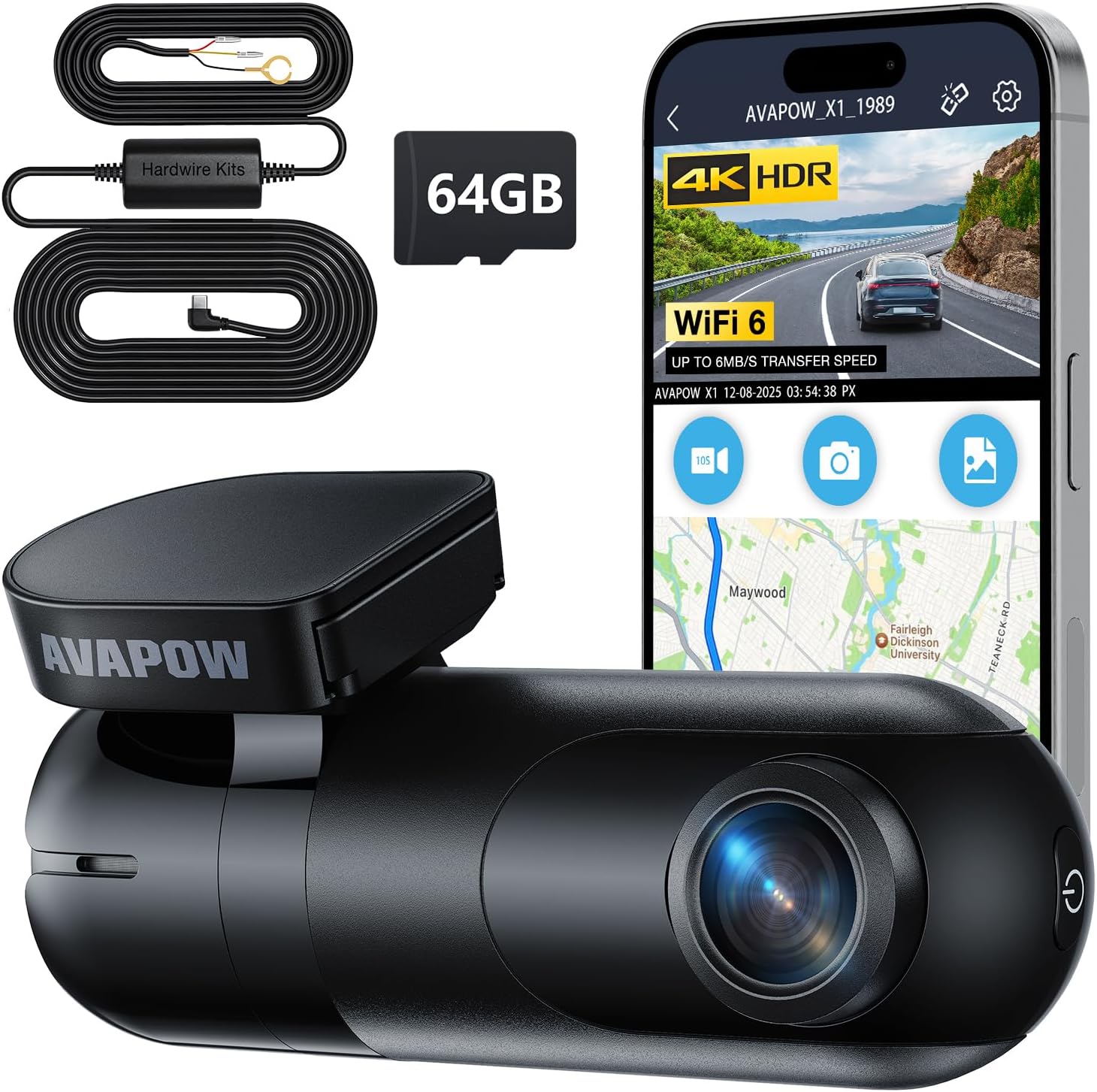
5. AVAPOW X1 4K Compact Front Dash Cam with Wi‑Fi 6 and Hardwire Kit
Best Compact Dash Cam
| Resolution | 3840×2160P (4K) @30fps |
|---|---|
| Wide angle | 170° front lens |
| Connectivity | Wi‑Fi 6 with phone app |
| Included storage | 64GB microSD card |
| Special features | G‑sensor, Loop Recording, Night Vision, Parking Monitor |
The AVAPOW X1 is a small, low‑profile front dash cam designed to stay discreet on the windshield while delivering ultra‑sharp 4K footage. It records 3840×2160 at 30 fps with a 170° lens, making license plates and road signs legible in daytime and, with WDR/HDR processing, improving low‑light captures. Built‑in Wi‑Fi 6 and a phone app let you download clips and change settings without removing the camera, and OTA updates keep firmware current. The included hardwire kit enables 24/7 parking mode with motion and collision detection, and the G‑sensor locks impact events so they are not overwritten during loop recording; a 64GB microSD card is included for immediate use. The unit is ultra‑compact and straightforward to mount, which minimizes obstruction of sight lines. Limitations to note are that 4K files are large so storage fills faster and transfer speeds depend on phone and Wi‑Fi conditions, and advanced settings may require some setup time in the app. For drivers who want a nearly invisible front camera with continuous parking monitoring, this model covers the essentials well.
Best for: Buyers who prioritize a low‑profile, easy‑to‑hide front camera that maintains full windshield visibility and provides reliable day/night evidence capture and parking monitoring.
Less Ideal for: Users who need multi‑camera fleets, internal cabin recording, or who prefer the simplicity of lower resolution files and minimal setup effort.
- True 4K 3840×2160 recording for clear detail capture
- Ultra‑compact form factor that stays low on the windshield
- Built‑in Wi‑Fi 6 and phone app for fast wireless transfers and settings control
- Hardwire kit included for 24/7 parking monitoring with motion and timelapse modes
- G‑sensor and loop recording with a 64GB microSD card included so it is ready to use
- 4K video produces large files that consume storage and require more time to transfer
Verdict: The best compact dash cam for buyers who need a low-profile, easy-to-hide camera that doesn't obstruct windshield sight lines.
6. 70mai A810 Lite 4K Dual Front and Rear Dash Cam with 5GHz Wi‑Fi 6
Best Wi-Fi / App Dash Cam

| Video Capture Resolution | 1080p, 2160p |
|---|---|
| Connectivity Technology | 5GHz Wi‑Fi 6 |
| Included Memory Card Size | 64 GB |
| Flash Memory Supported Size Maximum | 512 GB |
| Mounting Type | Windshield Mount |
The 70mai A810 Lite is a compact front-and-rear dash cam package designed to give you fast smartphone access and reliable recordings. It records true 4K at the front and 1080p at the rear, uses a wide 140 degree lens and HDR plus an f/1.55 aperture to capture readable license plates and improved low-light detail. The built-in 5GHz Wi‑Fi 6 and companion app let you preview live footage, download clips at high speed, and change settings without removing the SD card. Optional 4G LTE support and 3-mode GPS mean you can add remote live view and vehicle tracking when paired with the compatible hardwire/4G kit. Parking features include G-sensor emergency lock, time-lapse parking monitoring, loop recording, and low-voltage protection for safe long-term use. The unit uses a supercapacitor for better heat tolerance. Trade-offs are typical of feature-rich dash cams: some advanced remote features require the separate hardwire/4G accessory, and you will need a microSD card management routine for long continuous recording. Installation is straightforward and the compact shape fits discreetly behind the mirror in a Jeep Gladiator without blocking sightlines.
Best for: Drivers who prioritize quick smartphone access to footage and frequent clip downloads, and want a compact front-and-rear system that stays discreet behind the mirror on a Jeep Gladiator.
Less Ideal for: Users who need built-in cellular service out of the box or those who prefer a completely standalone unit without reliance on a smartphone app for key functions.
- True 4K front and 1080p rear recording for clear evidence capture.
- 5GHz Wi‑Fi 6 and app control for fast previewing and downloading to a smartphone.
- HDR plus f/1.55 aperture and enhanced night vision for better low-light performance.
- 24H parking modes with G-sensor and time-lapse plus low-voltage protection.
- Supercapacitor design improves heat resistance and longevity in hot environments.
- Remote 4G live view and alerts require an additional hardwire/4G accessory to enable.
- Advanced features rely on the companion app so some functions depend on smartphone connectivity and app updates.
Verdict: The best Wi‑Fi/app-enabled dash cam for users who want convenient smartphone access to footage, quick downloads, and remote configuration.
7. VIOFO A329S 3‑Channel 4K Front + 2K Cabin & Rear Dash Cam (STARVIS 2, Wi‑Fi 6)
Best Premium Dash Cam

| Video resolution | 4K+2K+2K |
|---|---|
| Frame rate | 30fps each |
| Field of view | 210 degrees (cabin) |
| Storage support | Up to 4TB SSD or 512GB microSD |
| Connectivity | Wi‑Fi 6, Type‑C (USB 3.0) |
The VIOFO A329S is a high-end three‑camera dash cam package designed to record front, cabin, and rear views simultaneously. It records 4K@30fps at the front and 2K@30fps for cabin and rear, using STARVIS 2 sensors and HDR to preserve detail in bright and low‑light scenes. For a Jeep Gladiator owner this means clear license plates and wide coverage of the cab and bed area while driving or parked. The unit supports large storage options including up to 4TB SSD or 512GB microSD, and a power‑saving hybrid parking mode that triggers on impact to capture events without draining the vehicle battery when hardwired. Wi‑Fi 6 and a USB 3.0 type‑C port make downloading long 4K clips fast, and built‑in GPS logs location and speed for evidence. Installation is tidy with slim coaxial cables and included mounts, though routing the cabin and rear leads in a Gladiator may take extra effort compared with a single‑camera setup. This is a feature‑rich choice for buyers seeking durable, high‑resolution recordings and fast workflow on a premium build.
Best for: Jeep Gladiator owners who prioritize top-tier image quality, multi‑camera coverage, and fast footage workflow and are willing to invest in a durable, fully featured system.
Less Ideal for: Buyers wanting a simple plug‑and‑play single‑camera solution or those who prefer to avoid routing multiple cables through the cab and bed should consider simpler models.
- True 3‑channel recording with 4K front and 2K cabin and rear for comprehensive coverage
- STARVIS 2 image sensors plus HDR deliver strong low‑light detail and reduced noise
- Supports up to 4TB SSD or 512GB microSD for long continuous recording without frequent overwrites
- Wi‑Fi 6 and USB‑C (USB 3.0) enable very fast downloads and firmware updates
- Hybrid power‑saving parking mode with impact detection minimizes battery drain while protecting the vehicle
- Hardwiring kit for full parking features is sold separately and adds installation complexity
Verdict: The best premium dash cam for buyers willing to pay more for superior image sensors, advanced features, and long-term durability.
Choosing the Right Jeep Gladiator Dash Cam: Key Factors to Consider
Video Quality and Low-Light Performance
Video clarity is the primary reason to install a dash cam. Higher resolution and a good dynamic range improve license plate legibility and capture more useful detail in bright sunlight and shadow. Low-light performance matters for dawn, dusk, and nighttime driving; sensors that handle noise and preserve contrast increase the chance of usable footage after an incident.
Also consider frame rate and field of view. A wider field of view captures more of the scene but can increase distortion, which may affect ability to read distant details. Frame rate influences how smoothly motion is recorded; higher frame rates can be helpful for fast-moving scenes on highways or when recording trail action.
Mounting, Size, and Windshield Fit
Mounting affects both visibility and durability. The Gladiator's windshield angle and interior layout mean some mounts can block sightlines or interfere with overhead controls. Choose a compact dashboard camera or one with a low-profile adhesive mount to minimize intrusion.
Also assess mount stability for off-road conditions. A secure mount reduces vibration and prevents footage blur. Consider whether the unit uses adhesive or suction, and whether it supports a two-part mount that allows easy removal without reorienting the camera.
Power Options and Parking Mode
Power management is crucial for continuous protection. Hardwire or dedicated parking power solutions allow the dash cam to monitor the vehicle when parked without draining the battery. Look for units with voltage cutoffs or built-in battery protection to prevent a dead vehicle battery.
Parking mode types vary: motion-triggered recording, time-lapse, and impact-triggered events are common. For Gladiator owners who park on trails or street, a reliable parking mode should start quickly on impact or motion and preserve pre- and post-event clips for later review.
Storage, Loop Recording, and File Management
Loop recording dash cams overwrite old footage when the memory card is full, which keeps continuous coverage without manual intervention. Check supported microSD capacities and whether the unit uses high-endurance cards for constant write cycles. Files should be easy to export, either via mobile app or by removing the card.
Look for features like event-lock to protect incident clips from being overwritten, and clear file organization so you can find incident footage quickly after an event.
Durability and Heat Tolerance
The Gladiator often sees intense sun and high interior temperatures. A dash cam with proven heat tolerance is less likely to fail prematurely or suffer recording corruption. Housing materials, rated operating temperatures, and internal thermal management all matter.
Also consider ingress protection and dust resistance for owners who take their Gladiator off-road. Units with secure casing and well-sealed connectors will typically outlast cheaper, less robust alternatives.
Connectivity and Ease of Use
Wi-Fi enabled dash cams and mobile apps simplify configuration and allow quick footage review without removing a card. Look for intuitive apps that let you download clips and update firmware. GPS logging can add value by timestamping and recording vehicle speed and location for incident context.
However, connectivity should not be favored over reliable core recording behavior. A camera that fails to capture or corrupts files despite having Wi-Fi will not serve its purpose, so weigh convenience against dependability.
Installation Tips for the Gladiator Windshield
Position the camera behind the rearview mirror where it has an unobstructed forward view but does not block sightlines. The Gladiator's tall stance means a slightly higher mounting point still captures the hood and road ahead without excessive sky.
Route power and any rear camera cables along existing trim lines and under the headliner where possible. Use removable trim tools to tuck cables into A-pillar channels to keep them neat and avoid rattles.
When hardwiring, connect to an ignition-switched power source for normal operation and to a fused constant power line if you need parking mode. If you are unsure about the vehicle wiring, have a professional complete the hardwire to avoid voiding warranties or tripping vehicle electrical protections.
- Clean the windshield area before applying adhesive mounts.
- Use high-endurance microSD cards rated for continuous recording.
- Check camera angle and do a short test drive to confirm horizon level and framing.
Best Mounting Locations and Visibility Considerations
A low-profile adhesive mount behind the rearview mirror keeps the camera discreet and helps preserve driver sightlines, which is important for both safety and compliance with local laws. Suction mounts allow easy removal but may be less secure on rough terrain.
Avoid mounting too low on the windshield where the hood or grille obstructs the view. When possible, align the camera so the horizon sits near the top third of the frame for a balanced view of the road and nearby traffic.
- Adhesive mounts for long-term use
- Two-part mounts for quick detach
- Check local windshield obstruction regulations
Using Dual or Front-and-Rear Camera Setups
Front and rear dash camera setups provide additional coverage for rear-end collisions, parking incidents, and when reversing on tight trails. Rear cameras can be wired independently or linked through a single unit that records both channels simultaneously.
Consider the cab-to-bed configuration of the Gladiator when routing a rear camera cable. Some runs require more cable length and secure attachment points to prevent chafing during tailgate use.
- Ensure the rear camera has a suitable viewing angle for license plate capture
- Use sealed connectors for outdoor-facing rear cameras
- Plan cable runs to avoid interference with tailgate movement
Data Management and Legal Considerations
Regularly back up important incident clips to prevent accidental loss. If you rely on loop recording, lock critical files immediately after an event to prevent overwrite. Keep a dedicated storage routine so footage is accessible when needed.
Be mindful of local laws regarding audio recording and windshield-mounted devices. Mute or disable audio recording if local regulations require it, and position the device to comply with visibility rules.
- Rotate and archive important clips weekly if you drive frequently
- Check state or local restrictions on windshield obstructions and audio recording
- Label saved clips with date and brief description for easier retrieval
Maintenance and Firmware Updates
Keep firmware up to date for stability improvements and bug fixes. Regular updates can improve file handling and parking mode reliability. Check manufacturers' release notes for changes affecting camera performance.
Periodically inspect mounts and cable runs for loosening or wear, especially after off-road trips. Replace microSD cards on a schedule if you notice corrupted files or recording failures.
- Check firmware quarterly or after major software notices
- Inspect adhesive mounts annually and replace if degraded
- Use a thermal-safe storage location for spare cards and accessories
How We Chose the Best Jeep Gladiator Dash Cam
We prioritized attributes that matter for Jeep Gladiator owners who use their truck on public roads and off-road trails. Evaluation criteria included: video resolution and low-light performance, because clear evidence and scenic capture depend on sensor and lens quality; mounting options and footprint, to ensure the camera fits the Gladiator windshield and does not obstruct sightlines; power and parking modes, including reliable hardwire or ACC power behavior for unattended parking monitoring; build durability and heat tolerance to withstand sun exposure in a high-riding cabin; and connectivity and storage features such as loop recording and easy file transfer.We excluded models that lack continuous loop recording, insufficient low-light capability, or no practical mounting option for the Gladiator cockpit. We also filtered out units with unreliable parking surveillance behavior or unclear power management. Our picks emphasize real-world durability and consistent recording performance rather than novelty features. The resulting shortlist reflects devices likely to perform well for typical Gladiator usage scenarios, from daily commuting to trail runs and road trips.
Our full evaluation process is outlined in our review methodology.
FAQ
Will a dash cam drain my Gladiator battery when parked?
It depends on the power setup. Hardwired units with a dedicated parking power kit and voltage cutoff minimize battery drain. Basic cigarette-socket powered units may slowly discharge the battery if left connected for long periods.
Can I install a front and rear dash camera without professional help?
Many owners can install dual-channel systems using the included cables and adhesive mounts, but routing a rear camera cable through the cab and hardwiring for parking mode can be tricky. If you are uncomfortable with vehicle wiring or headliner removal, a professional install is recommended.
What microSD card capacity should I use in a Gladiator dash cam?
Choose a high-endurance microSD card sized to your recording needs. For continuous 1080p recording, cards in the 64GB to 256GB range are common. Larger cards reduce how often files loop-over but make file transfer and searching longer.
Does GPS matter in a Gladiator dash cam?
GPS is useful for timestamping location and speed during an incident, which can aid insurance or legal follow-up. It adds contextual data but is not necessary for basic video evidence if your priority is clear footage.
How do I ensure dash cam footage is admissible after an incident?
Keep original files backed up and avoid re-encoding them. Note timestamps and, if available, GPS logs to corroborate events. Chain-of-custody concerns can arise if files are edited, so preserve the raw clip when possible.
Will dust and vibration from off-road use affect recording?
High-quality dash cams with secure mounts and robust housings handle vibration and dust better. Regular cleaning of the windshield and periodic mount checks help maintain steady, usable footage during and after off-road trips.
Final Verdict
Prioritize clear video, reliable power management, and a secure mount when picking a dash cam for your Jeep Gladiator. Decide whether single-channel front coverage is sufficient or if a front-and-rear setup better matches your use, especially for parking and rear-impact protection. Balance features like Wi-Fi and GPS against proven recording stability and heat tolerance to ensure uninterrupted protection.Ultimately, focus on the core functions that matter most for your driving routine: readable footage in varied light, dependable parking behavior, and a mounting solution that fits the Gladiator cabin. Those tradeoffs will guide you to a dash cam that performs reliably on daily drives and during off-road adventures.
Explore More:
- Check out all Jeep Gladiator parts & accessories
- Explore Electronics
- Browse all Accessories
