

Note: This article contains affiliate links. If you click on these links and make a purchase, I may earn a small commission at no extra cost to you. This helps support my research and content. Read my full affiliate disclosure here.
If you own a Ram 3500 with the Cummins diesel, coolant selection matters more than you might think. The right coolant protects the engine and turbocharger, helps manage high towing loads, and reduces the risk of costly corrosion and overheating in heavy-duty service.This guide covers the top shortlisted coolants suitable for the Ram 3500 Cummins and explains the criteria we used to evaluate them, including corrosion inhibition, service life, and compatibility with cooling-system materials. Read on to see which coolant types are best suited for sustained towing and severe-duty driving, and why those factors matter for long-term reliability.
Looking for other parts? See all Ram 3500 parts & accessories.
Top Picks at a Glance
| Best Overall Coolant A balanced, reliable coolant that suits most DIY mechanic needs | Mopar 50/50 Prediluted Antifreeze/Coolant MS.90032 |  |
| Best Budget Coolant Low-cost option that provides basic protection without frills | Zerex Pre-Charged 50/50 Heavy Duty Antifreeze/Coolant (1 gal) |  |
| Best Extended-Life Coolant Formulated for long change intervals and reduced maintenance frequency | Zerex Heavy Duty Nitrite Free Extended Life Concentrate Antifreeze/Coolant 1 Gal |  |
| Best Concentrated Coolant Concentrate that requires mixing, offering transport savings and flexibility | Mopar Antifreeze-Coolant Concentrate (1 Gallon) |  |
| Best Pre-Mixed Coolant Ready-to-use formulation for quick top-ups and simple installation | Zerex G05 50/50 Ready-to-Use Antifreeze/Coolant, 1 Gallon |  |
1. Mopar 50/50 Prediluted Antifreeze/Coolant MS.90032
Best Overall Coolant

| Formula | 50/50 prediluted |
|---|---|
| Specification | MS.90032 |
| Temperature range | -34°F to 265°F |
| Service life | 10 Year/150,000 Mile |
This Mopar 50/50 prediluted coolant is a ready-to-use formula intended to provide long-term corrosion protection and freeze/boil performance for compatible vehicles. It is labeled as a 10-year formula with operating protection from about -34°F to 265°F, so you can pour it directly into the cooling system without mixing. For routine service on the Ram 3500 Cummins covered by the article goal, this coolant aligns with manufacturer chemical requirements and simplifies maintenance for DIYers who want a factory-quality replacement. Its prediluted nature reduces the chance of mixing errors and the long-life formulation means extended service intervals. The main limitation is that it is specific to Mopar/Chrysler chemical specs and part numbers, so it should only be used where the vehicle manufacturer approves this type of coolant; it is not a universal concentrate for custom mixing or for systems requiring a different chemistry. Also the prediluted bottle adds storage and transport volume compared with concentrates.
Best for: DIY owners of Ram 3500 Cummins trucks who want a factory-quality, ready-to-use coolant for routine service and long service intervals and who prioritize simplicity and correct chemistry.
Less Ideal for: Owners who need a concentrate for custom mixing, who require a different coolant chemistry than Mopar specifies, or who service multiple vehicle makes with non‑Mopar coolant requirements.
- Ready-to-use 50/50 mix eliminates need to dilute and avoids mixing mistakes
- Long-life formulation rated for up to 10 years of protection under specified conditions
- Factory-formulated to meet Mopar/Chrysler coolant specifications for compatible vehicles
- Designed to match Mopar chemical specs so not suitable where a different coolant chemistry is required
Verdict: The best all-around coolant for DIY mechanics, offering the right mix of corrosion protection, freeze/boil performance, and compatibility for general service and peace of mind.
2. Zerex Pre-Charged 50/50 Heavy Duty Antifreeze/Coolant (1 gal)
Best Budget Coolant
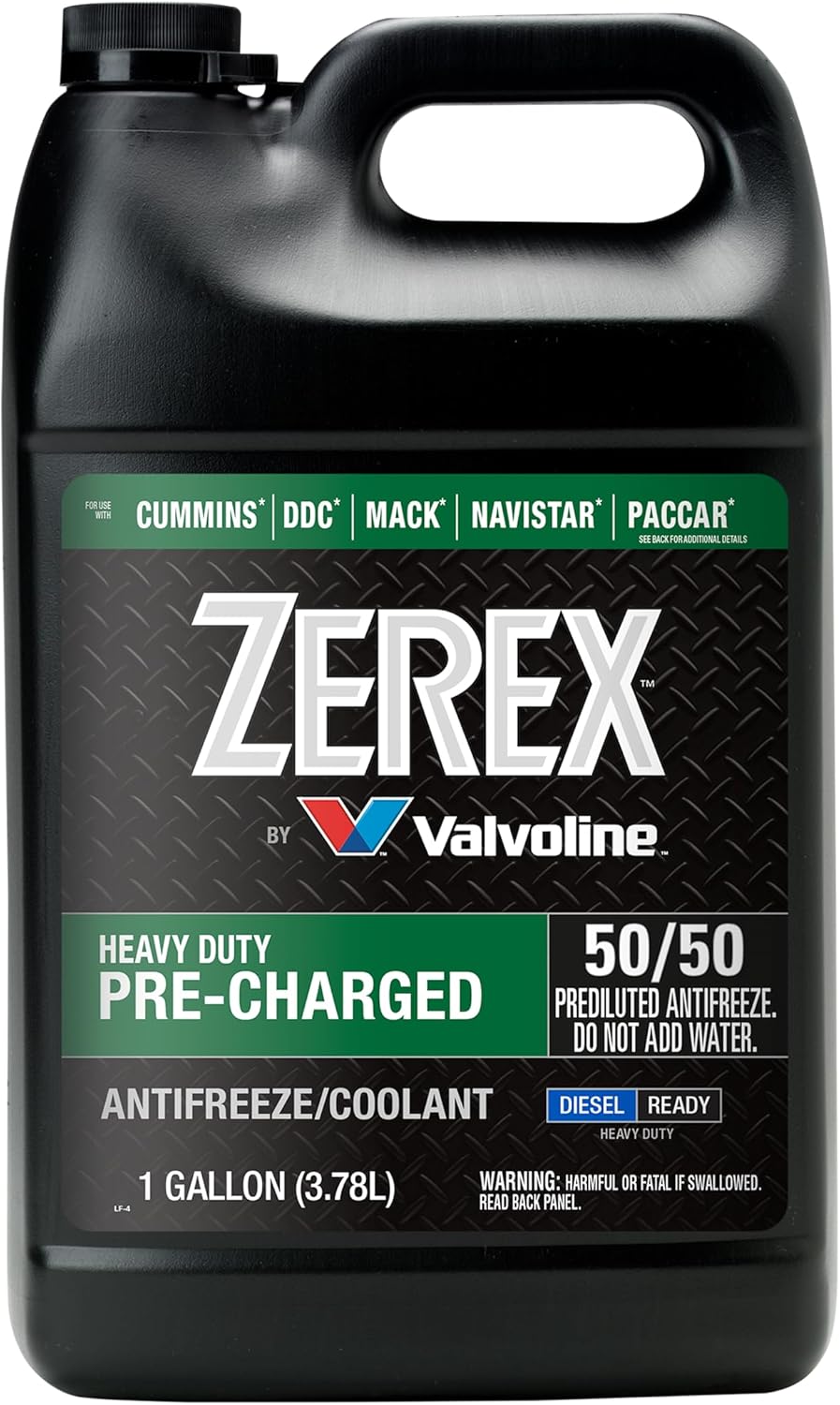
| Formulation | 50/50 prediluted ready-to-use |
|---|---|
| Application | Heavy-duty diesel engines and light trucks |
| Additives | Nitrite with corrosion, scale and rust inhibitors |
| Performance claim | Up to 3 years / 150,000 miles / 3,000 hours |
Zerex Pre-Charged 50/50 Heavy Duty Antifreeze is a premixed coolant aimed at diesel and heavy-duty engines but suitable for routine service in light trucks. It arrives ready to pour, eliminating dilution errors, and is pre-charged with nitrite plus corrosion, scale and rust inhibitors to protect radiators, water pumps and internal metal surfaces. The low-silicate formula helps reduce cavitation and pitting common in high-compression diesel engines, and an included defoamer minimizes foam that can affect cooling performance. Zerex backs the product with a 3 year/150,000 mile or 3,000 hour performance claim when used per directions. Practical benefits include convenience for quick top-offs or system refills and factory-quality corrosion protection without extra mixing. Limitations for buyers seeking specialty organic acid formulations or extended-interval premium chemistries: this is a traditional heavy-duty nitrite-based coolant designed for standard maintenance, not a premium long-life substitute for systems requiring specific OEM organic coolants.
Best for: Buyers who want a dependable, no-fuss coolant for regular maintenance on heavy-duty diesel trucks and light-duty diesel Ram 3500 Cummins owners prioritizing reliable corrosion and freeze protection on a budget.
Less Ideal for: Owners who need a specific OEM-specified organic acid extended-life coolant or who require a specialty formula for unique manufacturer specifications should look elsewhere.
- Premixed 50/50 ready-to-use formula removes need to dilute.
- Formulated with nitrite and corrosion inhibitors to protect against pitting and rust in diesel engines.
- Low-silicate blend helps limit cavitation and scale in heavy-duty applications.
- Includes a defoamer so it is compatible with hoses, gaskets and plastics.
- Not an organic long-life coolant so it may not match every OEM long-interval spec for some modern engines.
Verdict: The best low-cost coolant for budget-minded buyers who need dependable rust and freeze protection for routine maintenance without paying for premium additives.
3. Zerex Heavy Duty Nitrite Free Extended Life Concentrate Antifreeze/Coolant 1 Gal
Best Extended-Life Coolant
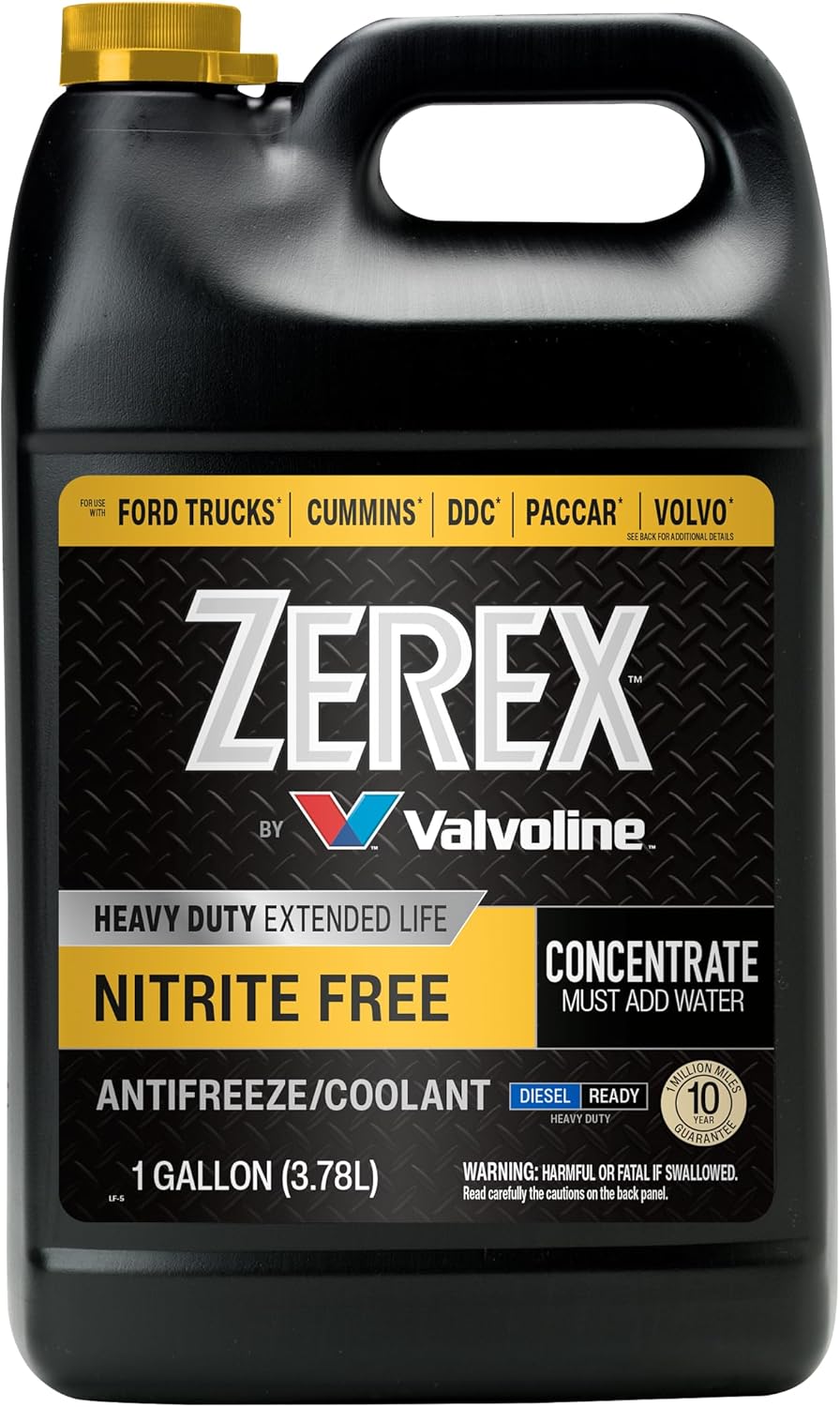
| Formulation | Concentrate |
|---|---|
| Technology | Organic Acid Technology (OAT) |
| Compatibility notes | Nitrite-free ELC for heavy-duty diesel engines |
| Mix ratio | 50/50 with water |
Zerex Heavy Duty Nitrite Free Extended Life concentrate is formulated for heavy-duty diesel engines and is intended to be mixed 50/50 with clean or demineralized water before use. It uses organic acid technology to protect internal components from cavitation, hard-water scale and corrosion while avoiding silicates, amines, and borates that can cause deposits. The product targets long service intervals, claiming protection for up to 10 years, 1,000,000 miles or 20,000 hours when used per instructions and without supplemental additives. For a Ram 3500 with a Cummins diesel this coolant addresses common fleet concerns like liner pitting and water pump corrosion and is suitable for systems with EGR and aftertreatment technologies that specify nitrite-free ELCs. Practical benefits include reduced coolant-change frequency and broad protection across diesel cooling-system metals. Limitations are that it is a concentrate requiring proper dilution and that you must confirm Cummins or Ram service specs for your model year before switching, since some engines require specific factory-compatible formulas.
Best for: Diesel owners who prioritize long drain intervals and want a nitrite-free extended-life coolant that minimizes shop visits and routine coolant changes for heavy-duty use.
Less Ideal for: Owners who prefer ready-to-use pre-diluted coolants or those who must follow a factory-specified coolant with different inhibitor chemistry for their specific model year.
- Organic acid technology helps prevent corrosion, cavitation, and hard-water scale
- Silicate-, amine-, and borate-free formulation reduces risk of deposit formation
- Designed for heavy-duty diesel systems including engines with EGR and aftertreatment
- Guaranteed extended protection when used per label up to 10 years or 1,000,000 miles
- Sold as a concentrate so requires correct 50/50 mixing before use
- Must verify compatibility with specific Cummins/Ram service specifications for certain model years
Verdict: The best extended-life coolant for owners who want longer drain intervals and sustained inhibitor performance to minimize coolant changes and shop time.
4. Mopar Antifreeze-Coolant Concentrate (1 Gallon)
Best Concentrated Coolant

| Volume | 1 gallon |
|---|---|
| Type | Concentrate |
| Manufacturer Part Number | 68163848AB |
| Fitment note | Intended for Mopar vehicles; confirm with VIN |
This Mopar concentrated antifreeze-coolant is a factory replacement 1-gallon bottle designed for vehicles in the Mopar family, including Ram models. It ships as a concentrate so you mix it with distilled water to achieve the correct protection level for your climate and engine. The formula is described as safe for all radiators and both gas and diesel engines and includes a bittering agent to discourage ingestion. For a DIYer working on a Ram 3500 Cummins, mixing concentrate gives precise control over freeze and boil points and makes storing a single gallon easier than premixed coolant. Being a genuine Mopar part means the chemistry is intended to match factory service recommendations for compatible Mopar engines. Limitations are that you must mix at the right ratio, and the listing suggests confirming fitment by VIN for model-year coverage; the product does not include premixed ready-to-use fluid and assumes you have access to distilled water and measurement tools.
Best for: DIYers who want factory-quality coolant they can mix to exact concentrations for a Ram 3500 Cummins and prefer buying concentrate for storage and cost efficiency.
Less Ideal for: Drivers who want a ready-to-use coolant or who prefer not to handle dilution or measure mixing ratios should choose premixed products instead.
- Factory genuine Mopar formula matched to Mopar engines
- Concentrate format lets you mix to spec for precise freeze/boil protection
- 1-gallon size is convenient for storage and multiple top-offs
- Suitable for both gas and diesel engines
- Requires correct mixing with distilled water before use and measuring tools
Verdict: The best concentrated coolant for DIYers who prefer to mix to spec, allowing cost savings, easier storage, and precise freeze/boil point control.
5. Zerex G05 50/50 Ready-to-Use Antifreeze/Coolant, 1 Gallon
Best Pre-Mixed Coolant

| Formulation | Hybrid Organic Acid Technology (HOAT) |
|---|---|
| Mixture | 50/50 ready-to-use |
| Volume | 1 gallon |
| Freeze protection | Approximately -34F |
| Boil protection | Approximately 265F |
Zerex G05 arrives pre-mixed at a 50/50 ratio so you can top up a cooling system quickly without measuring or diluting. It uses Hybrid Organic Acid Technology to combine conventional and organic inhibitor chemistries, which helps guard aluminum components and combustion chambers against rust, liner pitting, and scale. For routine service on a Ram 3500 with a Cummins diesel, this coolant provides ready freeze protection to about -34F and boil-over protection to around 265F, and Valvoline notes fleet and lab testing backing its corrosion control. The yellow formula is designed to be safe with hoses, gaskets, and plastics used in modern cooling systems. The trade-off is that it is a single-vehicle chemistry commonly recommended for manufacturers like Ford, Chrysler, and Mercedes-Benz, so you should confirm compatibility with Cummins service recommendations for your model year before a full-system fill. For fast top-ups and straightforward maintenance this ready-to-pour gallon minimizes fuss and dilution mistakes during routine coolant service.
Best for: Technically minded owners who want a no-mix, ready-to-pour coolant for quick top-ups and simple maintenance on a Ram 3500 Cummins without fuss or mixing mistakes.
Less Ideal for: Those planning a complete coolant flush who cannot verify chemistry compatibility with their Cummins model year should choose a coolant explicitly specified by the vehicle manufacturer.
- Ready-to-use 50/50 mix eliminates measuring and dilution errors for fast top-ups.
- HOAT chemistry targets rust and liner pitting while protecting aluminum components.
- Pre-mixed formula provides freeze protection to about -34F and boil-over resistance to about 265F.
- Formulated to be safe for hoses, gaskets, and common plastics in modern cooling systems.
- Designed around a specific HOAT chemistry profile so confirm manufacturer compatibility before using as a full-system fill.
Verdict: The best pre-mixed coolant for users who want a no-mix, ready-to-pour solution for fast top-ups and straightforward service without dilution errors.
Choosing the Right Ram 3500 Cummins Coolant: Key Factors to Consider
Coolant Chemistry and Specification
Coolant chemistry determines how the fluid protects different metals and rubber components in your Ram 3500 Cummins. Diesel engines often require silicate- or phosphate-containing formulations or specially blended organic acid technologies that address cast iron liners, aluminum heads, and turbocharger contact points. Choosing the correct specification helps prevent galvanic corrosion and material degradation.
Reviewing manufacturer or Cummins guidance for acceptable chemistries is important because using the wrong type can reduce inhibitor effectiveness or require more frequent changes. Some chemistries perform better under heavy-load thermal cycling common in towing, while others prioritize very long drained intervals but may need initial supplemental treatments.
Corrosion Protection and Additives
Effective corrosion protection is critical for the Ram 3500 Cummins because diesel operation and higher coolant temperatures accelerate wear on liners, head bolts, and the water pump. Look for coolants that specify protection levels for aluminum, cast iron, brass, and soldered joints, and those that include inhibitors to reduce cavitation erosion on cylinder liners.
Additive packages also affect compatibility with gaskets and hoses. Some formulations include additional lubricant components to protect water pump seals under high torque cycles, which matters for vehicles regularly towing heavy loads or operating at sustained high RPM.
Service Life and Maintenance Interval
Service life influences maintenance cost and downtime for a heavy-duty Ram 3500 Cummins. Long-life coolants can extend drain intervals and reduce the frequency of full coolant changes, but only if initial fill and top-off practices follow the product guidance. Longer intervals are attractive for fleet owners or owners who want fewer service visits, but they require confirming compatibility before topping off with different chemistry.
Also consider the practical aspects of service: whether the coolant is sold pre-mixed or requires dilution, and whether its maintenance schedule aligns with typical coolant flush procedures you perform on the Ram 3500.
Freeze and Boil Protection
Your coolant must provide sufficient freeze protection for winter storage and boil-over resistance during heavy towing or hill climbs. The effective freeze point depends on concentration; many pre-mixed options provide a safe balance without manual mixing. Boil protection relates to both coolant composition and system pressure; maintaining the right coolant concentration helps preserve the radiator cap and coolant routing under high thermal loads.
If you regularly tow heavy loads or operate in high ambient temperatures, prioritize formulas rated for higher boil-over thresholds and follow recommended concentration guidelines to maintain optimal thermal performance.
Compatibility With Existing System
Compatibility with the existing coolant in your Ram 3500 Cummins is essential when topping off or performing a partial refill. Mixing incompatible chemistries can neutralize corrosion inhibitors and create sludge. Before adding fluid, identify whether your cooling system currently contains an OEM-approved long-life formula or an older conventional product, and follow the recommended flush procedure if changing types.
When in doubt, a complete system flush and refill with the chosen coolant chemistry reduces risk. Pay attention to instructions about initial fill, recommended test intervals, and any required supplemental treatments for long-life systems.
Material Protection and Component Longevity
Diesel engines place specific demands on cooling system materials. The coolant must protect the turbocharger, cylinder liners, head gaskets, and ancillary components like the EGR cooler if present. A product that minimizes erosion and preserves sealing surfaces helps prevent leaks and costly repairs.
Consider the impact of coolant on non-metal components too: hoses, clamps, and plastic expansion tanks can be affected by certain additive packages. Choosing a coolant formulated for heavy-duty diesel applications helps maintain the integrity of these parts over extended service intervals.
Why Diesel Engines Need Different Coolants
Cummins-equipped Ram 3500 engines run at high torque and often see extended idling, heavy towing, and higher exhaust gas temperatures. These operating conditions change how coolant behaves compared with light-duty gasoline use, so formulations that focus on diesel-specific corrosion and liner protection are preferable.
Diesel coolants commonly include additives that address cavitation and liner pitting, and they may balance silicate or organic acid inhibitors differently to suit cast iron and aluminum interfaces. Choosing a coolant designed for diesel service reduces the chance of premature component wear.
- Addresses liner cavitation and pitting
- Formulated for mixed metal protection in diesel engines
- Designed for sustained high-temperature loads
Mixing and Top-Off Best Practices
If you are topping off between full services, confirm the chemistry of the existing coolant before adding more. Partial top-offs with an incompatible product can shorten inhibitor life and create deposits. When unsure, perform a drain and flush and refill with the chosen coolant chemistry.
Many modern coolants come pre-mixed to avoid concentration errors. If you use a concentrated product, follow the manufacturer guidelines for the correct water ratio and use distilled water to minimize mineral deposits.
- Identify existing coolant chemistry before topping off
- Prefer pre-mixed formulas to simple field mixing
- Use distilled water when diluting concentrates
Signs Your Ram 3500 Needs a Coolant Service
Watch for early indicators such as frequent overheating during towing, discolored coolant, or a sweet or unusual odor after extended use. These signs can indicate degraded inhibitor packages or contamination that require a full flush and refill.
Other symptoms include increased corrosion around hose clamps, radiator leakage, or intermittent gauge spikes. If you notice foaming in the expansion tank, that may signal aeration from a failing head gasket or coolant breakdown and should be inspected promptly.
- Overheating while towing or under load
- Discolored or cloudy coolant
- Visible corrosion or leaks around fittings
How a Proper Flush Extends System Life
A correct coolant flush removes deposits and old inhibitor residue, restoring circulation and helping new inhibitors work effectively. For the Ram 3500 Cummins, flushing according to a product-specific procedure reduces the chance of mixing incompatible chemistries and extends the life of the water pump and radiator.
When performing a flush, follow vehicle manufacturer guidance for system fill and air-bleeding steps to ensure no trapped air pockets remain. Properly bled systems maintain consistent flow and temperature control under heavy loads.
- Removes corrosion by-products and sludge
- Allows full benefit of fresh inhibitor packages
- Reduces risk of water pump or thermostat issues
Seasonal Considerations for Heavy-Duty Use
In cold climates, ensure the chosen coolant provides sufficient freeze protection at your operating concentration. In contrast, hot-weather or high-altitude users should prioritize boil resistance and thermal stability to cope with increased engine load during towing.
Adjust maintenance intervals based on duty cycle. A Ram 3500 that spends most of its time towing heavy trailers needs more frequent inspection of coolant condition than one used primarily for light-duty commuting.
- Maintain proper concentration for freeze protection
- Prioritize boil resistance for heavy towing in hot climates
- Inspect coolant condition more frequently under severe duty
Still looking for the perfect fit?
Select your Ram 3500 configuration to see the most relevant Coolants recommendations
How We Chose the Best Ram 3500 Cummins Coolant
We applied a fleet-focused, specification-driven process to identify the coolants shortlisted for a Ram 3500 Cummins. Selection began with manufacturer recommended chemistries and specifications that match diesel engine needs and common OEM requirements. We prioritized products that explicitly address diesel-specific concerns such as protection for wet sleeve liners, turbocharger components, and additives that control cavitation and cylinder liner pitting.Key evaluation criteria included corrosion inhibition performance across aluminum and cast iron surfaces, longevity or service interval claims under heavy-duty cycles, antifreeze capacity for seasonal extremes, and compatibility with common sealing materials and hoses used in the Ram 3500 cooling system. We also considered recommended maintenance practices tied to each coolant type, ease of mixing or pre-mixed formulations, and suitability for coolant flush procedures.Exclusions: we excluded products that lack clear diesel-specific data, do not list compatibility with Cummins-specified alloys, or are designed only for light-duty gasoline applications. The final list reflects a balance of protection, longevity, and fitment for the Ram 3500 Cummins cooling system.
Our full evaluation process is outlined in our review methodology.
FAQ
How often should I change coolant in a Ram 3500 Cummins?
Frequency depends on the coolant type and operating conditions. Long-life diesel coolants can often extend intervals, but heavy towing or severe-duty use usually requires more frequent inspection and sometimes earlier change intervals. Check the coolant condition and follow the maintenance interval recommended by the chosen coolant chemistry.
Can I mix different coolant chemistries in my Cummins-equipped Ram 3500?
Mixing incompatible chemistries is not advised because it can neutralize inhibitors and create deposits. If you are unsure of the existing coolant type, perform a full flush and refill with the selected chemistry to avoid adverse reactions.
Is a pre-mixed coolant better than a concentrate for this truck?
Pre-mixed coolants remove the risk of dilution errors and are convenient for field service. Concentrates give you control over freeze protection levels but require precise mixing with distilled water. Choose based on your comfort with mixing and the local climate demands.
What are the signs of coolant-related turbocharger or liner issues?
Look for increased oil contamination, unusual smoke under load, or localized coolant loss that cannot be traced to external leaks. These symptoms can indicate coolant circulation problems or liner erosion and should be inspected by a technician familiar with diesel cooling systems.
Do I need any special tools to perform a coolant flush on a Ram 3500 Cummins?
Basic tools and a proper drain/flush setup are typically sufficient, but thorough bleeding tools and a pressure tester help ensure the system is fully purged of air and that there are no hidden leaks. Specialized service equipment may be beneficial for a complete system exchange.
How does towing frequency affect coolant choice?
Frequent towing increases thermal and mechanical stress on the cooling system, so selecting a coolant with robust corrosion inhibitors and strong boil resistance is important. It also means you should inspect coolant condition more often and adhere to more conservative service intervals.
Final Verdict
For a Ram 3500 Cummins, prioritize coolants formulated for diesel engines that offer strong corrosion protection, resistance to cavitation, and a service life suited to heavy towing. Confirm compatibility with your current cooling system before topping off, and consider a full flush when changing chemistries to avoid neutralizing inhibitors.Balance the desire for longer drain intervals against the demands of frequent towing and high engine loads. Use the guidance above to weigh tradeoffs and select a coolant that protects engine components while matching your maintenance preferences and operating conditions.
Explore More:
- Check out all Ram 3500 parts & accessories
- Explore Fluids & Chemicals
- Browse all Accessories
