

Note: This article contains affiliate links. If you click on these links and make a purchase, I may earn a small commission at no extra cost to you. This helps support my research and content. Read my full affiliate disclosure here.
Picking the right coolant for your Ford Maverick matters for day-to-day reliability and long-term engine health. The cooling system controls operating temperatures, prevents corrosion in the radiator and engine passages, and supports heater performance in cold weather. Using a coolant that matches your Maverick's formulation and maintenance needs reduces the risk of overheating, premature component failure, and costly repairs.This guide covers the top coolant options shortlisted for the Ford Maverick and explains how they perform on the most important criteria for this vehicle. We evaluate cooling effectiveness, corrosion protection, and service life so you can choose the best fit for your maintenance plan. Read on for practical guidance before you add or flush coolant in your Maverick.
Looking for other parts? See all Ford Maverick parts & accessories.
Top Picks at a Glance
| Best Overall Coolant A balanced, widely compatible coolant that fits most DIY needs | PEAK OET Extended Life Orange 50/50 Prediluted Antifreeze/Coolant, 1 Gal. |  |
| Best Budget Coolant An affordable ready-to-use or concentrate option that saves money | PEAK All Vehicles 50/50 Prediluted Antifreeze & Coolant, 1 Gal. |  |
| Best OEM Ford Coolant Fluids formulated to meet Ford's specs and OEM performance standards | Ford Genuine VC-13-G Yellow Concentrated Antifreeze/Coolant, 1 Gallon |  |
| Best 50/50 Prediluted Coolant Ready-to-use coolant pre-mixed 50/50 for quick topping off | Valvoline Multi-Vehicle 50/50 Ready-to-Use Antifreeze Coolant, 1 Gallon |  |
| Best Concentrate Coolant Undiluted concentrate for custom mix ratios and extreme cold protection | PEAK Global Lifetime Concentrate Antifreeze and Coolant, 1 gal. |  |
| Best Extended-Life Coolant Formulas guaranteed for long service intervals and high-mileage protection | PEAK Titanium 50/50 Prediluted Antifreeze & Coolant, 1 Gal |  |
| Best Heavy‑Duty/Nitrite‑Free Coolant Robust formulations designed for heavy-duty use and diesel-grade protection | Zerex Heavy Duty Nitrite Free Extended Life Concentrate Antifreeze/Coolant 1 Gal |  |
1. PEAK OET Extended Life Orange 50/50 Prediluted Antifreeze/Coolant, 1 Gal.
Best Overall Coolant

| Dilution | 50/50 Prediluted |
|---|---|
| Recommended for | North American vehicles (Ford, Chrysler, GM) |
| Volume | 1 gallon |
| Formulation | Organic acid technology (OAT) |
This PEAK OET Extended Life Orange 50/50 prediluted coolant is a ready-to-use antifreeze formulated for North American vehicles and uses organic acid technology to protect cooling system components from rust and corrosion. It comes pre-mixed so you can top off the radiator or perform a quick refill without measuring concentrate, and the formulation is intended for Ford, Chrysler, and GM systems that call for an orange extended-life coolant. The product promises long service life when used as part of a full flush and fill and includes a bittering agent to discourage ingestion. For routine maintenance on a Ford Maverick, the convenience of 50/50 predilution and the extended-life corrosion inhibitors make it a practical choice for owners who want a low-fuss coolant that matches factory replacement chemistry. Keep in mind it is specifically an orange OAT-style formula, so it should be used only where that coolant type is recommended and not mixed with different coolant chemistries.
Best for: Ford Maverick owners who prioritize a safe, factory-style extended-life coolant that is easy to use for routine top-offs and periodic flushes.
Less Ideal for: Drivers who need a universal coolant for mixed-chemistry systems or who require a concentrated product to custom-blend specific dilution ratios.
- Prediluted 50/50 mix ready for quick top-offs with no mixing required
- Formulated with organic acid technology for extended corrosion protection
- Designed for North American vehicles and compatible with Ford coolant chemistries
- Guaranteed long service life when installed as part of a full flush and fill
- Orange OAT formula must not be mixed with other coolant chemistries
Verdict: Choose this slot if you want the safest, most versatile coolant option that balances compatibility, corrosion protection, and ease of use for routine maintenance.
2. PEAK All Vehicles 50/50 Prediluted Antifreeze & Coolant, 1 Gal.
Best Budget Coolant

| Compatible with Vehicle Type | Car, Truck, Motorcycle, SUV |
|---|---|
| Automotive Fit Type | Universal Fit |
| Liquid Volume | 1 Gallons |
| Size | 50/50 |
PEAK All Vehicles 50/50 comes ready to pour and is intended to top off or replace coolant without mixing. It provides immediate protection for cooling-system metals, including aluminum, and is formulated for long service life so you can expect extended corrosion protection. In typical use you pour it into the Maverick's coolant reservoir or radiator after draining and flushing or for quick top-offs; the prediluted mix removes guesswork about concentration. Notable features include universal fitment for passenger cars, trucks, SUVs, and motorcycles, a 50/50 concentration that balances freeze and boil protection, and a proprietary inhibitor package aimed at long-term metal protection. The main limitation is that it is a generic all-vehicle formula rather than a vehicle-specific coolant chemistry, so if a Ford Maverick calls for a particular OEM specification you should confirm compatibility before switching. For routine maintenance and emergency top-offs this product is a practical, low-effort option for keeping the cooling system protected.
Best for: Buyers wanting a low-cost, no-fuss coolant for routine maintenance or emergency top-offs who prioritize convenience and basic long-term corrosion protection.
Less Ideal for: Drivers who must meet a specific Ford coolant specification or who prefer manufacturer-designated formulations for warranty or performance reasons should consider a model-specific coolant.
- Ready-to-use 50/50 prediluted formula eliminates mixing and reduces installation errors
- Universal fit claims make it simple for general maintenance and quick top-offs
- Formulated inhibitors provide corrosion protection for aluminum and other cooling-system metals
- One-gallon jug is convenient for a full top-off or partial refill
- Generic all-vehicle formulation may not match specific manufacturer coolant specifications
Verdict: Pick this when you need a low-cost coolant that still provides basic freeze/boil and corrosion protection without breaking the bank.
3. Ford Genuine VC-13-G Yellow Concentrated Antifreeze/Coolant, 1 Gallon
Best OEM Ford Coolant

| Brand | Ford |
|---|---|
| Model | VC-13-G |
| Type | Concentrated ethylene glycol antifreeze/coolant |
| Mix ratio | 50/50 with distilled water |
This Ford Genuine VC-13-G concentrated antifreeze is a manufacturer-specified coolant intended for Ford vehicles and similar applications. It is an ethylene glycol-based yellow formula supplied as a concentrate so you mix it 50/50 with distilled water to achieve freeze protection down to about -34°F and boil protection up to roughly 265°F. The formulation includes corrosion inhibitors for long-life protection and a bittering agent to discourage ingestion. Use is straightforward: drain and flush the cooling system per service intervals, then top up or refill with the mixed coolant to factory fill level. The main practical benefit is compatibility with Ford cooling systems and confidence that the fluid meets factory requirements, which helps avoid chemical mismatch and potential cooling-system issues. Limitations are that it is a concentrate requiring proper mixing and you should not mix it with different colors or coolant chemistries, so conversions or cross-use with non-Ford formulas require a full system flush.
Best for: Buyers who prioritize using factory-spec fluids to maintain cooling system compatibility and preserve manufacturer service guidelines for Ford vehicles.
Less Ideal for: People who want a ready-to-use premixed coolant or those planning to switch coolant chemistries without performing a complete system flush.
- Factory-formulated to meet Ford coolant specifications for compatibility with Ford engines
- Concentrate allows 50/50 mixing to achieve broad freeze and boil protection
- Contains corrosion inhibitors for longer life in cooling systems
- Includes a bittering agent to reduce accidental ingestion
- Requires correct mixing with distilled water before use rather than sold pre-mixed
- Not compatible with other coolant types or colors without a full system flush
Verdict: Use this slot if you prefer a factory-spec coolant that matches manufacturer requirements and helps preserve warranty and cooling-system compatibility.
4. Valvoline Multi-Vehicle 50/50 Ready-to-Use Antifreeze Coolant, 1 Gallon
Best 50/50 Prediluted Coolant

| Size | 1 Gallon |
|---|---|
| Flash Point | 250 Degrees Fahrenheit |
| Automotive Fit Type | Universal Fit |
| Model | Multi-Vehicle |
Valvoline Multi-Vehicle 50/50 Ready-to-Use Antifreeze is a premixed coolant intended for quick top-offs and routine service without mixing water. It is formulated to meet ASTM D3306 and contains Valvoline’s Alugard Plus additive for compatibility with other ethylene glycol-based coolants and to protect aluminum and other cooling system metals. In practice this makes it convenient for a Ford Maverick owner who needs a fast, clean refill after a radiator flush or to top off low level during maintenance. The premixed 50/50 ratio covers freeze protection down to about -34F and provides boil-over protection up to about 265F, while corrosion inhibitors reduce scale and leaks. The main compromises are that it is a single, pre-blended formulation so you cannot adjust concentration for extreme climates, and the yellow dye means color-matching with an existing coolant might not be useful for diagnosing mixing. For straightforward, no-fuss coolant service on a Maverick this product is an easy, reliable option.
Best for: Drivers who want a no-mix, ready-to-use coolant for fast top-offs or routine service on a Ford Maverick and value convenience and reliable corrosion protection.
Less Ideal for: Owners who need to tailor coolant concentration for extreme cold or hot climates or who require a specific factory-color coolant for warranty or diagnostic reasons should consider alternatives.
- Premixed 50/50 ratio eliminates mixing and saves time during top-offs or coolant changes
- Formulated to ASTM D3306 standard for use in most automobiles and light trucks
- Alugard Plus additive designed for compatibility with other ethylene glycol coolants and protection of aluminum components
- Provides wide temperature protection range against freezing and boiling
- Cannot be concentrated or diluted further for nonstandard extreme climate needs
- Yellow premixed color may mask prior coolant colors used for system diagnosis
Verdict: Choose a prediluted 50/50 product when you want a no-mix solution for fast top-offs or service without measuring water.
5. PEAK Global Lifetime Concentrate Antifreeze and Coolant, 1 gal.
Best Concentrate Coolant

| Formulation type | Concentrate |
|---|---|
| Technology | Phosphate-enhanced Organic Acid Technology |
| Compatibility | All American, Asian, and European automobiles and light to heavy duty trucks |
| Volume | 1 gallon |
This PEAK Global Lifetime concentrate is a mix-at-home coolant aimed at providing corrosion protection across a wide range of cooling systems. You mix it to the concentration you need for freeze and boil points, which makes it useful for achieving specific protection targets or keeping compact stock for multiple service jobs. The formula uses phosphate-enhanced Organic Acid Technology and is free of silicates, borates, nitrites, and amines, so it is safe to top off existing systems without dramatically changing coolant color. Practical benefits include fast-acting protection for aluminum and other cooling-system metals and compatibility with American, Asian, and European passenger vehicles and light to heavy duty trucks. Limitations are that concentrates require correct mixing with distilled water to reach desired protection and a full flush is recommended before switching to ensure maximum lifetime performance. The product contains a bittering agent so handle spills carefully and follow safety guidance when diluting and filling the system.
Best for: Buyers who want a compact concentrate they can mix to exact freeze or boil targets and perform multiple service jobs themselves while maintaining long-term corrosion protection.
Less Ideal for: Drivers who prefer ready-to-use premixed coolant or who are uncomfortable measuring and diluting concentrate should choose a prediluted option instead.
- Concentrate format lets you mix to custom freeze and boil points.
- Phosphate-enhanced organic acid inhibitors protect aluminum and other metals from corrosion.
- Compatible for top-offs without changing existing coolant color.
- Formulated without silicates, borates, nitrites, or amines for broad compatibility.
- Requires correct mixing with distilled water and proper flush procedures to deliver promised lifetime protection.
Verdict: Opt for a concentrate when you want to mix to specific freeze/boil targets or store compactly for multiple service jobs.
6. PEAK Titanium 50/50 Prediluted Antifreeze & Coolant, 1 Gal
Best Extended-Life Coolant

| Formulation | 50/50 prediluted |
|---|---|
| Volume | 1 gal |
| Performance standards | Meets ASTM D6210, D3306, D4985 |
PEAK Titanium 50/50 is a ready-to-use antifreeze designed for long change intervals and broad compatibility with existing coolant colors and chemistries. It is typically used for routine top-offs and full coolant fills where extended protection is desired, offering a 50/50 premix so you can pour straight into the cooling system without measuring. The formula is engineered to clean component surfaces and resist heat-insulating films that reduce heat transfer, and it earned a top score in water pump protection testing, which is useful for preventing premature pump wear. PEAK claims protection for more than 15 years or 500,000 miles when maintenance recommendations are followed, making it appealing for owners who prefer lower-frequency coolant service. The practical trade-offs are that it is a universal prediluted solution rather than a vehicle-specific fluid, so those following strict manufacturer coolant specifications should verify compatibility before a full flush, and its bright yellow color may differ from the factory fluid color in some Mavericks.
Best for: Ford Maverick owners who want a low‑maintenance, long‑life coolant for fewer flushes and reliable water pump protection when performing routine top-offs or full system fills.
Less Ideal for: Owners who must strictly follow a specific factory coolant specification or color requirement for warranty or service reasons should consult their dealer or manual before use.
- Prediluted 50/50 formula ready to pour with no mixing required
- Formulated to resist heat‑insulating films and clean component surfaces
- Top-rated water pump protection in ASTM D2809 testing
- Claims extended protection up to 15 years or 500,000 miles with proper maintenance
- Universal formula may not match every manufacturer’s recommended coolant specification exactly
Verdict: Select this when you want a coolant engineered for extended change intervals and longer corrosion protection between flushes.
7. Zerex Heavy Duty Nitrite Free Extended Life Concentrate Antifreeze/Coolant 1 Gal
Best Heavy‑Duty/Nitrite‑Free Coolant
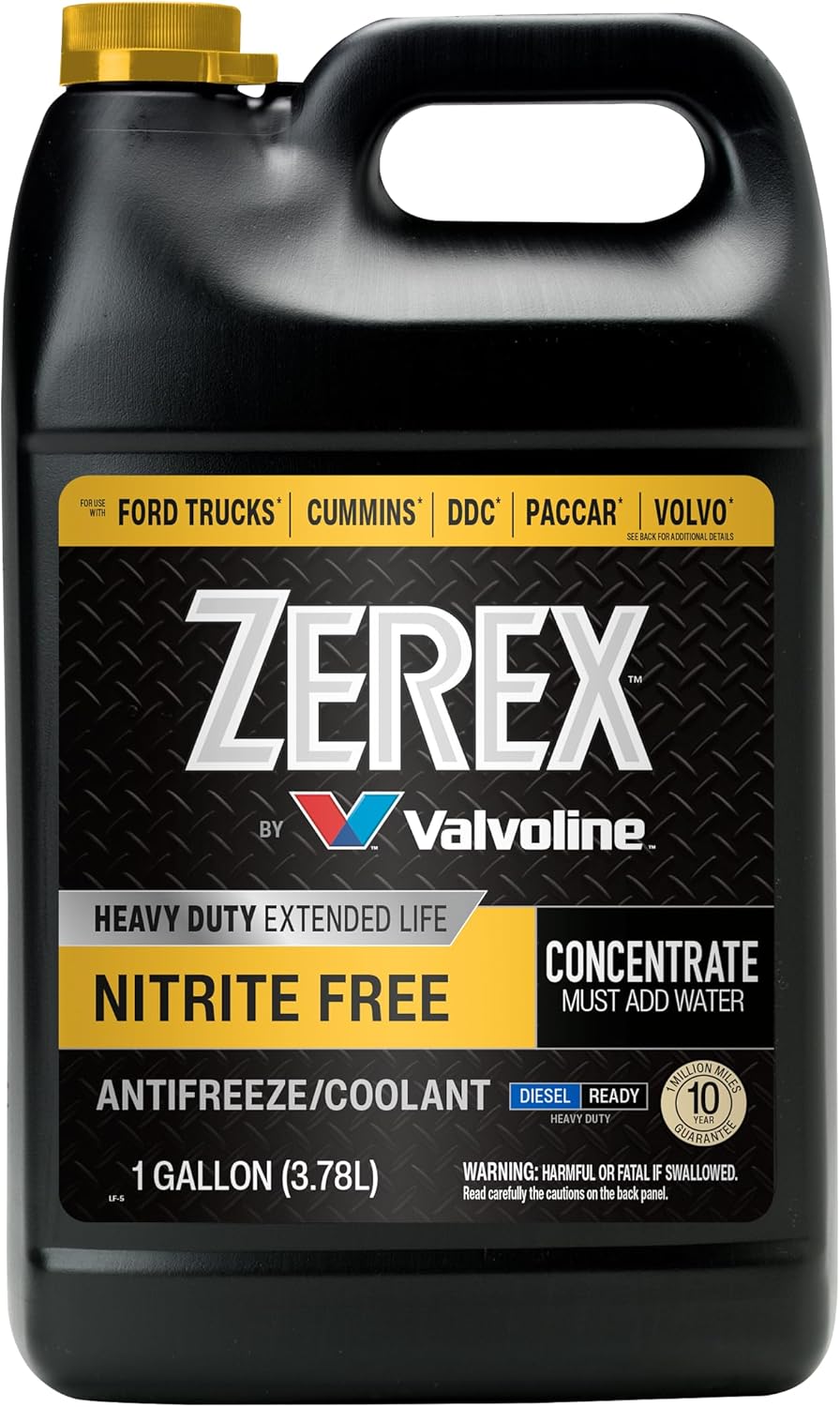
| Concentrate | Mix 50/50 with water |
|---|---|
| Chemistry | Organic Acid Technology (nitrite-free) |
| Special Features | Silicate, amine, and borate free |
| Service Life Claim | Up to 10 years or 1,000,000 miles |
Zerex Heavy Duty Nitrite Free Extended Life is a concentrated antifreeze formulated with Organic Acid Technology for long-term corrosion protection in demanding cooling systems. It is intended to be mixed 50/50 with water and used where manufacturers specify a nitrite-free extended life coolant, protecting cylinder liners, water pumps, and other metals from pitting, cavitation, and hard-water scale. The formula is silicate, amine, and borate free and claims long service life up to 10 years or 1,000,000 miles when used per label instructions. Practical benefits include strong protection against corrosion and deposits, compatibility with a wide range of heavy-duty engine technologies, and reduced need for supplemental additives. Limitations are that it is a concentrate requiring proper dilution and matching to Ford cooling specifications, and because it is a nitrite-free OAT type it may not be the right choice where an alternative chemistry is explicitly required by factory guidance.
Best for: Buyers who need a tougher, nitrite-free coolant for heavy loads or demanding cooling conditions on Ford vehicles and prioritize long-term corrosion protection and extended service intervals.
Less Ideal for: Drivers who must follow a specific non-OAT Ford coolant chemistry or who prefer a ready-to-use premixed solution should consider other options.
- Nitrite-free OAT formula protects against cavitation, pitting, and corrosion in heavy-duty cooling systems
- Silicate, amine, and borate-free chemistry reduces risk of harmful deposits on metal surfaces
- Concentrate that mixes 50/50 for flexible use and longer shelf/usage economy
- Claims extended service life up to 10 years or 1,000,000 miles when used per instructions
- Requires correct dilution and confirmation of Ford coolant specification before use
Verdict: Pick this slot if you need a tougher, nitrite-free formula built for heavier loads or more demanding cooling-system environments.
Choosing the Right Ford Maverick Coolant: Key Factors to Consider
Coolant Chemistry and Compatibility
The chemical formulation determines how the coolant protects metal surfaces and interacts with seals and hoses. For the Ford Maverick, choose a coolant with inhibitor packages compatible with aluminum radiators, water pumps, and engine blocks used in this vehicle. Using the wrong chemistry can accelerate pitting and corrosion or cause swelling in rubber components.
Check whether the coolant is an ethylene glycol or propylene glycol base and whether it uses organic acid technology or traditional silicate/phosphate inhibitors. Each approach has different longevity and maintenance implications. When topping off or switching coolant types, a full system flush may be required to avoid chemical reactions between incompatible additives.
Corrosion Protection and Inhibitor Longevity
Effective corrosion inhibitors preserve radiator fins, engine water jackets, and internal metal surfaces over time. Evaluate how long the manufacturer rates the inhibitor package to remain effective at normal service intervals; longer-lasting inhibitors reduce the need for frequent coolant changes and lower long-term maintenance work for the Maverick.
Inhibitor depletion patterns matter because uneven depletion can lead to localized corrosion. Look for products with documented lab data or industry-standard test performance showing protection for aluminum and mixed-metal systems typical of modern vehicles.
Freeze and Boil-over Performance
Coolant must provide freeze protection in cold weather and a high boiling point under operating pressure to prevent vapor lock. For a Ford Maverick that sees seasonal temperature swings, ensure the coolant reaches the recommended freeze point when mixed at the correct concentration and delivers a safe boiling temperature when pressurized in the cooling system.
Verify recommended mix ratios and consider pre-diluted options if you prefer less handling. Proper concentration also affects corrosion protection, so follow guidelines for antifreeze-to-water ratio to maintain both thermal and chemical protection.
Service Interval and Maintenance Impact
Different coolants advertise varying service intervals, from two-year to multi-year coverage. For Maverick owners who prefer lower-frequency maintenance, long-life formulations can reduce flush frequency but may require specific testing to confirm inhibitor condition. Factor in how often you are willing to perform coolant checks and flushes when choosing.
Also consider whether the coolant requires supplemental conditioners or monitoring tools. Simpler maintenance procedures can reduce labor time and error during routine service.
Seal and Hose Compatibility
Coolant interacts continuously with rubber hoses, gaskets, and seals. Some formulations can cause softening or hardening of certain elastomers over long exposure, increasing the chance of leaks. For the Ford Maverick, select coolants labeled as safe for automotive rubber and plastic components used in modern cooling systems.
If you are topping off rather than performing a full flush, ensure compatibility with the existing coolant chemistry to avoid adverse reactions that could affect seals.
Ease of Use and Serviceability
Practical considerations like whether the product is a concentrate or pre-mix, the clarity of mixing instructions, and container design affect everyday use. Pre-mixed coolants remove the need for precise dilution and reduce the risk of incorrect concentrations, while concentrates can be more economical and allow exact control over freeze and boil points.
Also consider label clarity on disposal and environmental handling, and whether the product supports common workshop practices such as pressure testing and coolant recycling procedures.
Understanding Ford Maverick Cooling System Basics
The Maverick cooling system uses a pressurized loop that circulates coolant through the engine block, cylinder head passages, and radiator. The system controls engine temperature under load and during idle, and it also supplies the cabin heater core. Knowing this layout helps when diagnosing overheating or selecting the right coolant concentration.
Regular inspection points include the radiator cap, hoses, overflow tank level, and condition of coolant. Air pockets, a degraded thermostat, or a failing water pump can mimic coolant performance problems, so rule those out before replacing or topping off fluid.
- Check coolant level in the overflow reservoir only when the engine is cold.
- Look for discoloration, sediment, or oil contamination which indicate internal problems.
- Pressure-test the system if you suspect leaks or head gasket issues.
Mixing Ratios and When to Use Pre-Mix
Coolant performance depends on achieving the correct antifreeze-to-water ratio. Typical recommendations fall near 50 percent antifreeze by volume for balanced freeze and boil protection, but local climate and driving conditions can justify adjustments. Follow the product label and Ford maintenance guidance for concentration targets.
Pre-mixed coolant removes the guesswork and is convenient for quick top-offs or when you lack distilled water. Concentrates require careful measurement and use of distilled water to avoid mineral deposits in the cooling system.
- 50/50 generally provides protection to about -34 degrees Fahrenheit and raises boiling point when under system pressure.
- Use distilled water with concentrates to prevent scale buildup from minerals in tap water.
Signs You Need a Coolant Flush or Replacement
Routine checks will reveal when coolant is degraded. Common indicators include rusty or brown fluid, reduced heater performance, overheating episodes, or visible sediment in the reservoir. If the system has seen oil contamination or persistent overheating, a full flush is warranted.
Regular maintenance intervals vary by coolant type, but scheduled flushing and replacement help remove contaminants and restore inhibitor balance. When changing chemicals or switching inhibitor types, perform a complete flush to avoid mixing incompatible chemistries.
- Discolored or milky coolant suggests contamination and necessitates a flush.
- If the cooling system has not been serviced within the manufacturer-recommended interval, plan for replacement during routine maintenance.
How Climate Affects Choice and Concentration
Where you drive the Maverick influences both the required freeze protection and long-term corrosion needs. In cold climates you may prioritize lower freeze points, while in hot regions boiling protection and thermal stability take precedence. Seasonal driving patterns should inform whether to use a long-life concentrate or a pre-mixed option tuned for temperature extremes.
Adjust concentration based on the coldest expected ambient temperature and ensure that the boiling point remains adequate under system pressure when operating at highway speeds or towing.
- Increase antifreeze percentage for extreme cold, but be mindful of reduced heat transfer at very high concentrations.
- In hotter environments, ensure adequate coolant volume and a functioning radiator cap to maintain pressure and raise the coolant boiling point.
Routine Tests To Monitor Coolant Health
Simple, periodic testing can extend cooling system life and prevent surprises. Test strips or handheld testers measure freeze protection and inhibitor presence, while pH tests can indicate acidification that accelerates corrosion. A visual inspection for deposits and regular pressure checks round out a practical monitoring routine.
Document test results and service dates so you can spot trends like steadily falling inhibitor levels or progressive contamination. This helps determine the optimal interval for flushing and replacement specific to your Maverick.
- Use test strips to verify antifreeze concentration and glycol level.
- Check pH and conductivity if you suspect contamination or long-term degradation.
How We Chose the Best Ford Maverick Coolant
Our selection process focused on properties that directly affect Ford Maverick cooling system health and driver outcomes. We prioritized formulations that offer long-lasting corrosion inhibitors compatible with aluminum radiators and engine cooling passages commonly used in this vehicle. Thermal performance under typical Maverick operating temperatures was another key filter, emphasizing stable boiling and freeze protection at recommended concentrations.We also considered service life and maintenance cadence, favoring products that reduce the frequency of flushing while still maintaining inhibitor integrity. Compatibility with standard service procedures — including mixing ratios, concentrate versus pre-mix options, and safe use with common gasket and seal materials — was assessed. Ease of use and clarity of manufacturer instructions were secondary considerations.Excluded items included any coolant formulations known to be incompatible with Ford coolant specifications or those lacking clear inhibitor chemistry information. We did not consider specialty race-only coolants or additives intended as temporary repairs. The final list reflects products that balance cooling capacity, corrosion control, and real-world serviceability for the Ford Maverick.
Our full evaluation process is outlined in our review methodology.
FAQ
How often should I flush the coolant in my Ford Maverick?
Flush intervals depend on the coolant chemistry and manufacturer recommendations. Long-life formulations often extend service intervals, while traditional inhibitors may need replacement more frequently. Check your Maverick's maintenance schedule and inspect coolant condition to set an appropriate interval.
Can I top off with any engine coolant if my Maverick is low?
You should avoid mixing different inhibitor chemistries without confirming compatibility. Topping off with the same type and formulation is safest. If the existing fluid is unknown, consider a full flush before refilling to prevent chemical interactions.
What are the risks of using tap water with coolant concentrate?
Tap water contains minerals that can cause scale and reduce heat transfer over time. Using distilled water with concentrate prevents deposits and extends the life of the coolant and radiator. In areas with very hard water, always dilute concentrates with distilled water.
Is a higher antifreeze concentration always better for protection?
Not necessarily. Extremely high antifreeze concentrations can reduce heat transfer and strain cooling performance. Follow recommended mix ratios to balance freeze protection, boiling point, and thermal conductivity for best results in a Maverick.
How do I tell if coolant is contaminated with oil or combustion gases?
Oil contamination often makes coolant appear slick or milky, while combustion gases can produce persistent bubbling, overheating, or changes in coolant level. A pressure test and chemical analysis can confirm contamination and indicate whether a flush or mechanical repair is needed.
Should I change the coolant before installing a new water pump or radiator on the Maverick?
It is good practice to drain and refill the system when replacing major components. Fresh coolant helps ensure proper circulation and prevents introducing old contaminants into the new parts. Also inspect hoses and clamps while the system is open.
Final Verdict
Pick a coolant that matches the Maverick's material compatibility and your preferred maintenance rhythm. Prioritize formulations with proven corrosion protection for aluminum systems, and match antifreeze concentration to your local climate and driving demands. Balance the convenience of pre-mixed options against the flexibility of concentrates when planning service intervals.Ultimately, regular inspection and testing of coolant condition are as important as the initial product choice. If you maintain proper concentration and monitor inhibitor health, you will minimize overheating risk and extend the life of the cooling system components on your Ford Maverick.
Explore More:
- Check out all Ford Maverick parts & accessories
- Explore Fluids & Chemicals
- Browse all Accessories
