

Note: This article contains affiliate links. If you click on these links and make a purchase, I may earn a small commission at no extra cost to you. This helps support my research and content. Read my full affiliate disclosure here.
Picking the correct coolant for a 2003-2007 Honda Accord matters because the right formula prevents corrosion, maintains proper engine temperature, and supports the cooling system over time. These Accords use specific corrosion inhibitors and service intervals that influence which coolant types are appropriate.This guide lists the top shortlisted options for this model years range and explains the evaluation criteria we used, including compatibility with Honda cooling systems and expected service life. Use the details below to decide which coolant best fits your maintenance plan before you perform a coolant flush or top-off.
Looking for other parts? See all Honda Accord parts & accessories.
Top Picks at a Glance
| Best Overall Coolant The best all-around coolant choice balancing protection and ease | Honda Genuine Extended Life Antifreeze/Coolant Type 2, 1 Gallon (50/50 Pre-Diluted) |  |
| Best Budget Coolant A low-cost option that still protects engines adequately | Prestone MAX Asian Green 50/50 Antifreeze Coolant (1 Pack) |  |
| Best Extended-Life Coolant Formulated for longer service intervals and durable inhibitor packages | Zerex Asian Vehicle Green 50/50 Ready-to-Use Antifreeze/Coolant (1 Gallon) |  |
| Best Concentrate Coolant Undiluted concentrate that you mix to the recommended coolant ratio | PEAK OET Extended Life Green Concentrate Antifreeze/Coolant (1 Gal) |  |
| Best Pre-Mixed Coolant Ready-to-use formula that requires no dilution or measuring | PEAK OET Extended Life Blue 50/50 Prediluted Antifreeze/Coolant for Asian Vehicles, 1 Gal. |  |
1. Honda Genuine Extended Life Antifreeze/Coolant Type 2, 1 Gallon (50/50 Pre-Diluted)
Best Overall Coolant

| Volume | 1 gallon |
|---|---|
| Formula | 50/50 pre-diluted ethylene glycol |
| Service interval | Up to 5 years or 60,000 miles |
| Manufacturer | American Honda Motor Company |
This Honda genuine Type 2 coolant is a ready-to-use, long-life 50/50 ethylene glycol formula intended as a direct replacement for factory fill in Honda vehicles. You pour it straight from the 1-gallon bottle during a coolant service or top-off without mixing, and its blue formulation is designed to protect metal and non-metal cooling components from corrosion and rust. The product advertises freeze protection and boil-over resistance and a recommended service interval up to 5 years or 60,000 miles under normal conditions, which simplifies maintenance for DIYers wanting a low‑frequency change schedule. Because it is a factory-specified fluid, it helps avoid fitment or chemistry concerns that can arise when mixing different coolant types. The principal trade-off is cost compared with generic universal coolants, but buyers prioritizing compatibility and long service life will find the convenience and confidence worth the premium.
Best for: Someone who wants a straightforward, no-mix coolant that matches Honda factory chemistry and minimizes maintenance frequency when servicing a 2003–2007 Accord.
Less Ideal for: Buyers on a tight budget who prioritize lowest upfront cost over factory-spec chemistry or those who need a universal coolant for multiple different makes and models.
- Factory-approved formula matched to Honda cooling systems
- Pre-mixed 50/50 ready to use with no dilution required
- Long service life rated up to 5 years or 60,000 miles
- Protects metal and non-metal components against corrosion and rust
- Higher price than many generic universal coolants
Verdict: The best all-around coolant that balances corrosion protection, freeze/boil performance, and ease of use for most DIY cooling-system jobs.
2. Prestone MAX Asian Green 50/50 Antifreeze Coolant (1 Pack)
Best Budget Coolant
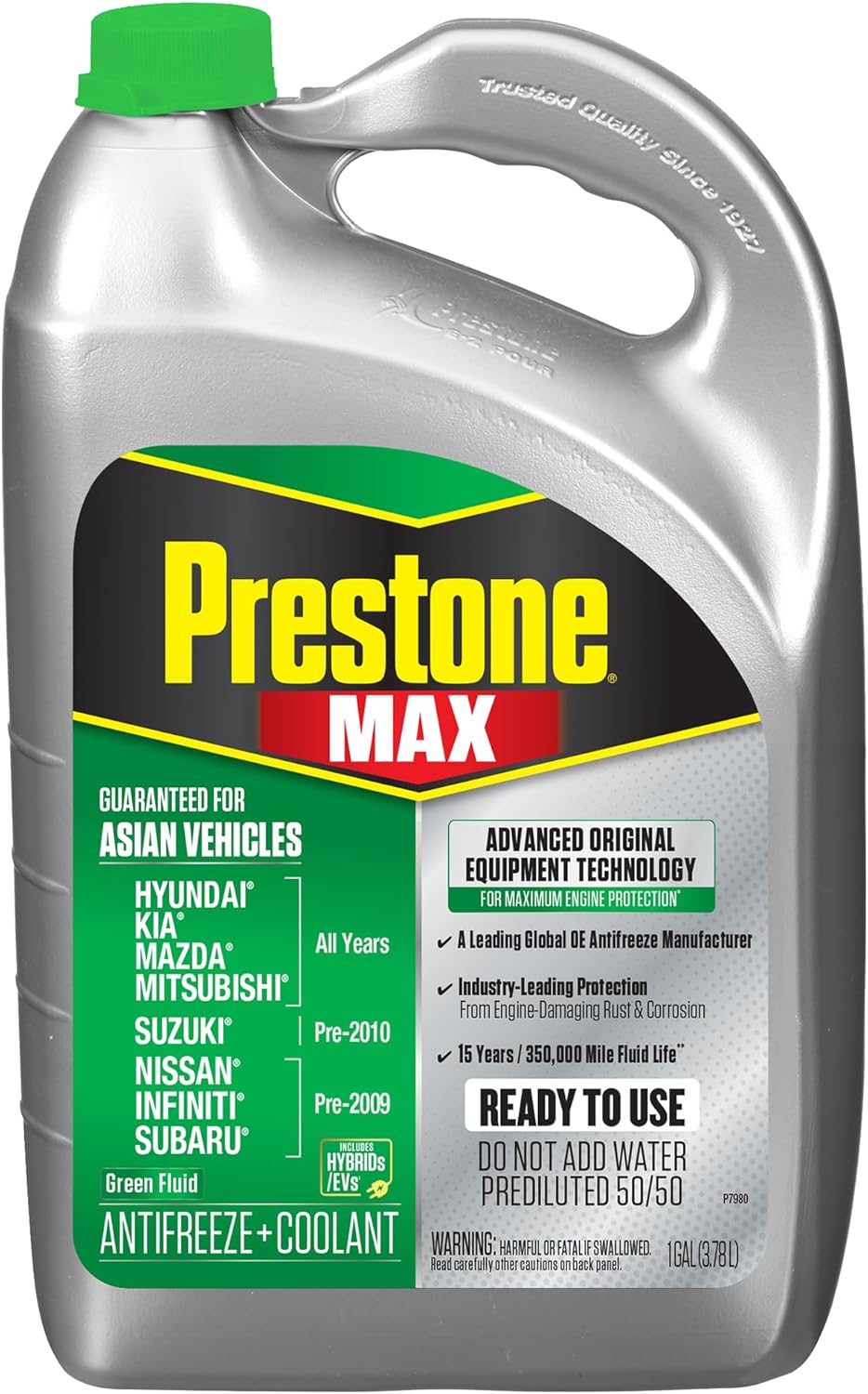
| Blend | 50/50 premixed |
|---|---|
| Vehicle focus | Asian vehicles |
| Corrosion protection | Prestone CorGuard technology |
This premixed 50/50 coolant is designed for Asian-market cooling systems and delivers straightforward freeze and boil protection while helping limit corrosion. You pour it straight into the reservoir or radiator without mixing, which makes topping off or a full coolant change quick and simple. The product highlights Prestone CorGuard technology for corrosion control and includes a bitterant to discourage accidental ingestion. In practice it keeps coolant levels stable on long drives and in mixed climates, and reviewers report compatibility with older Asian cars. It does not advertise extended-life or advanced hybrid chemistry found in some premium coolants, so expect standard service intervals rather than multi-year fill-and-forget performance. That makes it a practical, low-cost option when you want reliable thermal protection and corrosion inhibition without paying for OEM-specific or long-life formulas.
Best for: Budget-conscious owners of 2003–2007 Honda Accord looking for an affordable, ready-to-use coolant that provides reliable freeze/boil protection and corrosion control for routine maintenance.
Less Ideal for: Drivers who want long-life, manufacturer-specified hybrid coolants or long service intervals should consider OEM-specified or extended-life formulas instead.
- Premixed 50/50 formula ready to pour with no dilution needed
- Formulated for Asian vehicles so it matches common coolant chemistries for those applications
- Includes corrosion inhibitor technology to protect cooling system metals
- Bitterant added to reduce risk of accidental ingestion
- Widely reported stable performance and good value in user feedback
- Not marketed as an extended-life or hybrid long-life coolant so intervals may be shorter than premium formulas
Verdict: The best low-cost coolant for budget-conscious buyers who need reliable basic corrosion and freeze/boil protection without premium additives or features.
3. Zerex Asian Vehicle Green 50/50 Ready-to-Use Antifreeze/Coolant (1 Gallon)
Best Extended-Life Coolant

| Brand | Zerex |
|---|---|
| Model | Asian Vehicle Green |
| Mixture | 50/50 ready-to-use |
| Technology | Hybrid Organic Acid Technology (HOAT) |
Zerex Asian Vehicle Green is a one‑gallon, pre-mixed 50/50 coolant built around Hybrid Organic Acid Technology with a phosphate additive to protect aluminum and other metals in modern Asian-made engines. It is intended for topping off or full system fills and is designed to resist corrosion, scale and rust while protecting water pumps, radiators and hoses. As a ready-to-use formula it removes the need to mix concentrate, which simplifies DIY work and reduces the chance of incorrect dilution. The HOAT inhibitor package aims for longer service life than older conventional formulas, so it fits owners who want extended drain intervals and lower cooling-system maintenance. Limitations include the lack of a concentrated option for precise post-flush rebalancing and the fixed 50/50 mix that can make achieving an exact concentration after a flush more difficult. Use this when the vehicle maker specifies a green HOAT coolant or when a pre-mixed solution is preferred for convenience.
Best for: Buyers who prioritize longer drain intervals and a durable inhibitor package for Asian‑spec engines and prefer the convenience of a ready-to-use coolant.
Less Ideal for: Those who need concentrated antifreeze to precisely adjust coolant ratio after a complete flush or who must follow a different manufacturer color/spec requirement.
- HOAT formulation with phosphate additives helps protect aluminum and other cooling system metals.
- Pre-mixed 50/50 reduces mixing errors and is convenient for DIY top-offs and fills.
- Formulated to resist corrosion, scale and rust which supports longer component life.
- Widely used OEM-approved formula that matches many Asian manufacturer specifications.
- No concentrate option in the U.S., making precise post-flush concentration adjustments harder.
Verdict: The best extended-life coolant for owners who prefer longer drain intervals and more durable inhibitor chemistry to reduce maintenance frequency.
4. PEAK OET Extended Life Green Concentrate Antifreeze/Coolant (1 Gal)
Best Concentrate Coolant

| Volume | 1 gallon |
|---|---|
| Concentrate | Yes |
| Vehicle focus | Asian vehicles (POAT green) |
| Contains bittering agent | Denatonium Benzoate |
This PEAK OET concentrate is a phosphate‑enhanced organic acid technology coolant sold as a concentrated green formula you mix with water before use. It is designed for Asian vehicle applications and is intended for flush, fill, or topping off the cooling system. As a concentrate it gives DIY mechanics control over the final 50/50 or other mix ratio, so you can tune freeze and boil protection to local climate and driving conditions. The formula claims extended life protection when installed after a complete flush and fill, and the product includes corrosion inhibitors to protect aluminum and other cooling system components. Being a vehicle‑specific formulation, it is useful when a manufacturer calls for a green POAT coolant. Expect typical concentrate handling: you must measure and mix with distilled water and follow vehicle manufacturer specifications to avoid compatibility issues. The product also contains a bittering agent for safety. The main limitation is that this is targeted at certain Asian coolant specs, so verify that a 2003–2007 Honda Accord requires or allows a phosphate‑enhanced green concentrate before use.
Best for: A DIYer who wants precise control over coolant concentration and long‑life corrosion protection and who will follow manufacturer mixing and flushing procedures for a 2003–2007 Honda Accord.
Less Ideal for: Drivers who prefer a ready‑to‑use 50/50 premix or who cannot confirm that their Accord accepts a phosphate‑enhanced green concentrate should choose a different formulation.
- Concentrate form lets DIYers mix to the exact antifreeze/water ratio for climate and boil protection.
- Formulated with phosphate‑enhanced OAT chemistry and corrosion inhibitors to protect cooling system metals.
- Extended life formulation intended to provide long service intervals when used after a full flush and fill.
- Bittering agent added to deter accidental ingestion.
- Specifically formulated for Asian vehicle POAT requirements so may not match every vehicle coolant spec.
Verdict: The best concentrate coolant for DIYers who want the flexibility to mix at the correct antifreeze/water ratio for optimal freeze and boil protection.
5. PEAK OET Extended Life Blue 50/50 Prediluted Antifreeze/Coolant for Asian Vehicles, 1 Gal.
Best Pre-Mixed Coolant

| Formulation | Phosphate‑enhanced Organic Acid Technology (OET) |
|---|---|
| Dilution | 50/50 prediluted |
| Volume | 1 gallon |
| Recommended for | Asian vehicles (list includes Honda) |
This PEAK OET coolant arrives pre‑diluted 50/50 so you can pour it straight into the cooling system without measuring or mixing, which is ideal for quick top‑offs and DIY maintenance. It uses a phosphate‑enhanced Organic Acid Technology formula intended for a range of Asian vehicles and is advertised to prevent rust and corrosion across cooling components. In practice the product simplifies routine coolant service and reduces the risk of dilution mistakes that can happen when mixing concentrate at home. The 1‑gallon size covers most top‑off jobs and short flush‑and‑fill intervals, and the bottle is easy to pour. Limitations include the need to confirm compatibility with the factory coolant spec in your vehicle; color alone is not a guarantee of fit. Also this is a prediluted formula, so it is not suitable if your cooling system requires a specific concentrate or a different chemistry. For a 2003–2007 Honda Accord, check the owner manual and use this only if the recommended coolant type matches PEAK OET’s formulation.
Best for: DIYers who value a convenient, ready‑to‑pour coolant for straightforward top‑offs and routine cooling system maintenance and who will confirm their Accord’s coolant spec before use.
Less Ideal for: Technicians or owners who need concentrated coolant for custom mix ratios or vehicles that require a different coolant chemistry than phosphate‑enhanced OET.
- Ready‑to‑pour 50/50 premix removes mixing errors and speeds top‑offs
- Extended‑life OET formulation aimed at corrosion and rust protection
- 1‑gallon size is convenient for multiple top‑offs or a single flush and fill
- Bottle design and pre‑dilution make DIY maintenance cleaner and faster
- Must verify vehicle coolant chemistry compatibility before use
- Not suitable when a concentrated product is required for long‑term dilution control
Verdict: The best pre-mixed coolant for DIYers who want a convenient, ready-to-pour solution that eliminates mixing errors and simplifies top-offs.
Choosing the Right 2003-2007 Honda Accord Coolant: Key Factors to Consider
Coolant Chemistry and Inhibitor Type
Different coolant chemistries use distinct inhibitor packages to protect metal components. For the 2003-2007 Honda Accord, compatibility with aluminum head and engine alloys, as well as soldered joints in the radiator, is critical. An incompatible inhibitor can accelerate corrosion or lead to degraded seals and hoses.
Know whether the coolant uses inorganic additives, organic acid technology, or a hybrid formula. Inorganic additive coolants often require more frequent changes but have been used historically in many Hondas. Organic acid and hybrid long-life coolants can extend service intervals but must be clearly specified as safe for Honda cooling system materials.
Recommended Service Life and Maintenance Interval
Service life varies widely across coolant types. Some formulations are labeled for short intervals and others for extended life up to several years or more. For vehicles in the 2003-2007 range, choosing a coolant with a reputable stated service interval helps users plan coolant flushes without over- or under-servicing the system.
Bear in mind that the stated life assumes proper mixture ratio and that the cooling system is free of contaminants. If the system has not been flushed in many years, replacing the coolant and performing a flush is often recommended before switching to a long-life product.
Mixture Ratio and Freeze/Boil Protection
The performance of any coolant depends on mixing concentration with water. A 50/50 mix is the common baseline that balances freeze protection, boil resistance, and corrosion control. For owners in colder climates, higher concentration may be needed for freeze protection but could slightly reduce heat transfer efficiency.
Check the coolant's documented freeze and boil protection at common mixture ratios and ensure it meets the cooling demands of the Accord's engine. Also confirm whether the product is pre-mixed or concentrated, since the latter requires correct dilution during service.
Material Compatibility and Seal Friendliness
Hoses, gaskets, and seals in the cooling system must remain flexible and leak-free over time. Some coolant formulations can harden or swell seals if their additive balance is wrong. For the 2003-2007 Accord, look for fluids that explicitly state compatibility with OEM elastomers and radiator construction.
Also consider compatibility with the heater core and plastic components. Fluids that are labeled to be safe with mixed-metal systems reduce the risk of electrochemical corrosion between dissimilar metals.
Clarity, Color, and Contaminant Visibility
Coolant color and clarity can help during inspections and troubleshooting. A stable, clear fluid makes it easier to spot oil contamination, rust particles, or scale. Some long-life coolants maintain color stability longer, which aids in routine checks and early detection of cooling system issues.
While color alone does not indicate performance, rapid discoloration is a useful indicator that the system may have internal corrosion or gasket failure that needs attention.
Ease of Service and Availability
Serviceability matters because owners often top off or change coolant outside a shop. Pre-mixed options reduce dilution errors, while concentrated formulas are more compact to store and ship. Also assess local availability and whether the product's instructions are clear for do-it-yourself coolant flushes.
Consider whether the coolant requires special handling, extended flush procedures, or additive conditioners. Simpler service steps reduce the chance of installation mistakes that could compromise system protection.
Why Correct Coolant Matters in Older Accord Engines
The 2003-2007 Accord cooling system has components that can be sensitive to wrong inhibitor chemistries, particularly as parts age. Using an appropriate coolant reduces the risk of internal corrosion, heater core clogging, and premature radiator degradation.
For vehicles with higher mileage, the right formula helps stabilize metal surfaces and maintain heat transfer efficiency, which supports consistent cabin heat and prevents overheating during prolonged driving.
- Protects aluminum heads and radiator tubes from corrosion
- Maintains thermostat and water pump performance
- Helps prevent heater core and passageway clogging
When to Perform a Coolant Flush on a 2003-2007 Accord
Flush intervals depend on prior maintenance and the coolant type. If the coolant history is unknown or the system shows signs of contamination or discoloration, perform a full flush before refilling. For known long-life fluids, follow the manufacturer-stated interval and inspect the fluid condition periodically.
Always check hoses, clamps, and the radiator cap during a flush. Replacing old hoses or a weakened cap at the time of coolant service can prevent leaks and maintain system pressure.
- Flush if fluid is rusty, cloudy, or has oil contamination
- Inspect and replace worn hoses and thermostat as needed
Mixing with Distilled Water and Why It Matters
Using distilled or deionized water preserves the coolant's inhibitor effectiveness by avoiding minerals that can deposit and reduce heat transfer. Tap water contains dissolved minerals that may accelerate scale formation and interfere with corrosion protection.
If a concentrated product is used, follow the recommended dilution ratios exactly. Inconsistent mixing can change freeze and boil points and reduce the life of the coolant's inhibitor package.
- Use distilled water when diluting concentrated coolant
- Aim for a 50/50 mix unless the product guidance or climate dictates otherwise
Signs Your Accord's Cooling System Needs Attention
Watch for elevated operating temperature, fluctuating gauge readings, sweet-smelling coolant odors, or visible coolant loss. These symptoms often precede more serious issues like head gasket leaks or localized corrosion.
Also monitor cabin heater performance. Weak or intermittent heat can be caused by clogged heater cores or low coolant flow, both of which are related to the condition of the coolant and system cleanliness.
- Overheating under load or in traffic
- Visible rust flakes or sludge during inspection
- Sweet smell in the cabin indicating possible leaks
Maintaining Cooling System Health Between Flushes
Periodic inspections and top-offs are useful to maintain system integrity. Check coolant level in the overflow reservoir with the engine cold and look for changes in color or oil contamination. Address minor issues quickly to avoid costly repairs.
Regularly inspect the radiator cap and pressure, since a failing cap can reduce boiling point protection and promote cavitation. Keep records of service intervals and the type of coolant used to ensure consistent maintenance.
- Check reservoir level monthly
- Replace radiator cap if pressure testing shows leaks
Still looking for the perfect fit?
Select your Honda Accord configuration to see the most relevant Coolants recommendations
How We Chose the Best 2003-2007 Honda Accord Coolant
We focused on formulations and attributes that directly affect longevity and system health in 2003-2007 Honda Accord cooling systems. Key evaluation criteria included corrosion inhibitor chemistry and compatibility with Honda's cooling system materials, recommended service life or extended-life claims, freeze and boil protection at typical mixture ratios, and clarity of manufacturer compatibility guidance for the 2003-2007 Accord range.We also considered fluid stability under heat cycling and resistance to foaming, since these factors impact thermostat operation and heater core flow. Performance in independent corrosion and cavitation testing reports, where available, was used as a supporting data point. Packaging and concentration (pre-mix versus concentrated) were noted for user convenience during service.Exclusions: We excluded any fluid formulations explicitly labeled incompatible with Honda vehicles or those lacking clear inhibitor chemistry. Generic listings with no stated service life or technical specifications were not considered. The final list balances OEM replacement-style formulations and modern long-life options that meet the compatibility and durability needs of the 2003-2007 Accord.
Our full evaluation process is outlined in our review methodology.
FAQ
Can I switch to a long-life coolant in my 2003-2007 Accord?
You can switch if the long-life formulation is stated to be compatible with Honda cooling systems and the system is properly flushed beforehand. If the existing coolant is old or contaminated, perform a full flush to avoid mixing incompatible inhibitors.
Is it safe to top off with a different coolant color?
Mixing colors does not automatically mean incompatibility, but you should confirm the chemistries match. When in doubt, avoid topping off with an unknown formulation and instead perform a flush and refill with a known compatible product.
How often should I check the coolant level in the overflow tank?
Check the overflow tank monthly and before long trips. Top off when the engine is cold using the correct 50/50 mixture if needed, and inspect for signs of contamination or oil presence.
Will a coolant change improve heater performance in an older Accord?
If heater performance is poor due to clogged passages or severely degraded coolant, a flush and refill can restore flow and heat transfer. However, if the heater core is physically blocked or leaking, coolant change alone may not solve the issue.
Do I need distilled water when diluting concentrated coolant?
Yes, using distilled or deionized water is recommended when diluting concentrated coolant to avoid mineral deposits that can reduce corrosion protection and heat transfer efficiency.
Can I perform a coolant flush myself on this Accord?
Many owners can perform a flush with basic tools, but ensure you follow proper procedures for draining, refilling to the correct mix, and burping air from the system. If you are unsure about diagnosing contamination or bleeding air pockets, seek professional assistance.
Final Verdict
Choose a coolant that explicitly lists compatibility with the 2003-2007 Honda Accord cooling system materials and matches the service life you want between changes. Prioritize inhibitor chemistry, correct dilution with distilled water, and a product that maintains freeze and boil protection at the commonly used mixture.If the system is older or the coolant condition is unknown, start with a complete flush before switching formulas. That approach reduces risk and clarifies future maintenance intervals so you can keep the Accord operating reliably.
Explore More:
- Check out all Honda Accord parts & accessories
- Explore Fluids & Chemicals
- Browse all Accessories
