

Note: This article contains affiliate links. If you click on these links and make a purchase, I may earn a small commission at no extra cost to you. This helps support my research and content. Read my full affiliate disclosure here.
If your Honda Fit feels loose or the front end vibrates, replacing the control arm can restore steering precision and improve ride stability. Choosing the right Honda Fit control arm matters because fitment, bushing type, and ball joint quality directly affect alignment, handling, and long-term wear. This guide covers seven shortlisted control arms selected for fit and durability and explains the practical differences buyers should weigh. Read on to understand the criteria we used and what to look for when you inspect or replace a control arm.
Looking for other parts? See all Honda Fit parts & accessories.
Top Picks at a Glance


TRQ Front Steering & Suspension Kit with Control Arms, Tie Rods and Sway Bar Links

| Included Components | 6 Piece Steering & Suspension Kit |
|---|---|
| Auto Part Position | Front Lower |
| Fit Type | Vehicle Specific Fit |
| Material Type | Alloy Steel, Aluminum, Cast Iron, Stainless Steel |
This TRQ kit bundles two front lower control arms with ball joints, two outer tie rods, and two sway bar links to restore steering precision and front-end stability. Designed as a vehicle-specific direct-fit kit, the components arrive pre-greased and anti-corrosion coated so you can install them without modifications and with minimal prep. Typical use is for a front-end overhaul when worn ball joints or tie rods cause looseness, uneven tire wear, or steering noise; having all key front components in one box reduces parts-sourcing and trips to the store. Notable features include pre-assembled control arms with pre-greased joints, corrosion-resistant finishes, and included installation videos from the manufacturer to simplify DIY work. The practical benefits are a tighter, more confident steering feel and fewer installation variables compared with buying parts separately. Limitations to consider are occasional fitment mismatches reported on some vehicle applications and mixed long-term durability feedback, so verify fitment for your Honda Fit and be prepared to address warranty or return steps if needed.
Best for: Buyers who prioritize convenience and want a single, mostly plug-and-play kit to refresh the front lower steering and suspension quickly with minimal parts hunting and fewer shop visits.
Less Ideal for: Drivers who need a guaranteed long-term performance upgrade or who prefer sourcing individual premium-brand components for exact OEM match should consider alternatives.
- Complete front-end kit includes control arms, ball joints, tie rods, and sway bar links to simplify repairs
- Pre-greased ball joints and anti-corrosion coating reduce initial servicing and extend surface life
- Vehicle-specific direct-fit design minimizes the need for modifications during installation
- Manufacturer provides step-by-step installation videos to help DIYers complete the job
- Some customers reported fitment issues on particular vehicles requiring returns or exchanges
- A few reviews indicate premature failure on isolated units, so lifespan can vary
Verdict: A convenient all-in-one front steering and suspension kit that streamlines a lower-control-arm refresh for drivers who want a fast, direct-fit DIY solution.
TRQ Front Suspension Kit — Control Arms with Ball Joints and Sway Bar Links for 2007–2008 Honda Fit

| Fit Type | Vehicle Specific Fit |
|---|---|
| Auto Part Position | Front Lower |
| Unit Count | 1.0 Count |
| Exterior | Machined |
This TRQ front suspension kit bundles two front lower control arms with ball joints and two front sway bar links as a direct-fit replacement for 2007–2008 Honda Fit models. Designed for straightforward DIY installation, the components arrive preassembled and pre-greased so you can swap them into the suspension without modifications. The kit is anti-corrosion coated for longer surface life and the included sway bar links and ball-joint control arms improve steering response and reduce clunking from worn bushings. For a performance-oriented buyer, the restored road feel and tighter handling are the main benefits, and TRQ provides installation videos to speed the job. Limitations to note are that this is a factory-style replacement rather than an adjustable performance arm, so it will not change alignment geometry or lower ride height. Fitment is vehicle-specific, so confirm compatibility for the 2007–2008 Fit before purchase.
Best for: Performance-oriented buyers who want to restore factory handling and steering response on a 2007–2008 Honda Fit with a quality direct-fit replacement and minimal installation fuss.
Less Ideal for: Drivers seeking adjustable aftermarket control arms for alignment tuning or lowered ride height should consider dedicated performance arms instead.
- Complete kit includes both front lower control arms with ball joints plus two sway bar links for a single install
- Pre-greased and preassembled components reduce installation time and hassle
- Anti-corrosion coating helps extend surface life in road conditions
- Vehicle-specific design means parts fit without modifications when matched to the 2007–2008 Fit
- Not adjustable for camber or caster so it does not provide performance tuning capability
- Includes only front lower components and sway links so additional suspension parts may still need replacement
Verdict: A solid factory-quality replacement kit that restores steering feel and handling on 2007–2008 Honda Fit models but is not designed for alignment tuning.
Detroit Axle Front Right Lower Control Arm for 2009–2013 Honda Fit / 2010–2011 Insight

| Fit Type | Vehicle Specific Fit |
|---|---|
| Auto Part Position | Front Right Lower |
| Auto Part Orientation | Passengers Side |
| Material Type | Alloy Steel, Stainless Steel |
This Detroit Axle front right lower control arm is a vehicle-specific replacement that restores steering and suspension geometry on compatible Honda Fit and Insight models. It comes assembled with the ball joint, so installation is straightforward for a competent DIYer or mechanic and typically replaces a worn control arm to eliminate play, vibration, or wandering. Constructed from alloy and stainless steel and subjected to impact and fatigue testing, it aims to match factory fit and performance while offering a long spare-parts availability window. Practical benefits include a direct bolt-on fit, integrated ball joint to save labor, and positive owner reports of improved ride smoothness and restored handling. Limitations to consider are that fitment must match your model year exactly and some users reported minor fit adjustments on non-exact matches; a professional alignment after installation is required to ensure proper tire wear and steering. This part is best used as a budget-conscious, quality-minded replacement rather than an upgrade for performance driving.
Best for: Practical optimizers who want a reliable, factory-style replacement that restores handling and saves installation time without overspending.
Less Ideal for: Buyers seeking high-performance suspension upgrades or parts for vehicles outside the specified Honda Fit/Insight year range should look elsewhere.
- Vehicle-specific design for direct fit to listed Honda Fit and Insight years
- Ships with ball joint pre-assembled to reduce installation time
- Made from alloy and stainless steel for corrosion resistance and durability
- Backed by testing for impact, wear, and fatigue and long spare-part availability
- Requires exact year/model fitment so ordering the wrong year can need modifications
- Some users reported minor clearance or fit adjustments on certain vehicles
Verdict: A budget-friendly, factory-quality front right lower control arm that restores proper steering and suspension on the specified Honda Fit and Insight models.
A-Premium Front Left Lower Control Arm with Ball Joint and Bushing for Honda Fit (2015–2019)

| Vehicle Fitment | Honda Fit 2015, 2016, 2017, 2018, 2019 |
|---|---|
| Position | Front Lower Left (Driver Side) |
| Material | Steel |
| Includes | Ball joint and bushing, pre-greased |
This A-Premium front left lower control arm is a complete replacement assembly that includes the ball joint and bushing pre-greased for easier installation on Honda Fit 2015–2019 models. It replaces the factory lower control arm to address common suspension issues like clunking, steering wander, uneven tire wear, and vibration. Because the part ships as a vehicle-specific fit and arrives with bushings and a ball joint installed, it reduces installation steps compared with sourcing separate components. The steel construction should provide solid durability for everyday driving while the included hardware helps simplify a DIY swap or a straightforward shop replacement. Limitations to expect are typical of budget aftermarket parts: fitment can require minor adjustments during installation and long-term durability may not match higher-end factory-quality components. It does come with a one-year parts guarantee that covers the item itself but not labor or related expenses.
Best for: Budget-conscious Honda Fit owners who want a ready-to-install suspension repair that replaces the lower control arm, ball joint, and bushing in one purchase to minimize upfront cost and simplify a DIY or shop replacement.
Less Ideal for: Drivers seeking the longest-lasting, factory-matching suspension components or those doing performance or track-focused upgrades should consider higher-tier or OEM-equivalent options.
- Complete assembly with ball joint and bushing included, reducing parts sourcing
- Pre-greased components simplify installation and initial break-in
- Vehicle-specific fit for Honda Fit 2015–2019 limits compatibility guesswork
- Steel construction intended for everyday durability
- Aftermarket budget part may require minor fitment adjustment during installation
- Long-term durability likely below higher-end or factory-quality replacements
Verdict: An affordable, all-in-one replacement lower control arm assembly that simplifies repair for Honda Fit (2015–2019) owners on a tight budget.
Detroit Axle Front Lower Control Arms Kit with Ball Joints and Outer Tie Rods for Honda Fit / Insight

| Fit Type | Vehicle Specific |
|---|---|
| Auto Part Position | Front Lower |
| Material Type | Alloy Steel |
This Detroit Axle kit replaces both front lower control arms (with pressed ball joints) plus both outer tie rod ends so you can do a full front lower-end refresh in one job. It is built from alloy steel with a high‑strength design intended to resist wear and corrosion and to handle repeated impact loads. Fitment is vehicle specific and many buyers report straightforward, bolt‑on installation and quick alignment after installation. The practical benefit is restoring proper steering feel and eliminating clunks from worn joints without sourcing separate parts. Limitations to note are that the kit is an aftermarket replacement so minor fitment differences have been reported on rare vehicles and installers should verify if any small modifications or clip holes are needed for older chassis variants. You will also need a proper alignment after installation and professional torqueing of fasteners for long bushing life.
Best for: Reliability‑focused owners who want a single, cost‑effective repair that restores front suspension function and steering confidence without frequent rework.
Less Ideal for: Buyers who demand exact factory‑matched parts for cosmetic or collector restorations or those wanting upgraded performance suspension components should consider alternatives.
- Complete front lower-end kit includes two lower control arms with ball joints and both outer tie rod ends for a single replacement job
- Vehicle‑specific direct-fit design simplifies installation and reduces fitment guesswork
- Alloy steel construction and reinforced design aim to resist corrosion and handle repeated impact loads
- Kit restores steering precision and eliminates common symptoms of worn lower suspension components
- Some users report small fitment differences on older chassis that required drilling or minor adjustments
- As an aftermarket part there can be variability between batches compared with factory parts
Verdict: A ready‑to‑install, vehicle‑specific lower control arm and tie rod kit that restores front suspension function and steering feel for Honda Fit and Insight owners.
Detroit Axle Front End 8‑Piece Suspension Kit for 2009–2014 Honda Fit
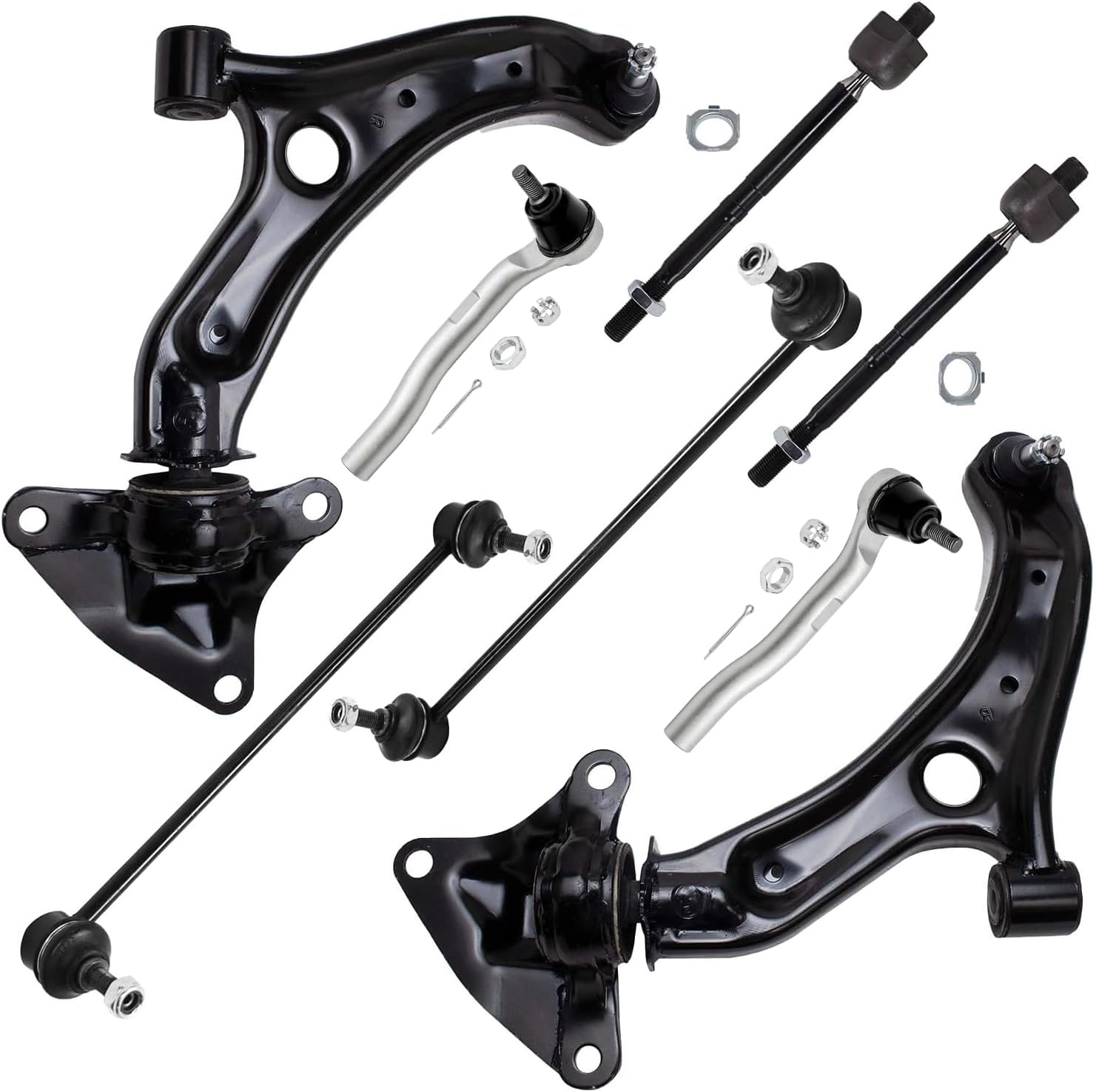
| Fitment | 2009–2014 Honda Fit (front lower) |
|---|---|
| Kit contents | 2 lower control arms with ball joints, 2 inner tie rods, 2 outer tie rods, 2 sway bar end links |
| Manufacturer | Detroit Axle |
| Manufacturer Part Number | 8CS501119 |
This Detroit Axle 8‑piece front end kit bundles the parts typically replaced together when a Fit’s front end starts to feel loose: two lower control arms with pressed ball joints, inner and outer tie rod ends, and sway bar end links. It is intended for a one‑vehicle refresh of front lower suspension components and is used during routine steering and alignment repairs to restore steering response and reduce play. The parts are tested for impact and fatigue and arrive ready for installation with factory replacement fitment claims for 2009–2014 Honda Fit models. The practical benefit is convenience and value — you get all the common wear items in one purchase instead of buying pieces separately. Limitations to expect are mixed quality reports from users and the known difficulty of pressing in ball joints during installation; shop tools or a press may be required. Some buyers also note missing small extras such as protective boots. This kit suits a balanced buyer who wants a full front lower refresh without sourcing individual parts, but expect a competent installer and a post‑installation alignment.
Best for: Balanced buyers who prioritize convenience and value and want a single purchase to refresh the front lower suspension on a Honda Fit, while accepting that a professional or equipped DIYer will handle the install.
Less Ideal for: Drivers seeking premium, factory‑matched ride quality or those wanting to replace only a single failing component rather than an entire kit should consider alternative options.
- Complete kit covers both lower control arms, inner and outer tie rod ends, and sway bar end links for a single front‑end refresh
- Packaged to fit 2009–2014 Honda Fit models for straightforward replacement and reduced part‑sourcing hassle
- Manufacturer states parts undergo impact, wear, and fatigue testing to support durability claims
- Good value versus buying individual components separately
- Control arms include pressed ball joints that can be difficult to install without a press or specialist tools
- Some reviewers report inconsistent feel or harshness compared with factory parts
- Kit does not include small ancillary items such as tie rod boots in some cases
Verdict: A convenient, value‑focused full front lower suspension kit for 2009–2014 Honda Fit owners who want a single purchase to restore steering tightness, provided you have the tools or a shop for installation.
TRQ Front Lower Control Arm with Ball Joint Set (2-piece) for 2007–2008 Honda Fit

| Fitment | 2007–2008 Honda Fit |
|---|---|
| Quantity | 2 Piece |
| Auto Part Position | Front Lower |
| Manufacturer | TRQ |
This TRQ kit supplies both front lower control arms with integrated ball joints for the 2007–2008 Honda Fit, intended as a direct replacement for worn factory components. Installation is aimed at DIYers and professional shops alike since the arms arrive pre-assembled and are described as vehicle-specific fit, so they bolt into the original mounting points without modification. Notable features include machined exterior finish and TRQ’s library of installation videos, which help with alignment and torque procedures. In use the parts restore steering feel and front-end stability when original arms are worn, and many buyers report straightforward fitment and improved handling. Limitations to consider are mixed reports on long-term durability of the ball joints and the lack of an accessible grease fitting, which means you cannot re-lubricate the joint in service and may expect variable lifespan depending on driving conditions. Expect good fit and handling benefits right away, but plan for periodic inspection on high-mileage or harsh-weather vehicles.
Best for: Drivers focused on restoring or improving front-end response on a 2007–2008 Honda Fit who prioritize a performance-oriented, direct-fit replacement and want a mostly DIY-installable solution.
Less Ideal for: Those seeking a rebuildable or greasable ball-joint solution for frequent heavy-duty driving or off-road use should consider alternatives with serviceable joints or heavy-duty designs.
- Sold as a matched pair covering both driver and passenger front lower positions
- Pre-assembled with ball joints for faster, no-modification installation
- Vehicle-specific fit for 2007–2008 Honda Fit reduces alignment issues after install
- Manufacturer provides installation videos to guide DIY installs
- Ball joints are not serviceable and lack a factory-style grease fitting
- Some users report inconsistent long-term durability under heavy use
Verdict: A convenient, performance-minded direct-fit replacement that restores steering feel quickly but uses sealed, non-greasable ball joints that may limit long-term serviceability.
Choosing the Right Honda Fit Control Arm: Key Factors to Consider
Fitment and Vehicle Specificity
Accurate fitment to the Honda Fit is essential because an arm that does not match mounting points or bushing orientation can throw suspension geometry out of spec. Confirming vehicle-year and submodel fitment reduces the risk of needing additional modifications or returning parts.
A part designed specifically for the Honda Fit preserves factory steering and suspension angles, which affects tire wear and handling. When fitment is ambiguous, installation can be more time consuming and may require supplemental hardware or fabricating adapters, so prioritize arms with explicit Honda Fit compatibility.
Bushing Type and Durability
Bushings control how much flex the control arm allows and influence ride comfort versus steering feedback. Rubber bushings provide more vibration isolation and a softer ride, while synthetic or polyurethane bushings often offer firmer response and longer life but may transmit more noise.
Consider bushing construction because worn or inappropriate bushings lead to clunking, alignment drift, and uneven tire wear. Look for materials and designs that balance lifetime and NVH characteristics appropriate to how you drive the vehicle.
Ball Joint Construction and Serviceability
Many front lower control arms incorporate a ball joint; the quality of that joint affects steering precision and safety. A well-sealed, properly hardened ball joint resists wear and tolerates road contaminants, while a poorly made joint can develop play that causes wandering or uneven tire wear.
Also consider whether the ball joint is replaceable or integrated. Replaceable joints simplify future maintenance, while integrated joints may require full-arm replacement when the joint wears. Serviceability affects long-term ownership costs and downtime.
Material, Coating, and Corrosion Resistance
Control arms are exposed to road grime and moisture, so base material and protective coatings influence longevity. Steel arms with robust powder coating or galvanized finishes resist rust longer than untreated metal, reducing the chance of structural weakening or seized mounting points.
Aluminum arms can save weight and resist corrosion differently, but surface treatment and structural design still determine long-term durability. Prioritize arms whose materials and coatings match the climate and road conditions where you drive.
Alignment and Geometry Retention
A replacement control arm must allow the suspension to be aligned within factory specifications. Small differences in bushing preload, arm length, or mounting hole placement can lead to camber or toe offsets that affect handling and tire life.
Consider whether the arm supports standard alignment procedures and whether additional adjustable components are needed. Proper geometry retention minimizes the need for corrective shims and simplifies post-installation alignment.
Installation and Maintenance Considerations
Some control arms are direct-fit and bolt in with common tools, while others require press-fitting bushings or ball joints. Ease of installation affects labor time and whether you can perform the job at home or should plan for professional installation.
Also evaluate how easy it is to service the arm later, for example whether bushings or ball joints can be replaced independently. Clear installation guidance and access to compatible mounting hardware reduce frustration and lower the total cost of ownership over time.
How to Recognize Control Arm Problems on a Honda Fit
Early recognition of suspension issues saves time and prevents secondary damage. On a Honda Fit, a failing Honda Fit control arm most commonly reveals itself through changes in ride quality, uneven tire wear, or strange noises during driving. These symptoms often start subtly and progress, so note any new clunks, thuds, or a feeling that the front end wanders.
Use a quick checklist to separate suspension noises from other sources. Engine or transmission sounds are usually constant across steering inputs, while control arm symptoms will change when you go over bumps, turn the wheel, or load one side of the car. Keep a log of when and where symptoms occur to help a mechanic diagnose the issue faster.
- Clunking or knocking when hitting potholes or speed bumps
- Pulling to one side or a vague steering feel
- Rapid or uneven tire wear on the fronts
- Vibration in the steering wheel at low speeds
Inspecting Bushings and Ball Joints on the Fit
Visual and hands-on inspection is the most direct way to spot trouble. Focus on the control arm bushing area and the ball joint interface. Look for cracks, separation, or grease leakage. Excessive movement at the ball joint or visible deterioration of rubber bushings indicates the part is past its useful life.
If you suspect bushing trouble, check for control arm bushing wear by lifting the front of the car safely and using a pry bar to test for play. Excessive travel or a loose mount confirms replacement is needed. For ball joint checks, observe vertical play or listen for creaking when the suspension cycles.
- Check bushings for cracking, splits, or missing rubber
- Look for torn dust boots or grease leakage at the ball joint
- Use a pry bar to test lateral and vertical movement
- Inspect mounting bolts and surrounding frame for distortion
Preparing for a Control Arm Replacement on a Honda Fit
A planned replacement reduces labor time and avoids surprises. Before ordering parts, verify the correct Honda Fit control arm part number for your model year and any sub-configuration. Having the correct part on hand prevents work stoppage and repeated trips to the parts store.
Also prepare basic tools and consumables. Common needs include new mounting hardware if the original bolts are torque-to-yield, anti-seize or thread locker as specified, fresh grease for serviceable joints, and new sway bar links if they show wear. If you are budgeting, research the front control arm cost as part of the total repair estimate so you can compare the price of different assembly options.
- Confirm the exact control arm part number before purchase
- Gather torque wrench, jack stands, and impact or breaker tools
- Plan for fresh alignment after installation
- Decide whether to replace related components at the same time
Installation Tips for a Smooth Swap
Whether you are doing the job yourself or supervising a shop, attention to detail during installation reduces the chance of future issues. Start with good working clearances and use proper lifting points for safety. Replace worn hardware and follow torque specifications from the factory manual.
During installation, make sure the suspension is in a natural, unloaded position when tightening bushing bolts if the factory manual calls for that. This prevents preloading rubber components and improves service life. If the control arm includes a serviceable ball joint, pack it with the correct lubricant and torque the nut to the specified value.
- Tighten bushing bolts with suspension at specified position
- Always use a calibrated torque wrench for critical fasteners
- Replace rusted or damaged mounting hardware
- Verify ball joint cotter pins or locking hardware are secured
Post-installation Checks and Alignment Considerations
After any control arm work, inspect the vehicle at rest and on a short test drive. Listen for new noises and confirm steering response is consistent. Although alignment specifics are covered elsewhere on the page, practical checks include confirming the steering wheel is centered and the car tracks straight on a level road.
Addressing control arm alignment issues promptly prevents uneven tire wear and poor handling. Even if the toe seems close, always schedule a professional alignment after replacement so caster and camber are within specification. Keep notes of pre- and post-repair behavior to validate the repair.
- Confirm steering wheel center and straight-line tracking
- Check tire wear patterns after a few hundred miles
- Schedule a four-wheel alignment with printout of specs
- Re-torque critical fasteners after an initial break-in period
Cost, DIY Versus Professional Service, and Common Decisions
Deciding whether to perform a control arm replacement yourself depends on experience, tools, and the availability of a safe workspace. For mechanically experienced owners, the job can be done at home, but it requires lifting the car safely, removing suspension components in sequence, and ensuring a precision alignment afterward. If you are unsure how to tell if control arm is bad or how to reverse symptoms, a professional inspection is a reasonable step.
When choosing between a do-it-yourself approach and professional service, factor in labor rates, alignment costs, and potential need for additional parts. Labor time varies with model year and whether both sides are done. If you are comparing upper control arm vs lower options for repair or replacement, verify which arms your Fit uses in the front suspension and replace the affected side accordingly.
- DIY is possible with proper tools and alignment plan
- Professional service includes inspection, replacement, and alignment
- Compare total cost including parts, alignment, and labor
- Document part numbers and service steps for future reference
How We Chose the Best Honda Fit Control Arm
We evaluated products based on fitment accuracy, bushing construction, ball joint quality, material and corrosion protection, and ease of installation. Fitment accuracy ensures the arm mounts exactly to Honda Fit suspension points and maintains the factory geometry. Bushing construction was judged for material type and expected longevity because bushings translate road inputs and isolate vibration. Ball joint quality matters for steering precision and predictable wear characteristics. Material and corrosion protection affect service life, especially in climates with road salt or moisture. Ease of installation and compatibility with common alignment specifications were also considered since replacement often coincides with alignment adjustment.We excluded units that lacked clear vehicle-specific fitment data, had unverifiable construction details, or relied solely on proprietary claims without measurable specs. We focused on control arms that balance durability and maintainability, and that allow proper alignment settings after installation.
Our full evaluation process is outlined in our review methodology.
FAQ
How do I tell if a Honda Fit control arm is bad?
Common signs include clunking or knocking from the front suspension, wandering or vague steering, and uneven tire wear. You may also notice vibration at certain speeds or visible play when the wheel is lifted and the suspension is manipulated. A professional inspection can confirm worn bushings or ball joint play.
Can I replace just the control arm bushing instead of the whole arm?
Sometimes bushings can be replaced separately if the arm and ball joint are still in good condition and the bushing is serviceable. However, many arms require press tools or specific skills to replace bushings, and integrated designs may necessitate replacing the entire arm. Assess the arm condition and serviceability before deciding.
Will installing a new control arm fix alignment issues?
A new, correctly fitted control arm can restore the ability to align the suspension to factory specifications, but installation alone does not guarantee correct alignment. After replacement you should perform a professional alignment because bushing preload and mounting tolerances influence toe and camber.
How long do control arms usually last on a Honda Fit?
Lifespan varies by driving conditions, climate, and material quality. In moderate conditions, control arms often last many years, but frequent exposure to rough roads or corrosive environments can accelerate wear. Regular inspections of bushings and ball joints help spot issues early.
Are replacement control arms difficult to install?
Difficulty depends on the arm design and your mechanical experience. Direct-fit arms that arrive with bushings and ball joints preinstalled are generally straightforward for experienced DIYers. Arms requiring pressed-in components or precise torque and alignment may be better handled by a professional.
Final Verdict
When choosing a Honda Fit control arm, prioritize accurate fitment, bushing quality, and ball joint construction because those elements most directly affect steering feel, alignment, and durability. Balance material and corrosion protection with serviceability to match your driving conditions and maintenance preferences.Expect to follow up replacement with a professional alignment and periodic inspections of bushings and ball joints. That approach minimizes tire wear and preserves handling while keeping long-term ownership costs predictable.
Explore More:
- Check out all Honda Fit parts & accessories
- Explore Control Arms Maintenance & Repair Guides
- Explore Suspension & Steering
- Browse all Auto Parts
