

Note: This article contains affiliate links. If you click on these links and make a purchase, I may earn a small commission at no extra cost to you. This helps support my research and content. Read my full affiliate disclosure here.
Choosing the right brake fluid for your Mercedes-Benz E-Class matters because fluid condition directly affects pedal feel, brake response, and long-term system health. Old or inappropriate fluid can absorb moisture, lower boiling point, and accelerate internal corrosion, which reduces safety and increases repair needs. This guide summarizes the top shortlisted brake fluids suitable for the E‑Class and explains the key technical factors you should weigh.Below you will find the top picks and concise notes on why each made the list, followed by practical buying factors and maintenance tips to help you make a confident choice.
Looking for other parts? See all Mercedes-Benz E-Class parts & accessories.
Top Picks at a Glance
| Best overall The best all-around choice for most situations | ATE TYP 200 Racing-Quality DOT 4 Brake Fluid, 1 L |  |
| Best quality Built to a higher standard if you want something more solid | Prestone DOT 4 Synthetic Brake Fluid (12 oz.) |  |
| Best Value The sweet spot between price and what you get | Bosch ESI6 Low Viscosity Extended Life Brake Fluid, 1 Quart |  |
| Best budget The cheapest option that still gets the job done reliably | Liqui Moly Brake Fluid DOT 5.1, 250 ml |  |
| Highest Rated A top-rated pick with lots of positive feedback | Motul RBF 600 Factory Line Racing Brake Fluid DOT 4, 500 ml |  |
| Most popular A crowd favorite that many people choose with confidence | Brembo L04005 DOT 4 Brake Fluid (0.55 L) |  |
| Best Seller A high-volume bestseller chosen again and again | Valvoline DOT 3 & 4 Synthetic Brake Fluid, 32 oz |  |
1. ATE TYP 200 Racing-Quality DOT 4 Brake Fluid, 1 L

| Liquid Volume | 32 Fluid Ounces |
|---|---|
| Recommended Uses For Product | Brake System |
| Specific Uses For Product | Suitable for all DOT-compliant brake and clutch systems |
| Flash Point | 280 Degrees Celsius |
ATE TYP 200 is a racing-grade DOT 4 brake fluid formulated to resist high temperatures and protect brake components from corrosion. It is used like any traditional brake fluid: fill the master cylinder reservoir and bleed the system during a fluid change or servicing. The formula emphasizes high dry and wet boiling points, low foaming during filling and bleeding, and additives that inhibit rust, which together give a firmer pedal feel and reliable braking under sustained or spirited driving. The product comes in a metal can that is easy to pour and store, and the low-viscosity characteristics make it compatible with modern ABS systems. Limitations are that it is a conventional glycol-based DOT 4 fluid so it must not be mixed with silicone-based fluids, and service intervals still depend on vehicle use and moisture contamination despite claims about extended life. Also this specific listing notes the product is discontinued by the manufacturer, so sourcing identical batches may vary.
Best for: Balanced all-round Mercedes-Benz E-Class owners who want a reliable, high-heat DOT 4 fluid that improves pedal feel and protects the brake system during everyday driving and occasional spirited use.
Less Ideal for: Drivers seeking the absolute lowest-viscosity fluids for the newest brake-by-wire systems or those requiring silicone-based brake fluids should look at other formulations.
- High dry and wet boiling points for strong heat resistance under spirited or heavy use
- Additive package that provides corrosion protection for brake system components
- Low foaming during filling and bleeding simplifies fluid changes and reduces air ingestion risk
- Packaged in a metal can that is easy to pour and stores well
- Glycol-based DOT 4 chemistry means it cannot be mixed with silicone-based fluids
- Listing indicates the product may be discontinued which can affect consistent availability
Verdict: A strong all-around DOT 4 choice for Mercedes-Benz E-Class owners who need heat-resistant, corrosion-protective brake fluid, provided they use a glycol-based fluid.
2. Prestone DOT 4 Synthetic Brake Fluid (12 oz.)

| Liquid Volume | 340.2 Milliliters |
|---|---|
| Upper Temperature Rating | 510 Degrees Fahrenheit |
| Recommended Uses For Product | Corrosion Inhibitor |
| Unit Count | 12.0 Fluid Ounces |
Prestone DOT 4 synthetic brake fluid is designed to replace factory-spec DOT 4 fluid in vehicles calling for that grade, offering a higher dry boiling point and additives to limit corrosion and water absorption. It is typically used when flushing or topping a brake system and is compatible with ABS, disc and drum systems that specify DOT 4. The formula emphasizes extended service life — Prestone advertises a 50,000-mile interval — and comes in smaller 12 oz. bottles that make it convenient to use fresh fluid for a single flush or to keep on hand for maintenance. Practical benefits include improved resistance to overheating and brake fade under demanding driving, plus corrosion inhibitors that protect metal components inside the system. Limitations: it is only appropriate where DOT 4 is specified and will not provide the higher wet boiling performance of DOT 5.1-grade fluids preferred for sustained track use; smaller bottle sizes mean more waste if you need larger-volume refills.
Best for: Performance-oriented owners who prioritize stable brake performance and longer service intervals for a Mercedes‑Benz E‑Class during spirited road use and regular high-temperature braking.
Less Ideal for: Drivers who regularly track their E‑Class and require the higher wet boiling resistance of DOT 5.1 or those who need bulk quantities for frequent full-system servicing.
- Higher dry boiling point than minimum DOT 4 standards, which helps reduce brake fade during spirited driving
- Formulated to resist water absorption and protect against corrosion inside the brake system
- Synthetic extended-life formulation intended to lengthen replacement intervals
- Small 12 oz. bottles are convenient for single flushes and reduce the need to store opened quarts
- Not suitable when a vehicle manufacturer calls specifically for DOT 5.1 or silicone-based fluids required for some high-performance applications
Verdict: A dependable, extended‑life DOT 4 fluid that boosts boil resistance and system protection for performance-minded E‑Class drivers who use DOT 4.
3. Bosch ESI6 Low Viscosity Extended Life Brake Fluid, 1 Quart

| Unit Count | 32.0 Fluid Ounces |
|---|---|
| Container Type | Can |
| Viscosity | 5w |
| Item Form | Liquid |
Bosch ESI6 is engineered to deliver faster ECU/ESP response and higher wet boiling resistance than conventional fluids by combining low viscosity with a high wet boiling point. It is used as a direct replacement when a vehicle specifies DOT 3, DOT 4, or DOT 5.1 and is typically installed during a full brake fluid change and system bleed. Notable features include a high wet boiling point to reduce vapor lock risk, lower viscosity at cold temperatures to improve ABS and stability system response, and lubricity additives that reduce component wear and noise. The formula is marketed for longer service intervals compared with older DOT fluids, which can cut maintenance frequency for the braking system. Important limitations are that performance gains depend on a full fluid flush rather than topping off and the fluid is not compatible with silicone-based DOT 5 systems, so it must not be used where DOT 5 is required. Multiple quarts will be needed to complete a full system replacement and proper bleeding.
Best for: Performance-oriented drivers who prioritize crisp brake and stability-system response and seek a higher-performance factory-replacement fluid for spirited driving and track-aware road use.
Less Ideal for: Drivers who must use silicone-based DOT 5 fluid or those looking for a one-quart top-off solution without performing a full system flush.
- Low viscosity improves ABS/ESP response at low temperatures
- High wet boiling point reduces risk of vapor formation under heavy braking
- Compatible with DOT 3, DOT 4 and DOT 5.1 systems for backward compatibility
- Lubricity additives help reduce wear and brake system noise
- Longer recommended service interval compared with traditional DOT 3 and DOT 4 fluids
- Not compatible with silicone DOT 5 brake systems
- Optimal benefits require a full fluid change rather than topping off
Verdict: ESI6 offers improved brake-system response and higher wet boiling resistance for drivers seeking a higher-performance factory-replacement brake fluid.
4. Liqui Moly Brake Fluid DOT 5.1, 250 ml
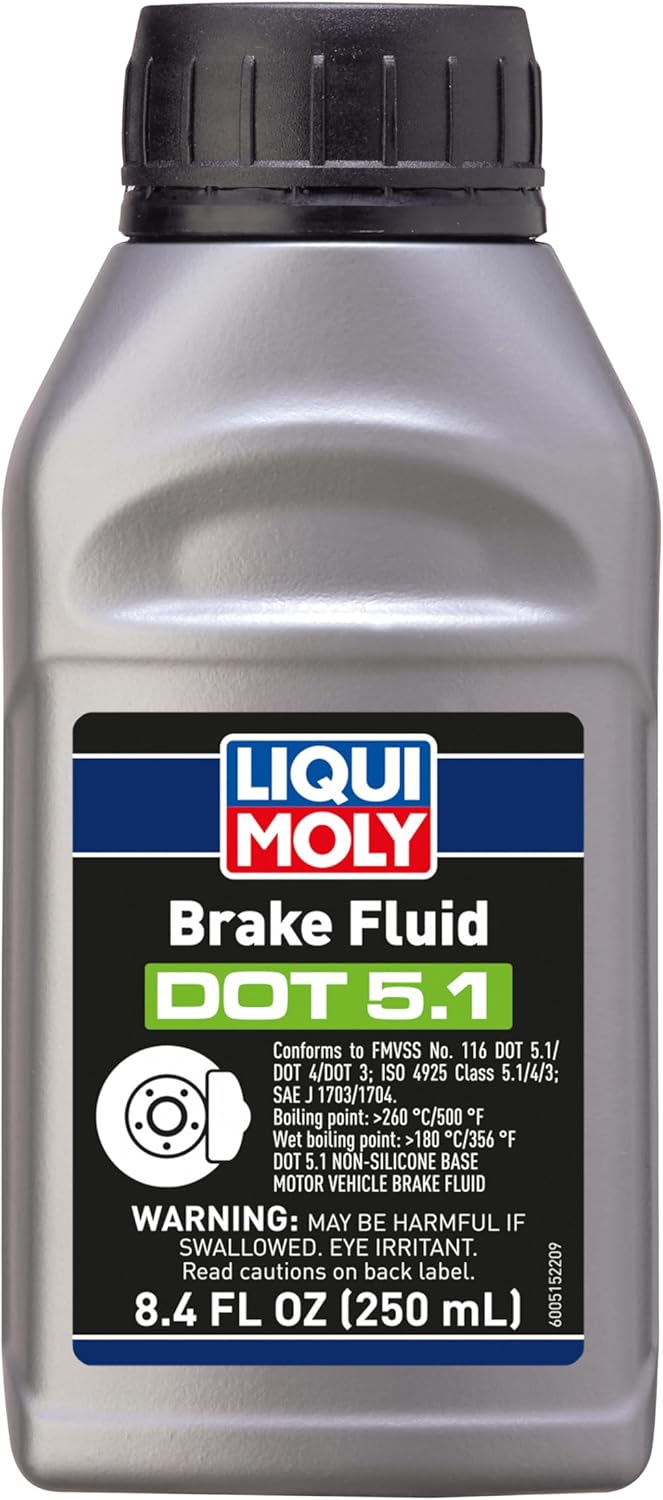
| Liquid Volume | 250 Milliliters |
|---|---|
| Brake Fluid Type | DOT 5.1 |
| Form | Liquid |
| Unit Count | 8.4535 Fluid Ounces |
This Liqui Moly DOT 5.1 brake fluid is a synthetic formulation sold in a 250 ml bottle for topping off or servicing hydraulic brake systems. It is formulated to deliver higher wet and dry boiling points than DOT 3 and DOT 4, and contains corrosion and oxidation inhibitors plus scavengers to limit steam formation when moisture is present. In real-world use it works as a short service refill or for a full fluid change on systems that require DOT 5.1, helping preserve brake feel under high temperatures and heavy use. The small bottle is convenient for a one-axle service or carrying in a workshop, and the OEM-quality formulation means it mixes with other high-quality synthetic brake fluids. Limitations are the small volume if you need a full system flush and the safety hazards typical of glycol-based fluids, so protective gear and careful disposal are required.
Best for: Budget-conscious owners who prioritize a factory-quality DOT 5.1 refill for occasional topping off or maintenance on their Mercedes-Benz E-Class and want a trusted brand without paying a premium.
Less Ideal for: Owners planning a full system flush who need multiple liters or technicians who prefer bulk containers for repeated shop use should look for larger volume options.
- High wet and dry boiling points for better thermal stability under heavy braking
- Includes inhibitors to reduce corrosion and oxidation in the brake circuit
- Compatible and miscible with other high-quality synthetic brake fluids
- 250 ml bottle is small for a full brake system flush on most cars
- Contains hazardous chemicals that require protective handling and proper disposal
Verdict: A compact, budget-friendly DOT 5.1 fluid that delivers high-temperature performance for topping off or small brake jobs on the E-Class but is too small for full-system flushes.
5. Motul RBF 600 Factory Line Racing Brake Fluid DOT 4, 500 ml

| Liquid Volume | 500 Milliliters |
|---|---|
| Recommended Uses For Product | Brake oil |
| Lower Temperature Rating | 399 Degrees Fahrenheit |
| Upper Temperature Rating | 399 Degrees Fahrenheit |
| Flash Point | 327 Degrees Celsius |
Motul RBF 600 Factory Line is a synthetic DOT 4 brake and clutch fluid formulated for high-temperature performance in hydraulic systems. It is typically used for aggressive driving or track sessions where repeated heavy braking raises fluid temperatures; the very high dry boiling point keeps compression of vapour and brake fade to a minimum. Because it is non-silicone and engineered for racing, it performs well under wet conditions too, with a high wet boiling point that helps reduce vapor locking after moisture exposure. Practical benefits include stronger, more consistent pedal feel during repeated hard stops and reduced chance of overheating-related brake failure. The main limitations are that it is highly hygroscopic so it will absorb moisture over time, requiring more frequent fluid changes than lower-performance fluids, and it is positioned as a performance product rather than an everyday long-interval service fluid. Also the product is sold per bottle, so plan quantities when flushing a whole system.
Best for: Reliability-focused buyers who prioritize consistent braking performance under heavy use and want a fluid that resists fade during spirited driving or occasional track days.
Less Ideal for: Drivers who prefer minimal maintenance intervals or want a low-cost, long-interval service fluid for only light daily driving should consider alternatives.
- Very high dry boiling point for sustained braking under track or spirited driving
- High wet boiling point improves performance after moisture exposure
- 100% synthetic, non-silicone formula for thermal stability and consistent pedal feel
- Suitable for both brake and hydraulic clutch systems
- Hygroscopic nature means it requires more frequent changes to maintain performance
- Sold in single 500 ml bottles which may require buying multiple bottles to service a full system
Verdict: Choose Motul RBF 600 when you need a high-temperature, reliable DOT 4 fluid for demanding braking, but be prepared to change it more often due to its hygroscopic nature.
6. Brembo L04005 DOT 4 Brake Fluid (0.55 L)

| Item Form | Liquid |
|---|---|
| Viscosity | High |
| Flash Point | 245 Degrees Celsius |
| Liquid Volume | 0.55 Liters |
The Brembo L04005 DOT 4 brake fluid is a ready-to-use hydraulic fluid designed to replace old fluid in disc and drum brake systems. It is typically used when flushing and refilling a vehicle brake system to restore braking responsiveness and reduce the risk of vapor lock during hard use. Notable features include a high dry and wet boiling point, resistance to oxidation and corrosion, and a pour-friendly bottle for controlled filling. In practice that means steadier pedal feel during repeated heavy braking and longer chemical stability inside the lines compared with lower-spec fluids. Limitations are the modest 0.55 liter bottle size, which may require buying two bottles for a full flush on many vehicles, and the general need to follow Mercedes-Benz brake fluid DOT specification and service intervals rather than relying on fluid alone to fix mechanical issues. Proper system bleeding and moisture control remain necessary to get the stated performance benefits.
Best for: Convenience-driven buyers who want a reliable, name-brand DOT 4 fluid that delivers predictable braking performance with minimal fuss during routine brake flushes.
Less Ideal for: Drivers seeking large-volume servicing supplies or those who need a DOT specification other than DOT 4 should look at alternatives geared to professional shops or different fluid classes.
- High dry and wet boiling points for more consistent braking under repeated heavy use
- Formulated to resist oxidation and corrosion, helping preserve brake system components
- Packaged in a bottle with a pour spout for easier, cleaner refills
- Small 0.55 L bottle may be insufficient for a complete system flush on many vehicles
Verdict: A compact, high-boiling DOT 4 fluid from a reputable brand that improves brake stability but may require multiple bottles for a full Mercedes‑Benz E‑Class flush.
7. Valvoline DOT 3 & 4 Synthetic Brake Fluid, 32 oz

| Unit count | 32.0 Fluid Ounces |
|---|---|
| Liquid volume | 0.92 Liters |
| Intended use | Vehicle brake systems |
| Form | Liquid |
Valvoline DOT 3 & 4 Synthetic Brake Fluid is a glycol-based fluid formulated to meet both DOT 3 and DOT 4 specifications, intended for routine brake system service and full fluid flushes. It is typically used to refill hydraulic brake and clutch systems after bleeding or when replacing old fluid, and its higher boiling point helps resist vapor lock under sustained or heavy braking. The low-moisture formula and compatibility with conventional fluids make bleeding straightforward with minimal foaming, aiding complete air purges and predictable pedal feel. Practical benefits include broad compatibility across systems that accept DOT 3 or DOT 4, corrosion protection for internal components, and a familiar handling profile for workshops. Limitations are inherent to its class: it is a glycol fluid so it is hygroscopic and will absorb moisture over time, requiring periodic changes, and it is not a specialized racing fluid with ultra-high dry boiling points. For Mercedes-Benz E-Class applications, confirm the vehicle’s factory brake fluid recommendation before use.
Best for: A risk-averse, mainstream buyer who prioritizes a proven, factory-quality replacement for routine maintenance on a Mercedes-Benz E-Class and wants predictable braking behavior without hunting for specialty products.
Less Ideal for: Owners seeking competition-grade or track-focused brake fluids with significantly higher dry boiling points should consider dedicated racing fluids instead.
- Meets both DOT 3 and DOT 4 specifications for flexible use
- Higher boiling point than basic DOT 3 fluids to reduce vapor lock risk
- Low-moisture formula and minimal foaming simplify bleeding and flushing
- Compatible with conventional glycol-based brake fluids for top-up or replacement
- Hygroscopic nature requires regular replacement to maintain performance
- Not formulated to the extreme boiling point targets used in dedicated racing fluids
Verdict: A reliable, workshop-friendly DOT 3/4 brake fluid suited to routine service on Mercedes‑Benz E‑Class vehicles, but not for track-focused high-temperature use.
Choosing the Right Mercedes-Benz E-Class Brake Fluid: Key Factors to Consider
Boiling Point (Dry and Wet)
A brake fluid must resist vapor formation at high temperatures because vapor compresses more than liquid and reduces braking efficiency. Dry boiling point indicates the fluid's performance when new, while wet boiling point reflects performance after absorbing moisture. Both metrics matter because everyday driving and occasional heavy braking raise fluid temperature, and retained moisture lowers the wet boiling point over time.
Choose a fluid with a sufficiently high dry and wet boiling point for your driving style. Higher boiling point fluids suit spirited driving or towing, while standard values may suffice for relaxed commuting. Regularly monitoring and replacing fluid maintains safe boiling-point margins.
DOT Rating and Chemical Type
DOT ratings define minimum performance and chemical composition standards that affect compatibility and maintenance. DOT 3 and DOT 4 are common glycol-based types, with DOT 4 offering higher boiling points. Some formulas are enhanced to exceed standard DOT 4 specifications for performance.
Understanding the DOT rating helps ensure you select a fluid with chemical properties aligned to manufacturer guidance. Using a fluid with a different DOT rating can have implications for boiling point and hygroscopic behavior, so always consider the system requirements and avoid mixing incompatible chemistries without proper flushing.
Hygroscopicity and Moisture Management
Most common brake fluids absorb moisture from the atmosphere over time, which lowers boiling point and increases corrosion risk inside the braking system. The rate at which a fluid absorbs water affects how often you will need to replace it and how long it maintains peak performance.
Look for information on moisture uptake and recommended flush intervals. If you prioritize low maintenance or live in humid climates, consider fluids with slower moisture absorption or plan for more frequent brake fluid flushes to preserve braking performance and protect internal components.
Seal and Component Compatibility
Brake system seals, hoses, and ABS module internals are made from specific elastomers and materials that can react differently to various fluid chemistries. Incompatible fluids can cause swelling, shrinkage, or accelerated aging of rubber parts, leading to leaks or ABS faults.
Verify that the chosen fluid is chemically compatible with the materials used in the Mercedes‑Benz E‑Class braking system. Manufacturer specifications and technical data sheets typically list compatibility information. Prioritizing compatibility reduces the risk of premature component failure and costly repairs.
Longevity and Service Interval Recommendations
Different fluids have varying recommended service intervals based on chemical stability and hygroscopic behavior. A longer recommended interval can reduce maintenance frequency but may require a higher-performance formula to maintain safe boiling-point margins over time.
Balance the convenience of longer intervals against the importance of regular maintenance. Even when using a fluid with longer life, periodic checks for contamination and moisture remain important. Follow the vehicle's service recommendations and adjust intervals based on climate and driving demands.
Performance Needs and Driving Conditions
Your typical driving style influences which brake fluid features matter most. Urban commuting with light braking places different demands on fluid thermal stability than frequent highway driving, aggressive braking, or track use. Heat generation, duty cycles, and exposure to steep descents all affect fluid temperature and degradation.
Match the fluid's thermal and chemical properties to your expected use. If you anticipate higher thermal loads, prioritize fluids with higher dry and wet boiling points and clear guidance on flushing intervals to maintain consistent pedal feel and stopping power.
How We Chose the Best Mercedes-Benz E-Class Brake Fluid
We focused on fluids that meet Mercedes‑Benz specifications and deliver consistent hydraulic performance under real driving conditions. Our selection criteria prioritized boiling point (dry and wet), moisture absorption rate, chemical compatibility with E‑Class seals and ABS components, and standards compliance such as DOT ratings. We also considered shelf life, recommended service intervals, and manufacturer material specifications that affect seal swelling and corrosion protection.We excluded fluids lacking documented compatibility with German luxury vehicle hydraulic systems or those with unclear specification claims. We did not include product heuristics based on marketing alone; instead we emphasized measurable specifications and compatibility notes that matter for longevity and safety. The final list highlights options that balance thermal performance, chemical stability, and system compatibility for typical E‑Class use cases.
Our full evaluation process is outlined in our review methodology.
FAQ
How often should I change brake fluid in a Mercedes‑Benz E‑Class?
You should follow the vehicle manufacturer's recommended interval, which often ranges from every 1 to 2 years depending on driving conditions. Moisture uptake and driving habits influence the exact timing, so more frequent checks are common in humid climates or for vehicles that see heavy use. Regular diagnostics or fluid testing can help determine the optimal replacement schedule.
Can I mix DOT 3 and DOT 4 brake fluids in my E‑Class?
DOT 3 and DOT 4 fluids are both glycol-based and can usually be mixed, but mixing alters the system's overall boiling-point performance and hygroscopic characteristics. It is better to maintain a single, compatible fluid type and to perform a full flush if changing between different DOT ratings to restore predictable thermal behavior.
What are signs that my brake fluid needs attention?
Common signs include a softer or spongy brake pedal, reduced braking effectiveness under repeated stops, or an illuminated warning light related to brake system service. Visual checks may reveal dark or cloudy fluid, which can indicate contamination. Any such symptoms warrant inspection and fluid testing or replacement.
Is high performance or synthetic brake fluid necessary for normal driving?
For typical daily driving, a standard DOT‑rated fluid that meets manufacturer specifications is usually sufficient. High performance or specialty synthetic fluids offer higher boiling points and may be beneficial if you frequently drive aggressively or encounter heavy thermal loads. Consider your driving demands before opting for a higher-spec fluid.
What does a brake fluid flush involve?
A brake fluid flush replaces old, moisture-laden fluid with fresh fluid and removes contaminants from the hydraulic circuit. The process typically involves bleeding each brake line until new fluid with correct color and clarity appears, and it may require pressure or vacuum tools for a complete exchange. A proper flush restores boiling-point margins and helps prevent corrosion.
Conclusion
Selecting the right brake fluid for a Mercedes‑Benz E‑Class means balancing thermal performance, chemical compatibility, and maintenance needs. Prioritize a fluid with appropriate dry and wet boiling points for your driving conditions, confirm compatibility with E‑Class seals and ABS components, and follow recommended service intervals to manage moisture buildup.Remember that higher-performance fluids improve boiling-point margins but do not eliminate the need for regular flushing. Choose based on expected driving demands and plan routine inspections to keep braking performance consistent and reliable.
Explore More:
- Check out all Mercedes-Benz E-Class parts & accessories
- Explore Fluids & Chemicals
- Browse all Accessories
