

Note: This article contains affiliate links. If you click on these links and make a purchase, I may earn a small commission at no extra cost to you. This helps support my research and content. Read my full affiliate disclosure here.
Replacing worn ball joints matters because they directly affect steering responsiveness, tire wear, and vehicle safety. If you drive a Toyota Tundra, choosing the right ball joint helps maintain stable handling and consistent alignment under load.This guide highlights seven shortlisted ball joint options chosen for proper fitment and proven durability. We evaluated each on fitment accuracy, material quality, and expected service life so you can quickly find suitable replacements. Read on for the factors that should guide your selection and the top choices for this truck.
Looking for other parts? See all Toyota Tundra parts & accessories.
Top Picks at a Glance
| Best Reviewed A top-rated pick with lots of positive feedback | Toyota Genuine Lower Ball Joint (43330-39585) |  |
| Most Popular A crowd favorite that many people choose with confidence | Detroit Axle Front 4‑Piece Ball Joint Kit for Toyota Tundra/Sequoia (2007–2019) |  |
| Best Quality Built to a higher standard if you want something more solid | Toyota Genuine Parts Lower Ball Joint (43340-39595) |  |
| Best Budget The cheapest option that still gets the job done reliably | ECCPP Lower Front Ball Joint Kit for 2003 Toyota Tundra / Sequoia (2 pcs) |  |
| Most Sold A high-volume bestseller chosen again and again | Toyota 43330-39466 Lower Ball Joint |  |
| Best Value for Money The sweet spot between price and what you get | Detroit Axle Front 4-Piece Ball Joint Kit for 2004–2006 Toyota Tundra |  |
| Best Overall The best all-around choice for most situations | TRQ Front Steering & Suspension 10-Piece Kit (PSA65024) |  |
1. Toyota Genuine Lower Ball Joint (43330-39585)

| Manufacturer | Toyota |
|---|---|
| Model | Ball Joint |
| Manufacturer Part Number | 43330-39585 |
| Exterior | Machined |
This is a factory-quality lower ball joint sold by Toyota to replace a worn or failed front suspension ball joint. It installs in place of the original component and is used when steering looseness, uneven tire wear, or suspension noise indicates a bad joint. As a genuine Toyota part it matches factory fit and finish and avoids fitment headaches that sometimes come with aftermarket units. Customers report long service life under normal and offroad use, which translates to fewer repeat jobs and greater confidence on remote roads. The part is machined to OEM tolerances so it preserves steering geometry and ride characteristics after installation. The main limitation is cost compared with aftermarket alternatives and the expectation that professional installation or proper tools are needed to press and torque the joint correctly. If you want an exact factory replacement and plan to keep the truck long term, this part removes doubt about compatibility and durability.
Best for: Reliability-focused buyers who prioritize factory-spec repairs and want a one-time, durable solution for a Toyota Tundra's front suspension.
Less Ideal for: Buyers looking for the lowest upfront price or a quick DIY substitute without access to proper suspension tools should consider aftermarket alternatives or professional installation options.
- Factory-quality fit and finish for direct replacement
- Matches factory tolerances to preserve steering geometry
- Proven long-term durability reported by users, including offroad conditions
- Higher cost than many aftermarket ball joints
- Requires proper tools or shop press for correct installation
Verdict If you want a dependable, factory-spec replacement for a Toyota Tundra front lower ball joint, this genuine Toyota part is the safe, long-term choice.
2. Detroit Axle Front 4‑Piece Ball Joint Kit for Toyota Tundra/Sequoia (2007–2019)
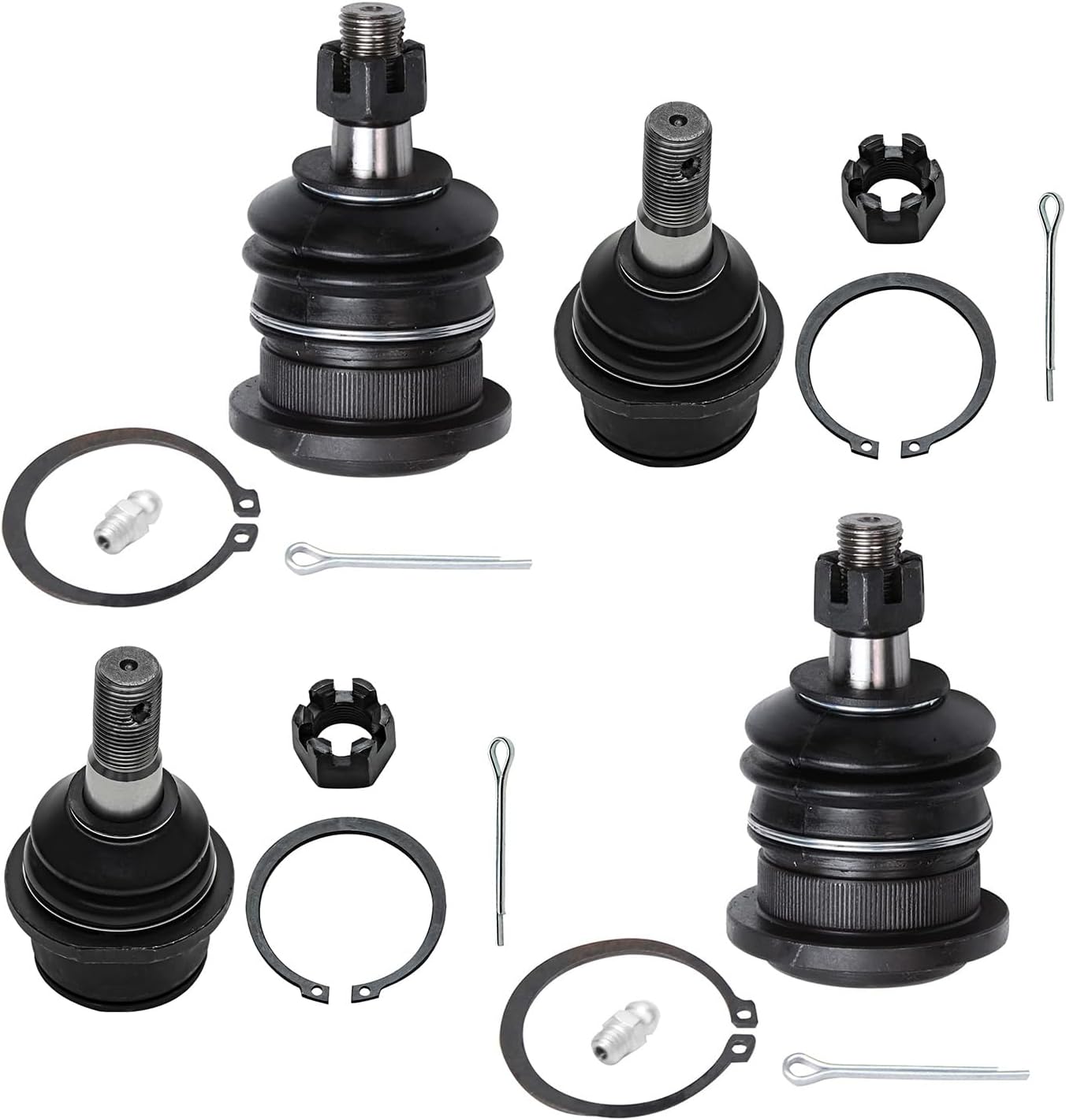
| Fitment | 2007–2019 Toyota Tundra, 2008–2019 Toyota Sequoia |
|---|---|
| Contents | 2 front lower ball joints and 2 front upper ball joints |
| Manufacturer | Detroit Axle |
| Warranty | 10-Year Warranty |
This Detroit Axle kit supplies two lower and two upper front ball joints intended as a direct replacement for specified Toyota Tundra and Sequoia model years. Installers use it when worn ball joints cause looseness, clunking, or uneven tire wear; the kit drops into the control arms and is tightened to factory locations, then the vehicle needs a post-replacement alignment. Detroit Axle says the parts undergo impact and fatigue testing and the kit includes mounting hardware. Practical benefits include a complete front set so you can replace both sides at once and restore steering feel without hunting for individual pieces, and many buyers report a tight, factory-style fit. Limitations to note are mixed reports on hardware quality and occasional lack of pre-applied grease, so expect to add grease fittings or swap fasteners when necessary and follow torque and alignment steps carefully. This is a convenience-oriented, budget-friendly aftermarket option that aims to match factory fit and function but may require minor prep at installation.
Best for: Buyers who prioritize convenience and want a single aftermarket kit to quickly restore front-end firmness and steering feel without sourcing individual parts.
Less Ideal for: Drivers who need heavy-duty, off-road rated components or who prefer premium OEM-brand parts for extended service intervals should consider higher-end or dealer options instead.
- Complete four-piece kit replaces both upper and lower front ball joints so both sides can be serviced in one job
- Made and tested for durability claims including impact and fatigue testing reported by the brand
- Fits listed Toyota Tundra and Sequoia years with many users reporting tight, factory-style fit
- Includes mounting hardware so no need to source separate bolts and nuts for most installs
- Some customers report thin or undersized supplied bolts and castle nuts that may be swapped for stronger fasteners
- Parts may arrive without much grease in fittings so installers should be prepared to grease components during installation
Verdict A convenient, complete front ball joint kit for Tundra/Sequoia owners that restores steering feel affordably but may need minor prep like greasing or stronger fasteners.
3. Toyota Genuine Parts Lower Ball Joint (43340-39595)

| Manufacturer | Toyota |
|---|---|
| Model | Joint Assy, Lwr Ball |
| Manufacturer Part Number | 43340-39595 |
| Exterior | Machined |
| Voltage | 12 Volts |
This genuine Toyota lower ball joint is a direct-fit replacement designed to restore factory steering and suspension geometry on the Tundra. It installs in place of the worn lower ball joint and is used whenever the front suspension shows play, uneven tire wear, or steering looseness. Because it is a genuine Toyota part, the component is machined to factory tolerances and uses the original fitment points so it bolts in without modification. The practical benefits are long-term durability and predictable handling that match the truck's original setup, which is important for performance-oriented drivers who want stable steering feel and consistent alignment. The main limitations are cost compared with aftermarket alternatives and occasional shipping or packing errors reported by buyers receiving incorrect side parts, so confirm the part number and fitment before installation. Expect OEM-level reliability but plan for typical installation labor and alignment afterward.
Best for: Performance-oriented buyers seeking factory-correct handling and durability for their Tundra who prioritize driving feel and long-term reliability over lowest upfront cost.
Less Ideal for: Buyers focused solely on minimizing initial expense or those looking for performance-upgraded ball joints with nonfactory specifications should consider aftermarket alternatives.
- Factory-quality machining and fitment for Toyota vehicles
- Direct-fit replacement that installs without modification
- Consistent steering feel and suspension geometry restoration
- Proven longevity in real-world use compared with many aftermarket units
- Higher purchase cost than aftermarket ball joints
- Some customers report receiving the wrong side part in certain orders
Verdict Choose this OEM Toyota lower ball joint if you want factory-fit handling and durability for a Tundra; skip it if you need a low-cost or nonfactory performance modification.
4. ECCPP Lower Front Ball Joint Kit for 2003 Toyota Tundra / Sequoia (2 pcs)

| Fitment | 2003 Toyota Tundra, 2003 Toyota Sequoia |
|---|---|
| Kit contents | 2 lower ball joints (driver and passenger) |
| Manufacturer part number | 813369-ECC-QIN-0001 |
| OEM part number | K80385 K80384 |
This ECCPP kit supplies both left and right lower front ball joints intended for 2003 Toyota Tundra and Sequoia. It is a direct-replacement style suspension part used to restore steering precision and cornering stability that degrade when ball joints wear. The kit ships with the driver and passenger side units and is marketed with one year of support. In practice these replace factory lower ball joints during routine front suspension repair or when you diagnose excessive play, uneven tire wear, or clunking from the front end. Buyers can expect basic compatibility with the stated 2003 Toyota models and a price-focused alternative to OEM parts. The notable benefits are simple swap-in fitment for the listed application and the ability to renew steering feel without replacing entire control arms. Limitations are typical for value aftermarket parts: long-term durability may not match factory-quality replacements and you should verify fitment with your vehicle before installation. Professional installation or proper tools are recommended for safety and alignment afterward.
Best for: Budget-conscious Toyota Tundra owners who want an affordable, direct-replacement lower ball joint solution to restore steering feel without replacing larger suspension components.
Less Ideal for: Owners seeking a long-term, high-mileage factory-quality rebuild or those who prefer a brand-name OEM part and dealer-backed warranty should consider higher-end replacements or dealer options.
- Includes both driver and passenger lower ball joints for a single-front-axle repair.
- Sold as a direct replacement for the specified 2003 Toyota Tundra and Sequoia fitment to simplify sourcing.
- Price-oriented aftermarket option that restores steering control and reduces play.
- Manufacturer states product testing and offers one year of support for the part.
- Aftermarket construction may not match long-term durability of factory-quality replacements.
- Kit documentation requires buyers to confirm fitment using vehicle lookup rather than detailed measurements.
- Does not include installation hardware or alignment service.
Verdict A cost-focused replacement kit that makes it easy to refresh the lower front ball joints on 2003 Toyota Tundra or Sequoia, but it may not match OEM longevity.
5. Toyota 43330-39466 Lower Ball Joint

| Manufacturer | Toyota |
|---|---|
| Model | Ball Joint |
| Exterior | Machined |
| Manufacturer Part Number | 43330-39466 |
This is a genuine Toyota lower ball joint intended as a direct replacement for the factory suspension on compatible Toyota trucks. It installs in the lower control arm to restore proper steering and suspension geometry after wear or failure. As a factory part it matches OEM fit and tolerances, so installation is straightforward when using the correct service procedures and hardware. Buyers can expect machined surfaces and the factory part number for easy identification, and several owner reports note reliable fit and years of service. Limitations are typical of any direct-replacement ball joint: you should inspect related components and use fresh fasteners during installation since the part ships as the joint only and may not include all secondary hardware for older vehicles. Professionals or experienced DIYers with the right tools will have the smoothest install experience.
Best for: Risk-averse mainstream buyers who prioritize reliability and fitment will appreciate a factory replacement that reduces uncertainty and rework when servicing a Tundra's lower suspension.
Less Ideal for: People seeking a lower-cost aftermarket upgrade or a performance-oriented ball joint with heavier-duty features should consider specialty alternatives instead.
- Factory-manufacturer part for exact fit and factory-spec tolerances
- Machined exterior for consistent seating and durability
- Direct replacement that simplifies parts lookup and matching to Toyota part number
- May not include all installation hardware required for older or corroded mounting points
- Requires proper tools and torque procedures for safe installation
Verdict Choose this OEM Toyota lower ball joint when you want a direct, factory-spec replacement for dependable fit and function on a Toyota Tundra.
6. Detroit Axle Front 4-Piece Ball Joint Kit for 2004–2006 Toyota Tundra

| Vehicle fitment | 2004–2006 Toyota Tundra |
|---|---|
| Kit contents | 2 front upper + 2 front lower ball joints |
| Brand | Detroit Axle |
| Manufacturer part number | 4S1900677 |
This Detroit Axle kit supplies two front upper and two front lower replacement ball joints intended for 2004–2006 Toyota Tundra trucks. It is used when worn or damaged ball joints produce clunking, uneven tire wear, or loose steering feel; the kit installs in the factory locations and restores proper suspension geometry. Notable features include full kit coverage for both sides, factory-style fitment claims, and parts that underwent impact and fatigue testing. In practice the parts are a tight fit—helpful for correct alignment at installation—but some users report minimal grease in fittings and mixed comments about included hardware quality, so expect to add grease and possibly replace thin bolts or nuts during installation. Benefits are straightforward: a complete front-set replacement at a value price that can revive steering feel and ride stability without sourcing individual components. The main limitations are variable hardware quality and a handful of reports of premature failures, so diligent inspection at install and a post-install alignment are recommended.
Best for: Practical owners who prioritize getting reliable, full-front suspension replacement at a sensible price and who are comfortable inspecting and topping up hardware during installation.
Less Ideal for: Drivers seeking premium, heavy-duty aftermarket ball joints or those unwilling to swap supplied fasteners or perform minor prep work should consider higher-end alternatives.
- Complete four-piece kit replaces both upper and lower front ball joints for the Toyota Tundra front end
- Factory-style fitment promotes correct alignment and usually seats tightly in suspension mounts
- Undergoes impact, wear, and fatigue testing according to the brand, suggesting baseline durability
- Good value compared with buying individual components or premium branded alternatives
- Some units ship with little grease in fittings requiring additional lubrication at install
- Included bolts and castle nuts may be undersized or lower quality than factory fasteners
Verdict A budget-friendly, full front ball joint kit that restores steering and suspension function for 2004–2006 Tundra owners who will inspect and top up hardware during installation.
7. TRQ Front Steering & Suspension 10-Piece Kit (PSA65024)

| Model | TRQ PSA65024 10 Piece Steering & Suspension Kit |
|---|---|
| Application Specific Design | No modifications necessary |
| Pre-greased | Yes |
| Anti-Corrosion Coated | Yes |
This TRQ 10-piece front steering and suspension kit bundles the common wear items you replace when refreshing a Tundra front end: inner and outer tie rods, upper and lower ball joints, and sway bar links. It is sold as a direct-fit replacement for compatible Toyota Tundra years and is pre-greased and anti-corrosion coated to reduce initial prep and extend surface life. Installers will appreciate pre-assembled components and TRQ’s DIY videos that guide bolt-on replacement, so a competent DIYer or independent shop can complete a front-end renewal without complicated modifications. Practical benefits include restoring steering precision and reducing play by replacing multiple worn parts at once, which can save time versus buying parts separately. Limitations to consider are mixed user reports about variable fitment on some vehicles and occasional shorter longevity on certain sway bar links; some buyers also noted omitted hardware that may require sourcing bolts during install. Confirm fitment for your specific Tundra year before ordering and be prepared to supply any missing fasteners during installation.
Best for: Practical optimizers who want a consolidated, cost-conscious front-end refresh for a Toyota Tundra and prefer to do the work or use an independent shop to stretch repair dollars.
Less Ideal for: Buyers seeking lifetime-grade heavy-duty suspension upgrades or commercial users who need maximized longevity and heavy-load components should consider higher-end or purpose-built alternatives.
- Complete kit replaces common front steering and suspension wear parts together, saving time sourcing components separately.
- Pre-greased and anti-corrosion coated parts reduce initial maintenance and help with early durability.
- Designed as direct-fit replacements to simplify installation and avoid modifications.
- Includes TRQ DIY video resources to assist installers and reduce install uncertainty.
- Some customers report fitment inconsistencies across model years requiring verification before purchase.
- Reports of limited durability for certain sway bar links on higher-mileage use.
- Kit may not include specific hardware for all vehicles, so additional fasteners can be required.
Verdict A practical, full front-end replacement kit that restores steering feel on Toyota Tundra at a better value than buying pieces separately, provided you verify fitment and may source any missing bolts.
Choosing the Right Toyota Tundra Ball Joint: Key Factors to Consider
Fitment and Compatibility
Correct fitment ensures the ball joint mounts to the control arm and knuckle without modification. Using a direct-fit component preserves factory suspension geometry, reduces installation time, and minimizes the need for additional parts or adapters.
Check mounting type, stud thread size and length, and whether the part is designed for thetruck’s front lower or upper position. Incorrect fitment can cause premature wear, alignment problems, or unsafe handling.
Load Capacity and Design
Ball joints carry vertical and lateral loads; their internal design determines how well they handle those forces. Look for joints with bearing surfaces and stud designs rated to the expected loads of a full-size pickup, especially if you tow or carry heavy payloads.
Heavier-duty designs typically use larger studs, reinforced housings, or improved bearing constructions to reduce deformation and extend service life under repeated stress.
Materials and Corrosion Resistance
Materials and protective coatings affect longevity, especially in wet or salted-road environments. Hardened steel studs and heat-treated housings resist wear, while zinc plating or specialty coatings limit corrosion that can seize moving parts.
Rubber or synthetic seals and dust boots also matter because they keep contaminants out of the joint. A durable boot paired with corrosion-resistant materials helps preserve lubrication and slows wear.
Sealing and Lubrication
A good seal keeps grease in and dirt out, which directly extends joint life. Some joints come pre-lubricated with permanent seals, while others include grease fittings so you can service them periodically.
If the design allows regular greasing, maintenance can significantly extend service intervals. Conversely, a failed or torn boot will let contaminants enter and accelerate wear, so inspect seals during installation.
Installation and Serviceability
Installation complexity affects labor time and required tools. Direct-fit, bolt-on joints minimize shop time, while press-in types may need a ball joint press tool or removal of control arm components.
Consider whether the replacement requires special hardware or alignment after installation. Parts that include new nuts, cotter pins, or mounting hardware reduce the chance of missing pieces during a repair.
Warranty and Support
Warranty terms and manufacturer support indicate confidence in part longevity and provide recourse if a component fails early. Look for clear coverage periods and what is included under warranty such as defects in materials or workmanship.
Availability of technical support, clear fitment documentation, and return policies also help if you encounter fitment questions or installation issues.
FAQ
How do I know when a Toyota Tundra ball joint needs replacement?
Common signs include uneven tire wear, clunking or popping noises when turning, and looseness in the steering. You may also notice increased play at the wheel or unusual vibration during driving. A visual inspection can reveal torn boots or excessive movement when the wheel is rocked back and forth, but symptoms often vary by load and driving conditions.
Can I replace a ball joint myself on a Toyota Tundra?
Many competent DIYers can replace direct-fit ball joints, but the job often requires a ball joint press tool, torque specifications, and knowledge of suspension reassembly. Press-in types may need specialized tools and careful handling to avoid damaging control arms. If you are unsure, professional installation ensures correct fitment and proper torque.
Should I choose a replenishable ball joint with a grease fitting or a sealed unit?
Both options have advantages. Greaseable joints let you periodically replenish lubricant, which can extend service life if you maintain them. Sealed units are typically maintenance-free and can be more convenient, but if the seal fails the entire unit may need replacement. Consider expected maintenance frequency and exposure to contaminants when deciding.
Will replacing ball joints fix wheel vibration issues?
Replacing worn ball joints can reduce some steering-related vibration, particularly if play in the joint is causing wheel movement. However, vibration can stem from multiple sources such as tire balance, wheel bearings, or drivetrain components. Diagnose the root cause to ensure ball joints are the actual contributor to vibration.
Do I need a wheel alignment after replacing ball joints on a Toyota Tundra?
A wheel alignment is often recommended after suspension work that affects toe or camber settings. Replacing ball joints can alter suspension geometry enough to require alignment to prevent uneven tire wear and ensure proper handling. Check alignment specifications and have an alignment performed if steering feel or tracking is affected.
How We Chose the Best Toyota Tundra Ball Joint
We focused on parts and assemblies that fit Toyota Tundra suspension geometry and mounting points without modification. Key evaluation criteria included fitment accuracy to factory specs, material and coating quality to resist corrosion and wear, bearing or stud design for load handling, and expected service life under typical towing and off-road use. We also considered ease of installation, compatibility with common replacement tools, and the availability of replacement hardware where applicable.Excluded from the list were universal or non-specific joints that require custom welding or significant fabrication, aftermarket components with unclear fitment data, and items lacking clear material or performance specifications. Our filters prioritized direct-fit replacements and assemblies designed for front-end load patterns typical of full-size pickups.
Our full evaluation process is outlined in our review methodology.
Conclusion
Prioritize correct fitment, durable materials, and reliable sealing when choosing a replacement for a Toyota Tundra ball joint. Consider load capacity and whether you prefer a greaseable design or a sealed unit based on maintenance habits and driving conditions.Balance ease of installation and serviceability against long-term durability. If you tow or use the truck off road, opt for designs rated for higher loads and with robust corrosion protection to reduce repeat repairs.
Explore More:
- Check out all Toyota Tundra parts & accessories
- Explore Ball Joints Maintenance & Repair Guides
- Explore Suspension & Steering
- Browse all Auto Parts
