

Note: This article contains affiliate links. If you click on these links and make a purchase, I may earn a small commission at no extra cost to you. This helps support my research and content. Read my full affiliate disclosure here.
If you spend time outdoors with your Gladiator, the right awning makes campsites, tailgates, and roadside stops more comfortable and functional. You want a solution that mounts securely to the vehicle, deploys quickly, and stands up to sun, wind, and occasional rain. This guide gathers seven shortlisted Jeep Gladiator awnings that meet practical needs for shade, shelter, and ease of use. We evaluated options across setup time, mounting method, material toughness, and portability to help you find the best fit for how you use your truck.
Looking for other parts? See all Jeep Gladiator parts & accessories.
Top Picks at a Glance
| Best Overall The best all-around choice for most situations | Overland Vehicle Systems Nomadic 270 LTE Driver-Side Awning (270°) |  |
| Best Quality Built to a higher standard if you want something more solid | OVS Nomadic 180 Vehicle Awning with Travel Cover |  |
| Best Value The sweet spot between price and what you get | JOYTUTUS 6.6'x8.2' Vehicle Roof Rack Pull-Out Awning |  |
| Best Budget The cheapest option that still gets the job done reliably | VEVOR 4.6'x6.6' Vehicle Roof Rack Pull-Out Side Awning |  |
| Highest Rated A top-rated pick with lots of positive feedback | SAMOUT Vehicle Rooftop Pull-Out Awning, 6.6ft x 10ft (66 ft²) |  |
| Most Popular A crowd favorite that many people choose with confidence | Yescom Vehicle Retractable Side Awning with Blackout Coating |  |
| Best Seller A high-volume bestseller chosen again and again | HASIKA Versatility Vehicle Awning Teardrop Canopy |  |
Overland Vehicle Systems Nomadic 270 LTE Driver-Side Awning (270°)
| Material | 280G poly-cotton ripstop |
|---|---|
| Operation Mode | Manual |
| Coverage | 270-degree |
| Includes | 1000g PVC travel cover |
| Assembly Required | Yes |
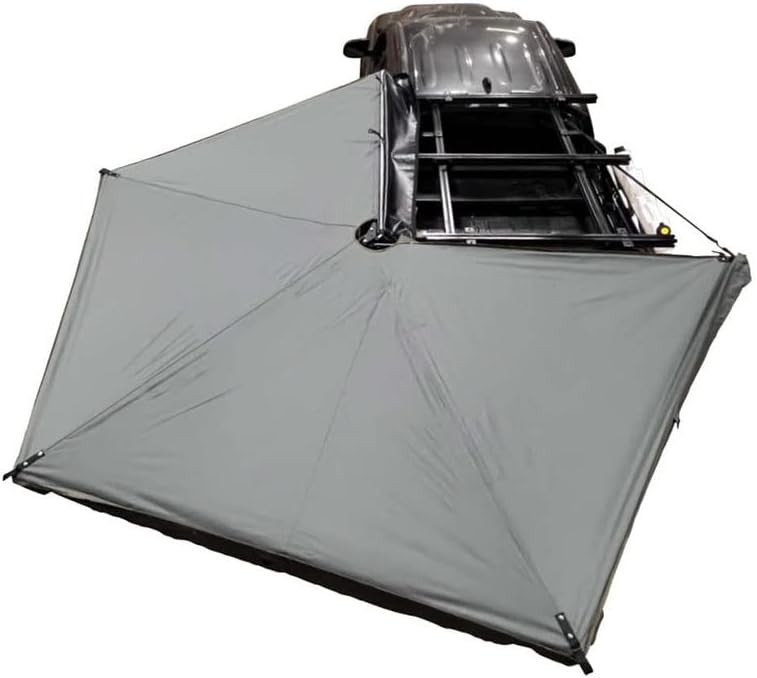
The Nomadic 270 LTE is a driver-side, manual vehicle awning built to give quick shade and rain protection for Jeep Gladiator owners who want a compact, reliable shelter. It mounts to a roof or bed rack and unfolds to a 270-degree canopy that uses reinforced hinges and heavy-duty rafters so no poles are required for deployment. The 280G poly-cotton ripstop fabric with heat-sealed seams keeps rain out and the included 1000g PVC travel cover secures the unit during transport. Setup and takedown are fast and straightforward and built-in leg supports let the awning freestand when needed. Practical benefits include strong weather resistance for day trips and easy packing for overland runs. Limitations to consider are that the mounting brackets may need alternative hardware to fit some Gladiator racks and the twist-lock leg mechanism used by the extendable legs can be less durable than cam-style clamps for heavy repetitive use. Overall this awning balances coverage, packability, and real-world durability for casual to serious weekend overlanding.
Best for: Balanced owners who want a dependable, easy-to-use awning that gives fast shade and weather protection for weekend overlanding and multi-day trips without adding excessive bulk.
Less Ideal for: Anyone needing a heavy-duty, permanent campsite awning or users who want a longest-possible coverage area should consider larger, more robust awnings and mounting systems.
- Wide 270-degree coverage for shade and rain protection
- Water-resistant 280G poly-cotton ripstop fabric with heat-sealed seams
- No-pole setup thanks to reinforced hinge and heavy-duty rafters
- Includes 1000g PVC travel cover for secure transport
- Built-in leg supports allow freestanding use
- Mounting brackets are basic and may require alternative hardware for some racks
- Twist-lock leg adjustments can wear faster than cam-clamp style mechanisms
Verdict: A compact, well-built 270-degree awning that fits the Gladiator crowd looking for quick setup, solid weather protection, and easy transport.
OVS Nomadic 180 Vehicle Awning with Travel Cover

| Coverage area | 88 square feet |
|---|---|
| Fabric type | 280G polycotton; 1000g PVC cover |
| Projection distance | 78.5 Inches |
| Operation mode | Manual, one-person deployable |
The OVS Nomadic 180 is a robust, performance-focused 180-degree awning designed to mount to a roof rack and deliver a large sheltered area for overland use. It unfolds quickly for one-person deployment thanks to reinforced hinges and heavy-duty rafters so you can create shade or rain cover in seconds; three pivoting aluminum poles are available for additional support and height adjustment when wind or rain picks up. The fabric uses thick polycotton with heat-sealed seams and stores in a 1000g PVC travel cover, so it resists water and packs down neatly when not in use. Supplied mounting hardware, tie-down cord and stakes let you anchor the awning for more demanding conditions, and the structure can carry small lights or gear. Trade-offs are its weight and size, which require a sturdy Gladiator roof rack and careful placement so the tailgate can still open; in sustained high winds you will need to deploy poles and secure anchors or stow it to avoid damage.
Best for: Performance-oriented buyers who prioritize durable, long-lasting shelter and plan extended overland use on a Jeep Gladiator with a beefy roof rack and professional mounting approach.
Less Ideal for: Not the best choice for users seeking a lightweight, minimalist awning for occasional day trips or those who cannot fit or reinforce a roof rack to handle the awning's weight and load.
- Large 88 sq ft coverage for ample shade and rain protection.
- Reinforced hinges and heavy-duty rafters allow one-person deployment without poles in calm conditions.
- Thick polycotton fabric with heat-sealed seams reduces seam leaks in rain.
- Includes mounting hardware, tie-down cord, stakes and a durable travel cover for storage and transport.
- Adjustable aluminum support poles and quick-lock height adjustment for securing in wind.
- Heavy and bulky compared with lightweight side awnings, requiring strong roof rack support.
- When mounted carelessly it can obstruct tailgate opening on some vehicles including the Gladiator.
Verdict: A rugged, performance-minded 180° awning that gives the Gladiator generous shelter and lasting durability if you can accommodate its weight and mounting needs.
JOYTUTUS 6.6'x8.2' Vehicle Roof Rack Pull-Out Awning
| Material | Aluminum brackets |
|---|---|
| Fabric Type | polyester cotton |
| Operation Mode | Manual |
| Projection Distance | 6.6 Feet |
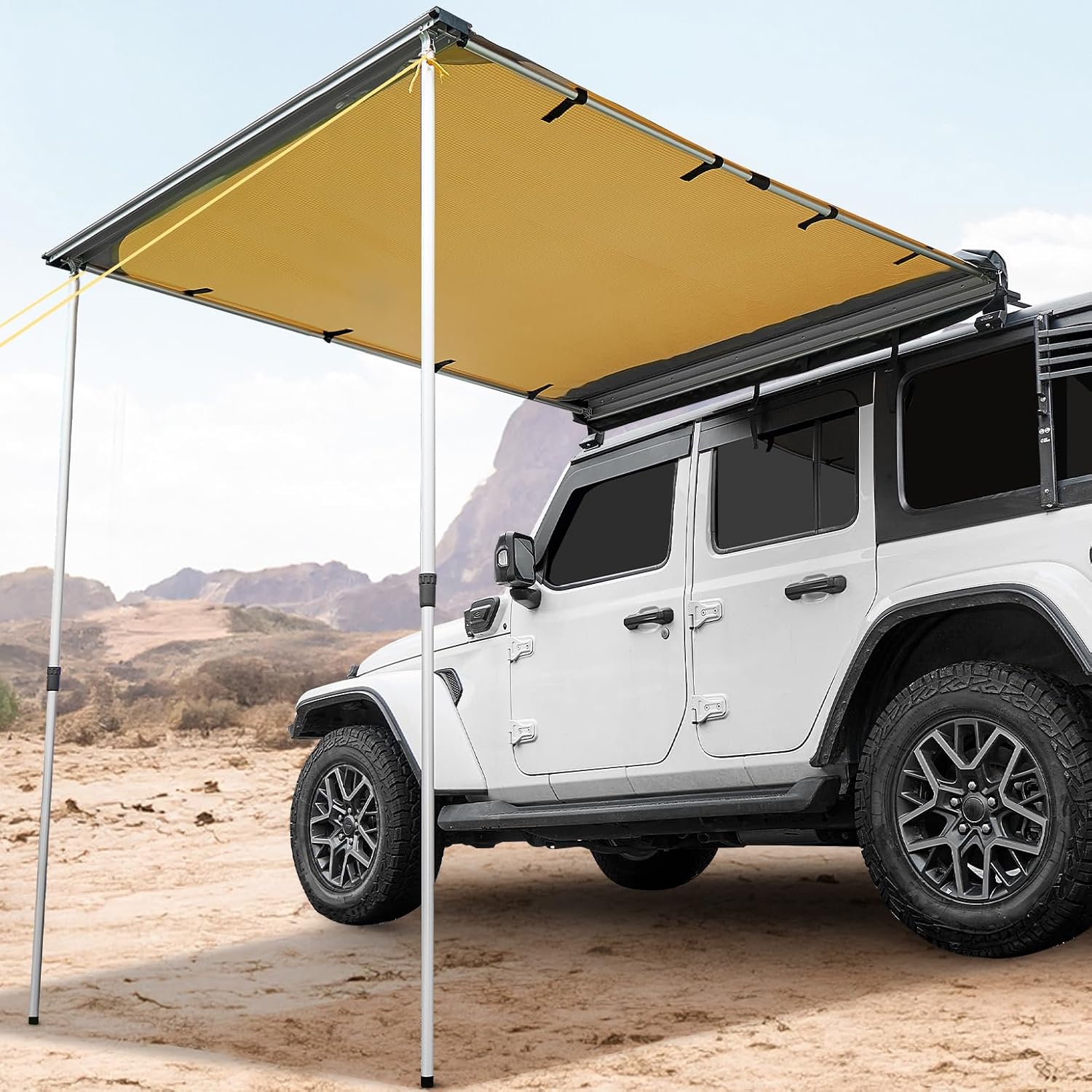
This JOYTUTUS awning mounts to a roof rack and pulls out to create a 6.6 by 8.2 foot sheltered area, giving quick shade for camping stops or tailgate setups. It uses telescopic aluminum brackets and twist-lock poles so one person can install or retract the unit in a minute, and the fabric is polyester cotton treated for waterproofing and UV resistance. The kit includes L-shaped brackets, wind ropes, stakes and basic hardware so you can bolt it to common roof racks and adjust leg height for uneven ground. Practical benefits are fast setup, compact folding for storage, and a sturdy feel from metal brackets and support bars compared with cheaper plastic designs. Limitations are that the manual operation and fabric are intended for fair-weather use rather than sustained high-wind exposure, instructions and mounting options can be vague, and some buyers reported missing parts out of the box requiring vendor support.
Best for: A practical optimizer looking for a low-cost, easy-to-use roof-rack awning for weekend overlanding and shade at campsites, prioritizing rapid setup and value over premium weatherproofing.
Less Ideal for: Not suited for users who need a permanent, heavy-duty awning that withstands frequent high-wind or extended wet-weather use on long expeditions.
- Fast telescoping setup and roll-back retraction for one-person use
- Metal brackets and folding support bars improve durability compared with plastic fittings
- Waterproof, UV-resistant polyester cotton canopy provides practical sun and light rain protection
- Includes mounting brackets, wind ropes and stakes for a more complete on-vehicle install
- Not engineered for heavy wind or prolonged severe weather use
- Installation instructions are sparse and mounting may require custom hardware or adjustments
Verdict: A budget-friendly, quick-deploy roof-rack awning that delivers good shade and solid hardware for weekend Gladiator adventures but is not a heavy-weather, permanent solution.
VEVOR 4.6'x6.6' Vehicle Roof Rack Pull-Out Side Awning

| Size | 4.6×6.6 ft |
|---|---|
| Material | Aluminum frame, Polyester fabric |
| Operation Mode | Manual |
| Projection Distance | 4.6 Feet |
| Fabric Protection | PU waterproofing, UV50+ |
The VEVOR 4.6'x6.6' side awning bolts to a roof rack and rolls out by hand to give a quick shade shelter beside your vehicle. It is designed for rooftop crossbars and includes multi-hole brackets, L-brackets, backing plates, wind ropes, stakes, and a waterproof carry bag so you can mount it to a Gladiator with an aftermarket roof rack. Setup uses telescopic support poles with twist-locks and a manual roll mechanism, making it something two people can deploy in minutes or one person with a little effort. The polyester ripstop fabric offers strong waterproofing, UV50+ protection, and a black sun-coating to reduce heat buildup beneath the canopy. Aluminum frames are anodized and powder-coated to resist rust. Limitations to note are the manual operation and basic instructions, the stakes and pole storage that some users find fiddly, and the awning’s lighter-weight pole system compared with higher-end overland brands, which means you should avoid use in strong wind. For a budget-focused Gladiator owner wanting quick, broad shade on day trips or campsite stops, this awning delivers a lot of coverage for the price but requires careful anchoring in exposed conditions.
Best for: Budget-conscious Gladiator owners who prioritize low cost and simple, occasional shade for day trips and campground stops and who are comfortable doing modest installation work to fit an aftermarket roof rack.
Less Ideal for: Buyers who need a permanently mounted, heavy-duty awning for frequent overland use in windy conditions or who prefer a motorized or rapid single-person deploy system should consider more robust, higher-cost alternatives.
- Includes complete mounting kit with adjustable multi-hole brackets for roof-rack attachment
- Polyester ripstop fabric with PU waterproofing and UV50+ sun protection
- Anodized, powder-coated aluminum frame resists rust and keeps weight reasonable
- Quick telescopic poles and twist-locks let two people set up or take down in minutes
- Comes with a weatherproof storage bag and reflective guy ropes for visible tie-downs
- Manual roll-out and basic instructions can make solo setup fiddly
- Support poles and stakes are lighter-duty than premium overland awnings and need secure anchoring
- Storage bag may not comfortably fit longer poles, requiring a second bag
Verdict: A low-cost, full-kit roof-rack awning that gives the Jeep Gladiator quick, effective shade if you accept manual setup and the need for careful anchoring in wind.
SAMOUT Vehicle Rooftop Pull-Out Awning, 6.6ft x 10ft (66 ft²)

| Material | Polyester, Ripstop |
|---|---|
| Projection Distance | 6.6 Feet |
| Shading Area | 66ft² |
| Water Resistance | PU 10000mm |
| UV Protection | UPF 50+ |
This SAMOUT rooftop pull-out awning is a mounted shelter designed to attach to roof crossbars and extend 6.6 feet from the vehicle to create about 66 square feet of covered space. For Jeep Gladiator owners it functions as a quick-deploy shade solution for camping, tailgating, or roadside work. The 280 GSM ripstop polyester has a PU 10000mm coating and UPF50+ rating, so it sheds light rain and blocks sun exposure, while the anodized telescoping poles with twist-locks let you set the height between roughly 4 and 7 feet. The kit ships in a heavy-duty PVC bag and includes mounting brackets and hardware for a typical rack mount, though some users adapt or buy additional clamps for nonstandard bars. Setup and takedown are straightforward but can be easier with two people for the larger size. Important limits: it is manually operated and lightweight, so it needs proper anchoring and is not intended for high-wind conditions. Pay attention to secure mounting and use guy lines or sand anchors at the beach to prevent movement.
Best for: A reliability-focused buyer who prioritizes a robust, straightforward shade solution for regular outdoor use on a Jeep Gladiator and values predictable performance over gimmicks.
Less Ideal for: Those who frequently need an awning for heavy weather or high-wind coastal use should consider a sturdier, permanently mounted hard-shell option instead.
- Large 66 sq ft coverage for substantial shade
- UPF50+ fabric and PU10000mm coating for sun protection and light rain resistance
- Anodized telescoping poles with twist-locks for adjustable height and quick setup
- Mounting hardware included and packs into a durable carry bag for storage and transport
- Not designed for strong winds and requires anchoring or guy lines for stability
- May need additional clamps or minor modification to fit some crossbar systems on a Gladiator
Verdict: A practical, easy-to-store rooftop awning built for dependable sun and light-rain protection on a Jeep Gladiator, but anchor it and avoid use in high winds.
Yescom Vehicle Retractable Side Awning with Blackout Coating

| Material | Aluminum Alloy and 420D Oxford Fabric |
|---|---|
| Operation Mode | Manual |
| Projection Distance | 101.19 Inches |
| Water Resistance | PU-coated up to 2000mm |
This Yescom retractable side awning mounts to roof rails or a roof rack and unrolls to create roughly a 6.6 by 8.4 foot sheltered area for shade and light weather protection. It is typically used on overland trips, tailgate gatherings, or campsite setups where you need fast shelter from sun or drizzle. Notable features include a PU-coated ripstop polyester fabric with UV50+ and water resistance, an aluminum alloy frame with stainless steel brackets, telescoping twist-lock poles, and included guy lines and stakes for anchoring. The retractable, foldable design makes it reasonably portable and easier to store when not in use. Practical benefits are quick setup for daytime shade, corrosion-resistant mounting hardware for outdoor exposure, and the ability to mount on the side or rear for flexible use around the truck. Important limitations are the lightweight poles and thin fabric compared with premium awnings, which means it requires care in wind and rough use, and assembly or deployment is easier with two people rather than solo.
Best for: A convenience-driven buyer who wants an affordable, portable awning for quick shade or tailgate shelter during day trips and casual overland use with minimal setup fuss.
Less Ideal for: Those who need a heavy-duty, windproof permanent rooftop awning or frequent solo installers who require instant single-person deployment without handling the fabric and poles.
- PU-coated ripstop polyester fabric offers UV50+ protection and water resistance for shade and light rain
- Retractable, foldable design stows in a carry bag for easier transport and storage
- Aluminum alloy frame with 304 stainless steel brackets resists rust for outdoor use
- Telescoping twist-lock poles provide quick height adjustment for different setups
- Poles and fabric are lighter duty than higher-end awnings and need care in strong wind
- Deployment and retraction are awkward to do alone and benefit from a second person
Verdict: A budget-friendly, portable awning that gives quick shade and light rain protection for casual Jeep Gladiator outings but needs careful handling in wind and is easier with two people.
HASIKA Versatility Vehicle Awning Teardrop Canopy

| Material | Ripstop 210T polyester |
|---|---|
| Waterproof rating | 3000 mm |
| Frame material | Alloy steel |
| Floor area | 76 Square Feet |
| Occupancy | Four-or-more-person |
The HASIKA teardrop awning mounts to a vehicle and creates a roomy shelter for cooking, lounging, or gear storage while camping or at outdoor events. It installs on the side of the vehicle and can be used with the included adjustable poles, staked guy lines, or left one end low for privacy. The fabric is ripstop 210T polyester with a 3000 mm waterproof rating and vents plus a large mesh side window for airflow and reduced wind load. Setup is reasonably quick for one person once you know the attachment points, and the kit packs down small for storage. Common weak points reported by users are the suction cups, light stakes, and thinner pole sections, so many owners substitute stronger suction cups, heavier guylines, or sturdier poles for long-term, windy use. For a Gladiator owner seeking a compact, vehicle-attached shelter this awning expands usable campsite space without a large roof rack rig, but it will perform best when reinforced for higher-wind conditions.
Best for: Risk-averse mainstream buyers who prioritize dependable, easy-to-store shelter for day trips and casual overland use and want a straightforward vehicle-mounted awning that increases usable campsite space.
Less Ideal for: Buyers planning frequent high-wind or long-term exposed setups should consider heavier-duty awnings or permanent rack-mounted systems designed for sustained severe conditions.
- Large coverage area suitable for 3–4 people, creating shade and light rain protection.
- Ripstop 210T polyester with 3000 mm waterproof rating provides reliable water shedding.
- Arched frame and adjustable poles allow standing room and flexible configurations.
- Packs down compactly for easy storage in a Jeep Gladiator's bed or cargo area.
- Mesh side window and vents improve ventilation and reduce wind strain when used correctly.
- Included suction cups and pegs are reported as weak and often replaced by users.
- Poles and guyline hardware are lightweight and may need aftermarket upgrading for sustained windy conditions.
Verdict: A compact, vehicle-mounted awning that gives Gladiator owners quick shade and rain protection out of the box but benefits from stronger suction cups and sturdier poles for windy conditions.
Choosing the Right Jeep Gladiator Awning: Key Factors to Consider
Mounting Method And Compatibility
How an awning attaches to your Jeep Gladiator affects stability and convenience. Look for mounting systems that match your vehicle's roof rack, bed rail, or roll bar attachment points so you avoid extra fabrication or permanent modifications.
Compatibility also determines if you can swap the awning between mounts or move it to a different side. Robust mounting brackets and multiple fasteners reduce sway in wind and improve safety during use. Consider whether the mount allows for quick removal and whether common roof accessories interfere with placement.
Canopy Material And Weather Resistance
The fabric and coating determine how well the awning handles sun, rain, and mildew. Durable polyester or solution-dyed acrylic with a waterproof coating typically provides reliable UV protection and sheds light to moderate rain.
Pay attention to seam sealing and water resistance ratings rather than marketing terms alone. Materials that resist fading and resist mold will last longer in regular use, especially if you frequently camp or park in sunny, humid, or coastal environments.
Setup Speed And Ease Of Use
A quick, intuitive deployment makes you more likely to use the awning regularly. Consider mechanisms such as manual arms with gas struts, crank systems, or simple roll-out designs that require minimal tools and one or two people.
Check how the awning secures when open and how much time is needed to add optional walls or tie-offs. Faster setups are especially valuable when arriving at a campsite in changing weather or when you need temporary shade during short stops.
Packed Size And Portability
Where the awning stores on your Gladiator and how easily you can move it off the vehicle matter for day-to-day use. Compact, lightweight units are easier to stow in the bed, under a tonneau, or to remove and carry by hand.
If you plan to swap between vehicles or use the awning off-vehicle, consider weight, handle design, and whether the awning comes with a protective cover. Heavier, bulkier awnings can provide greater durability but may be less convenient for solo users.
Frame And Hardware Durability
The strength and corrosion resistance of poles, arms, and fasteners affect long-term reliability. Look for anodized aluminum, powder-coated steel, or stainless components that stand up to repeated assembly and exposure to the elements.
Robust joints and locking mechanisms reduce wear and the chance of failure in wind. Also consider replacement part availability so you can service the awning over time rather than replacing the whole unit.
Accessory Options And Versatility
Optional extras such as detachable sidewalls, mosquito screens, awning arms, or additional mounting brackets expand how you use the awning. These accessories convert a simple shade into an enclosed shelter, privacy room, or bug-free lounge.
Versatility also includes whether the awning can be mounted on different sides of the vehicle or used freestanding with additional poles. Consider how accessories attach and whether they add much setup time or complexity.
Best Mounting Locations on the Gladiator and Configuration Trade-offs
The Jeep Gladiator offers several practical places to mount an awning, and the choice changes how you use the shade and store it when not in use. Common locations are the bed rail, the roof rack or crossbars, and the rollover bar or cab-mounted brackets. Each location affects accessibility, setup options, and how the awning interacts with the truck bed and camper gear.
Bed-rail mounts give a low mounting height that makes the awning easy to deploy into the bed or to use as a side shelter off the passenger side. Roof-rack or crossbar mounts raise the shelter higher, useful for creating a generous shaded area along the vehicle without blocking bed access. Cab-mounted or rollover bar locations create a compact, integrated profile and can be ideal when you want an over-bed shade or to keep the awning clear of gear stored in the bed.
- Bed-rail mounting: quick reach, good for side shade or bed coverage, limited headroom when used close to the vehicle.
- Roof-rack mounting: increased coverage footprint and better drainage, requires compatible rack crossbars and may be harder to reach during setup.
- Cab/roll bar mounting: low-profile, great for over-bed shelter and protecting bed cargo, but may limit how far the awning can extend from the vehicle.
Layout and Campsite Use Cases: Where a Gladiator Awning Shines
Thinking in terms of how you camp helps select the right awning orientation and accessories. If you frequently stop at established campgrounds, a larger footprint and easier anchoring will let you create a living area adjacent to the Gladiator. For dispersed or overland trips, prioritize compact, quick-to-deploy systems that minimize time spent on campsite setup.
Match the awning orientation to common activities. Use a side-deployed awning for cooking, dining and gear staging. A rear or over-bed deployment offers protected access to a bed-mounted fridge or kitchen. If you often run multi-vehicle convoys, configure the awning so it can serve as a shared canopy facing the road or between vehicles.
- Cooking and dining: side awning with a slight slope away from the vehicle for drainage.
- Gear and work station: over-bed or rear deployment keeps tools and storage under shelter.
- Social or shade area: higher roof-rack mounts for a larger communal footprint.
Practical Setup Tips and Camping Awning Installation on the Gladiator
A smooth installation and repeatable setup reduce frustration on every trip. Prepare mounting hardware and test-fit before you head out so you know how the brackets interface with Gladiator bed rails, crossbars, or cab mounts. Keep the right set of tools and use torque-limited drivers for any fasteners that require repeat tightening.
When deploying, work from vehicle-proximate points outward: extend the awning, lock the arms, then stake and tension the free edge. On the Gladiator the bed height makes it easy to use the tailgate as a step for reaching higher mounts. If your chosen awning is a retractable vehicle awning, practice the roll-out and retraction sequence so it becomes a two-person task when wind or awkward angles are involved.
- Test-fit brackets at home to confirm fit with bed rail caps and tonneau covers.
- Use soft straps or edge protectors when lifting the awning to and from a roof rack to avoid scratching paint.
- Practice one full deploy/retract cycle before the trip to identify any snags or stiff joints.
Wind, Rain and Sun Management for Gladiator Campers
Understanding wind and weather behaviour around the Gladiator helps protect your awning and campsite. The Gladiator body and cargo bed can create turbulent winds that stress anchors if the awning is not tensioned properly. Always angle the awning so wind loads are taken along the frame length rather than perpendicular to the arms when conditions are gusty.
For rain, set a low point along the awning edge to encourage runoff away from the vehicle and bed. Use added guy lines and ground stakes on the downslope side to hold that gutter position. For sun protection a sun shade awning for car use with reflective canopy material will reduce heat build-up at your campsite while still allowing airflow.
- Anchor to solid ground with heavy-duty stakes or weight bags in soft or sandy soil.
- Create a drainage slope by lowering one side slightly and tensioning guy lines.
- Reduce wind profile by partially rolling up the awning or adding wind panels when gusts pick up.
Accessories, Modular Add-ons and Using the Awning with Gladiator Gear
An awning becomes far more functional when paired with the right accessories. Consider attachable walls and annexes to convert the shaded footprint into a closed room for sleeping, changing or storage. Lighting strips, integrated gutters, and extension valances increase usability in the rain and at night. Make sure accessory attachment points match the awning design so panels and lights mount securely.
If you use bed-mounted kitchens, slide-outs or fridge drawers in the Gladiator, plan the awning footprint to keep those workspaces dry and accessible. Over-bed configurations that create a protected corridor to the tailgate let you operate gear without exposing it to the elements.
- Annex walls: add privacy and rain protection for sleeping or changing.
- Integrated lighting: choose LED strips that clip or velcro to the awning header for easy removal.
- Gutter and rain-channel attachments: route water safely away from doors and storage areas.
Storage, Care and Maintenance Tailored to the Gladiator Lifestyle
Proper storage and maintenance prolong awning life and keep it ready for the road. After each trip, thoroughly dry the canopy before rolling to prevent mildew. Inspect the frame and mounting hardware for signs of fatigue or corrosion and replace worn fasteners promptly. Store the packed awning in a secured area in the truck bed or a lockable storage box to prevent theft and to keep it from moving under hard braking.
For frequent overland use, set a simple maintenance routine: rinse salt and road grime after coastal trips, apply light lubrication to pivot points once a season, and touch up exposed metal with corrosion-resistant coatings. A compact repair kit with spare rivets, fabric patches and a small multi-tool will let you handle field repairs without cutting a trip short.
- Dry fully before packing to avoid mildew and odors.
- Keep a small field repair kit with straps, fabric patches and spare hardware.
- Secure the packed awning in a bed box or with locking brackets to prevent theft and movement.
How We Chose the Best Jeep Gladiator Awning
We focused on features that matter for Jeep Gladiator owners and outdoor use. Primary criteria included mounting compatibility with factory and aftermarket rack systems, measured ease of installation and deployment, canopy material and water resistance ratings, and hardware durability against corrosion and abrasion. We also weighed packed size and weight for stowage, integrated accessories such as sidewalls or awning arms, and the versatility of mounting positions for driver or passenger sides. Additional filters included the clarity of installation instructions and the availability of replacement parts. We excluded products that required extensive vehicle modification, lacked clear vehicle-specific fit information, or had insufficient user feedback on long-term durability. The final list prioritizes real-world practicality: secure mounting, reliable weather performance, and simple setup were decisive.
Our full evaluation process is outlined in our review methodology.
FAQ
Will a Jeep Gladiator awning fit my truck without drilling?
Many awnings are designed to attach to existing rack or rail systems, allowing tool-free or minimal-tool installation. Whether you avoid drilling depends on the specific mount you use and the accessories on your vehicle. If a non-drilling mount is important, look for clamps or bolt-on brackets that match your Gladiator's rack points.
How do I keep an awning secure in windy conditions?
Secure the awning to strong anchor points using the manufacturer's tie-downs and guy lines, and use ground stakes where possible. Lowering the awning if winds pick up and angling it to reduce wind profile can help. Robust mounts and additional support arms also improve resistance to gusts.
Are awning sidewalls worth adding for camping?
Sidewalls add privacy, wind protection, and shade extension, which can make campsites more comfortable. They increase setup time and add weight, so consider how often you will use the extra enclosure. For frequent overnight camping or bug-prone areas, sidewalls are often a practical choice.
What maintenance does an awning require?
Regularly brush off dirt and rinse the canopy to prevent buildup, and allow the fabric to dry fully before long-term storage to avoid mildew. Inspect hardware and fasteners for corrosion and lubricate moving parts as recommended. Store the awning in its cover or a dry location when not in use to prolong life.
Can I mount an awning on either side of my Gladiator?
Many mounting systems allow installation on the driver or passenger side, but compatibility depends on rack layout and accessory interference. Verify that mounting brackets and clearance work for the side you prefer and that doors and other components will not obstruct deployment.
How do I choose between permanent and removable mounts?
Permanent mounts offer greater stability and minimal movement once installed, which benefits frequent users. Removable mounts provide flexibility if you need to transfer the awning or free up rack space. Consider how often you will remove the awning and whether you are comfortable with any required tools.
Final Verdict
Prioritize secure mounting, durable materials, and easy setup when choosing a Jeep Gladiator awning. Think through how you will store and transport the unit and whether accessories like sidewalls or extra support arms matter for your typical trips. Tradeoffs are common: heavier, more robust systems offer better weather performance but reduce portability, while lighter units are easier to move but may need more care in wind.
Explore More:
- Check out all Jeep Gladiator parts & accessories
- Explore Exterior Accessories
- Browse all Accessories
