

Looking for the perfect fit?
Select your Ford F-350 configuration to see the most relevant Tow Hitch Receivers recommendations
Note: This article contains affiliate links. If you click on these links and make a purchase, I may earn a small commission at no extra cost to you. This helps support my research and content. Read my full affiliate disclosure here.
If you tow frequently with a Ford F-350, the right tow hitch receiver makes a big difference in safety, load control, and long-term durability. Upgrading or replacing the receiver affects how your truck handles heavy trailers, how easy it is to hook up, and how much weight you can safely carry.This guide highlights seven top-rated tow hitch receivers selected for strength, fitment, and installation practicality specifically for the F-350. We focus on structural capacity, mounting style, and compatibility so you can pick the receiver that best matches the trailers and towing scenarios you regularly face.
Top Picks at a Glance
| Best Overall Tow Hitch Receiver The top all-around receiver balancing strength, fitment, and features | ECOTRIC Class 5 Trailer Hitch 2" Receiver for Ford F-250/F-350/F-450 |  |
| Best Budget Tow Hitch Receiver A low-cost receiver that covers basic towing needs reliably | KUAFU Class 4 2" Trailer Hitch Receiver for Ford Super Duty Trucks |  |
| Best Premium Tow Hitch Receiver A higher-end receiver with superior materials and refined features | CURT Commercial Duty Class 5 Trailer Hitch, 2-1/2-Inch Receiver |  |
| Best Heavy-Duty Tow Hitch Receiver A reinforced receiver built for maximum towing and towing-intensive use | ECOTRIC Underbed Gooseneck Trailer Hitch Kit with 2-5/16-In. Flip-Over Ball, 30,000 lb Capacity |  |
| Best Compact Tow Hitch Receiver A smaller-profile receiver for reduced protrusion and cleaner look | CURT Class 3 Trailer Hitch 2-Inch Receiver (Model 13355) |  |
| Best 2-Inch Tow Hitch Receiver A standard 2-inch receiver offering broad accessory compatibility and strength | CURT Class 4 2-Inch Trailer Hitch Receiver (Model 14355) |  |
| Best Corrosion-Resistant Tow Hitch Receiver A receiver with superior coatings or materials for long-term rust protection | ALMULOO Class 4 2-inch Trailer Hitch Receiver for 1997–2016 Ford F-Series |  |
1. ECOTRIC Class 5 Trailer Hitch 2" Receiver for Ford F-250/F-350/F-450
Best Overall Tow Hitch Receiver

| Pull Force | 17000 pounds |
|---|---|
| Tongue Weight Capacity | 2550 lbs |
| Material Type | Alloy Steel |
| Finish Type | Powder Coated |
This ECOTRIC Class 5 trailer hitch is a direct-fit replacement designed for Ford Super Duty trucks and gives you a 2-inch receiver built to handle serious towing. It installs with basic hand tools and uses the factory mounting points so you can fit it in under an hour without welding. The hitch is alloy steel with a gloss powder coat for corrosion resistance and rock-chip durability, and the exposed crosstube design accepts a variety of heavy-duty accessories such as ball mounts, pintles, and winch mounts. Its 17,000-pound capacity and 2,550-pound tongue weight rating make it suitable for large trailers and equipment hauls, while the vehicle-specific fit reduces alignment and modification headaches. Be aware this is a weight-carrying Class 5 hitch and fit notes limit compatibility by spare tire size and exclude certain cab-and-chassis configurations, so confirm fitment before buying. If you need a high-capacity, factory-quality replacement hitch for a compatible Ford Super Duty, this covers the essentials well.
Best for: Buyers who want a high-capacity, factory-style replacement hitch for a compatible Ford Super Duty and prioritize strong towing capability with straightforward installation.
Less Ideal for: Anyone with a cab-and-chassis configuration or vehicles with larger spare tires that change fitment should look for a model specifically listed for their chassis or spare setup.
- High rated capacity: 17,000-pound towing and 2,550-pound tongue weight for heavy loads
- Direct vehicle-specific fit that installs with basic hand tools and no welding
- Alloy steel construction with gloss powder coat finish for corrosion and chip resistance
- Standard 2-inch receiver accepts a wide range of heavy-duty towing accessories
- Compatibility is limited by spare tire size and excludes some cab-and-chassis models
- Exposed crosstube design may restrict certain rear bumper or bed-mounted accessories
Verdict: The best all-around tow hitch receiver offering the right mix of load capacity, build quality, ease of install, and compatibility for most towing needs.
2. KUAFU Class 4 2" Trailer Hitch Receiver for Ford Super Duty Trucks
Best Budget Tow Hitch Receiver

| Compatible with Vehicle Type | Truck |
|---|---|
| Maximum Towing Capacity | 10000 Pounds |
| Pull Force | 10000 Pounds |
| Finish Type | Powder Coated |
This KUAFU Class 4 trailer hitch is a straightforward replacement receiver built for selected Ford F-150, F-250, F-350 and F-450 trucks that use a 2" hitch and a 20" spare tire location. It installs with included hardware and is made from high-grade steel with a powder-coated, anti-rust finish so it resists corrosion during regular towing use. The hitch is rated for 10,000 lb gross trailer weight and 1,000 lb tongue weight, with higher capacities listed for weight-distributing setups, so it covers common towing tasks like campers, cargo trailers, and work trailers when matched to your truck and trailer specs. Expect a no-frills fitment and function rather than premium styling or finish details; professional installation is recommended for correct torque and alignment. Some buyers may notice fitment nuances across model years and the paint is functional rather than decorative, but for hauling within the stated ratings this hitch delivers a practical, budget-focused option.
Best for: Buyers who prioritize a dependable, economical receiver that meets rated towing limits for Ford Super Duty trucks and want a straightforward, no-frills install.
Less Ideal for: Drivers seeking a premium-finish hitch, integrated accessories, or a universal multi-vehicle solution should consider higher-end alternatives or dealer options.
- Vehicle-specific fit for common Ford F-150/F-250/F-350/F-450 model years simplifies installation planning
- Class 4 2" receiver rated for 10,000 lb gross trailer weight and higher weight-distribution capacity
- High-grade steel construction with powder-coated finish for basic corrosion resistance
- Includes installation hardware and instructions for a complete kit out of the box
- Finish is functional powder coat rather than a premium protective coating which may show wear over time
Verdict: The best budget tow hitch receiver for buyers who need a dependable, economical option that meets rated towing requirements without extra features or premium finishes.
3. CURT Commercial Duty Class 5 Trailer Hitch, 2-1/2-Inch Receiver
Best Premium Tow Hitch Receiver

| Material Type | Carbon Steel |
|---|---|
| Gross Trailer Weight | 20,000 lbs |
| Tongue Weight | 2,700 lbs |
| Receiver Size | 2-1/2 inches |
The CURT Commercial Duty Class 5 hitch is designed to handle serious towing on Ford Super Duty trucks by providing a beefy 2-1/2-inch receiver and commercial-grade construction. Install it as a direct-mount replacement for compatible F-250, F-350, and F-450 model years to tow large trailers, car haulers, boats, and heavy equipment; the hitch is rated for up to 20,000 lbs gross trailer weight and 2,700 lbs tongue weight. CURT uses carbon steel construction, grade-8 mounting hardware, and a co-cured liquid A-coat plus carbide black powder coat finish for corrosion resistance in heavy-use environments. The receiver accepts heavy ball mounts, pintles, winch mounts, and weight-distribution setups, making it versatile for commercial towing tasks. Expect a robust, no-nonsense unit that prioritizes strength and proven attachment methods over cosmetic features. Buyers should verify vehicle fitment before purchase and be aware this is a heavy, installation-focused component that may require professional fitting or a lift to install.
Best for: Buyers who prioritize maximum towing strength and a rugged, long-lasting hitch finish for demanding, heavy-duty towing on a Super Duty truck.
Less Ideal for: Drivers looking for a lightweight or universal bolt-on receiver, or those who tow only light trailers and prefer a simpler, lower-capacity hitch.
- High towing capacity with 20,000 lb GTW and 2,700 lb tongue weight ratings
- Commercial-grade carbon steel construction with grade-8 mounting hardware
- Durable co-cured liquid A-coat plus carbide black powder coat finish for corrosion resistance
- Standard 2-1/2-inch receiver accepts heavy-duty mounts, pintles, and winch mounts
- Heavy unit that may require a lift or professional installation
- Compatibility limited to select Ford F-250, F-350, and F-450 model years
Verdict: The best premium tow hitch receiver for buyers willing to pay more for thicker steel, precision welding, integrated anti-rattle features, and longer-lasting finishes.
4. ECOTRIC Underbed Gooseneck Trailer Hitch Kit with 2-5/16-In. Flip-Over Ball, 30,000 lb Capacity
Best Heavy-Duty Tow Hitch Receiver

| Compatible with Vehicle Type | 1999-2016 Ford F-250 & F-350 Super Duty pickups only |
|---|---|
| Pull Force | 30000 Pounds |
| Automotive Fit Type | Vehicle Specific Fit |
| Material Type | Alloy Steel |
| Finish Type | Powder Coated |
This ECOTRIC underbed gooseneck hitch converts a compatible Ford Super Duty pickup into a heavy-duty towing setup that keeps the bed usable when the ball is flipped down. It is a vehicle-specific rail kit that installs under the bed and includes the flip-over 2-5/16 inch ball, spring-loaded safety chain loops, and mounting hardware. Constructed from alloy steel with a powder-coated finish, the hitch is rated for 30,000 pounds gross trailer weight and a 7,500 pound vertical/tongue load, which suits frequent heavy towing and commercial trailers. The kit is intended to fit 1999–2016 F-250 and F-350 pickups and is designed to work with standard suspensions without altering the factory exhaust. Practical benefits include a low-profile installed footprint that preserves bed space and corrosion-resistant coating for all-weather use. Limitations are that it is vehicle-specific so it will not fit cab-and-chassis models and professional installation is recommended for correct alignment and safety when working with heavy loads.
Best for: Drivers who tow heavy trailers regularly and need a factory-style underbed gooseneck solution that maximizes bed space while providing high gross trailer and tongue weight capacity.
Less Ideal for: People seeking a universal or multi-vehicle hitch, or those who only tow light loads infrequently and prefer simpler bumper-mounted receivers.
- High capacity: rated for 30,000 lb gross trailer weight and 7,500 lb vertical/tongue load
- Vehicle-specific underbed design preserves pickup bed usable area when ball is flipped
- Alloy steel construction with powder-coated finish for durability and corrosion resistance
- Includes flip-over 2-5/16 in. ball, spring-loaded safety chain loops, and mounting hardware
- Fits only 1999–2016 Ford F-250 and F-350 pickups and will not fit cab-and-chassis models
- Installation requires proper alignment and likely professional fitting for heavy-duty use
Verdict: The best heavy-duty tow hitch receiver for users who need higher gross trailer weight and tongue weight capacities and a sturdier construction for frequent or demanding towing.
5. CURT Class 3 Trailer Hitch 2-Inch Receiver (Model 13355)
Best Compact Tow Hitch Receiver

| Receiver tube size | 2-inch |
|---|---|
| Gross trailer weight | 6,000 lbs |
| Tongue weight | 600 lbs |
| Material | Carbon Steel |
| Finish | Powder Coated |
This CURT Class 3 trailer hitch is a vehicle-specific receiver engineered to give your Ford F-350 a standard 2-inch hitch for everyday towing tasks. It installs as a custom-fit kit and is rated for 6,000 lbs gross trailer weight and 600 lbs tongue weight, with higher ratings when used with a weight distribution system. Constructed from carbon steel with precise welding and a co-cured liquid Bonderite plus powder-coat finish, the hitch resists rust and chipping for long-term use. Typical uses include hauling utility trailers, boat trailers, campers and ATV haulers while retaining a factory-like fit and appearance. The 2-inch receiver accepts common hitch-mounted accessories such as ball mounts, cargo carriers and bike racks that do not hang vertically. Compared with bulkier aftermarket units, this design balances strength and a relatively low visual profile, but it still projects the standard receiver opening and requires proper installation to maintain vehicle clearance and towing limits. Fitment must be verified for specific F-350 model years before purchase.
Best for: Buyers who want a durable, factory-quality 2-inch receiver that stays relatively unobtrusive but still delivers full Class 3 towing capability for regular hauling on an F-350.
Less Ideal for: Shoppers seeking a recessed or ultra-low-profile hitch that hides the receiver when not in use should consider dedicated low-visibility designs instead.
- Vehicle-specific design for a close fit and straightforward installation
- Rated for 6,000 lb GTW and compatible with weight distribution systems for increased capacity
- Rugged carbon steel construction with co-cured liquid A-coat and powder coat for corrosion resistance
- Standard 2-inch receiver accepts widely available hitch accessories
- Not a hidden-frame or fully recessed low-profile design so the receiver opening remains visible
Verdict: The best compact tow hitch receiver for buyers who prioritize a low-profile design that stays out of the way while still providing standard towing capacity.
6. CURT Class 4 2-Inch Trailer Hitch Receiver (Model 14355)
Best 2-Inch Tow Hitch Receiver
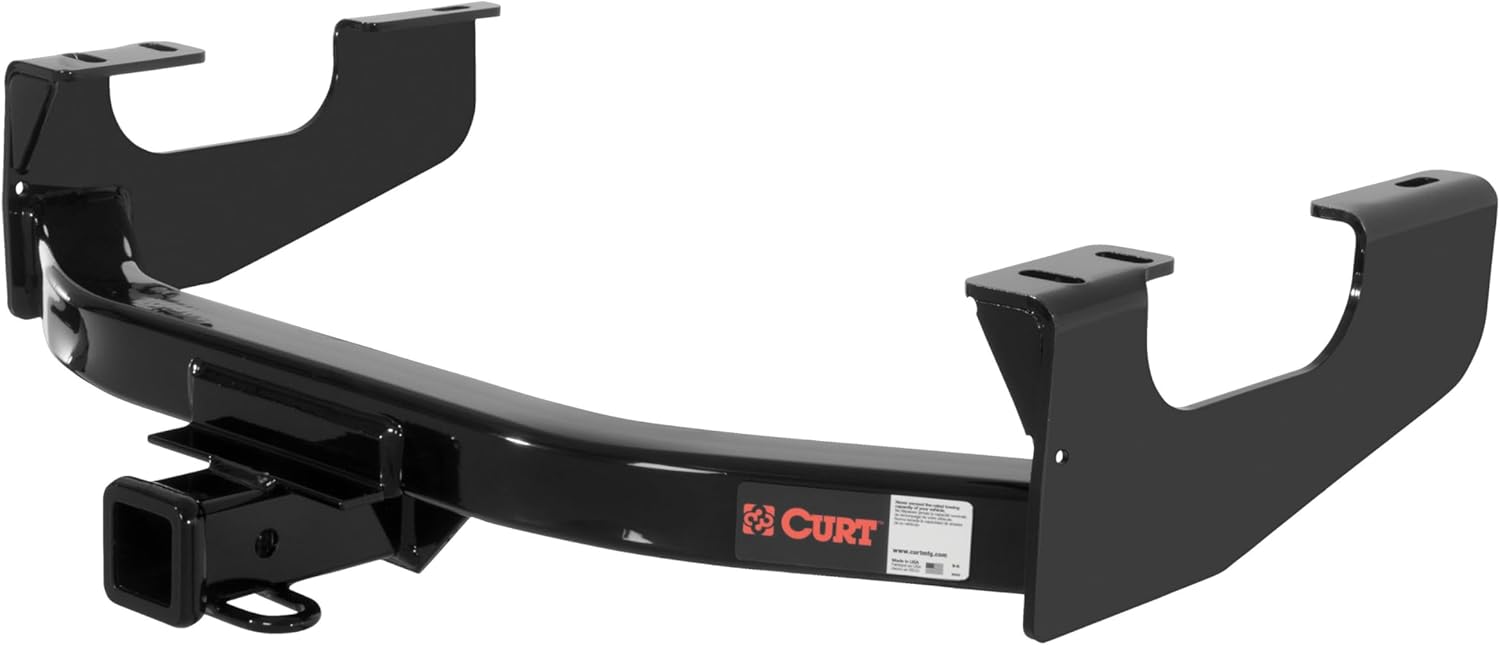
| Pull Force | 10000 Pounds |
|---|---|
| Material Type | Carbon Steel |
| Finish Type | Gloss, Powder-Coated |
| Included Components | Class 4 Hitch |
This CURT Class 4 2-inch receiver is a heavy-duty, vehicle-specific trailer hitch designed for Ford Super Duty trucks. It installs using the included hardware and is engineered to match the truck frame for a custom fit and a concealed main body that keeps a factory-style appearance. The hitch is made from high-strength carbon steel with a liquid A-coat plus powder-coat finish to resist corrosion and withstand regular towing use. It is rated for 10,000 pounds GTW with 1,000 pounds tongue weight and can accept a weight-distribution setup for increased WD capacity, so it suits large campers, boat trailers, and large utility trailers. Tested to SAE J684, it provides the structural capacity expected from a Class 4 receiver, but it is vehicle-specific so fitment must be confirmed for the Ford F-350 model years covered by the application. Installation is straightforward for a professional or experienced DIYer, though heavier components may require assistance during mounting.
Best for: Buyers who prioritize a common 2-inch receiver that delivers strong towing capacity and a factory-integrated look for their Ford Super Duty, and who want a robust, vehicle-matched hitch for hauling large trailers.
Less Ideal for: Shoppers seeking a universal or multi-vehicle hitch or a lighter-duty, lower-capacity receiver for occasional towing should consider other options.
- High towing capacity rated to 10,000 lb GTW and 1,000 lb tongue weight.
- Vehicle-specific design for a close, factory-style fit and concealed main body.
- Durable construction with carbon steel and a liquid A-coat plus powder-coat finish for corrosion resistance.
- Includes necessary hardware for complete installation and supports weight-distribution hitches.
- Fitment is vehicle-specific so you must verify exact F-350 year/configuration before purchase.
Verdict: The best 2-inch tow hitch receiver for shoppers who need the common receiver size that balances accessory compatibility, strength, and availability for typical towing setups.
7. ALMULOO Class 4 2-inch Trailer Hitch Receiver for 1997–2016 Ford F-Series
Best Corrosion-Resistant Tow Hitch Receiver

| Material | Alloy Steel |
|---|---|
| Finish Type | Powder Coated |
| Receiver Size | 2" x 2" |
| Maximum Towing Capacity | 12000 Pounds |
| Automotive Fit Type | Vehicle Specific Fit |
This Class 4 trailer hitch is built to attach to specific 1997–2016 Ford F-Series trucks and provides a full 2" x 2" receiver for heavy towing. Made from alloy steel with a powder coat finish, it is intended to withstand road exposure and resist surface corrosion compared with bare steel. The hitch is rated for up to 12,000 pounds gross trailer weight and includes installation hardware and instructions; professional installation is recommended for a secure mount. In use it gives a robust mounting point for hauling campers, cargo trailers, and other heavy loads while restoring or upgrading a factory-style receiver. The powder coat improves longevity in wet or salted conditions but is not the same as stainless steel, so exposed edges or mounting fasteners should be inspected and touched up over time. Overall it delivers a strong, truck-specific receiver that balances heavy-duty capacity with a corrosion-resistant finish for drivers who tow regularly in challenging environments.
Best for: Buyers who prioritize a heavy-duty, vehicle-specific receiver with a durable factory-style finish for frequent towing in wet or salty conditions and who plan routine inspection and upkeep.
Less Ideal for: If you need truly stainless or marine-grade hardware for minimal maintenance in extreme coastal or saltwater exposure, consider stainless or specialty marine-rated receivers instead.
- Vehicle-specific fit for 1997–2016 Ford F-150/F-250/F-350/F-450 simplifies installation alignment
- Class 4 2" receiver delivers high towing capacity suitable for large trailers and campers
- Alloy steel construction with powder-coated finish offers improved corrosion resistance versus uncoated steel
- Includes installation hardware and instructions so you have required parts on delivery
- Finish is powder coat rather than stainless steel so long-term corrosion protection depends on maintenance and touch-ups
Verdict: The best corrosion-resistant tow hitch receiver for buyers who want durable finishes or stainless components that resist rust and hold up in wet, salted, or coastal environments.
Choosing the Right Ford F-350 Tow Hitch Receiver: Key Factors to Consider
Towing and Tongue Weight Ratings
Rated towing and tongue weight capacities determine what trailers you can safely haul. For the F-350, choose a receiver with ratings that meet or exceed the gross trailer weight and tongue weight of the trailers you tow. Matching the receiver rating to your trailer prevents overloading the hitch or truck suspension.
Pay attention to tongue weight limits because they affect vehicle handling more directly than gross trailer weight. Underestimating tongue weight can lead to rear sag, reduced steering control, and uneven braking. Look for clear stamped or plate-rated values so you know the receiver meets real-world demands.
Mounting Style and Fitment
Mounting determines how the receiver attaches to the F-350 frame and influences installation time and structural reliability. Direct-fit bolt-on receivers that use factory frame holes usually require minimal drilling and maintain frame integrity. Some designs use removable crossmembers or weld-on plates; these may need more labor and can complicate future service.
Confirm the mounting approach works with your F-350 configuration, including any frame accessories, sensors, or factory wiring. A receiver that aligns with existing attachment points reduces installation risk and preserves towing geometry.
Hitch Class and Receiver Size
Hitch class and receiver tube size determine which hitch accessories and ball mounts are compatible. The F-350 commonly uses higher-class receivers that accept larger-diameter tubes for heavy towing. Ensure the receiver size matches the hitch accessories you plan to use to avoid adapters that can reduce capacity or add leverage that stresses the mount.
Consider whether you need a fixed-size receiver for maximum strength or a multi-size system that offers flexibility. Keep in mind that adapters and reducers change load paths and may lower the safe towing rating of the assembly.
Material, Construction, and Corrosion Protection
Receiver durability depends on material grade, weld quality, and protective finish. Heavy-gauge steel with consistent welds handles cyclical loads better than thinner, lighter materials. Corrosion protection such as robust powder coating, e-coat, or plated finishes helps the receiver resist rust from road salt and moisture.
Inspect whether the receiver design shields weld seams and fasteners from water intrusion. Long-term exposure to the elements can weaken connection points, so choose construction that minimizes trapped moisture and offers serviceable hardware.
Installation Complexity and Required Tools
Installation difficulty affects overall cost and downtime. Receivers that bolt to factory holes typically require basic hand tools, a torque wrench, and possibly a jack for support. More complex installs that require frame drilling, trimming bumpers, or temporary removal of crossmembers will increase labor time and may require specialized tools.
Factor in whether you will install the receiver yourself or rely on a shop. If your F-350 has aftermarket frame accessories, confirm compatibility to avoid rework. Clear instructions and included hardware reduce the chance of installation errors that can compromise safety.
Accessory Compatibility and Modularity
Think about the towing accessories you use now and might add later, including sway control units, weight distribution systems, and 5th wheel or gooseneck adapters. A receiver that supports standard mounting patterns and offers accessory-ready features simplifies upgrades.
Modular design can let you swap components without replacing the entire assembly. This is useful if your towing needs change, such as moving from conventional bumper towing to a fifth wheel setup. Ensure accessory attachments do not reduce the rated capacity of the receiver when installed.
Understanding Receiver Types for the F-350
Receivers for the F-350 vary by attachment method and intended use. Fixed-frame receivers mount directly to the truck frame for maximum rigidity and are common when towing heavy trailers regularly. Removable or drop-style receivers can offer clearance benefits or permit different mounting heights for varied trailers.
Knowing the differences helps you choose a receiver that balances strength with convenience. Consider how often you change towing setups, whether you need extra ground clearance, and if you prefer a permanent installation or something you can remove seasonally.
- Fixed receivers: high rigidity, minimal movement during tow
- Drop receivers: provide lower hitch height for level towing
- Removable options: allow for easier bumper clearance when not towing
How Receiver Mounting Affects Truck Handling
Where and how the receiver mounts affects load distribution and handling. A properly installed receiver keeps trailer forces well centered with the truck frame, preserving steering and braking balance. If the mount is flexible or lightly attached, you may notice increased sway or imprecise trailer tracking.
Additionally, correctly matched tongue weight and hitch height minimize rearward pitch and help maintain even braking. Pay attention to alignment and torque specifications during installation to keep handling predictable.
- Secure mounting reduces lateral movement and sway
- Proper hitch height maintains even weight distribution
- Torque to spec keeps fasteners from loosening under load
Preparing Your F-350 for Receiver Installation
Before installing a receiver, inspect the frame and underbody for corrosion, damage, or previous modifications. Clean mounting surfaces and apply rust treatment where needed to create a solid attachment. Remove any underbody trim or factory hardware that interferes with the receiver.
Gather necessary tools and confirm the truck configuration, such as cab length, bed type, and any factory tow package provisions. If you have factory wiring, route and secure electrical connectors away from moving parts and heat sources to protect trailer lights and brakes.
- Inspect frame and mounting points for rust or damage
- Clean and prep surfaces to ensure tight mating
- Verify wiring and sensors do not obstruct mounting area
Common Installation Pitfalls to Avoid
One frequent mistake is assuming all receivers fit identically; subtle differences in frame rails or aftermarket accessories can require trimming or alternate hardware. Do not overtighten bolts beyond specified torque as this can strip threads or deform mounting surfaces. Equally, under-torqued fasteners may loosen under load.
Another issue is neglecting to recheck fitment after initial road tests. Fasteners can settle and require re-torquing. Also ensure hitch pin and safety chain anchor points are rated for the loads you intend to tow.
- Do not overtighten or undertighten mounting bolts
- Recheck torque after a short break-in towing period
- Confirm anchor points meet required load ratings
When to Choose a Bolt-On Versus Weld-On Receiver
Bolt-on receivers that use factory holes are often preferable for F-350 owners who want a strong installation with minimal frame work. They preserve factory structure and are reversible. Weld-on receivers can provide a very rigid connection but require skilled welding and may complicate future service or resale.
Consider the tradeoffs: if you anticipate needing the highest possible capacity and plan permanent installation by a professional, weld-on can be appropriate. If you prefer serviceability and easier installation, a properly engineered bolt-on receiver is typically the better choice.
- Bolt-on: less invasive, reversible, generally quicker to install
- Weld-on: potentially higher rigidity, requires professional welding
- Choose based on long-term plans and installation resources
Planning for Fifth Wheel and Gooseneck Applications
If you intend to tow fifth wheel or gooseneck trailers, plan the receiver selection and bed setup accordingly. These towing systems transfer significant loads to the truck frame and often require reinforced mounting points or specialized rails. Ensure your chosen receiver and any adapters are rated for these applications and fit the F-350 bed layout.
Coordinate the receiver with suspension, brake upgrades, and wiring for heavy towing events. Proper integration prevents undue stress on the frame and helps maintain predictable handling when hauling large campers or commercial trailers.
- Verify receiver and adapters are rated for fifth wheel or gooseneck use
- Reinforce bed mounting and check frame compatibility
- Align receiver choice with suspension and brake upgrades
How We Chose the Best Ford F-350 Tow Hitch Receiver
We evaluated candidates using criteria that matter most for Ford F-350 owners who tow heavy loads. Primary considerations included rated towing and tongue weight capacity to ensure receivers can manage typical F-350 trailer tasks and remain within safe operational limits. Structural design and materials were assessed to judge long-term durability under repeated towing cycles and exposure to road salt or moisture.Fitment and mounting approach were critical. We prioritized receivers with direct-fit flanges or bolt-on mounting patterns that align to factory frame points to reduce installation complexity and preserve frame integrity. Ease of installation and required labor or specialized tools were also considered.Corrosion protection and finish quality were reviewed because salt, mud, and weather shorten component lifespan. Lastly, accessory compatibility and modularity were included to ensure the receiver accommodates common towing accessories and hitch types used with the F-350.Exclusions: we excluded adapters, light-duty trailer hitches not rated for heavy trucks, and receivers that require invasive frame modification beyond typical bolt-on installation. The list focuses on options suitable for the F-350 platform with realistic installation expectations.
Our full evaluation process is outlined in our review methodology.
FAQ
What receiver size is best for heavy towing on an F-350?
For heavy towing on the F-350, larger receiver tube sizes aligned with higher hitch classes are typically best. Choose a size and class that match your hitch accessories and exceed your trailer's rated tongue weight to maintain safe handling.
Can I install a tow hitch receiver myself on the F-350?
Many bolt-on receivers can be installed by a competent DIYer with basic tools and a torque wrench. More complex installs that require frame drilling, welding, or bumper modification are best handled by a professional to ensure structural safety.
How do I know if a receiver will fit my F-350 bed and frame?
Check the receiver's fitment notes against your truck configuration, including cab and bed length and any factory tow package. Look for products that specify direct compatibility with the F-350 to minimize the need for modifications.
Does using an adapter change towing capacity?
Yes, adapters and reducers can alter load paths and often reduce the effective rated capacity. Always follow manufacturer guidance and consider the combined ratings of the receiver, adapter, and accessory when calculating safe towing limits.
How often should I inspect the receiver and mounting hardware?
Inspect the receiver and fasteners before long trips and periodically during heavy-use seasons. Look for loose bolts, corrosion at welds, and signs of fatigue. Re-torque hardware after the initial break-in towing period and repair any corrosion promptly.
Will installing a heavier receiver affect my truck warranty or frame?
A properly engineered bolt-on receiver that uses existing factory mounting points usually does not harm the frame when installed to specification. However, weld-on modifications or improper installation could raise concerns with warranty coverage, so consult documentation and professionals if unsure.
Final Verdict
Prioritize rated capacity, secure mounting, and corrosion protection when choosing a tow hitch receiver for your Ford F-350. Match receiver size and class to the towing accessories you use and confirm the mounting approach fits your truck configuration.Weigh the tradeoffs between convenience and ultimate rigidity: bolt-on receivers offer easier installation and serviceability while more invasive options can provide added stiffness for extreme loads. Focus on proper installation and periodic inspection to keep towing safe and predictable.
