

Note: This article contains affiliate links. If you click on these links and make a purchase, I may earn a small commission at no extra cost to you. This helps support my research and content. Read my full affiliate disclosure here.
If you drive a Honda Accord with a continuously variable transmission, using the right CVT fluid matters for shift quality and transmission longevity. The wrong fluid can cause harsh or erratic behavior, reduced lubrication, and accelerated wear. This guide covers seven shortlisted CVT fluids chosen specifically for use in the Accord, with attention to compatibility, friction characteristics, and durability.Below we summarize the evaluation criteria and what each shortlisted option brings to the table, then walk through factors to consider so you can pick the best fluid for your driving style and maintenance plan.
Looking for other parts? See all Honda Accord parts & accessories.
Top Picks at a Glance
| Best Overall Transmission Fluid Top-performing CVT fluid balancing protection, shift feel, and longevity | Honda HCF-2 CVT Transmission Fluid, 5-Quart Pack |  |
| Best Budget Transmission Fluid Low-cost CVT-compatible fluid that covers routine service without breaking the bank | Beck/Arnley Premium CVT-HCF2 Transmission Fluid, 1 qt |  |
| Best Honda HCF‑2 Fluid Factory‑spec HCF‑2 formula specifically engineered for Honda CVT applications | Honda Genuine HCF-2 Continuously Variable Transmission Fluid, 1 QT |  |
| Best Universal CVT Fluid Multi‑vehicle CVT formula that claims broad OEM compatibility across makes | Castrol Transmax ATF/CVT Universal Automatic Transmission Fluid, 1 Gallon (3-Pack) |  |
| Best Full‑Synthetic Performance Fluid Full‑synthetic CVT oil focused on high thermal stability and anti‑wear additives | Valvoline Full Synthetic CVT Transmission Fluid, 1 Quart |  |
| Best Bulk & Workshop Pack Large jugs or multi‑quart packs for full flushes and shop use | Genuine HCF-2 CVT Automatic Transmission Fluid (12 × 1 qt) – eEuroparts |  |
| Best Anti‑Shudder / Smooth‑Shift Formula Blend formulated to minimize CVT judder and deliver consistently smooth shifts | Idemitsu CVTF Type H2 (HCF-2) CVT Transmission Fluid, 5 Quart |  |
1. Honda HCF-2 CVT Transmission Fluid, 5-Quart Pack
Best Overall Transmission Fluid

| Material | Mineral-based |
|---|---|
| Liquid Volume | 5 Quarts |
| Specific Uses For Product | Second-generation CVT transmissions in Honda vehicles |
| Item Form | Oil |
This is genuine Honda HCF-2 transmission fluid supplied in five one-quart bottles intended for second-generation Honda CVT gearboxes. It is used during fluid service to maintain the friction characteristics and hydraulic function the transmission was designed for, helping preserve smooth shift feel and mitigate belt or chain shudder. The formula emphasizes wear and pressure protection and a stable viscosity across a wide temperature range, which supports consistent performance in stop-and-go and highway driving. Because it is a factory-formulated product, it removes guesswork for DIY maintenance and reduces the risk of compatibility problems that can arise from mixing fluids. The liquid is mineral-based and labeled specifically for second-generation Honda CVTs, so it must be used exactly as recommended in the owner’s manual; it is not interchangeable with other CVT fluids or HCF-2 variants. Buyers should plan for proper disposal of used fluid and be mindful to follow Honda service intervals when topping or replacing fluid.
Best for: A Honda owner who wants a straightforward, factory-specified CVT fluid for DIY maintenance and prioritizes correct friction characteristics and compatibility over experimenting with aftermarket blends.
Less Ideal for: Drivers seeking extended drain intervals or a synthetic-based fluid with aftermarket performance additives should consider other products geared toward longer service life.
- Factory-formulated for second-generation Honda CVT transmissions, ensuring compatibility.
- Five one-quart bottles make measuring and topping straightforward for DIY service.
- Designed for stable viscosity and friction characteristics to reduce shudder and support smooth shift feel.
- Specifically tuned for pressure and wear protection to help extend transmission life.
- Mineral-based formulation may not match synthetic alternatives that offer longer drain intervals.
Verdict: Choose this slot if you want the single CVT fluid that delivers the best mix of anti-shudder control, wear protection, and reliable shift feel for DIY maintenance.
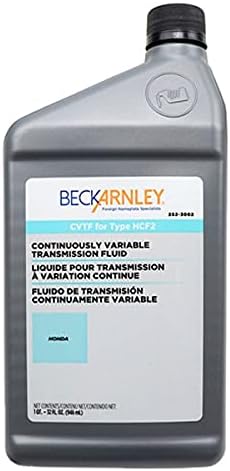
2. Beck/Arnley Premium CVT-HCF2 Transmission Fluid, 1 qt
Best Budget Transmission Fluid
| Viscosity | 5w-30 |
|---|---|
| Liquid Volume | 1 Quarts |
| Item Type Name | Beck Arnley 2523002 Transmission Fluid |
This Beck/Arnley CVT-HCF2 is a straightforward replacement fluid for vehicles that require the HCF-2 specification. It is intended for routine drain-and-fill service and is formulated from high-performance base oils with selective additives to protect seals and O-rings in continuously variable transmissions. In practice it pours and handles like a typical 1-quart bottle of transmission oil and is useful for topping off or scheduled fluid changes when you want a factory-quality formulation without paying for premium branded bottles. The product is not universal so you should verify HCF-2 compatibility with the vehicle's service manual or parts catalog before use. For Honda Accord models that call for CVT HCF-2, this provides an affordable OEM-style option, but it does not claim extended service life or vehicle-specific calibration that dealer-supplied fluids may offer.
Best for: Buyers who prioritize a low-cost, factory-compatible CVT fluid for routine maintenance on vehicles that specify HCF-2 and who prefer an affordable, easy-to-handle quart option.
Less Ideal for: Drivers seeking extended-interval, manufacturer-specified dealer fluids or fluids tailored for modified or nonstandard CVT systems should consider alternative options.
- Formulated to match HCF-2 specification for compatible CVT systems
- Protects seals and O-rings with selective additive package
- Sold in a convenient 1-quart bottle suitable for drain-and-fill or top-up service
- Not a universal fluid so it must be checked against the vehicle application before use
Verdict: Pick this if you need an affordable, OEM‑compatible CVT fluid for routine drain-and-fill jobs where cost matters more than extended service intervals.
3. Honda Genuine HCF-2 Continuously Variable Transmission Fluid, 1 QT
Best Honda HCF‑2 Fluid

| Unit Count | 32.0 Fluid Ounces |
|---|---|
| Part Number | 08200-HCF2 |
| Item Form | Liquid |
| Material | Synthetic |
| SAE J300 Viscosity Grade | 20W-50 |
This is the factory Honda HCF-2 transmission fluid packaged in a 1 U.S. quart bottle and formulated for Honda CVT and other transmissions that specify HCF-2. It is typically used during service or fluid changes to maintain the friction characteristics and internal material compatibility Honda engineers intended. The bottle contains a synthetic blend with an SAE J300 viscosity grade listed as 20W-50 and is sold as an OEM replacement labeled Honda part 08200-HCF2. In practice the fluid helps preserve smooth, consistent CVT operation and shift feel when installed to the manufacturer fill levels, and customers report improved shifting compared with generic alternatives. The primary benefits are assured compatibility with Honda seals and clutches and a factory-quality formulation designed to prevent corrosion. Limitations are that this is a single-quart retail bottle so larger jobs require multiple units, and it is positioned as a genuine part which can cost more than aftermarket CVT fluids that claim comparable performance.
Best for: Buyers who prioritize factory compatibility and want a Honda‑specified fluid to preserve CVT shift quality and component life in Accord transmissions.
Less Ideal for: Drivers looking for the lowest-cost aftermarket CVT fluid or those who need bulk quantities for multiple vehicles should consider larger or aftermarket options.
- Factory formula matched to Honda CVT friction and seal compatibility
- Synthetic formulation intended to resist corrosion and support transmission longevity
- Sold in a convenient 1 quart bottle for easy service and topping up
- Only one quart per bottle so multiple bottles are needed for a full drain and refill
Verdict: Use this slot when you want a Honda‑spec HCF‑2 fluid to match factory friction and compatibility for Honda CVT systems.
4. Castrol Transmax ATF/CVT Universal Automatic Transmission Fluid, 1 Gallon (3-Pack)
Best Universal CVT Fluid

| Unit Count | 384.0 Fluid Ounces |
|---|---|
| Number of Items | 3 |
| Material | Synthetic oils |
| SAE J300 Viscosity Grade | 5W-20 |
Castrol Transmax ATF/CVT Universal is a full‑synthetic transmission fluid designed to work in both conventional stepped automatics and many continuously variable transmissions. It is packaged as a three‑gallon bundle that suits a full flush or servicing multiple vehicles. The formula uses Castrol Smooth Drive technology to manage friction characteristics, which customers report produces smoother shifts, quieter operation, and reliable protection at higher temperatures. Practical benefits include broad manufacturer coverage that simplifies inventory for a small shop or a homeowner who services several cars, and the gallon jug size is convenient for complete services without multiple small bottles. Limitations to note are that vehicle compatibility still requires checking the Honda Accord’s owner manual or service spec for the correct CVT grade; not every CVT calls for a universal fluid. Also the product listing does not show a specific Honda approval number, so shops wanting factory‑specified fluids may prefer a Honda‑approved alternative.
Best for: Buyers who want a single, full‑synthetic CVT/ATF to service multiple vehicles or simplify workshop inventory while keeping a reliable fluid on hand for routine CVT maintenance on a Honda Accord.
Less Ideal for: Owners who need a Honda‑specified factory‑approved fluid for warranty or manufacturer‑recommended service should consult dealer recommendations or use a Honda‑branded fluid instead.
- Full synthetic formulation designed for both stepped automatic and CVT use
- Sold as three 1‑gallon jugs, convenient for full flushes or servicing multiple cars
- Castrol Smooth Drive technology aims to stabilize friction for smoother shifts
- Wide stated vehicle coverage reduces the need to stock multiple specialty fluids
- No explicit Honda CVT approval number shown in the product details
Verdict: Choose this option if you prefer a universal CVT fluid rated for many manufacturers to simplify shop inventory or service multiple vehicles.
5. Valvoline Full Synthetic CVT Transmission Fluid, 1 Quart
Best Full‑Synthetic Performance Fluid

| Item Type Name | Automatic Transmission Fluid |
|---|---|
| Specific Uses For Product | CVT transmission protection and optimization in automatic vehicles |
| Viscosity | 10W |
| Material | Synthetic |
Valvoline Full Synthetic CVT Fluid is a purpose‑built transmission fluid for belt and chain CVTs that prioritizes smooth shifting and component protection. In use it replaces or supplements factory CVT fluid to reduce shudder, improve torque transfer, and protect metal surfaces with anti‑wear additives and shear‑stable viscosity modifiers. Typical use is a drain-and-fill or service refill during scheduled maintenance; it is formulated for better high‑temperature stability and oxidation resistance than conventional fluids, so it holds friction characteristics longer under heavy city or highway use. Buyers will notice smoother launches and reduced driveline vibration after a change, and the fluid is clear to lightly tinted which helps spot contamination. Limitations are that CVTs are sensitive to exact fill amounts and manufacturer specifications vary, so matching Honda's required spec and checking levels carefully is essential; this product does not list a specific Honda OEM approval on the bottle. For routine maintenance on a Honda Accord CVT the fluid offers an affordable full synthetic option engineered for durability and consistent performance.
Best for: A practical Honda owner who wants a modern full‑synthetic CVT fluid that prioritizes long‑term stability and smoother shifting during regular maintenance.
Less Ideal for: Anyone who must use only Honda‑branded or explicitly Honda‑approved fluid for warranty or dealership service requirements should avoid this and use the factory‑specified fluid instead.
- Full synthetic base stocks for improved high‑temperature stability and oxidation resistance
- Formulated friction modifiers and anti‑wear additives for smoother launches and clutch protection
- Shear‑stable viscosity modifiers help maintain consistent performance over time
- Suitable for most belt and chain‑driven CVTs, making it versatile for service drain-and-fill procedures
- Product listing does not state a specific Honda CVT approval or OEM part number
Verdict: Select this pick when you want a modern full‑synthetic CVT fluid engineered for improved high‑temperature stability, reduced oxidation, and longer component life.
6. Genuine HCF-2 CVT Automatic Transmission Fluid (12 × 1 qt) – eEuroparts
Best Bulk & Workshop Pack

| Brand Name | eEuroparts |
|---|---|
| Item Form | Oil |
| Unit Count | 384.0 Fluid Ounces |
| Specific Uses For Product | Automatic Transmission |
| Liquid Volume | 1 Quarts |
This 12×1 quart pack supplies factory‑spec HCF‑2 CVT fluid intended for use in Honda continuous variable transmissions. It is sold as genuine OEM specification fluid and is aimed at shops or owners doing full fluid changes where multiple quarts are needed. In practice the case format makes measuring, topping and complete drain/refill services straightforward since each quart is prepackaged and labeled. Using the correct HCF‑2 formulation helps preserve CVT belt and clutch life and maintains shift quality compared with non‑specified fluids. The bulk pack also simplifies inventory for workshops and reduces the per‑quart handling compared with single retail cans. Limitations are standard for OEM fluids: this is specific to Honda CVT requirements and not a universal transmission oil, and you should confirm HCF‑2 fitment for the exact Accord year and CVT variant before service. The product is practical for routine scheduled services but offers little benefit for users who only need a single quart.
Best for: Shops, fleet operators, and DIYers who perform full CVT fluid changes on multiple Hondas and want the convenience and cost savings of a multi‑quart case.
Less Ideal for: Drivers who only need a single quart for a top‑up or who have a transmission that requires a different fluid specification.
- Supplied as 12 separate 1‑quart bottles for easy metering and storage
- Genuine HCF‑2 formulation matches Honda CVT fluid specification
- Good per‑quart value for shops and owners who perform full fluid changes
- Case format reduces packaging waste and keeps extra stock on hand
- Intended specifically for HCF‑2 CVT applications and not suitable for non‑CVT or different fluid specs
Verdict: Pick this slot if you perform full fluid changes, service multiple vehicles, or want the best per‑quart value from multi‑quart jugs and cases.
7. Idemitsu CVTF Type H2 (HCF-2) CVT Transmission Fluid, 5 Quart
Best Anti‑Shudder / Smooth‑Shift Formula

| Specification | HCF-2 |
|---|---|
| Volume | 5 Quart |
| Manufacturer | Idemitsu |
Idemitsu CVTF Type H2 is a full-coverage CVT fluid designed specifically for Honda transmissions that call for the HCF-2 specification. It is used as a direct replacement during CVT fluid service to reduce low-speed judder and keep belt/pulley and clutch engagement feeling consistent. The formula blends high-quality base oils with proprietary friction modifiers and anti-shudder additives, which should translate to smoother low-speed takeoffs and steadier torque transfer under everyday driving. The product also claims improved resistance to oxidation and thermal breakdown, so it is intended to hold up longer between services and help prevent sludge and varnish build-up. Practical benefits include easier drivability in stop-and-go traffic and potential preservation of clutch life in high-mileage Accords. Limitations are that this is a mission-specific CVT fluid so it is not suitable for torque-converter automatic or dual-clutch gearboxes and you must confirm HCF-2 compatibility with your model year before use.
Best for: Buyers focused on eliminating low-speed judder and preserving clutch feel in Honda CVT vehicles who prioritize smooth, consistent engagement during daily driving.
Less Ideal for: Drivers who need a universal automatic transmission fluid or who are servicing non-CVT gearboxes should look for a different product.
- Formulated to Honda HCF-2 specification for direct CVT replacement
- Anti-shudder friction modifiers aimed at reducing low-speed judder
- Claims strong oxidation and thermal stability to help extend fluid life
- Available in a 5-quart container suitable for most DIY fluid changes
- Not suitable for AT or DCT applications so limited to compatible CVTs
Verdict: Choose this when preventing low‑speed judder and preserving clutch/chain feel is your priority — the formula emphasizes friction modifiers and anti‑shudder performance.
Choosing the Right Honda Accord CVT Fluid Transmission Fluid: Key Factors to Consider
Manufacturer Compatibility and Spec Approval
Ensuring the fluid meets Honda's CVT specifications is the first step. Honda CVTs often require fluids with specific friction modifiers and additive packages tailored to belt-and-pulley systems. Using a fluid that matches the required spec reduces the risk of shudder, slipping, or improper clutch engagement.
Specification approval matters because some CVT fluids formulated for other makes or older designs will not provide the same coefficient of friction or anti-shudder performance. Confirming compatibility helps maintain hydraulic control and preserves the transmission's designed shift characteristics.
Friction Characteristics and Shudder Prevention
Friction behavior determines how smoothly the CVT transmits torque from the engine to the drivetrain. Fluids with inconsistent friction properties can cause shudder during low-speed torque transfer or hesitation under light throttle. Look for fluids formulated to deliver a stable coefficient of friction over temperature and service life.
A CVT fluid that resists friction fade will preserve consistent engagement of the belt or chain-driven pulleys and help maintain predictable acceleration and deceleration responses.
Thermal and Oxidation Stability
CVT systems generate heat during operation, and the fluid must resist breakdown at elevated temperatures. Fluids with strong thermal stability retain proper viscosity and protect hydraulic circuitry and valves. Oxidation-resistant formulations minimize varnish and deposit formation that can foul solenoids and regulators.
Choosing a fluid with proven high-temperature performance extends service intervals and reduces the chance of component sticking or erratic pressure control caused by degraded fluid.
Shear Stability and Viscosity Retention
Shear stability indicates how well the fluid maintains its viscosity under mechanical stress. CVT fluids that thin out due to shear lose their ability to maintain hydraulic pressure and can change the transmission's behavior. Good shear stability ensures consistent hydraulic response and longer fluid life.
Viscosity retention matters for both cold-start behavior and hot operation. A fluid that stays within its designed viscosity window helps preserve shift feel and reduces wear across varying temperatures.
Wear Protection and Additive Package
A robust additive package protects the metal surfaces, belts, chains, and bearings inside the CVT. Antiwear, corrosion inhibitors, and detergents help prevent surface pitting and maintain clean hydraulic passages. This reduces frictional losses and prolongs component life.
Selecting a fluid with targeted antiwear chemistry and corrosion control ensures long-term reliability, especially for drivers who frequently tow, haul, or operate in stop-and-go traffic that stresses the transmission.
Service Interval and Fluid Life
How often you will need to change the CVT fluid affects maintenance planning and total cost of ownership. Some formulations are engineered for extended drain intervals, while others are intended for more frequent replacement. Consider driving habits and the Accord's duty cycle when deciding how long to expect fluid performance.
Longer-life fluids reduce the number of service visits but require confidence in thermal stability and additive longevity. If you drive in severe conditions, a shorter interval with a robust fluid may be the better choice.
When to Change CVT Fluid in an Accord
Timing for a transmission fluid change depends on driving style, conditions, and the vehicle's service recommendations. Regular highway driving at moderate loads can stretch fluid life, while frequent city traffic, heavy loads, or towing calls for earlier service.
Look for signs that fluid service is due such as sluggish response, noticeable shudder at low speeds, or any unusual noises from the transmission area. If you maintain a proactive service schedule, you reduce the risk of contamination or degraded performance that can lead to mechanical wear.
- Follow the vehicle maintenance schedule as a baseline and shorten intervals for severe driving.
- Inspect fluid condition visually and by smell during service; dark or burnt-smelling fluid indicates oxidation.
- Account for driving habits when planning intervals: city and frequent stop-start driving increase fluid stress.
How Fluid Choice Affects Shift Feel and Fuel Economy
The right CVT fluid preserves the transmission's designed friction curve and hydraulic response. That translates directly to smoother, more linear acceleration and predictable engine load transition. Fluids that do not match the recommended characteristics can introduce lag, slip, or chatter.
Viscosity and friction modifiers also influence parasitic drag and hydraulic efficiency, which indirectly affect fuel economy. While fluid choice alone will not dramatically change mpg, a properly formulated CVT fluid helps the transmission operate within its intended efficiency window.
- Stable friction characteristics promote consistent throttle response.
- Viscosity retention supports efficient hydraulic operation across temperatures.
- Additives that reduce internal drag can help sustain factory fuel economy figures.
DIY Fluid Change Tips for Accord Owners
If you plan to perform a CVT fluid change yourself, prepare the correct amount of fluid, a clean work area, and the proper tools to access the transmission fill and drain points. Take time to warm the vehicle to operating temperature so the fluid drains more completely.
Follow Honda's fill and level procedures precisely. Overfilling or underfilling a CVT can cause poor operation or damage. Use a factory service manual or reliable OEM procedure to set the correct fluid level based on temperature.
- Warm the vehicle before draining to improve fluid flow.
- Use the specified fill method and temperature-based level check.
- Dispose of used fluid properly and clean any spilled fluid from hot surfaces.
Signs a CVT Fluid May Be Degraded
Degraded CVT fluid often shows visual and performance symptoms. Darkened fluid color, a burnt or acrid odor, increased shift shudder, or slipping under load all suggest that the fluid's chemistry has broken down. Solenoid sticking or delayed pressure response can also indicate contamination or varnish buildup.
Addressing degraded fluid early can prevent more serious mechanical wear. If you notice symptoms, arrange a service inspection and consider a complete fluid change combined with any recommended filter or screen cleaning.
- Dark color or strong burnt smell in the fluid.
- Increased shudder, hesitation, or slipping during acceleration.
- Erratic or delayed shift response and unusual noises from the transmission.
Choosing Between OEM and High-Performance CVT Fluids
OEM-formulated CVT fluids are developed to meet the vehicle manufacturer's specific friction and hydraulic requirements. They offer predictability and are a safe choice when maintaining factory shift characteristics and warranty-aligned service.
High-performance CVT fluids may emphasize extended life, higher thermal stability, or specialized anti-shudder chemistry. These can be attractive for drivers engaging in spirited driving or operating in extreme climates, but it is important to confirm they meet Honda CVT specifications before use.
- OEM fluids prioritize exact compatibility and predictable behavior.
- Performance-oriented fluids target longevity and thermal resilience.
- Always verify spec compliance before choosing a non-OEM formulation.
Still looking for the perfect fit?
Select your Honda Accord configuration to see the most relevant Transmission Fluids recommendations
How We Chose the Best Honda Accord CVT Fluid Transmission Fluid
To compile the shortlist of CVT fluids suitable for the Honda Accord, we applied a focused editorial filter that prioritized technical compatibility and real-world serviceability. We checked specification alignment with Honda CVT requirements, focusing on fluid formulations designed for belt-and-pulley CVT systems and fluids that meet the manufacturer-recommended performance sheets. We evaluated friction performance and torque capacity to ensure smooth launch and consistent shift feel under varied load.Thermal stability and oxidation resistance were weighted heavily because CVT systems run hot; fluids that maintain viscosity and resist varnish preserve hydraulic control and component life. Wear protection and additive package quality were assessed to limit metal-to-metal contact and protect bearings and clutches. We also considered shear stability and long-term service intervals since fluids that thin quickly can degrade gearing behavior.Exclusions: we excluded universal or ambiguous formulations not explicitly intended for CVT use, conventional automatic transmission fluids labeled only for torque-converter ATF service, and any fluids lacking clear technical data. The final picks reflect fluids that meet CVT-specific chemistry needs, manufacturer compatibility, and demonstrated stability in extended service conditions.
Our full evaluation process is outlined in our review methodology.
FAQ
How often should I change CVT fluid in a Honda Accord?
Change intervals depend on driving conditions. For normal highway driving, intervals aligned with the manufacturer's schedule are typical. For frequent city driving, towing, or stop-and-go conditions, shorten intervals and inspect fluid more often.
Can I use a standard ATF in my Accord CVT?
Standard ATF formulations for torque-converter automatic transmissions usually do not have the specific friction modifiers CVTs require. Using the incorrect fluid can cause shudder or improper engagement, so choose a fluid specified for CVT service.
Will a CVT fluid change fix shudder or slipping?
A fresh, compatible CVT fluid can eliminate issues caused by degraded or contaminated fluid. However, if shudder or slipping result from mechanical wear or damaged components, a fluid change alone may not resolve the problem.
Is it safe to perform a DIY CVT fluid change on an Accord?
DIY service is possible with the right tools and adherence to Honda's fill and level procedures. Precise temperature-based level checks are critical. If you are unsure, professional service ensures correct level and avoids potential damage.
Does CVT fluid affect fuel economy?
Yes, to a degree. A properly matched CVT fluid helps the transmission operate efficiently by maintaining hydraulic control and reducing internal drag. The effect on overall fuel economy is modest but real when fluid condition or formulation is out of spec.
Final Verdict
Choose a CVT fluid for your Honda Accord that matches the manufacturer's CVT specification and balances friction control, thermal stability, and shear resistance. Prioritize fluids with proven oxidation resistance and a robust additive package if you drive in heavy city traffic or extreme temperatures. For most owners, following the manufacturer's compatibility guidance and maintaining appropriate service intervals will deliver the best long-term reliability and consistent shift feel.
Explore More:
- Check out all Honda Accord parts & accessories
- Explore Fluids & Chemicals
- Browse all Accessories
