

Note: This article contains affiliate links. If you click on these links and make a purchase, I may earn a small commission at no extra cost to you. This helps support my research and content. Read my full affiliate disclosure here.
If you own a Ford F-150, having a dedicated OBD2 scanner can save time and frustration when diagnosing engine lights, drivability issues, and sensor faults. The right scanner helps you read and clear codes, view live data, and confirm repairs without guesswork. This guide covers seven shortlisted Ford F-150 OBD2 scanners chosen for their compatibility, ease of use, and diagnostics depth. Below you will find practical notes on what each model offers and the evaluation criteria used to pick them.
Looking for other parts? See all Ford F-150 parts & accessories.
Top Picks at a Glance
| Best Overall The best all-around choice for most situations | OBDLink MX+ OBD2 Bluetooth Scanner |  |
| Best Quality Built to a higher standard if you want something more solid | TOPDON AD600S ArtiDiag600S OBD2 Scan Tool with Touchscreen and 9 Reset Services |  |
| Best Value The sweet spot between price and what you get | BlueDriver Bluetooth Pro OBDII Scan Tool |  |
| Best Budget The cheapest option that still gets the job done reliably | OBDResource ELM327 USB OBD2 Adapter for Ford vehicles |  |
| Highest Rated A top-rated pick with lots of positive feedback | ANCEL AD310 Classic Enhanced OBD2 Code Reader |  |
| Most Popular A crowd favorite that many people choose with confidence | Autel AutoLink AL319 OBD2 Code Reader |  |
| Best Seller A high-volume bestseller chosen again and again | FOXWELL NT301 OBD2 Scanner – Check Engine Code Reader with Live Data |  |
OBDLink MX+ OBD2 Bluetooth Scanner

| Operating System | iOS, Android, Windows |
|---|---|
| Automotive Fit Type | Universal Fit |
| Brand | OBDLink |
| Model | OBDLink MX+ |
The OBDLink MX+ turns a phone or PC into a capable diagnostic tool for reading and clearing trouble codes and monitoring live parameters on Ford F-150s. It plugs into the vehicle OBD2 port and pairs quickly over Bluetooth to apps like FORScan, Torque, and the OBDLink app to display gauges, freeze frame data, and OEM-specific codes for systems such as ABS and SRS. Key strengths are fast, stable connections, wide app compatibility, and ongoing firmware updates that extend manufacturer support for Ford systems. The unit includes protections against over-voltage and battery drain, so it can be left connected during driving sessions without risking the vehicle battery. Practical limitations are its small plug-in form factor, which can catch on clothing or fall out of loosely seated ports in some vehicles, and the reliance on third-party apps for advanced functions beyond basic scanning. For a balanced F-150 owner who wants deep diagnostics without a bulky handheld tool, the MX+ delivers professional-level capability in a tiny package.
Best for: Balanced owners who want a single, reliable scanner to diagnose, monitor, and clear codes on their F-150 without buying a bulky dedicated tool and who value broad app support and ongoing firmware updates.
Less Ideal for: Professional shops that need a rugged, permanently-mounted diagnostic station or users who want all features built into a standalone handheld scanner rather than using phone or PC apps.
- Fast, reliable Bluetooth connection to iOS, Android, and Windows for real-time data.
- Strong app compatibility including FORScan and OBDLink app for Ford-specific diagnostics.
- Over-voltage and battery drain protection for safe long-term use while driving.
- Regular firmware updates that expand vehicle and OEM protocol support.
- Small dongle can protrude from the OBD2 port and may snag or fall out in some installations.
- Advanced functions require compatible third-party apps rather than being built into the adapter.
Verdict: A fast, firmware-updatable Bluetooth OBD2 adapter that gives F-150 owners deep, app-driven diagnostics in a pocket-sized package.
TOPDON AD600S ArtiDiag600S OBD2 Scan Tool with Touchscreen and 9 Reset Services

| Operating System | Android 11.0 |
|---|---|
| Supported protocols | OBD2/EOBD/JOBD & CAN/CAN-FD |
| Vehicle coverage | Works with OBDII-equipped vehicles (1996+ compatibility claimed) |
The TOPDON AD600S is a portable diagnostic tool that reads engine and system codes, performs four-system scans (AT/ENG/ABS/SRS) and offers nine service resets including oil, brake, TPMS, SAS, BMS, DPF and injector coding. It runs Android 11 on a responsive 5-inch color touchscreen, stores data on internal memory and updates over Wi‑Fi with one‑click lifetime updates. In use the AD600S auto-detects VINs, displays live data as text or waveform graphs, saves printable reports and includes an onboard code library and feedback module for troubleshooting. For a performance-oriented buyer working on a Ford F-150 it covers most routine diagnostics and service resets you will need at the shop or at home, including ABS bleeding and electronic parking brake tasks mentioned by users. Limitations are that initial setup requires internet activation and an account, large updates can use the internal 32GB storage and some advanced manufacturer-level programming found in dealer-level tools is not available. The AD600S balances professional features and portability for hands-on technicians and experienced owners who want high functionality without paying for top-tier commercial scanners.
Best for: Performance-oriented owners and technicians who want a portable, feature-rich scanner to diagnose and service a Ford F-150 themselves and prioritize fast, hands-on troubleshooting over dealer-only programming.
Less Ideal for: Users who need full dealer-level programming, advanced module coding, or who cannot connect the tool to Wi‑Fi for activation and updates should consider higher-end professional equipment or dealer service.
- Full four-system diagnostics (AT/Engine/ABS/SRS) plus nine service resets for common maintenance tasks
- 5-inch touchscreen with Android 11 for easy navigation, live-data graphs and report export
- One-click lifetime Wi‑Fi updates and 32GB onboard memory for storing scans and reports
- Automatic VIN detection and onboard DTC library speed up troubleshooting for Ford F-150 issues
- Requires online activation and an account before first use
- Large updates and saved reports can consume onboard storage and need occasional housekeeping
- Does not provide high-end dealer-level reprogramming or advanced manufacturer coding
Verdict: The AD600S packs near-professional diagnostics and multiple service resets into a handheld touchscreen unit that is ideal for performance-focused Ford F-150 owners who want dealer-level scanning features without the dealer price.
BlueDriver Bluetooth Pro OBDII Scan Tool

| Operating System | iOS and Android |
|---|---|
| Power Source | Vehicle |
| Special Features | Enhanced codes, Live Data, Mode 6, Repair Reports |
The BlueDriver Bluetooth Pro is a compact OBD2 dongle that pairs with the BlueDriver mobile app to give hobbyists and DIY mechanics access to both standard check-engine codes and enhanced system codes like ABS and SRS on supported vehicles. You plug the unit into the F-150s OBDII port, open the app, and run scans or monitor live PIDs while driving. Notable features include enhanced code reading for many makes, live-data graphs and gauges, Mode 6 advanced test data, freeze-frame snapshots, and in-app repair reports that suggest likely causes and common fixes. For an F-150 owner it is especially useful for confirming fault codes before a shop visit and for monitoring sensors in real time during test drives. The device is simple to use and stores history you can export or share with a technician. Limitations are occasional slow full-system scans and some connection glitches reported during lengthy operations, and a modest learning curve to interpret advanced results. The BlueDriver is a strong practical choice for owners who want more capability than a basic code reader without stepping up to professional hardware.
Best for: Practical optimizers who want a capable, phone-based scanner to diagnose and verify issues on a Ford F-150 before paying for shop time or ordering parts.
Less Ideal for: Technicians who need the fastest full-system scans, dedicated handheld interfaces, or dealer-level functions not exposed through a phone app.
- Reads and clears generic and many enhanced system codes including ABS and SRS for supported vehicles
- Live data display with graphing, gauges, and exportable logs for monitoring sensor behavior while driving
- In-app repair reports and likely-fix suggestions tied to each diagnostic trouble code
- Compact Bluetooth dongle that pairs to iOS and Android with stored history you can share
- Full-system scans and code clears can be slow compared with higher-end scan tools
- Occasional connection interruptions reported during long operations or cleaning procedures
Verdict: A practical, phone-based scanner that gives F-150 owners enhanced diagnostics and live data at a value-oriented price, with some speed and connectivity compromises.
OBDResource ELM327 USB OBD2 Adapter for Ford vehicles

| Compatible software | FORScan, Elmconfig, FF2, FoCCCus, Scanmaster |
|---|---|
| Supported vehicles | Ford/Lincoln/Mazda/Mercury (1996 and later), including F-150 |
| Operating system | Windows (XP, Vista, 7, 8, 10) |
This compact USB ELM327 adapter connects to a Ford F-150s OBD2 port and links to a Windows laptop to read and clear diagnostic trouble codes, view live data, and access deeper Ford modules when paired with software like FORScan, Elmconfig or FoCCCus. The adapter includes a manual MS-CAN/HS-CAN switch so it can communicate with different Ford bus types and the USB wired connection avoids the instability some users see with Bluetooth devices. In practice it is used for routine troubleshooting, pulling PIDs, and unlocking hidden Ford features such as mirror tilt on reverse, disabling chimes, tire size correction and trailer brake controller setup. The device requires a CH340T driver and a Windows-compatible diagnostic program, so initial setup involves driver and software installation. It is not plug-and-play and advanced coding requires some familiarity with Ford diagnostic tools and FORScan licensing. For Ford F-150 owners who want low-cost access to coding and module-level diagnostics, it provides strong capability for the price but demands a Windows laptop and a willingness to install drivers and learn the software.
Best for: Budget-conscious Ford F-150 owners who prefer DIY diagnostics and coding using a Windows laptop and want deep access without spending on professional tools.
Less Ideal for: Users who need a simple, turn-key scanner for quick code checks from a phone or who cannot run Windows; those preferring vendor-supported, plug-and-play devices should look elsewhere.
- Works with FORScan and similar Windows diagnostic software to access module-level Ford functions.
- Wired USB connection provides more stable data transfer than many Bluetooth adapters.
- Manual MS-CAN/HS-CAN switch lets the adapter communicate with different Ford CAN buses.
- Small, pocketable form factor that is convenient to carry in a toolbox.
- Requires manual driver installation (CH340T) and Windows software before it will function.
- Not plug-and-play and some advanced coding features require learning the software and obtaining FORScan license steps.
- No native macOS or mobile support; a Windows laptop or virtual machine is necessary.
Verdict: A low-cost, Windows-focused USB adapter that unlocks Ford F-150 module-level diagnostics and coding for buyers willing to install drivers and learn FORScan.
ANCEL AD310 Classic Enhanced OBD2 Code Reader

| Automotive Fit Type | Universal Fit |
|---|---|
| Operating System | Linux |
| Language | English |
| Voltage | 12 Volts |
The ANCEL AD310 is a straightforward handheld OBD2 code reader designed to read and erase check-engine codes on 1996-and-newer vehicles. You plug it into the F-150’s OBDII port and the unit powers from the vehicle, scans for stored and pending engine codes, and displays code definitions on its screen to help you decide whether a repair is needed. Its simple menu and clear on-screen code descriptions make it useful for quick checks at home or roadside troubleshooting. Practical benefits include fast code retrieval, the ability to clear codes after a repair, and a durable compact housing that feels solid in use. Important limitations are that it only covers engine and emission-related OBD2 functions and does not access ABS, SRS, transmission, or manufacturer-specific modules; the display and cable are basic compared with more advanced diagnostic tools. For Ford F-150 owners who want a reliable, no-frills way to confirm check-engine issues, this does the job; technicians or users who need in-depth live data or system-specific diagnostics will need a more capable scanner.
Best for: Reliability-focused buyers who prioritize a dependable, simple tool for confirming and clearing check-engine codes on an F-150 before pursuing repairs.
Less Ideal for: Users who need comprehensive diagnostics, live data graphs, or system-specific access for in-depth troubleshooting should choose a more advanced scanner.
- Direct plug-and-play operation from the F-150’s OBDII port with no batteries required.
- Reads and clears standard engine and emissions trouble codes quickly.
- On-screen code definitions help non-technical users interpret results immediately.
- Compact, solid-feeling handheld unit that is easy to store in the glove box.
- Does not access ABS, SRS, transmission, or other vehicle systems beyond standard OBD2 engine/emissions.
- No advanced live-data streaming or manufacturer-specific diagnostics.
- Basic screen and limited cable length compared with higher-end tools.
Verdict: A reliable, no-frills OBD2 reader that quickly confirms and clears engine codes on an F-150 but lacks advanced system diagnostics.
Autel AutoLink AL319 OBD2 Code Reader
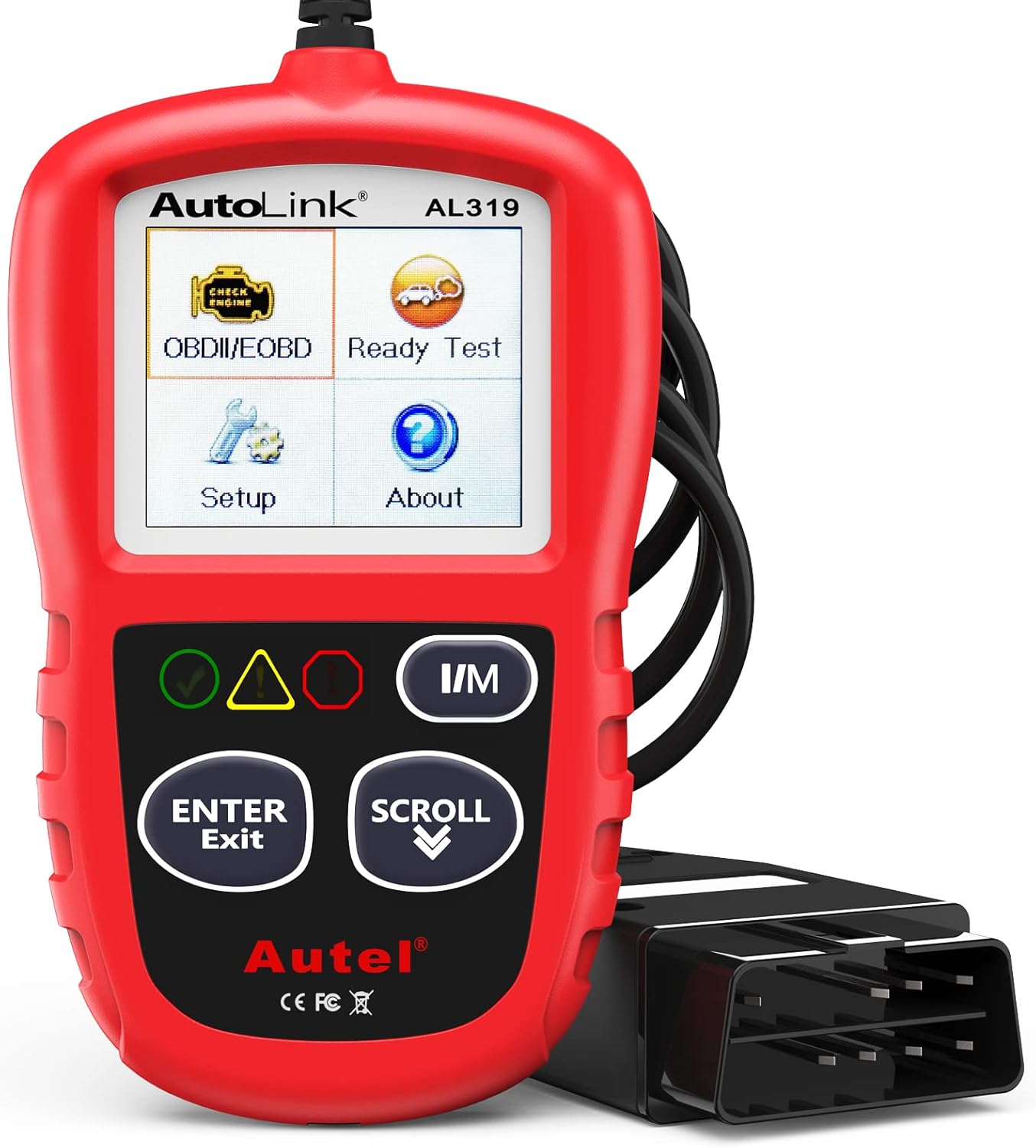
| Model | AutoLink AL319 |
|---|---|
| Voltage | 12 Volts |
| Special Features | One-Click I/M Readiness |
The Autel AutoLink AL319 is a compact, handheld OBD2 code reader designed to identify and clear check-engine light issues and to display live sensor data and freeze-frame snapshots. You plug it into the F-150's diagnostic port to read trouble codes, look up basic code definitions on-screen, monitor live PID values while driving, and use the one-click I/M readiness function to track emissions monitors. Its simple TFT color display, built-in speaker, and long cable make it convenient for quick checks in the cab or under the dash. The AL319 does not offer advanced resets or full system coverage beyond engine/OBD-II functions, so it will not perform SRS, ABS, or advanced service procedures. For everyday troubleshooting, pre-smog checks, and confirming repairs on a Ford F-150, it is fast, easy to use, and durable, though users who need deep module diagnostics or bi-directional controls will need a more capable scanner.
Best for: Convenience-driven buyers who want a no-fuss tool to diagnose and clear check-engine lights and confirm emissions readiness on a Ford F-150 without learning complex software.
Less Ideal for: Owners who need full system diagnostics, module programming, or bi-directional controls for advanced repairs should choose a professional-level scanner instead.
- Plug-and-play operation with simple menu for quick checks
- One-click I/M readiness lets you monitor emissions readiness during drive cycles
- Shows live data and freeze-frame to help verify repairs
- Compact, rugged design with long cable and no batteries required
- Limited to engine/OBD-II functions and cannot perform airbag, ABS, or advanced service resets
Verdict: A simple, reliable plug-and-play reader that handles check-engine codes and emissions readiness for Ford F-150 owners who prioritize convenience over advanced diagnostics.
FOXWELL NT301 OBD2 Scanner – Check Engine Code Reader with Live Data

| Compatible protocols | KWP2000, J1850 VPW, ISO9141, J1850 PWM, CAN |
|---|---|
| Vehicle coverage | 1996+ US and 2000+ EU/Asian OBDII vehicles (Ford F-150 compatible years) |
| Screen | 2.8" color display |
| Power | Powered via vehicle 16‑pin DLC |
| Battery | No internal battery; draws power from OBD port |
The FOXWELL NT301 is a compact plug-and-play OBD2 code reader designed to diagnose engine-related faults on compatible Ford F-150 models. You plug it into the vehicle DLC to read and erase diagnostic trouble codes, view live sensor streams with simple graphing, check I/M readiness for emissions, and retrieve the VIN. The unit displays code definitions and a help prompt for possible causes, which is useful if you are not a professional technician. It requires no internal battery and powers from the truck’s OBD port, so it is always ready when you need it. Important limitations: the NT301 focuses on engine/OBDII functions only and does not scan ABS, SRS, transmission modules, or perform advanced service procedures like module coding or bi-directional control. Windows is required for optional updates and PC reporting, and some users find the software and recording duration limited. For routine check-engine troubleshooting on an F-150 this tool is quick and practical, but it will not replace a full system dealer-level scanner for deeper diagnostics.
Best for: Risk-averse mainstream buyers who prioritize straightforward, reliable check-engine diagnostics for routine maintenance and emissions checks on their Ford F-150 and want a simple tool to verify repairs before visiting a shop.
Less Ideal for: Owners who need full-system diagnostics, module programming, dealer-level functions, or cross-platform PC and mobile integration should consider a more advanced scan tool.
- Plug-and-play operation that powers from the vehicle OBD2 port for immediate use
- Reads and clears engine diagnostic trouble codes and shows possible causes with a HELP button
- Live data graphing and VIN retrieval help track sensor trends and confirm repairs
- One-key I/M readiness check with LED indicators for quick emissions status
- Does not read ABS, SRS, transmission, or provide advanced service functions
- Windows-only support for updates and PC reporting; Mac and iOS not supported
- Recording length and PC software formatting can be limited for long-term logging
Verdict: A straightforward, reliable engine-focused reader for Ford F-150 owners who want quick check-engine codes and live data without dealer-level features.
Choosing the Right Ford F-150 OBD2 Scanner: Key Factors to Consider
Ford Compatibility and Protocol Support
Not all OBD2 scanners handle manufacturer-specific protocols or extended PIDs. For an F-150, ensure the scanner explicitly supports Ford OBD2 variants and can read both generic and Ford-enhanced trouble codes. Compatibility affects whether you can access engine, transmission, and emission-related data with full fidelity.
A scanner that lists Ford support will reduce blind spots during diagnosis and improve chances of seeing meaningful live-data parameters. This matters most when dealing with intermittent faults or manufacturer-specific codes that generic readers sometimes miss.
Live Data and Logging Capabilities
Live data streaming lets you watch parameters such as fuel trim, oxygen sensor voltages, and engine load in real time. Logging records these streams so you can review trends or share them with a technician. For the F-150, live data is essential when diagnosing drivability, idle, and sensor-related issues that only appear under certain conditions.
Look for clear graphing, customizable parameter sets, and adequate logging length. These features make it easier to correlate symptoms with specific sensor behavior and to verify repairs under road or idle conditions.
Ease of Use and Interface
The interface determines how quickly you can navigate menus, read codes, and run tests. Handheld scanners should have intuitive button layouts and readable screens, while Bluetooth or Wi-Fi dongles rely on well-designed mobile apps. For owners who perform their own maintenance, a simple, logical user experience reduces misreads and setup frustration.
Consider the clarity of code definitions, the ability to save reports, and whether the app or device supports multiple vehicle profiles. Good usability shortens troubleshooting time and reduces the chance of user error.
Advanced Diagnostic Functions
Beyond reading and clearing codes, advanced functions such as readiness monitors, component tests, ABS and SRS scanning, and bidirectional controls can be valuable. Depending on your F-150 year and trim, some functions may be more relevant than others. Prioritize the capabilities that match your typical repair tasks.
Having extra functions can prevent unnecessary visits to a shop for diagnostics that you could run yourself, but more advanced features often require a steeper learning curve. Balance capability with how comfortable you are with interpreting the results.
Software Updates and Support
Vehicle software evolves, and scanner manufacturers release firmware and app updates to maintain compatibility. A scanner with a clear update path and active support is more likely to work reliably with newer F-150 model years and patched vehicle systems.
Check whether updates are free or subscription-based, how frequently the maker issues updates, and what support channels are available. Good support reduces the risk that your tool becomes obsolete or fails to read evolving code sets.
Durability and Portability
Durability matters if you use the scanner in a garage or on the road. Handheld devices should have rugged housings and reliable connectors, while dongles should be compact and resilient. Portability affects how easy it is to carry the tool during inspections or when working on multiple vehicles.
Consider battery life, connector strain relief, and whether the unit can survive drops or exposure to workshop conditions. A durable tool offers better long-term value for owners who depend on frequent diagnostics.
Why an OBD2 Scanner Helps Ford F-150 Owners
A Ford F-150 OBD2 scanner gives owners direct insight into what the truck's onboard systems are reporting. Beyond simply illuminating a check engine lamp, a scanner reveals stored fault codes, freeze frame data, and other status information that narrows down probable causes. For owners who do routine maintenance, diagnose drivability issues, or want to track emissions readiness, a scanner is a practical investment that reduces guesswork and shop visits.
Using a compact OBD2 scanner for car lets owners verify repairs, clear service lights after work is complete, and monitor recurring faults that may indicate intermittent wiring or sensor problems. That capability is especially useful for F-150s with higher miles or those used for towing and heavy loads where heat and load cycles can trigger system faults.
- Quickly identify stored trouble codes and pending faults
- Confirm readiness monitors and emissions status before inspections
- Clear codes after repairs to verify successful fixes
- Record and replay freeze frame data to understand conditions when a fault occurred
Common OBD-II Codes and What They Mean for an F-150
Understanding the typical types of codes an F-150 reports helps prioritize repairs. Powertrain codes that begin with P03x through P08x often relate to ignition, fuel, and misfire conditions that directly affect driveability. Transmission related faults can show up as P07xx and may point to shift solenoids or pressure issues. Body and chassis codes, while less common, can indicate module communication problems or sensor failures in braking and airbag systems.
Some codes are generic across many vehicles but have F-150 specific causes. For example, a misfire code could come from an ignition coil or spark plug, but on certain F-150 engines it may more commonly be tied to coil-on-plug connections or PCM-controlled fuel trims. An OBD code reader will give the numeric clue, but pairing that code with inspection of wiring, connectors, and component history yields the proper repair path.
bullets:[
Identify whether a code is active, stored, or pending to set repair priority
Check freeze frame parameters to reproduce the fault during testing
Use live PID data to confirm sensor ranges before replacing parts
- Match code type to likely systems affected
- Verify related freeze frame and live data
- Inspect connectors and wiring harnesses near reported modules
Using a Scanner During Road Tests and Repairs
Road testing while connected to a scanner is one of the most effective ways to diagnose intermittent faults on an F-150. With the scanner logging data, you can reproduce the fault under load, during acceleration, or while towing, and then review the recorded stream to see what changed at the moment the code set. This is particularly helpful for misfires, transmission shift complaints, and engine hesitation.
When performing repairs, follow a systematic approach: record baseline data, make a single logical repair, then retest under the same conditions. Clearing codes before a road test can confirm whether a fault reappears and establish whether the repair was effective. Keep in mind that some emissions monitors require a set of driving conditions to reset, so plan tests that match those conditions when verifying readiness.
bullets:[
Start with capturing baseline live data and freeze frame before repairs
Replicate the driving conditions that triggered the code when possible
After repair, clear codes and perform the same road test to confirm resolution
- Log data during towing or heavy load use
- Perform before-and-after scans to validate fixes
- Use timed recording when faults are intermittent
Interpreting Live Data Streams for F-150 Engines and Drivetrain
Live parameter identification or PID streaming gives more actionable insight than codes alone. Key PIDs to monitor on an F-150 include fuel trims, short and long term, oxygen sensor voltages and response times, commanded and actual ignition timing, and mass airflow or manifold absolute pressure readings. These parameters show how the engine control module is adapting and whether sensors are reporting believable values.
For drivetrain concerns such as transmission slip or harsh shifts, monitor transmission fluid temperature, torque converter lockup status, and shift solenoid commands versus measured line pressure when available. Changes in fuel trims together with oxygen sensor data often point to fueling issues, while steady misfire counts per cylinder can identify a specific ignition or injector problem.
bullets:[
Track fuel trim trends to spot vacuum leaks or fuel delivery problems
Watch sensor response times to identify slow or failing oxygen sensors
Compare commanded values to actual readings to find actuator faults
- Monitor individual cylinder misfire counts
- Confirm transmission behavior with temperature and solenoid PIDs
- Use combined engine and transmission data when diagnosing driveability under load
Connectivity, Mobile Apps, and Managing Scan Data
Modern OBD2 scanners for F-150 owners often offer Bluetooth or Wi-Fi connections to mobile apps. These apps provide easier viewing of codes, live graphs, and history logs on a phone or tablet. They also simplify sharing saved reports with a technician. Choose an app that stores logs and exports data in common formats so you can compare before and after repair sessions.
Be mindful of data organization. Tag scans with date, mileage, and the driving condition under which the scan was made. This practice makes it far easier to track recurring issues and to provide a clear repair history. When using a car diagnostic tool app, keep both the app and the scanner firmware current to maintain compatibility with the F-150's modules and to ensure accurate readings.
bullets:[
Use apps that allow exporting logs for technician review
Label scan sessions with mileage and operating conditions
Keep firmware and app software up to date for module coverage
- Choose secure apps that protect vehicle data
- Organize scan history to track recurring faults
- Export logs in common formats for sharing
Troubleshooting Scanner Connection and Update Issues
Connection problems are a common source of frustration. If your Ford F-150 OBD2 scanner cannot connect, check the physical OBD-II port for debris and ensure the ignition is in the correct position for the module you need to access. Some modules only respond when the engine is running, while others require key-on engine-off. Try a different ignition state if the initial connection fails.
If certain modules do not respond, verify that the scanner supports the F-150's communication protocols and that the scanner firmware is current. USB adapters and wireless dongles may require OS-specific drivers or permissions on mobile devices. When updating scanner firmware, follow the vendor instructions carefully and avoid interrupting power during the process to prevent bricking.
bullets:[
Inspect the OBD-II port and fuse related to diagnostic power if no power to the scanner
Try key-on engine-off and engine-running states when connecting to different modules
Ensure firmware and app versions are compatible with the F-150 model year
- Check in-vehicle fuses that feed the diagnostic port
- Use a known-good cable or dongle to isolate connection faults
- Follow firmware update instructions precisely to avoid interruptions
How We Chose the Best Ford F-150 OBD2 Scanner
We focused on tools that reliably work with Ford F-150 electrical and diagnostic systems and that make common troubleshooting tasks straightforward for owners and independent techs. Key evaluation criteria included protocol compatibility with Ford OBD2 implementations, breadth of diagnostic functions (live data streaming, freeze frame, readiness monitors), clarity of code definitions and help text, and ease of use whether via a handheld interface or smartphone app. We also assessed build quality, update policy and support for future Ford model years, and the ability to access manufacturer-specific codes when available.Models were excluded if they lacked consistent Ford compatibility, offered only basic code reading without live-data support, or had poor update pathways. We prioritized scanners that balance practical features with reliable Ford-focused performance rather than specialty tools meant only for professional shops.
Our full evaluation process is outlined in our review methodology.
FAQ
Can any OBD2 scanner read Ford-specific codes on an F-150?
Many general OBD2 scanners will read basic generic powertrain codes, but Ford-specific or enhanced codes and extra data PIDs may require scanners that explicitly list Ford compatibility. If you need deeper diagnostics beyond generic trouble codes, choose a scanner that supports manufacturer-enhanced protocols or Ford-specific features.
Do I need a handheld scanner or will a Bluetooth dongle and app work?
Both options can be effective. Handheld scanners often provide an all-in-one, reliable interface without a phone, while Bluetooth dongles paired with a quality app can offer superior data visualization and easier updates. Your choice depends on whether you prefer a standalone device or the flexibility and advanced displays of a mobile app.
How important is live-data logging when diagnosing an F-150?
Live-data logging is often essential for diagnosing intermittent or performance-related issues because it lets you capture engine parameters during the exact conditions that trigger a fault. Without logging, you may miss transient events that only occur under load, at specific RPMs, or during certain driving conditions.
Will a scanner tell me how to fix the problem?
Scanners typically provide trouble code definitions and live data, which point to where a problem exists but do not always offer a complete repair procedure. Some tools include built-in code descriptions or guidance, but interpreting results and determining the exact repair usually requires mechanical knowledge or further testing.
How often should I update my scanner's software?
It is usually a good idea to check for updates periodically, especially after major vehicle software updates or when you encounter a new fault code. Regular updates help maintain compatibility and may add new functions or improved code definitions.
Final Verdict
Choosing the right Ford F-150 OBD2 scanner comes down to matching capabilities with the tasks you perform most often. Prioritize scanners that explicitly support Ford protocols, offer live-data streaming and logging, and provide the diagnostic functions you need for the vehicle systems you work on.Weigh ease of use and update support against advanced features. For a balance of practicality and depth, pick a tool that fits your comfort level with diagnostics and that offers reliable long-term compatibility.
Explore More:
- Check out all Ford F-150 parts & accessories
- Browse all Tools
