

Note: This article contains affiliate links. If you click on these links and make a purchase, I may earn a small commission at no extra cost to you. This helps support my research and content. Read my full affiliate disclosure here.
Maintaining proper oil pressure is essential to keep your Mitsubishi Lancer running smoothly and to protect internal components from premature wear. Choosing the right oil pump affects lubrication consistency, cold-start performance, and long-term engine durability. This guide looks at seven shortlisted oil pumps that meet common performance and reliability needs for the Lancer.We evaluated candidates based on flow and pressure characteristics, manufacturing quality, and ease of installation to help you pick a suitable replacement or upgrade. Read on to see the top options and the criteria we used to narrow the list.
Looking for other parts? See all Mitsubishi Lancer parts & accessories.
Top Picks at a Glance
| Best Overall The best all-around choice for most situations | Farningone 1125A105 Engine Oil Pump Assembly for Mitsubishi 4B12 2.4L |  |
| Best Quality Built to a higher standard if you want something more solid | Mitsubishi MD366260 Oil Pump |  |
| Best Value The sweet spot between price and what you get | Domestic Gaskets Oil Pump for 4G64/4G63T Engines |  |
| Best Budget The cheapest option that still gets the job done reliably | ShenBrala Engine Oil Pump MD366260 (replaces MD322509) for Mitsubishi 4G63/4G64 Engines |  |
| Highest Rated A top-rated pick with lots of positive feedback | A-Premium Standard Volume Oil Pump for Mitsubishi Lancer / Outlander Sport 2.0L |  |
| Most Popular A crowd favorite that many people choose with confidence | A-Premium Engine Oil Pump with Gasket and O-Ring, Compatible with Mitsubishi 2.4L |  |
1. Farningone 1125A105 Engine Oil Pump Assembly for Mitsubishi 4B12 2.4L

| Manufacturer | Farningone |
|---|---|
| Model | 1125A105 Engine Oil Pump |
| Manufacturer Part Number | 1125A105, 1125A203 |
| Compatible Models | Lancer 2009-2017 2.4L; Outlander 2008-2012 2.4L |
This Farningone 1125A105 oil pump is a direct-replacement unit intended for the 4B12 2.4L engines used in Mitsubishi Lancer (2009–2017) and Outlander (2008–2012). It installs in place of the factory pump and supplies engine oil pressure and circulation the same way as the original, making it suitable for routine engine rebuilds or repairs after pump failure. The listing notes machined exterior surfaces and manufacturer part numbers matching common replacement references, which suggests it follows factory specifications. Its straightforward single-item package makes it simple for a hands-on technician or experienced DIYer to swap the pump during a service interval. Buyers should expect standard aftermarket fitment practices such as checking gasket and fastener reuse and verifying clearances during installation. The product description includes a 1 year return policy from the seller, but the listing does not provide performance data, flow curves, or an extended warranty, so professional installers may prefer to confirm long-term reliability through experience or shops that provide installation guarantees.
Best for: Balanced buyers who want a factory-style replacement pump for routine maintenance or engine repair and prefer a straightforward part that matches common Mitsubishi part numbers.
Less Ideal for: Drivers seeking upgraded performance pumps with documented higher flow or extended warranties should consider performance-specific or dealer-sourced alternatives.
- Made as a direct replacement for 4B12 2.4L Mitsubishi engines matching common part numbers
- Machined exterior finish indicating precision manufacturing
- Simple single-part package that is ready for straightforward installation
- Compatible with both Lancer (2009–2017) and Outlander (2008–2012) 2.4L models
- No published flow or pressure specifications to compare with factory performance
- Manufacturer warranty details and long-term durability data are not provided
Verdict: A direct-replacement oil pump that matches common Mitsubishi 4B12 part numbers for a practical, no-frills repair or rebuild.
2. Mitsubishi MD366260 Oil Pump

| Manufacturer | Mitsubishi |
|---|---|
| Model | Universal |
| Item model number | MD366260 |
| Manufacturer Part Number | MD366260 |
The Mitsubishi MD366260 oil pump is a direct-fit replacement designed to restore proper oil pressure and flow in compatible Mitsubishi engines. It installs in the engine’s oiling system and drives oil from the sump through internal galleries to bearings and valvetrain components, so it is typically used during engine rebuilds or when low oil pressure is diagnosed. The part is listed as a Mitsubishi-manufactured component with the same part number used by the factory, which suggests factory-quality machining and clear fitment intent. As a straightforward mechanical component it offers a simple, durable solution with no electronic elements to fail. Limitations are typical of any mechanical replacement: compatibility must be confirmed against your engine code and the pump requires professional installation and proper break-in and oil change procedures after fitting. There is no bundled hardware or installation guidance included in the listing beyond basic product identification.
Best for: Performance-oriented Mitsubishi owners seeking a factory-quality replacement to restore or maintain engine oiling for track or spirited street use.
Less Ideal for: Casual DIYers who want a plug-and-play kit with instructions and hardware or owners unsure of their exact engine part number should consider alternatives with clearer fitment support.
- Factory part number match for direct-fit replacement
- Manufactured by Mitsubishi for factory-quality machining and tolerances
- Simple mechanical design with long service life when installed correctly
- Listing provides minimal installation guidance or accessory hardware
- Fitment must be verified against specific Mitsubishi Lancer engine codes before purchase
Verdict: A factory-manufactured Mitsubishi oil pump providing a direct-fit, high-quality replacement to restore proper engine oil circulation.
3. Domestic Gaskets Oil Pump for 4G64/4G63T Engines

| Manufacturer Part Number | OP5040 |
|---|---|
| OEM Part Number | MD366260 |
| Brand | Domestic Gaskets |
| Fitment Engines | 4G64, 4G63T |
| Package Includes | 1 Oil Pump |
This Domestic Gaskets oil pump is a factory-replacement style unit intended to restore oil pressure and lubrication to 4G64 and 4G63T Mitsubishi engines. It installs in place of the original pump during engine service or when a failed pump causes low pressure, and the listing includes one pump with fitment for several Mitsubishi models and compatible Chrysler/Dodge applications. The product emphasizes durability and a designed fit to match factory mounting and flow characteristics so it can be used in routine rebuilds or maintenance without extensive modification. Practical benefits are straightforward: it returns proper oil circulation, protects bearings and valvetrain components, and supports a long-term engine rebuild at a lower cost than dealer parts. Limitations include the usual variability in aftermarket tolerances compared with factory parts and the need to confirm exact engine code and model year fitment before purchase to avoid fitment issues.
Best for: Practical optimizers looking for a cost-effective, factory-style replacement to restore oil pressure during an engine rebuild or repair on specified Mitsubishi Lancer engines.
Less Ideal for: Buyers seeking dealer OEM parts, performance-upgraded oil pumps, or who prefer parts with explicitly published manufacturer warranty coverage should consider other options.
- Designed to match factory mounting and operation for direct replacement
- Covers common Mitsubishi 4G64 and 4G63T engine fitments used in Lancer and Eclipse models
- Supplies essential oil circulation to protect bearings and valvetrain during operation
- Sold as a single complete pump for straightforward installation during rebuilds
- Aftermarket tolerances may differ from factory parts leading to possible variation in longevity or fit
- Fitment must be verified against engine code and year to ensure compatibility
Verdict: A budget-minded, factory-style replacement oil pump for restoring proper oil circulation on specified Mitsubishi 4G64 and 4G63T engines.
4. ShenBrala Engine Oil Pump MD366260 (replaces MD322509) for Mitsubishi 4G63/4G64 Engines

| Manufacturer | ShenBrala |
|---|---|
| Model | Engine Oil Pump |
| Manufacturer Part Number | MD366260 |
| OEM Part Number | MD366260, MD322509 |
| Position | Inner |
This ShenBrala oil pump is a direct-replacement inner oil pump intended for Mitsubishi engines using MD366260/MD322509 part numbers, covering 4G63 and 4G64 applications in models like Lancer, Eclipse, Galant, and Outlander. It restores oil circulation when an old pump is worn or failing and is installed in the engine oiling system in place of the factory pump. The listing highlights manufacturing to match factory tolerances and a durable construction aimed at restoring proper oil pressure and protecting engine bearings. For a budget-focused repair it offers a straightforward way to return oiling performance without the cost of a remanufactured unit or dealer part. Limitations are typical for economy replacements: fitment must be confirmed by part number or VIN and long-term durability may vary compared with higher-end remanufactured or OEM pumps. Installation requires standard mechanical access to the oil pump and correct gasket/seal replacement to avoid leaks.
Best for: Budget-conscious owners seeking a low-cost, direct replacement oil pump for routine engine repairs on Mitsubishi Lancer-era cars who prioritize value and immediate restoration of oil pressure.
Less Ideal for: Owners looking for a premium remanufactured or dealer-sourced pump for guaranteed long-term reliability or warranty-backed service should consider higher-end options.
- Designed to match factory tolerances for direct-fit replacement on compatible Mitsubishi 4G63/4G64 engines
- Covers multiple Mitsubishi models commonly needing affordable repair options
- Marketed as durable construction to restore oil flow and engine protection
- Includes manufacturer support with one year of after-sale assistance
- Aftermarket budget part so long-term durability and exact performance compared with factory or premium remanufactured pumps is uncertain
- Requires careful fitment verification by part number or VIN before purchase
Verdict: A cost-focused, direct-fit replacement oil pump intended to restore oil pressure on compatible Mitsubishi 4G63/4G64 engines without the premium price of remanufactured or dealer parts.
5. A-Premium Standard Volume Oil Pump for Mitsubishi Lancer / Outlander Sport 2.0L
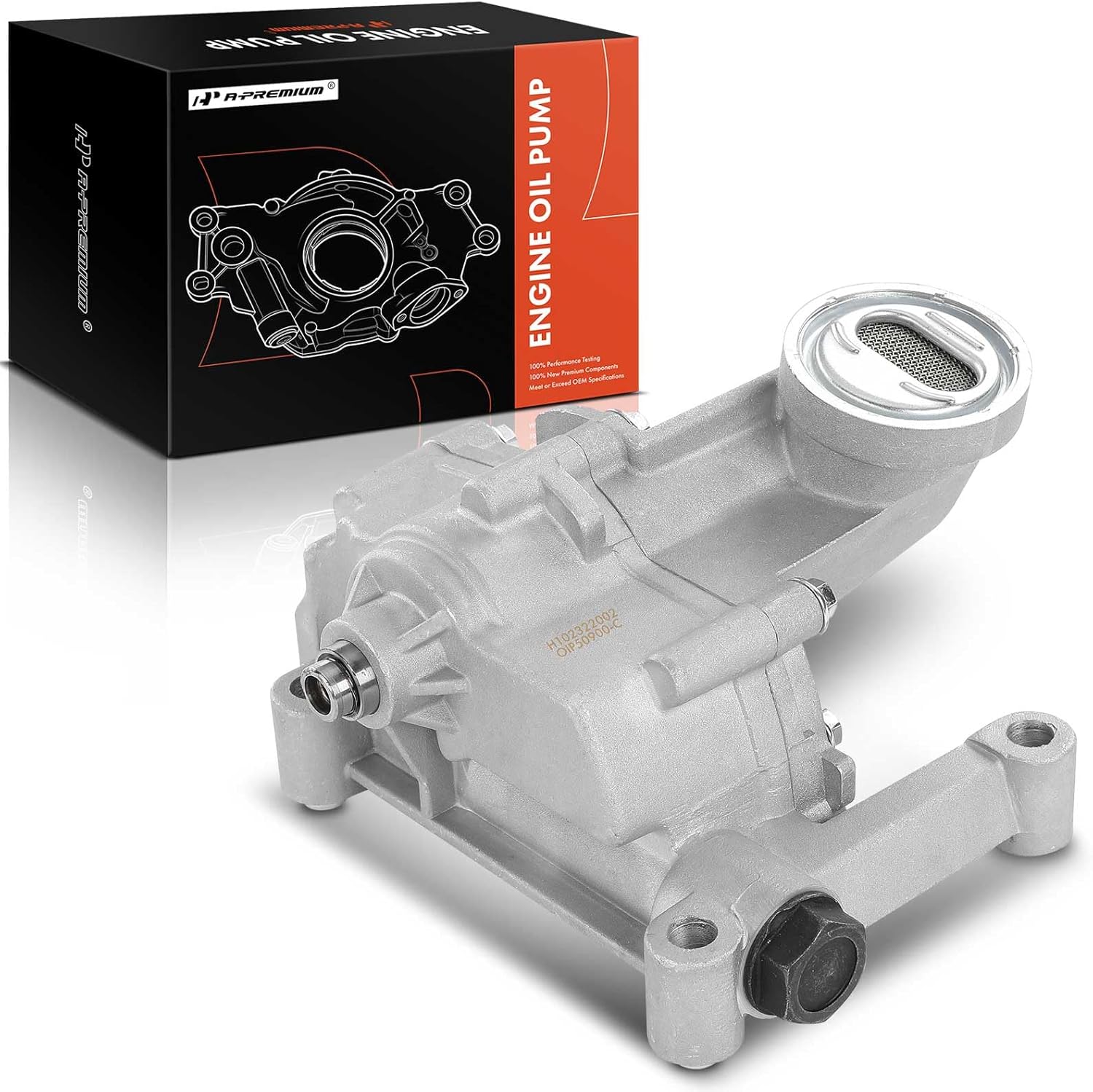
| Compatible Vehicles | Mitsubishi Lancer 2007-2017, Outlander Sport 2011-2020 |
|---|---|
| Engine | 2.0L L4 |
| Housing Material | Aluminum |
| Volume Type | Standard Volume |
| Pressure Type | Standard Pressure |
This A-Premium oil pump is a direct-style replacement intended to restore factory oil circulation for 2.0L Mitsubishi Lancer and Outlander Sport engines. It is a standard-volume, standard-pressure pump with an aluminum housing and three mounting holes, so it installs like the factory unit and returns proper lubrication to engine internals. Typical use is as a service replacement when the original pump shows wear, low pressure, or during an engine rebuild. The practical benefits include restoring oil pressure to protect bearings and cam components and a one-year unlimited-mileage guarantee for added confidence. Limitations are that it does not include an O-ring and buyers must confirm exact fitment against reference numbers before ordering. For owners focused on reliable, like-for-like replacement rather than performance upgrades, this pump covers the essential function at a modest value but requires routine correct installation and the usual post-installation oil pressure verification.
Best for: Reliability-focused owners who want a like-for-like factory-quality replacement pump to restore correct oil pressure and protect engine long-term.
Less Ideal for: Owners seeking performance upgrades or higher-flow oiling solutions for modified or high-output engines should consider dedicated performance pumps instead.
- Designed to match factory mounting and fitment for specified 2.0L Mitsubishi models
- Aluminum housing for corrosion resistance and heat dissipation
- Standard-volume/pressure design restores correct oil circulation for normal driving
- Backed by a one-year unlimited-mileage guarantee
- Does not include an O-ring, so a seal must be sourced separately
- Not intended as a high-volume or high-pressure upgrade for performance builds
Verdict: A straightforward factory-style replacement oil pump that restores proper oil circulation for 2.0L Mitsubishi Lancer and Outlander Sport engines.
6. A-Premium Engine Oil Pump with Gasket and O-Ring, Compatible with Mitsubishi 2.4L

| Brand | A-Premium |
|---|---|
| Manufacturer | PremiumpartsWhosale |
| Item model number | MN137803 |
| Condition | New |
This A-Premium engine oil pump is a direct replacement designed for Mitsubishi Lancer (2004-2006), Eclipse (2006-2012), and Galant (2004-2012) with the 2.4L 4-cylinder engine. It circulates engine oil to lubricate and cool internal components, and arrives with a gasket and O-ring for a complete seal during installation. The housing is aluminum, which helps keep weight down while providing corrosion resistance, and the part is packaged as a boxed unit intended for straightforward swap-in replacement. In practice this pump suits routine engine rebuilds or repairs where the original pump has failed or is leaking, and the included seal components reduce the need to source extra parts. Limitations to be aware of are that fitment must be double-checked against vehicle compatibility references before purchase and one reported customer received a damaged casting at the oil pickup area, so inspect the part before installation. A-Premium backs the unit with a one-year unlimited-mileage guarantee.
Best for: Convenience-focused owners who want a ready-to-install, factory-replacement style pump for a 2.4L Mitsubishi and prefer a package that includes sealing components to minimize extra shopping and delays.
Less Ideal for: People seeking a performance-upgraded or heavy-duty oiling solution for racing or high-horsepower builds should look for specialty pumps designed for elevated flow and pressure.
- Includes gasket and O-ring for a complete seal at installation
- Aluminum housing offers corrosion resistance and lower mass
- Sold as a direct replacement for specified Mitsubishi 2.4L models
- Boxed packaging and single-part reference number simplify ordering
- Fitment must be verified against vehicle references to ensure compatibility
- Small number of reviews and at least one report of shipping damage to the pickup area
Verdict: A convenient, boxed direct-replacement oil pump that includes gasket and O-ring for straightforward installation on Mitsubishi 2.4L engines.
Choosing the Right Mitsubishi Lancer Oil Pump: Key Factors to Consider
Flow Rate and Pressure Output
Oil pump flow and pressure are the primary factors that determine how well the oil circulates through the engine. A pump must deliver sufficient flow at idle and higher RPMs to maintain an adequate oil film on bearings and cam lobes. Pressure regulation also matters; the regulator or relief valve should keep pressure within safe limits to avoid oil starvation or excessive stress on seals.
When evaluating pumps, look for specifications or test data showing volumetric flow at common engine speeds and the pressure range of the relief valve. Match the pump capability to the engine's oiling needs and the viscosity range you plan to use, since thicker or thinner oils will change delivered pressure and flow.
Materials and Build Quality
The materials and tolerances used in the pump influence longevity and resistance to wear. Hardened gears, precision-machined housings, and corrosion-resistant finishes reduce internal wear and help the pump retain efficiency over time. Poorly made pumps can produce increased internal leakage and reduced pressure as tolerances open up.
Inspect construction details such as gear hardness, shaft support, bearing type, and sealing surfaces. Pumps built with tighter tolerances tend to maintain consistent flow longer, while robust finishes help avoid premature failure in engines that see varied operating conditions.
Compatibility and Fitment
Proper fitment to the Mitsubishi Lancer engine is crucial for straightforward installation and correct operation. The pump must match mounting points, drive method, and clearances specific to the engine. A pump that requires excessive modification can introduce installation errors or unexpected clearances that affect performance.
Verify that the pump is designed for the exact Lancer engine variant and that it uses compatible gaskets and seals. Consider whether the pump's pickup tube and screen position align with the oil pan geometry to avoid cavitation or starvation under real-world conditions.
Pressure Regulation and Relief Mechanism
A reliable pressure relief mechanism protects the engine from overpressure while ensuring adequate delivery at low speeds. The design of the relief valve and its setpoint influence transient performance during cold starts and high-load conditions. If the relief valve sticks or is poorly calibrated, you can see wide pressure swings that harm engine components.
Choose pumps with proven relief valve designs and documented setpoints that match the engine's requirements. Consider whether adjustment or serviceability of the relief mechanism is possible, since maintainable components can be recalibrated or replaced during long-term maintenance.
Serviceability and Replacement Parts
Access to replacement gaskets, seals, and internal parts affects long-term ownership cost and downtime. Pumps designed with serviceable components let you replace wear items rather than the entire assembly. Availability of compatible gasket and seal kits simplifies repairs and reduces the risk of leaks after installation.
Evaluate whether the pump has common service parts and whether those parts are easy to source. Clear installation documentation and replacement-part diagrams reduce installation errors and make planned maintenance more predictable.
Installation Complexity and Tools Needed
Some oil pumps are straightforward bolt-in replacements, while others require removal of ancillary components, special alignment, or precise torque sequences. Installation complexity affects labor time and the likelihood of improper reassembly, which can lead to leaks or incorrect clearances.
Consider whether the job requires engine lifting, timing cover removal, or specific tools to align gears and set clearances. If you plan to handle the replacement yourself, choose a pump with clear instructions and minimal special-tool requirements to reduce the chance of installation mistakes.
How We Chose the Best Mitsubishi Lancer Oil Pump
We focused on oil pumps that offer reliable lubrication performance and durable construction suitable for Mitsubishi Lancer engines. Our editorial filters prioritized measured or specified flow rate across operating RPMs, consistent pressure control, and materials or finishes that resist wear and corrosion. We also considered build features that affect longevity, such as hardened gears or reinforced housings, along with compatibility with common engine oil viscosities for this vehicle.Ease of installation and availability of service parts were factored in, since realistic maintenance time and access to replacement gaskets or seals influence ownership experience. We looked for pumps with clear installation instructions or commonly available fitment guides to reduce the risk of installation errors. Exclusions: we did not consider units lacking adequate technical specifications, pumps designed for unrelated engines, or products without documented construction details. The resulting list emphasizes pumps that balance proven hydrodynamic performance, durable materials, and practical serviceability for the Mitsubishi Lancer.
Our full evaluation process is outlined in our review methodology.
FAQ
What are common symptoms of a failing oil pump in a Mitsubishi Lancer?
Common signs often include a drop in oil pressure gauge readings or warning lights, unusual engine noise that can result from reduced oil film, and visible oil pressure fluctuations at idle. You may also notice increased engine wear or performance changes over time. These symptoms usually warrant inspection rather than immediate assumptions about the pump alone.
Can I replace the oil pump myself during routine maintenance?
Often it depends on your mechanical experience and the specific Lancer engine. Some replacements are relatively straightforward with basic hand tools, while others require removal of covers, alignment of drive components, or special tools. If you are comfortable following detailed instructions and have the necessary tools, DIY replacement is feasible, but allow time for careful gasket and seal installation.
How important is using the correct oil viscosity with a new pump?
Oil viscosity affects the pump's pressure and flow characteristics. Thicker oils increase pressure but may reduce flow at low temperatures, while thinner oils flow more easily but can lower pressure. Use viscosities recommended for your engine and driving conditions to ensure the pump operates within its intended range and provides proper lubrication.
What should I check before installing a replacement oil pump?
Inspect the pump for machining defects, verify that mounting surfaces and bolt patterns match, and ensure you have the correct gaskets and seals. Check the pickup tube and screen for alignment with the oil pan, and confirm the relief valve moves freely. Preparing the mating surfaces and using new seals reduces the risk of leaks after installation.
How long do oil pumps usually last in a Mitsubishi Lancer?
Lifespan depends on driving conditions, oil maintenance, and the pump's build quality. With regular oil changes and proper engine care, a well-made pump can last many years, while pumps subjected to neglect or contamination may wear sooner. Monitoring oil pressure trends helps detect gradual degradation before failure.
Conclusion
When choosing an oil pump for a Mitsubishi Lancer, prioritize flow and pressure characteristics that match the engine's needs, durable construction, and proper fitment to avoid installation issues. Balance ease of maintenance and availability of service parts against performance features like relief valve design.Accept that tradeoffs exist between absolute flow capacity and pressure control. Focus on a pump that provides consistent lubrication across operating conditions and that you can install or service with confidence to protect engine longevity.
Explore More:
- Check out all Mitsubishi Lancer parts & accessories
- Explore Oil Pumps Maintenance & Repair Guides
- Explore Engine
- Browse all Auto Parts
