

Note: This article contains affiliate links. If you click on these links and make a purchase, I may earn a small commission at no extra cost to you. This helps support my research and content. Read my full affiliate disclosure here.
If you tow with a Subaru Outback, choosing the right trailer brake controller affects safety, stopping distance, and driver confidence. You want a unit that delivers predictable braking, integrates cleanly with your vehicle, and is straightforward to install and set up. This guide summarizes the shortlisted top picks across different control styles and installation needs. We evaluated each option for braking performance and fitment practicality to help you narrow choices before checking compatibility and installation details.
Looking for other parts? See all Subaru Outback parts & accessories.
Top Picks at a Glance
| Best overall The best all-around choice for most situations | REDARC Tow‑Pro Liberty Electric Trailer Brake Controller |  |
| Best Quality Built to a higher standard if you want something more solid | REDARC Tow-Pro Link Electric Trailer Brake Controller with USB Remote and 6-Axis Sway Control |  |
| Best Value The sweet spot between price and what you get | CURT Venturer NEXT Time-Delay Trailer Brake Controller (51116) |  |
| Best budget The cheapest option that still gets the job done reliably | Pro Series 80500 POD Time-Delay Trailer Brake Controller |  |
| Highest Rated A top-rated pick with lots of positive feedback | Tekonsha Brakeman IV Time-Delay Trailer Brake Controller |  |
| Most popular A crowd favorite that many people choose with confidence | HRepair 90195 Universal Trailer Brake Controller (Proportional, LCD) |  |
| Best Seller A high-volume bestseller chosen again and again | CURT TriFlex NEXT Proportional Electric Trailer Brake Controller |  |
1. REDARC Tow‑Pro Liberty Electric Trailer Brake Controller

| Voltage | 12 Volts |
|---|---|
| Supports | 1–2 axles |
| Includes | Remote head assembly and 3.3 ft cable |
| Manufacturer | Redarc |
The REDARC Tow‑Pro Liberty is a proportional trailer brake controller designed to give smooth, automatic braking for 1–2 axle trailers while staying unobtrusive in the cabin. It installs as an in‑dash style unit with a small remote dial and a 3.3 ft cable so the controller box can be hidden under the dash and the control knob mounted in a blank switch location for a factory look. In use the inertial proportional mode delivers gradual, road‑sourced braking that reduces push and pull compared with time‑based controllers, and an easy manual override is available when you need extra stopping power. Notable features include active calibration and sway control, a compact dial interface, and support for common vehicle wiring harnesses sold separately for clean integration. Practical benefits are tidy installation, straightforward setup, and consistent on‑road performance for everyday towing. Limitations to note are the need to buy vehicle‑specific or universal harnesses separately for Subaru Outback integration and that the control button assembly can be fussy to mount in very shallow panels.
Best for: A balanced all‑round buyer who wants a reliable, tidy brake controller that blends into the dash and delivers smooth proportional braking for everyday towing with a Subaru Outback.
Less Ideal for: Drivers who need a controller built specifically for heavy duty or off‑road trailer use or who prefer a plug‑and‑play controller with included vehicle harnesses should consider other options.
- Proportional inertial braking for smooth, road‑sourced trailer control
- Compact remote dial that allows the main unit to be hidden for a factory appearance
- Active calibration and sway control improve stability with typical trailer loads
- Supports 1–2 axle trailers common to small campers and boat trailers
- Simple setup and configuration that suits infrequent and frequent towing alike
- Vehicle wiring harnesses and switch inserts are sold separately, adding parts to a Subaru Outback installation
- Button assembly can be difficult to mount flush in very shallow dash panels
Verdict: Pick the Tow‑Pro Liberty if you want a compact, factory‑style proportional controller for smooth daily towing with your Subaru Outback, but plan to buy the vehicle harness separately.
2. REDARC Tow-Pro Link Electric Trailer Brake Controller with USB Remote and 6-Axis Sway Control

| Manufacturer | REDARC |
|---|---|
| Model | Tow-Pro Link |
| Braking modes | Everyday (proportional), Manual Off-Road |
| Control options | USB remote, Tow-Pro app, Apple CarPlay, Android Auto |
| Sensor | 6-axis motion sensor |
The REDARC Tow-Pro Link is a plug-and-play electric trailer brake controller designed to add dependable trailer braking and advanced safety to vehicles with a 7-pin connector. For Subaru Outback owners seeking high-quality braking performance, the unit mounts between the vehicle harness and 7-way, auto-calibrates, and uses a 6-axis sensor to deliver stable proportional braking in everyday driving and a Manual Off-Road Mode for steep or loose-surface descents. Control options include the pre-paired USB-A remote with an LED gain bar, the Tow-Pro Controller app, or integration with Apple CarPlay and Android Auto for in-dash adjustment and monitoring. SwayStop Plus provides on-demand trailer-brake activation to help correct sway events without taking hands off the wheel. Typical use is straightforward: install under the vehicle or inline at the 7-pin, plug the remote into a USB socket, and fine-tune gain while towing. Practical benefits are smooth braking transitions, easy setup in around 15 minutes, and multiple control interfaces that suit a performance-focused driver. Limitations to note are reported occasional Bluetooth pairing friction and some user reports of brief brake drag on certain trailers which may require wiring checks or adjustments.
Best for: Performance-oriented buyers who prioritize precise, stable trailer braking and in-dash control for confident towing on highways and twisty or uneven roads.
Less Ideal for: Buyers who need a simple time-delayed or proportional controller without smartphone or in-dash integration or those unwilling to troubleshoot wiring if unusual brake behavior appears.
- Plug-and-play 7-pin installation with active calibration simplifies setup
- 6-axis motion sensor provides stable proportional braking through corners and uneven roads
- Multiple control methods: USB-A remote, mobile app, and Apple CarPlay/Android Auto integration
- SwayStop Plus feature allows quick trailer-brake activation to help correct sway events
- Some users report occasional Bluetooth pairing difficulty when using the app
- A few reports of brief trailer-brake dragging on certain setups that may need verification
Verdict: A high-quality, plug-and-play brake controller that gives Subaru Outback owners proportional braking, app and in-dash control, and advanced sway intervention for confident towing.
3. CURT Venturer NEXT Time-Delay Trailer Brake Controller (51116)

| Voltage compatibility | 12-volt systems |
|---|---|
| Brakes controlled | Up to 6 brakes (1–3 axles) |
| Controller type | Time-delay |
| Mounting | Low-profile bracket, mount at any angle |
The CURT Venturer NEXT is a slim, time-based brake controller designed to manage electric trailer brakes from inside the cabin. It installs discreetly using a low-profile bracket and can control up to six brakes (1 to 3 axles), with fully adjustable gain and ramp settings shown on an LED ramp indicator whose brightness can be changed for day or night use. Typical use is straightforward: mount it where you can see the LED display, wire it into the Outback wiring harness (a CURT plug-and-play harness is recommended), and tune the gain and load settings to match your trailer. The unit has no internal moving parts and can be mounted at any angle, which simplifies installation and reduces maintenance. Limitations to note are that it is a time-delay controller rather than an inertia-based model, so braking feels less linked to vehicle deceleration and may require more fine-tuning for heavier trailers; the supplied double-sided tape is weak so a more secure method is often needed for long-term mounting. For Subaru Outback owners towing lightweight campers or small trailers, it offers a compact, budget-friendly control option with clear visual feedback.
Best for: Practical optimizers who want a compact, low-cost brake controller that is easy to install and tune for everyday towing with lightweight trailers on a Subaru Outback.
Less Ideal for: Drivers who tow heavy trailers frequently or who prefer braking behavior directly tied to vehicle deceleration should consider an inertia-type controller instead.
- Compact low-profile design fits unobtrusively in the cabin
- Controls up to 6 trailer brakes (1–3 axles) for common small-to-medium trailers
- Adjustable gain and ramp time with LED ramp progress display and brightness control
- Can be mounted at any angle and has no internal moving parts for simpler installation
- Time-delay operation is less responsive than inertia-based controllers for heavier loads
- Mounting tape provided is not durable for long-term use
Verdict: A compact, budget-friendly time-delay controller that is easy to install and tune for light towing but not as dynamically responsive as inertia units.
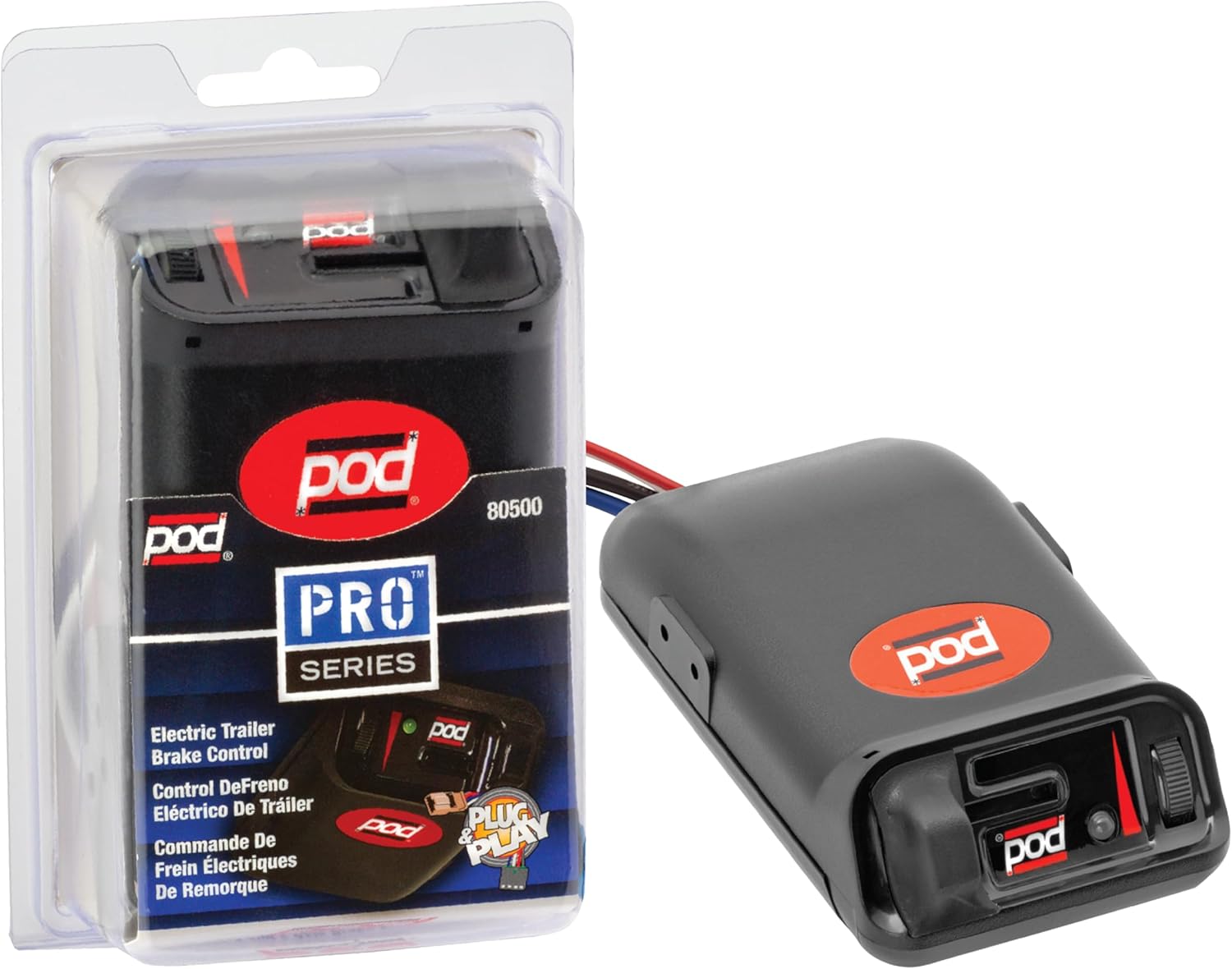
4. Pro Series 80500 POD Time-Delay Trailer Brake Controller
| Compatible axles | 1-2 axles |
|---|---|
| Voltage | 12 Volts |
| Brake type | Time-delay (digital) |
The Pro Series 80500 POD is a simple, time-delay trailer brake controller intended for light towing on a Subaru Outback with a compatible wiring harness. It applies braking power that ramps up at a fixed rate when the Outback’s brakes are used and displays output on a two-digit LED so you can see how aggressively the unit is commanding the trailer brakes. Installation is straightforward when you use a vehicle-specific Tekonsha plug-and-play harness, and because it is time-based it can be mounted in any orientation under or above the dash. The manual lever gives on-demand trailer braking for quick stops, and the unit includes internal circuit protection and diagnostic indicators to help spot wiring faults. As a budget model it is not proportional, so braking feel will be less smooth than inertia controllers on steep descents or heavy loads, and some users report occasional quality-control issues such as missing hardware or dead units out of the box. For occasional towing with a small trailer behind an Outback it delivers the basics reliably when installed correctly.
Best for: Budget-conscious Subaru Outback owners who tow light trailers occasionally and prioritize low cost and simple, no-fuss installation.
Less Ideal for: Drivers who tow frequently, pull heavy loads, or need proportional braking performance for steep or technical terrain should consider a proportional controller instead.
- Easy plug-and-play installation with a vehicle-specific wiring harness available
- Clear two-digit LED display for output and diagnostics
- Manual override lever for immediate trailer braking
- Time-delay design allows mounting in any orientation
- Built-in circuit protection and short-circuit diagnostics
- Time-delay operation is not proportional so braking feels less smooth under variable conditions
- Reported occasional quality-control problems like missing screws or dead units
Verdict: A low-cost, easy-to-install controller that covers basic towing needs on an Outback but lacks proportional braking for heavier or frequent towing.
5. Tekonsha Brakeman IV Time-Delay Trailer Brake Controller

| Controller type | Time-delay digital |
|---|---|
| Trailer axles supported | 1-4 axles |
| Brake systems compatible | Electric and electric-over-hydraulic |
| Diagnostics | Real-time diagnostics and short-circuit protection |
The Tekonsha Brakeman IV is a time-based digital brake controller designed for straightforward towing tasks. It detects when you apply the vehicle brakes and sends a ramped output to the trailer, with front-panel buttons to set power, adjust sync aggressiveness, and engage a manual override. Installation is simplified by a plug-and-play port when used with a vehicle-specific wiring harness, and the unit can be mounted above or below the dash since orientation does not affect operation. The Brakeman IV supports electric and electric-over-hydraulic systems and includes diagnostic indicators and short-circuit protection to help identify connection issues. Its time-delay behavior makes it well suited to light-duty trailers and simple towing setups but means it will not react proportionally to trailer inertia like a proportional controller, which can feel less refined with heavier loads. For Subaru Outback owners seeking a reliable, easy-to-install controller for occasional towing, the Brakeman IV delivers straightforward controls and basic safety features, though heavier or performance-oriented towing will benefit from a proportional unit instead.
Best for: Reliability-focused buyers who prioritize simple, proven hardware and straightforward installation for routine towing with a Subaru Outback.
Less Ideal for: Drivers who tow heavy, high-inertia trailers or who want the most responsive, proportional braking feel should consider a proportional controller instead.
- Simple plug-and-play installation when paired with the correct vehicle harness
- Clear digital indicators and diagnostics for connection and fault detection
- Manual override and adjustable power/sync controls for on-the-fly tuning
- Works with electric and electric-over-hydraulic braking systems
- Compact mounting flexibility since orientation does not affect operation
- Time-delay design does not apply braking proportionally to trailer inertia, less smooth with heavier trailers
- Vehicle-specific wiring harness is sold separately and required for plug-and-play fitment
Verdict: A dependable, easy-to-install time-delay controller that is a good fit for light-duty Subaru Outback towing but not for heavy or precision towing needs.
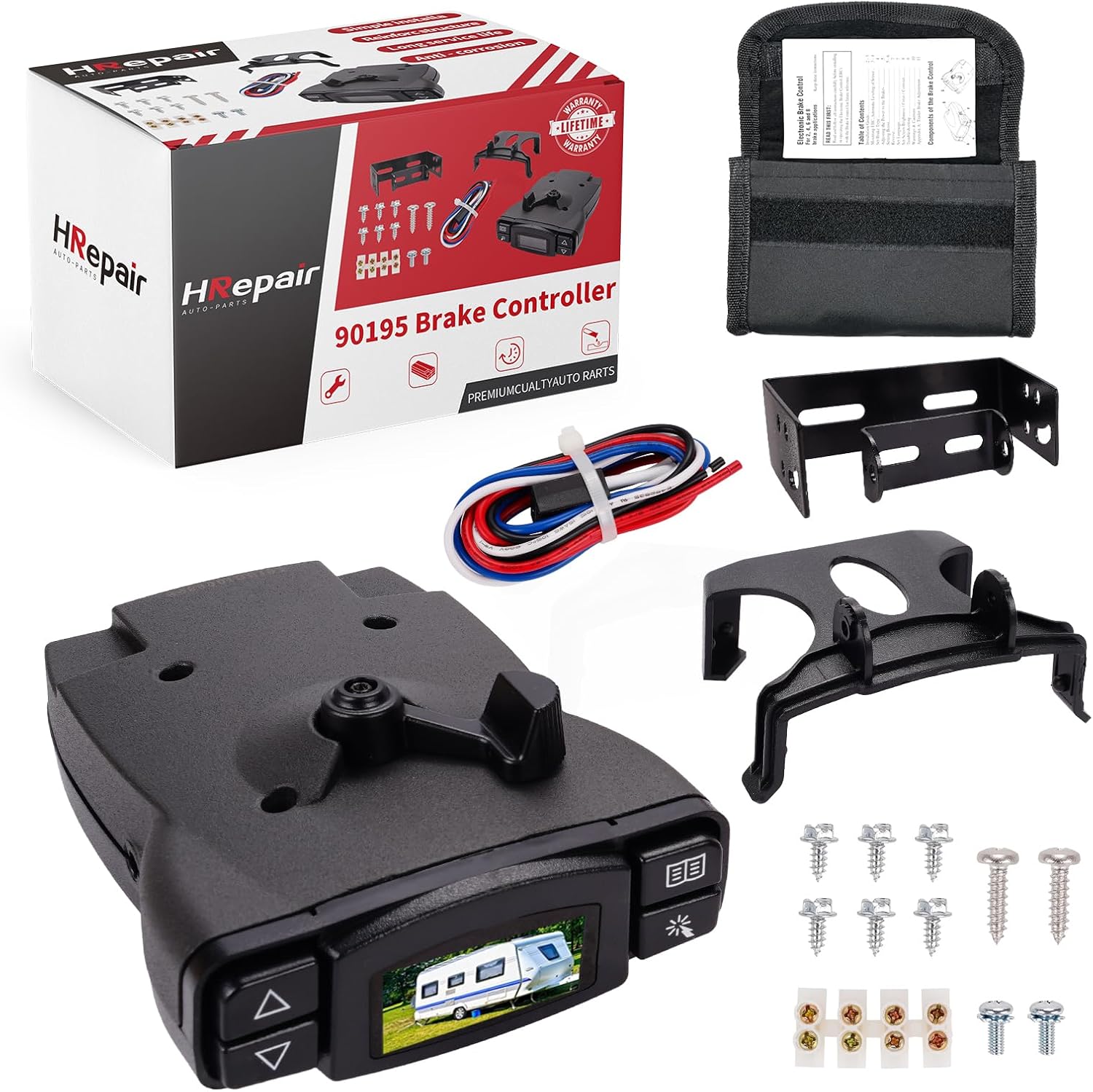
6. HRepair 90195 Universal Trailer Brake Controller (Proportional, LCD)
| Model | 90195 |
|---|---|
| Brand | HRepair |
| Supports trailers | 1-4 axles |
| Display languages | English, Spanish, French |
The HRepair 90195 is a compact proportional trailer brake controller designed to manage electric trailer brakes by matching trailer braking to vehicle deceleration. Typical use is in-vehicle mounting on the dash or under it with the included hardware and wiring harness, and it supports manual braking through a built-in lever for immediate trailer brake application. Notable features include an easy-to-read digital display that reports output voltage and diagnostics, three boost levels to adjust initial braking feel, and the ability to save up to five different presets so you can switch settings between trailers or drivers. Installation is simplified by a plug-and-play style harness and standard wiring that fits common factory trailer wiring installations on compatible vehicles. Practical benefits include smoother proportional braking versus time-delay units and quick setup for different trailer loads. Limitations to be aware of are mixed reliability reports for the display and occasional reports of the unit running hot, and some users find the small screen and menu navigation less intuitive than simpler knob-style controllers. If you value flexible, feature-rich proportional control for everyday towing on a Subaru Outback, this unit covers the bases but expect to check fit and long-term durability.
Best for: Convenience-driven buyers who want a feature-rich proportional controller that is easy to set up, supports multiple trailer presets, and offers digital feedback for routine towing with a Subaru Outback.
Less Ideal for: Drivers who prefer the simplest, most fail-safe mechanical interfaces or those who need proven long-term reliability above advanced features should consider other controller styles.
- Proportional braking for smoother, vehicle-matched trailer brake application
- Adjustable three-level boost for tuning initial brake response to trailer load
- Stores up to five presets so different trailers or drivers can reuse saved settings
- Digital display shows brake voltage output and basic diagnostics
- Includes plug-style wiring harness and mounting hardware for easier installation
- Some users report display failures or glitches after months of use
- Can run hot during extended use according to user reports
- Menu-driven small LCD can be harder to read and adjust while driving compared with simple knob controllers
Verdict: A budget-friendly, feature-packed proportional controller that simplifies tuning for multiple trailers but has mixed long-term reliability reports.
7. CURT TriFlex NEXT Proportional Electric Trailer Brake Controller

| Model | TriFlex NEXT |
|---|---|
| Manufacturer | CURT |
| Brake capacity | 2-8 brakes (1-4 axles) |
| Protection features | Reverse polarity and short-circuit protection |
The CURT TriFlex NEXT is a slim, in-cab proportional brake controller designed to give predictable trailer braking by sensing vehicle motion with a triple-axis accelerometer. It mounts with a low-profile bracket and can be installed at any angle, making it easy to fit into an Outback dashboard space; CURT recommends using its wiring harness for a plug-and-play hookup. The unit supports 2 to 8 brakes (1 to 4 axles) and offers adjustable gain and ramp time so you can tune braking force to different trailer weights and driving conditions. The full-text display, day/night brightness and diagnostic readouts simplify setup and troubleshooting, and built-in protections guard against polarity and short circuits. Some owners report occasional power or responsiveness issues that required unplugging or replacement, so while many installations run trouble-free, there is a risk of intermittent failures. For Subaru Outback owners who want a modern, tuneable proportional controller that installs neatly under the dash, the TriFlex NEXT is a capable option if you pair it with proper wiring and test thoroughly after installation.
Best for: Risk-averse mainstream buyers who prioritize reliable, factory-quality braking behavior and a clean, low-profile install for everyday towing with a Subaru Outback.
Less Ideal for: Drivers who need a no-compromise commercial-grade controller or who cannot tolerate any possibility of intermittent failures should consider more proven alternatives.
- Triple-axis accelerometer provides proportional braking for smooth, responsive stops
- Slim, low-profile design and versatile bracket allow flexible mounting in limited dash space
- Adjustable gain and ramp time let you tune braking to different trailer loads
- Full-text display with day/night brightness and diagnostics makes setup and troubleshooting easier
- Some users report intermittent power or control failures requiring resets or returns
- Requires vehicle-specific wiring harness (sold separately) for easiest plug-and-play installation
Verdict: A compact, tuneable proportional controller that fits an Outback well and delivers smooth braking for most towing needs but carries some reports of intermittent failures.
Choosing the Right Subaru Outback Trailer Brake Controller: Key Factors to Consider
Control Type and Braking Response
The fundamental choice is between time-delayed and proportional control. Proportional controllers detect tow vehicle deceleration and apply trailer brakes in direct relation to how you slow, which usually gives smoother, more intuitive braking. Time-delayed units deliver a preset power curve that can work for some loads but often requires more manual tuning.
Consider how you drive and the types of trailers you tow. If you frequently encounter variable traffic or steep grades, a proportional controller will typically reduce trailer surge and produce more predictable handling. For lighter, consistent loads, a time-delayed unit can be simpler but may feel less refined.
Installation Method and Cabin Fit
Installation options range from dash-mounted in-cab units to under-dash modules. In-cab controllers offer quick adjustments while driving and are generally easier to access, which matters when tuning gain or mode on the go. Under-dash or hidden modules create a cleaner interior look but require durable, clearly labeled controls accessible from the driver position.
Think about where you prefer to mount controls and how much visibility and reach you need. Also review how the unit integrates with the Outback dash and existing wiring paths to avoid complicated routing or interference with airbags and electronics.
Wiring Compatibility and Harnessing
Proper electrical integration affects both safety and functionality. Look for controllers that support standard 4- or 7-pin trailer wiring and that include or have available harnesses suited to the Outback. Clear wiring diagrams and plug-and-play harness options reduce installation time and the chance of wiring errors.
Also consider whether you will need additional relays, fuses, or a charge line for battery-backed features. Reliable wiring and robust connectors help prevent intermittent faults and protect the vehicle's electrical system.
Adjustability and Tuning Options
A controller with flexible gain and boost settings lets you tailor braking force to trailer weight, cargo distribution, and road conditions. Look for features such as manual boost, incremental gain steps, and profile memory if you tow multiple trailers. Some units also provide separate settings for anti-lock brake compatibility.
Fine-tuning capability matters when you want to minimize trailer yaw or reduce stopping distance. Controls that are easy to reach and adjust while stationary or moving at low speed can greatly simplify achieving a comfortable feel.
Diagnostics and User Feedback
Good feedback helps you identify wiring faults, open circuits, or trailer brake issues before they become hazards. Seek controllers that include clear LED indicators, fault codes, or a simple readout showing applied power level. Diagnostic functions shorten troubleshooting time and increase confidence when hooking up a trailer.
Units that make it easy to test the trailer brakes from the cab without driving remove guesswork during setup and help verify wiring after installation.
Durability and Environmental Resistance
Controllers are exposed to vibration, temperature swings, and occasional moisture depending on mounting location. Choose units built with robust housings and rated components to withstand long-term towing use. Corrosion-resistant terminals and sealed connectors extend service life and reduce maintenance.
Consider the expected towing frequency and conditions. A more rugged unit may cost more but will often provide steadier performance and fewer failure points over years of use.
How We Chose the Best Subaru Outback Trailer Brake Controller
We focused on features and criteria that matter specifically to Outback owners who tow. Key evaluation points included braking control type and responsiveness to vehicle brake input, ease and method of installation in the Outback cabin, compatibility with typical trailer wiring and hydraulic or electric actuator setups, and adjustability for trailer weight and tongue load. We also prioritized units with clear user controls and reliable diagnostics so drivers can tune braking behavior on the road. Durability and build quality were assessed for sustained performance under highway towing conditions. Units were excluded if they required vehicle-specific modifications beyond common wiring harnesses, or if they lacked the adjustability needed for a range of trailer sizes. The final list reflects practical balance among performance, installability, and operational clarity for Subaru Outback towing scenarios.
Our full evaluation process is outlined in our review methodology.
FAQ
Do I need a trailer brake controller for towing with my Subaru Outback?
Whether you need a controller depends on the trailer weight and local regulations. Many heavier trailers with electric brakes require a controller to activate the trailer brakes. Even when not legally required, a controller can improve braking stability and shorten stopping distances for heavier loads.
What is the difference between proportional and time-delayed controllers?
A proportional controller senses vehicle deceleration and applies trailer braking in proportion to that motion, often yielding smoother and more natural braking. Time-delayed controllers apply a preset braking power curve after a brief delay and may need manual adjustments to suit different trailer loads.
How difficult is trailer brake controller installation in the Outback?
Installation difficulty varies by controller style and how close your Outback's wiring is to the chosen mounting location. Many units offer vehicle-specific harnesses and clear diagrams that make installation straightforward for someone comfortable with basic wiring. If you are unsure, a professional installer can ensure safe and compliant hookup.
Can I install the controller myself without modifying the vehicle?
You can often install a controller without permanent vehicle modifications by using plug-in harnesses and existing trailer wiring points. However, some installations may require routing wires and securing modules in tight spaces. Avoid modifications that interfere with vehicle systems and follow manufacturer wiring instructions.
How do I tune the controller for different trailers?
Start with conservative gain settings and perform short braking tests at low speed, gradually increasing gain until the trailer brakes assist without causing instability. For proportional units, check responsiveness and adjust as needed. Keep a record of preferred settings for each trailer to streamline future setups.
Conclusion
Choosing a brake controller for a Subaru Outback is about matching control style, installation preferences, and adjustability to how and what you tow. Prioritize a controller that gives predictable braking response, straightforward wiring options, and accessible tuning controls. Expect tradeoffs between simplicity and refinement: time-delayed units are often easier to set up while proportional systems provide smoother behavior on varied terrain. Focus on reliability, diagnostics, and ease of installation to get the safest towing experience.
Explore More:
- Check out all Subaru Outback parts & accessories
- Explore Electronics
- Browse all Accessories
